
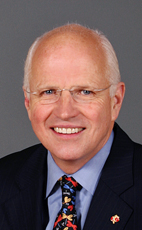
House of Commons photo

Crucial Fact

  • His favourite word was veterans.

Last in Parliament March 2011, as Conservative MP for New Brunswick Southwest (New Brunswick)

Won his last election, in 2008, with 58% of the vote.

Statements in the House

Tobacco Act November 16th, 1998

Madam Speaker, I am pleased to second the motion put forward by the member for Winnipeg North Centre. She has done a lot of work on this bill for which I thank her on behalf of a lot of Canadians.

Bill C-42 does nothing to toughen the Tobacco Act. I agree completely with my colleague from Macleod who just spoke. It does nothing. It is interesting that the parliamentary secretary is here today to speak on behalf of the minister who is out of the country. If I were the minister with the House debating a bill like this I would be out of the country today too.

We must remember this government was elected five years ago to do something and it has done absolutely nothing. I remind the Canadian people that in 1994 the government reduced taxes on tobacco. It was the first and basically the only thing it did. The government caved in to smugglers instead of addressing the real concern of Canadians, in particular young Canadians who are becoming addicted to cigarette smoking. Instead of addressing and fighting the smuggling problem with the weapons and resources of the Government of Canada, the government caved in to the big tobacco companies. As a result of that we have 40,000 Canadians a year, documented, dying because of smoking. The government simply adds to the problem. This bill does nothing at all to change that.

The government now has an opportunity to do something but it has done nothing. It is just a continuation of what it has done since it was first elected, absolutely nothing, just caving in to the interests of the big tobacco companies.

When the parliamentary secretary spoke about 20 minutes ago she did not even consider the amendment to which we are speaking now. Without this amendment tobacco companies would be able to put up new sponsorships signs on buildings while the bill is still before parliament and have those signs up for another five years. That is bizarre. What the parliamentary secretary did to add insult to injury when she was before the committee, when we were going through this clause by clause, was simply read a statement prepared by the Minister of Health to put forth an amendment without explaining fully the rational of that amendment. That is devious at best. We will not go into what I would call it if I were in a real foul mood. It was not the right thing to do.

What we have is the parliamentary secretary being conned by her own minister and his departmental people to put through that amendment which would basically allow the companies to advertise for another five years if they chose to put up signs between now and when royal assent is given. This is absolutely bizarre.

I mentioned 40,000 Canadians dying every year in Canada because of smoking. That is documented and every major health think tank and association in Canada agrees with those figures, as does every member of parliament, including members of the government. They do not argue that figure.

That would be equivalent to 100 Canadians every day dying in an airplane crash. If an airplane crashed every day in Canada and killed 100 people on board, we would at the end of the year have the same number of deaths, slightly less, as with smoking. That is putting it in perspective. What would we do in the House of Commons? What would the Canadian people think of the Minister of Transport if we had a plane crashing every day in Canada, killing 100 people? We would have his resignation on the floor of the House of Commons within a week. But no, this government allows this to happen day in and day out, doing absolutely nothing about it. That is wrong. Excuse the pun, it is dead wrong.

We just had Remembrance Day. On an annual basis we lose more Canadians to cigarette smoking than we did in World War II. Combine all the Canadian deaths in World War II between 1939 and 1945. They do not add up to the number of Canadians who die on a yearly basis because of smoking.

Under any other set of circumstances this would be an outrage, but why is it not? The cigarette manufacturers use millions of dollars to convince us that smoking is okay. What they are advertizing is lifestyle. They are not advertising reality. They are advertising lifestyle and spending millions of dollars to do it.

Coming before parliament from the other place is Bill S-13. It was introduced in the Senate by Senator Kenny. It will be introduced in the House by a Liberal backbencher. The bill will be killed by the government. It is absolutely bizarre because the bill would attack the problem the way it has to be attacked, with real dollars to educate young Canadians about the dangers of smoking.

It would dedicate $125 million a year to educate young Canadians about the dangers of smoking.

We will never have a tobacco bill that is worth anything unless we attack smoking from the price point, that there is a direct relationship between the price of the product and the consumption of a product. That is true of any product. We need a bill that strongly hits advertising and education at the same time.

Unless those ingredients are present in a bill, nothing will to change. We will continue to lose 40,000-plus Canadians a year to smoking.

Smoking kills. The only way we can win this war is to wage war on the cigarette manufacturers. What would be wrong with placing 50 cents a carton, less than 5 cents a pack, at the manufacturing level? Let us call that a levy. Let us be realistic. That is what we have to do.

We need real dollars to attack these people. Some of the biggest cigarette manufacturing companies in the world actually own chains of drug stores. Examine who owns Shoppers Drug Mart. Find out who owns it. I challenge every Canadian to do some research and find out who owns some of these drug chains. They are owned by the shareholders who happen to be the same shareholders who own the shares of major cigarette or tobacco companies.

Here we have the biggest of the biggest in terms of corporate Canada, international corporate strength, day in and day out allowing young Canadians to take up the habit.

What we have to do is fight this with every resource we have. We have a bill that will soon be introduced here by a backbench member of the government, to be shot down by the government because it addresses the problem. It does something about it.

What we have is the Government of Canada being held captive by the big boys, the big corporate giants who figure it is in their best interests to sell a product to Canadians that actually kills Canadians.

This amendment speaks for itself. It puts teeth in a very weak bill and I think it is incumbent on the government to support this amendment.

Bill S-13 November 3rd, 1998

Mr. Speaker, my question is for the government House leader. Is the government willing to provide government time for the House to debate and vote on Bill S-13, an act to incorporate and to establish an industry levy to provide for the Canadian Anti-Smoking Youth Foundation?

Health October 28th, 1998

Mr. Speaker, between 25 to 30 Canadians die each year because of CJD, otherwise known as mad cow disease.

Three years ago the Canadian Red Cross ordered the single largest recall of blood products in the history of the country because of CJD contamination.

Will the minister now do what the British have done and what Bayer Inc. has done and ban the use of British plasma? The clock is ticking. The minister has a chance to do something. Will he act now?

Supply October 26th, 1998

Madam Speaker, I rise on a point of order. As much as I enjoy listening to the member, it is my understanding that we are in 10 minute speeches and he is splitting his time with his colleague next door. I am hoping that we could hear from his colleague.

Supply October 26th, 1998

Madam Speaker, I was listening with great attention to the member for Durham. I have a clarification on a reference he made to the member for Saint John. I know there were little questions and responses between the two of them earlier in the day. I think I know what the member for Saint John was talking about in reference to Ontario and the premier of Ontario.

I think the premier of Ontario is rightly upset because Ontario's economy is very robust and we do not question that. I understand that the member comes from an area where the economy is going along very nicely, thank you very much.

The premier of Ontario was concerned that not very many people in Ontario collect unemployment insurance in relation to the rest of the country. Ontario constitutes about 40% of the Canadian economy. It is the lowest area in the country for benefits in terms of unemployed workers receiving benefits. The premier has a right to be concerned about that as they are paying in but not reaping the rewards. It is not that they want to because obviously it is better to have people working than not working.

The statistics speak for themselves. I will quote statistics released by the Department of Human Resources Development about a week ago. The statistics will bear this out.

In Ontario fewer than 30% of the unemployed get unemployment insurance, the lowest rate in the country. In comparing the 10 provinces and 50 U.S. states, Ontario is between Montana and Missouri and just below the average for the United States as a whole.

That is part of the point the member for Saint John was making and probably the member for Durham as well. What we are looking at and the premier is saying is let us look at what we are doing with the surplus because the surplus does not exist. Premier Harris is saying “You are taking more out of my workers and my employers than you have to”. The federal government is applying that surplus in the EI account against general revenues. It simply disappears. There is no account.

In terms of the EI surplus I would like to hear what the member for Durham has to say.

Health October 22nd, 1998

Mr. Speaker, I think this is the same minister who fell asleep at the switch in regard to Canada's tainted blood supply system. Have we not learned something by Krever? When other nations are taking action now to protect their citizens, we want assurances that the same tragedy we are suffering now will not occur again because of inaction by the minister.

Health October 22nd, 1998

Mr. Speaker, the dreaded mad cow disease that ravaged Britain has jumped the species barrier.

The human version of the disease is identified as CJD. Because of the possibility of infectious agents being in their blood supply the British government has outlawed the use of all U.K. plasma.

In March 1998 Britain closed its own plasma industry and stopped accepting blood from its citizens, all because of the connection between British beef and the mad cow disease which could be harboured in the blood supply system.

What assurances will the minister give us that he is doing everything to protect—

United States Immigration Act October 9th, 1998

Mr. Speaker, while in Washington this week I met with several congressional leaders both from the Senate and the U.S. Congress.

We now know that we have a 30 month reprieve in relation to section 110 of the U.S. Immigration Act. However, this is not a permanent solution. What we need is a permanent solution.

What I am asking is for the Government of Canada to pursue vigorously a permanent solution to section 110 of the U.S. Immigration Act.

We enjoy the biggest trading relationship in the world between Canada and the United States. We want this resolved on a permanent basis.

Charitable Contributions October 1st, 1998

Madam, Speaker, it gives me pleasure to rise on behalf of my party to speak to Motion No. 318.

Under the current Liberal government in power personal income taxes are among the highest in the industrialized world. Quite frankly Canadian people are being taxed to death. Even on such things as individual charitable donations the Canadian public is not given a break. In the meantime the government has been cutting and slashing social investment grants and funding to charitable institutions to the extent that many have difficulty keeping their heads above water.

The wording of the motion before us is worth looking at. The motion calls for the government to bring in legislation making the tax deduction for contributions to charitable organization no less than the tax deduction for contributions to political parties. Presently, as has been stated by others this evening, if a donor contributes $100 to a political party he or she would receive a $75 federal tax credit. The same individual who contributes $100 to the cancer society would only receive a $17 federal tax credit. That is the problem that the motion is attempting to address.

The motion is cleverly worded, for the lack of a better expression. Motion No. 318 does not specifically recommend that the government should increase the tax credit for donations to charities from 17% to 75% although this would be an option. Rather, it allows the government to use its discretion to choose optimal tax credit rates.

This is a bit of a cop-out in terms of the motion before us. The motion is laudable and worth consideration, but it is obviously putting the onus back on the government. Any motion should clearly define exactly what it is going to do, for obvious reasons.

It is fashionable and almost honourable given the political atmosphere out there to attack politicians and political parties. We have a pretty good system of tax relief and tax credits for individuals who want to contribute to political parties. The $100 donation winds up giving a $75 tax credit. There is a lot of good in that.

Another side of the argument says that could be and possibly should be reduced. We do not want to fall into the same kind of political financing as has happened in the United States of America where $1 million campaigns are the order of the day and there is basically no limit on political financing. In this country it is possible for ordinary Canadians to get elected and to contribute to political parties. There is complete transparency in the process. I do not want to see that diminished in any way and that is part of the consideration this evening.

A speaker from my party debated this issue a few months back. However, one component we do not want to overlook in this equation is the clambering for special tax status if this change ever came about.

I think my Quebec colleague would agree with me. How many of us in this House of Commons regardless of political party have been approached by groups that want special tax status as a charitable donation. They want to be recognized as a charitable organization. The line up would be endless if we changed the system significantly. There would be so much clambering it would be unmanageable for the government.

There is a danger in a wholesale change of the system. That leads into the argument, and of course this was on debate today as well, about the Canadian tax system and the complexity of the Canadian tax code. If the Canadian tax code were laid here next to me, it would dwarf me. It is much taller than my six foot two inches.

Our Canadian tax code is overly complex. I do not think there is any one of us in this House that does not use the services of a professional accountant to do our income taxes at the end of the year. I certainly have been using one for years. Most of us do because of the complexity of it. It is one of those things we no longer want to do ourselves for obvious reasons. It goes right back to the word complexity.

This is interesting and quite humourous. It is an interesting reflection on the complexity of our tax code and why we are forced into hiring professionals to compile our taxes. I lent this line to the member for Kings—Hants who used it today in the House but I am taking credit for it as if I invented it. The complexity of the tax code forces us to use professionals to compile our taxes for us. They say that compiling our own tax returns is the only do it yourself project that could land us in jail if it is not done to perfection.

I do not think we want any more complexity in the tax code. I think we would like to see a levelling of the playing field in the sense of charitable donations versus political donations, but it has to be thought through.

The efforts of the member have to be commended. This goes beyond partisan politics. I do not think there is a member on either side of this House who thinks government can be the be all and end all, the sort of blanket approach to curing all the ills of society. We have to leave part of it up to charitable organizations in our hometowns, our churches, all the various organizations that do good across Canada each and every day. We do not want to see that end. We want to see that enhanced.

The value in this member's motion is that if charitable associations were given better tax treatment, the resources and the money these organizations would have to help our friends, neighbours and often ourselves through those charitable donations would most likely increase. That would be a good thing. It would take some of the onus off the government to do the very things that governments today are doing.

Some of the programs governments are engaged in from time to time in that blanket approach, and this government is no different, sometimes do not work. What is good for Newfoundland sometimes is not good for British Columbia. That is on any given day of the week. That happens. Quebec, Ontario or the rest of the country.

The organizations that deliver services best are usually the ones in our backyards. We have to do everything possible to enhance that type of giving and that type of ownership of our hometowns.

We commend the member. He is on the right track. I would like to see this idea carried forward and the government come up with legislation that would address this inequity in our tax system.

We are prepared to support the motion. The onus then goes back on the government to take this motion seriously and introduce tax law that would change the status quo.

Points Of Order October 1st, 1998

Mr. Speaker, I point out to all viewers and to this House that you were not being insensitive when I was cut off before getting out the breast cancer research information number.

Under Standing Order 31, time restraint is very important and I simply ran out of time. That number is 1-800-387-9816.