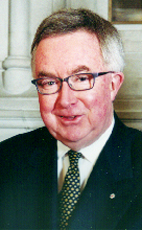
House of Commons photo

Crucial Fact

  • His favourite word was commons.

Last in Parliament May 2004, as Progressive Conservative MP for Calgary Centre (Alberta)

Won his last election, in 2000, with 46% of the vote.

Statements in the House

Canadian Forces April 11th, 2003

Mr. Speaker, on Wednesday the Minister of National Defence told the defence committee that Canada's deployment to Afghanistan will be delayed to August or September. When the minister first made the announcement in February, senior military officers either resigned or told reporters that Canada would need NATO's help to honour the commitment.

Has the deployment been delayed because the minister has been unable to secure enough support from other NATO countries? If not, what is the reason for this latest mistake by the minister?

Iraq April 11th, 2003

Mr. Speaker, rebuilding a democratic state in Iraq without destabilizing the region will be a complex and difficult task. The chances of success will be better if the interim government is established under the aegis of the United Nations. Some have suggested holding a conference on the future of Iraq, as was done for Afghanistan.

Could the Acting Prime Minister tell us if Canada approves this concrete proposal? And would the government be prepared to propose a Canadian site for such a conference?

Iraq April 11th, 2003

Mr. Speaker, my question is for the acting prime minister.

Regarding reconstruction in Iraq, yesterday the foreign affairs minister said we have not yet exactly got a request yet.

Lester Pearson did not wait for a request in the Suez. We did not wait for a request on apartheid or in dealing with famine in Ethiopia. Leadership is about taking the initiative. That used to be Canada's trademark in the world. Now we are the country that ducks.

Our historic reputation is still strong enough that we can make a real contribution on the role of the United Nations in reconstruction.

What in the world is the Government of Canada sitting back and waiting for? Why not take a Canadian initiative--

Right Hon. Prime Minister April 8th, 2003

Mr. Speaker, I never knew the real Mackenzie King, so I cannot judge whether the current Prime Minister is a reincarnation. They both communed famously with people who were not there. Both moved forward sideways and then denied having moved at all.

On political issues of the utmost importance, both expressed themselves in a completely incomprehensible fashion. The current Prime Minister—what an improvement—can be equally incomprehensible in both official languages. One might even wonder if he is not speaking some new official language of his own.

Among the Prime Minister's contributions is the fact that in the election of 1972 I would never have got here without him. He was, as my colleague for Qu'Appelle reminded us, the minister responsible for national parks where, among other things, no local government was allowed.

He came to Jasper to meet a throng of citizens outraged by his policies and he told them, “If you don't like things here, there is a road going east, and a road going west”. Some in the House will be familiar with that diplomatic style.

Certainly it helped me to take the road to Ottawa, defeating a very good Liberal and a friend of the Prime Minister, Allen Sulatycky, who now, miraculously, and on his merit, is associate Chief Justice of the Court of Queen's Bench of Alberta. In Alberta at least, the Prime Minister appoints good judges.

These 40 year tributes are unusual. There was one for Mr. Diefenbaker, who had served 39 years, 6 months and 19 days, but he had to die first. There was one for Herb Gray, who had served 39 years, 6 months and 26 days, but he had to leave first.

In tributes, it is customary to point out good deeds. I will therefore not recall recent events today. As parliamentarians, and as Canadians, the Prime Minister and I have profound differences of opinion. And, of course, in all instances, the Prime Minister is wrong.

What I do want to recall today is the member for Saint-Maurice who fought and spoke with passion for his province as part of his country, the minister who, in those early days at least, was the most approachable in cabinet, and most of all, the political competitor who rarely quits and is shrewd and tough and dangerous in the corners.

The Liberal Party has no idea what it is losing.

The Prime Minister has been here longer than the eternal flame, but he is still a relative newcomer in a Parliament that is sitting now in its third century.

This chamber has seen the patricians and the trailblazers, the steady and the eccentric, and in the likes of MacDonald and Laurier, and Diefenbaker and Tommy Douglas and Trudeau, the occasional sparks of brilliance.

But the real promise of our democracy, in this land where wealth and privilege are not supposed to be decisive, the true accomplishment, is to be simultaneously the Prime Minister and le petit gars de Shawinigan.

My party and I congratulate the Prime Minister on his longevity and Aline for her forbearance.

Member for LaSalle--Émard April 8th, 2003

Mr. Speaker, the Prime Minister has a personal duty to ensure that his ministers are not in conflict of interest. The Prime Minister's ethics counsellor sat in on the secret meetings between the former minister of finance and the shipping company the former minister owns.

On April 2 I asked the Prime Minister whether he had asked the ethics counsellor whether the then finance minister discussed his company's move to Barbados. The Prime Minister said, “I have not been informed”. That was six days ago.

Has the Prime Minister informed himself now and will he give us his word, categorically, that the member for LaSalle—Émard was not in conflict of interest.

Iraq April 8th, 2003

Mr. Speaker, the Prime Minister tells us what Kofi Annan is doing. He tells us what Tony Blair is doing. Then he says that we will sit back and wait to see what happens.

The Prime Minister knows there is a major difference between humanitarian aid and reconstruction. He knows Tony Blair and other European leaders are making concrete positive proposals about the UN role.

What specifically is Canada proposing to give the United Nations the authority to play a leading role in the reconstruction of post-war Iraq?

Situation in Iraq April 8th, 2003

Mr. Speaker, I sympathize with the hon. member. Very often in the House when people speak a lot they do not have the opportunity to listen as much as they might like to.

The House would know that on several occasions I have cited, including today, mais je l'ai fait en français, resolutions 678, 687 and 1441 of the United Nations as giving to this intervention, in my view, the legal authority of the United Nations. So I believe that this is a conflict under United Nations authority. I have said that for some weeks. I am pleased to have the opportunity, I think having communicated that to everyone else in the country, to communicate it now to the member for Okanagan—Coquihalla.

Situation in Iraq April 8th, 2003

Mr. Speaker, my view has been from the outset that this is an action authorized by the United Nations. We support the United Nations. We should have been there.

I think that it is confusing and hypocritical for the government to pretend that while Canadian soldiers on exchange are subject to mortal combat we are not there. Of course we are there; they are there. The Prime Minister might not be there. The Canadian Forces are there.

Would it be helpful for us in these late days in the war to ask for a presence on the ground? I think that would depend on how long the fighting is going to continue. The real question is, do we have the credibility given our recent record to make a case for the United Nations? I believe we have that credibility. If the war persists, then I think we should consider making an honest nation of ourselves and having our policy follow our practice, which is to be there.

Situation in Iraq April 8th, 2003

Mr. Speaker, I thank the hon. member for his question. I do not have an untempered faith in the United Nations. My faith in the United Nations is very much tempered and very much qualified, tempered by experience.

It has plenty of failures. My argument is simply that it is the best agency available. What I have been arguing here is that it should be playing the lead role. I cannot conceive of a situation in which the United States would step aside from a major role or the United Kingdom would step aside from a major role. Those major roles would have to be played.

I agree absolutely with the member, and I think I said so in my remarks, that the only instruments we can see that can guarantee short term stability are the armies. I would add the army of Iraq, because I think that as an institution it is going to be essential to establish cohesion there, but that is in the short term and I have no doubt about the military capacity in the short term and the essential nature of that presence.

It is the medium and the longer term that I am worried about. I do not know the degree of faith of the hon. member in the Pentagon and the United States to see this through. I suspect he has some reservations, as most people would. What we have to do here is find some system that gives the world a choice. At the moment, there is no choice. There are a few lonely voices that are talking about giving the United Nations a mandate, but no one is taking the active leadership to provide that kind of mandate. That means that the burden will fall, by default, to the United States.

I commend the speech given by the former secretary Baker in Toronto and, indeed, the study undertaken by the Baker Institute and the Council of Foreign Relations on which that speech was based, which spelled out a different and much broader approach. That is in a sense what I am advocating here. I have not given up on the United Nations, but I am not blind about its weaknesses nor naive about its capacities. I simply think it is the best agency available to the world in these circumstances.

Situation in Iraq April 8th, 2003

Mr. Speaker, we have found, and frankly I have found in other incarnations as minister of the Crown, that there are limits to what governments can do. Governments obviously must take the lead.

What struck us most about the response to the famine was that people in communities whom we had thought might not be interested became engaged in an overwhelming way. The most striking response was from the Innu community in the north, where people were accustomed to taking care of their own, to building communities.

However, I had a similar experience, as the hon. member will recall, in 1979 with regard to the Vietnamese boat people. The Government of Canada at the time offered to match the sponsorship of any private organization. The consequence was that Vietnamese refugees came to Canada in a higher proportion than any other country in the world.

The point is that if the government leads and sets up an agency that has the authority of the government, it is then possible to draw upon the myriad of talents in the country which are substantial and particularly germane with regard to some of the problems that are facing Iraq. Name a country that has had more experience with drawing diversity together. Name a country which, in its international mandate, has had more experience with dealing with the problems of poverty and establishing institutions which are seen as legitimate in the countries in which they are established.

This country has a unique reputation. I do not want to sound partisan, but it is a reputation which, for reasons of budgetary constraint, has been running down lately. I see the former minister of national defence here. Our military has skills that go beyond the typical skills of fighting, and has extraordinary skills in institution building and in rebuilding on the ground. Canada has all these skills. In addition to that, we still have a unique reputation in the world and a capacity to influence others.

I think one would find consensus in the House for the proposition that, notwithstanding our disagreements on the question of the war, there is a common belief that we should be active in leading the reconstruction. I think that would find support everywhere in the House and in the country.

I would be very interested, as I am sure other members of the House would be, if the government were to pursue in a more formal consultation, not in the heat of debate, the particular things that Canada might do. I am encouraged that the minister representing the government in the chamber has expressed an interest in this approach and I hope that it will be followed.