That was shameful. No respect.

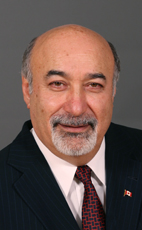 House of Commons photo
Lost his last election, in 2011, with 32% of the vote.
Committees of the House April 22nd, 2005
That was shameful. No respect.
Committees of the House April 22nd, 2005
Mr. Speaker, I had two questions, but the minister was kind enough to respond to the first question of GIS with respect to seniors.
I was elected in the greatest city of Toronto. A strong city makes for a strong province and a strong country. I know he has been speaking with the Federation of Canadian Municipalities. My second question is, what are we doing with the city of Toronto and other cities, and what are the mayors saying because they need support? What has the minister done in the budget with respect to cities?
Civil Marriage Act March 24th, 2005
Mr. Speaker, it is a privilege to stand today and talk to Bill C-38.
Before I get into my comments I want to begin by thanking the residents of Scarborough Centre who, a year and a half ago, responded to a questionnaire I sent out which asked them for their views on this most important issue and whether they agreed or disagreed. It is not every day that a member of Parliament has this most unique opportunity to express the views of his or her constituents. Therefore, when we vote on this bill, either in favour or not, it will not simply be our view, it will be the view of those constituents.
I would like to give those statistics that came into my office that were compiled September 8, 2003: 94.3% were against redefining the traditional term of marriage and 5.7% were in favour. When we do surveys or polls, it is said that 500 is a substantial number, 600 is very good but 800 is even better. Well, this was 1,050 responses and that does not include the hundreds of e-mails, telephone calls, letters, et cetera.
What am I driving at? When we have this most unique opportunity on a free vote, as the Prime Minister committed to and kept his word, I believe that if each member of Parliament had approached it in a similar way, they would have then truly expressed the wishes of their constituents and, indeed, the vast majority of Canadians. Unfortunately, that has not been done.
I would like to refer to what was said earlier today when the previous member and the member from Niagara West—Glanbrook spoke. What I do not like about the debate that is unfolding is the fact that instead of pointing out the pros and cons, the merits or demerits of this, they consistently attacked the Prime Minister and ministers.
Let us put everything into perspective. The government does not have a majority in numbers. Let me say for the record what the numbers are in the House today. The Liberals have 133 members. The Conservative Party has 99 members. The Bloc Québécois has 54 members. The NDP has 19. We have two independents and one vacancy. If my math serves me correctly, the opposition side has 175 members. Therefore, if they chose to defeat this bill they could do it. However all I heard today was how only the Prime Minister's voice matters. That is just not true and it is being intellectually dishonest. The Prime Minister committed to a free vote and that is what we are having.
What does the member of the Conservative Party have to say about his colleagues who will be voting in favour of this bill, unlike members of other parties, for example, who have insisted that it is mandatory to support this legislation?
I will take a moment to express some of my concerns with the legislation. When I was approached after the 1993 election, I was asked for my personal view on marriage and I said that I supported the traditional term of marriage as that between a man and woman to the exclusion of all others. However I did not go out and persistently try to change people's minds. I told them that we would win when the issue came to the floor, that we would have an open and transparent debate and that everybody would have their say. Here we are today.
What happened back in that mandate? We brought forth legislation to avoid discrimination based on sexual orientation, which was good legislation. However, leading up to that debate I can recall the member from Burnaby, Mr. Robinson, saying that was all they wanted, some protection. After that vote was successfully achieved, they were out there saying that it was just a beginning, which was when I started to have concerns.
Let us fast-forward down the road to today where we are saying that we should simply pass Bill C-38 given that the Supreme Court of Canada put it in our court. My concern about this is that the vote has not even unfolded yet and we are hearing the member for Vancouver East, who is concerned about adoption, saying:
It would seem to me to be obvious that if you recognize their right to marry, then on what basis do we deny people the right to adopt children?
Yukon's adoption laws are ambiguous, while gay couples are denied adoption rights in New Brunswick, Prince Edward Island and Nunavut. Other jurisdictions have various interpretations. My concern is that adoption rights will be the next step.
I also am not convinced that religious groups will be protected. Let us assume for a moment that they are protected in legislation. We know the legislation has been contested. I am concerned that if a religious group denies a request to perform a service then another challenge will come and we begin again.
The attorney general of British Columbia also had some concerns. An article in the Vancouver Sun on February 3, 2005, states:
Polygamy law vulnerable to legal challenge: Plant: B.C.'s attorney-general....
The article goes on to state, “'Canada's law prohibiting polygamy is vulnerable to a legal challenge and could be struck down because of conflicts with religious freedoms', says B.C. Attorney General Geoff Plant”.
Today we are bringing forth legislation to defend, under the charter, minority rights. What is to stop anybody in the future from saying that his or her rights are being infringed upon? And, of course, we will have a challenge.
If we were to look back 15, 20, 30 years ago we would see that certain initiatives were against the law. It was against the law In the United States to be a homosexual or a lesbian. Who can say that down the road this again will be challenged in the courts and somehow a different ruling will be brought forward?
We do want to protect all Canadians. I am very proud of the Prime Minister for having given us a free vote. However the numbers on the Liberal side are not enough to pass the legislation. I therefore send a challenge to the other parties, the Conservative Party, the Bloc Québécois and the NDP, to canvas their constituents, especially if we are here to represent our constituents on such issues where there is a free vote, and no matter what the response, yea or nay, they should then stand and be the voice of their constituents, whether they agree or disagree. Unfortunately, that has not happened.
I wanted to go on record to express my views, as I have in the past, and I wanted to bring these statistics forward. I encourage members of the Conservative Party to stop attacking the Prime Minister or the government on this issue. I encourage them to bring forward their views, their suggestions, their positions and to stick to that. This is not sparring across the floor. This is probably one of the most important issues that we have faced and that I have faced since I was first elected in 1993.
I am glad today that I am not expressing my view and my opinion only. I will be expressing the views and the opinions of the vast majority of the constituents of Scarborough Centre.
Parliament of Canada Act March 23rd, 2005
Madam Speaker, I wish to be recorded as voting against the motion.
(The House divided on motion, which was agreed to on the following division:)
The Budget March 7th, 2005
Madam Speaker, if anybody knows about clawbacks, it is the Progressive Conservative Party, the spinoff of the Reform Party.
I am a little ticked off. I do leave that impression. I challenge that member to go out there and line up any military person to come before the tube or publicly and make a different statement. So I challenge him.
He can stand in this House and say all the hogwash he wants because he knows he can get away with it. He is full of hot air as far as I am concerned. Let him line up the military and we will see what the response is. In essence, what he is doing here is calling the commander a liar. Let him go out there and say that.
The Budget March 7th, 2005
Madam Speaker, I listened to the member's comments and I will respond with respect to the military first. I am not in a position to say whether it was good or bad, but neither is the member who asked the question. We are not going to talk about honesty.
The commander-in-chief, Commander Hillier, stood up after the budget and thanked the government for committing the billions of dollars that it did to the military. Those are the people who are front and centre, not the member nor myself. They are the ones who pass judgment, not myself. Unless the military lied to the nation on public television that it was very satisfied, then I am lying to the House.
The member knows very well how much I have worked with him on the issue of shipbuilding in Canada. We must understand that times are changing. Industries change; conditions change. We develop our niches, for example, in certain specialities and countries come here to do other things, whether it be auto et cetera. As far as the shipbuilding industry is concerned, it is a very difficult issue. We have provided some creative ways to address it. I am hopeful that some day we will be able to retain some of those quality jobs in Canada.
The Budget March 7th, 2005
Mr. Speaker, as I rise to speak on the budget, I first want to take this opportunity to express on behalf of my family and constituents our condolences to the families and colleagues of the RCMP officers who lost their lives in this most tragic situation. My family and my constituents asked me to do so at the first opportunity.
Before I speak about the budget, let me say that I have met with the superintendents from 41 and 42 division and with councillor Michael Thompson. I have said repeatedly how we have to address this horrendous situation with the grow houses and, as an example, look at changing the Criminal Code to provide minimum sentences.
For me it is a real pleasure to have the opportunity to speak about this second budget for the 10 minutes I have. As we know, the first budget was brought in when the right hon. Prime Minister first assumed office last year. This is really the first budget in which we have had an opportunity to commence what we discussed during the campaign of 2004, the promises that were made.
Before I get into the nitty-gritty, I thank my colleague from Malpeque very much for sharing his time with me. He talked a lot about his community and the farming and fishing industries, et cetera.
It is often said that the past always affects the future. In order for me to stand here today to talk about this budget, it is incumbent upon me and very important that we take this opportunity to turn back the clock for a moment, to try not just to appreciate but more to understand why we find ourselves today in this enviable position of being able to continue to reinvest in our country as a whole. There are many areas that I hope to have an opportunity to go into, from seniors to youth, from the farming community to our urban and rural areas, et cetera.
Permit me to go back to 1993-94 when the Liberal team assumed government. It was no secret that the finances of the nation were a shambles. We were literally almost a bankrupt country, unofficially, with a very high deficit of $43 billion. We had an uncontrollable debt that was way out of whack. We had high unemployment. We had a nation that psychologically was just not there. There was no confidence.
Our approach then and now was not and is not revolutionary in any way. It is an approach of common sense and understanding, but more so one of balance. We all know that we cannot satisfy every request completely, but let us look at what has happened today.
First of all, I do not think there is another country that can boast of having seven consecutive balanced budgets. Never before in the history of our country have we had this. I dare anyone to stand and say that is not an accurate statement. It is unprecedented and unheard of. It just does not happen that for seven consecutive years a country has balanced budgets and, thank God, very healthy surpluses.
In trying to address the needs of the nation, we are now in an enviable position, not one of investing but one of continuing to reinvest. Continuing reinvestment is really continuing to meet the promises the Liberals have made over the years, promises that we made in the last budget and that we are meeting once again today.
The strength of our ability to eliminate the deficit and reduce the debt substantially, by almost $60 billion, was not on the backs of anybody. Yes, there were adjustments made, and yes, fine tuning had to be done. Nobody said we did not do it, but we went right to the people in 1993 and said we had to make some tough decisions and at the end of the day Canadians could judge us accordingly.
Madam Speaker, you and I were elected back in 1993 and made those commitments. We were in the enviable position, as we were nearing that first mandate, of being able to say to the people, “Here are tangible results”.
I am sure and confident in saying that one of the most important issues for Canadians was and is health care. Health care was the issue that was front and centre then, it is today and I am sure it will be in the future.
We asked Mr. Romanow, a well respected former premier, to do a review of health care. He came back with recommendations. Then what did we do? We not only met those recommendations but we exceeded them. Why? Because we made a commitment to Canadians: we want to make sure that each and every Canadian has the opportunity to have access to our health system no matter where they live in Canada.
Aside from that, one area that is of great concern to all of us, and we heard it loud and clear as we were going through the last election, is of course the well-being of our cities. Mayor after mayor right across the country said they needed help. I am one who has often said that in order to have a strong country we must have a strong city infrastructure, which makes for a strong province and thus results in a strong country.
Not only did we in the last budget commit fuel taxes worth billions of dollars to the provinces, for which we were applauded by the Federation of Canadian Municipalities even during the election, but it was reconfirmed in the budget again. Over the next five years it will total almost $5 billion and will continue to grow. I thank the Federation of Canadian Municipalities and the mayors for being honest and straightforward and for acknowledging the support we have been giving them. So again, on the new deal for the cities and the promises we have made, we have kept those promises.
Another area that I have great concern for, as I am sure all members do, has to do with our seniors. I must say that the member for Trinity--Spadina spearheaded this effort. I thank the Minister of Finance, because this confirms to me that the input we provide in prebudget consultations is listened to.
Yes, there was a program to unfold and increase the GIS over a period of five years, but what did the Minister of Finance do? He did it immediately and over a two year period.
Why? Because in my view and in the view of many others, seniors as a group in our country are not income generators. They rely on their pension system, on their GIS, for example. They do not have the ability to say that they are going to work 20 or 30 hours this week and get an increase. No. They are on fixed incomes. As far as I am concerned, this move tells seniors that we have heard them loud and clear and, based on a balanced approach, we are trying to do our best to address that call as well.
I was very pleased indeed that the Minister of Finance responded to our seniors. It makes me very proud when I meet with seniors and tell them what the government has done.
At the same time, it has often been asked since the budget was announced, “Where is the tax relief?” People say they got nothing for tax relief.
Members tend to forget that in 2000 a five year program rolled out by the government was the largest tax relief ever in the history of our country. It was $100 billion. As of January 2005, we are now into the fifth year of that program. In my humble opinion, there is no need to go in that direction for more tax relief when we are already into the fifth year. As we continue our healthy progress with surpluses in the future I am confident that the minister responsible will listen to us. Yes, if there is room, we will do that as well.
Another important area is the $4 billion committed to a clean environment to ensure that we do whatever we can to eliminate unwanted greenhouse gas emissions. We need to ensure that systems are developed, programs are developed, and technology is supported so that we can protect the environment, for us and future generations. The government has made the biggest investment of close to $13 billion for our military. It has done a tremendous job.
Insurance Industry February 23rd, 2005
Mr. Speaker, I rise today to talk about an issue that is being discussed in almost every household in Ontario, and I am sure across the country. It has to do with insurance rates, auto, business, et cetera.
Although the parliamentary secretary earlier on very eloquently talked about it being a provincial jurisdiction, nevertheless, as the Insurance Bureau of Canada and other insurance companies, for example, come here to talk to us about their issues, I feel compelled to represent the voices and concerns of my constituents, and to express those concerns.
It has nothing to do with profits, but everything to do with the exorbitant rates that have been going up and up. Many people are saying, with this so-called reduction, that they are seeing nothing. We have to come to grips with this industry because it has a trickle down effect in terms of purchases, whether it be cars, expanding businesses, homes, et cetera.
I ask the insurance industry as a whole to get smart, wake up and do the right thing.
Department of International Trade Act February 10th, 2005
Mr. Speaker, the member is totally out to lunch. She talks about loss of jobs. I got into the computer business in the early 1970s, and there was this fear that jobs would be eliminated, that they would not longer be needed. Receptionists and typists jobs would be gone. It was nonsense.
We have seen what has happened in the past 20 or 30 years. There was a job loss for maybe for those secretary-receptionists who used manual typewriters. The jobs today are high tech. Secretaries have the ability to use various word processing facilities and databases. They are multi-diversified, multi-talented and multi-experienced. They are no longer “good morning, how are you, thank you, type a note” jobs. They have more skills to offer.
There should never be fear that because we are moving to another site, jobs will be lost. For every action there is a counter reaction. We have found means and ways over the years to recreate, reinvent and come back on the human rights side, as she so stressed, on the environment, et cetera. Canada at least knows where it stands. If we have the opportunity to go out there and compete through trading initiatives, we know that we will have the other side to present, not just the dollars and cents.
We have an obligation to this world called earth to try to protect it. We have supported Kyoto. We have invested in our environment like no other country has, our clear cutting in terms of our forestry. We have done our job.
By taking our experiences to these countries, we will also show them the way. Yes, we must be environmentally smart, decent, proper and ethical. However, I cannot go to the people's houses and force them to do what I want them to do. I can only suggest to them. Through the international bodies and cooperation, whether it be NAFTA and other bodies, we will do our best to ensure that the right thing is done.
Department of International Trade Act February 10th, 2005
Mr. Speaker, I listened very carefully to what the hon. member had to say. I think the key to her question was how we in these initiatives address the human rights violations of child labour laws, for example.
I asked this earlier and I will repeat it. What would the member prefer? She talked about the area being horrible and that people really had nothing. She talked about the effects on the population. They were already bad.
I will not refer to the area she did, but let us say there is an area with no infrastructure, water, nothing. Should we abrogate our responsibility and say that we will not be there? We can go back to when NAFTA first came into being. We talked about cheap labour in Mexico. I guarantee that if the member were to ask workers today how they are compared to 10 or 13 years ago, I am willing to bet, and I am not a betting man, dime for dollar that they would say they are better off today. Back then they were earning nothing, but now they have jobs.
The member brought forth concerns about human rights. My view was, is and will continue to be this. I would rather be there so I can have the opportunity to address it, but I know Rome was not built overnight. I do not have the ability to go in there tomorrow and tell them to change. It is a gradual process. By being there, we not only create economic activity, thus prosperity and opportunity for all concerned, but we also relate our ways, our Canadian approach, which is respect for human rights, dignity, et cetera. That is another part of Bill C-31. It might not be as tangible as they want to present it, but it is tangible and it is there.