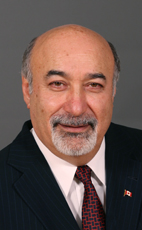
House of Commons photo

Crucial Fact

  • His favourite word was billion.

Last in Parliament March 2011, as Liberal MP for Scarborough Centre (Ontario)

Lost his last election, in 2011, with 32% of the vote.

Statements in the House

Credit Cards December 7th, 2004

Mr. Chair, I would like to pick up from where my colleague spoke so passionately. I am glad she referred to the Bible and other examples. However, in quoting what the member for Glengarry—Prescott—Russell said 14 years ago about capping it off at 5%, I will not deny that was said, and if we were to look back, that probably was said. However, fast-forwarding 14 years down the road, I say to my colleague from the NDP, capping off and controlling has not worked, as we have seen.

Members keep referring to 16%. The proposal is 5% over prime. Almost a decade ago when I came to this honourable House I remember that we talked about the horrendous interest rates, and the banks listened, which is why the Financial Consumer Agency of Canada, known as FCAC, was formed.

I want to pass on to my colleague and all members that there are credit cards today, which people can have without the so-called bells and whistles, that are at prime rate and maybe two percentage points over.

What is best, 2%, 3% or 5% over prime, as the hon. member says? In capping we may also be going in a different direction, but I believe that financial institutions and the credit card providers heard us a decade or so ago. They started to adjust over the course of the years and today they are offering credit cards or charge cards with a variety of flexibility in terms of rates, programs and what have you.

Computers for Schools Program November 30th, 2004

Mr. Speaker, I recently had the opportunity to present the 200,000th computer to John McCrae Senior Public School in my constituency on behalf of the Ontario computers for schools program.

The Ontario computers for schools program, in which our government through Industry Canada participated, ensures that we become the most connected and indeed the smartest country in the world. The computers for schools program was co-founded in 1993 by Industry Canada and the private sector. Computers are donated by governments and businesses for refurbishment. These computers are then donated to schools and libraries across the country, helping our youth to become computer literate and preparing them for the future.

In addition, I am also proud to inform the House that this 200,000th computer was refurbished by Youth at Risk from Bendale Business & Technical Institute, which is also located in my riding of Scarborough Centre.

As we have moved from a resource based economy to a knowledge based economy, the computers for schools program represents a tremendous addition to the technology inventory of our education system by increasing computer access for students. Congratulations to our--

Committees of the House November 30th, 2004

Mr. Speaker, opposition members talk about the garment industry. As much as we are support it becoming innovative, we forget one thing. For a garment to be produced, we need to have yarn. That segment of the industry has been totally forgotten by my colleagues. Yes, the LDC initiative is good. However, I am concerned that shops will be set up in the least developed countries and that in essence will eliminate what we have today.

My comments are related to not just innovating. In my view certain government offices, such as EDC, do not support this industry when it comes to exporting. I found out that they had increased their charges fivefold. No wonder my colleague from West Nova was so passionate when he talked about how Dominion and Britex disappeared, the heart of the community.

Some of our facilities, which are modern state of the art yarn manufacturers, are being impeded. As mentioned earlier by my colleague from Churchill, we have to get to the trade table. One table we are not at is the CAFTA table, Central America Free Trade Agreement. The Americans are there and are beating us out. They do not want subsidies. They simply want our government to be at the table to sign on the dotted line so they can compete.

Contraventions Act November 2nd, 2004

Mr. Speaker, I would like to be recorded as being opposed.

(The House divided on the motion, which was agreed to on the following division:)

The Budget March 29th, 2004

Mr. Speaker, I do not know what planet my colleague is living on. If our nation is to compete in a global economy, we must compete and play with all the rules. If we are going to be the boy scouts of the universe, then we will take a back seat to others. I am not prepared to see this nation be second fiddle to none. We will compete out there with the rules that are there and available to each and every one.

The Budget March 29th, 2004

I know he is trying to harass me so I cannot get my words in, but in all fairness I will continue because sometimes the truth is better.

Permit me to quote the Auditor General, if I may, Mr. Speaker. She was asked in committee, “Is this $100 million what you people, as the auditors, can't justify? Further paperwork may be able to justify it...”.

This is the question that really is important. The Auditor General was asked, “...Is it absolutely a fact that $100 million has disappeared illegally into somebody's pocket?”. The response by the Auditor General was, and I quote, “No, that is not a finding of the audit”.

The Auditor General said no, that it was not a finding of the audit. I would ask the Auditor General, with the greatest of respect to her and her office, to come forward and say this publicly, to say what she said before committee.

My time is up. I will wait for questions.

The Budget March 29th, 2004

The gentleman said it was stolen. I know he can say that because he is in this House and has immunity.

Permit me, if I may, just to quote what the Auditor General said before committee--

The Budget March 29th, 2004

Mr. Speaker, I wish to begin by thanking my colleague from Kitchener Centre for sharing her time with me because it gives me an opportunity to add my comments on budget 2004. I hear from my constituents and friends in Toronto, Scarborough and other parts of the country that given the circumstances and given what has happened to our economy and the worldwide economy, we are not doing too bad.

This gives us a opportunity to reflect on the fact that not too long ago, just a short 10 years ago in October 1993, this Liberal team assumed the responsibility of running the government and the country. It is important to take just a moment to reflect on where we were then and where we are today so that some of the figures mentioned in the budget will really make sense. As well, there is what has happened in the past couple of years.

It is important to say that in 1993 when this Liberal team took office we had a deficit of slightly over $42 billion. We were running a very high debt of close to $600 billion. The unemployment rate was close to 12% and our EI payouts were enormously high.

Let me say very quickly what today is like. As my colleague from Kitchener Centre mentioned earlier, we eliminated the deficit in 1997-98. Suddenly the books were balanced. Speaking about balances, as the Minister of Finance mentioned in his presentation, we have had seven consecutive balanced budgets. This has never been done, not since Confederation in 1867, not federally, provincially or municipally. Therefore, I think that we can take pride in ourselves as a nation and as a government for being responsible in addressing the economic woes of the nation.

I also would like to compare things for a moment. The previous Conservative government, here prior to us, did not once meet a budget target. The Conservatives talked a lot about balancing the books, but instead the deficit kept going up. As a result, the debt kept going up as well. I am not here to blame them or to blame anybody; I am simply here to point out the differences.

What has that done for us? In essence it has secured our economic sovereignty, because we no longer find ourselves in danger in regard to the bond market, for example, knowing that year in and year out we have brought forth not just balanced books but surpluses. There are several reasons for that.

Yes, the economy did well, but why did it do well? Why were over three million jobs created in the last 10 years? Instead of a 12% unemployment rate, the rate is now 7.1%. Many people are working and paying into the system as opposed to drawing out of it. That of course helps the government generate revenue. In turn, the government can then put that revenue into various programs, which I will outline in my speech as well.

It is also very important to talk about our economy in terms of our debt to GDP ratio. In 1993-94 it was hovering around 69% or 70%. Today it is at around 42%. Surely Canadians who follow the activities of the government can look at that figure and say that we have really made a quantum leap toward better times. We have made a leap toward better times, especially for seniors, as was outlined by my colleague from Kitchener Centre, and for our youth in regard to the types of investments she mentioned and which I will also cover.

When we compare that economic position with others in the G-7, we can take pride in ourselves by saying that Canada stands number one in terms of economic activity, job creation, and prospects for the future in terms of our investments in research and development and in terms of our environment as well.

Our environment is a very important issue. Let us look at the investment in the environment that the government has made most recently. In the budget, the government announced an investment of $4 billion over 10 years to clean up contaminated sites. The Sydney tar ponds is one of those sites. This issue is important to all Canadians, not just members from the Atlantic provinces. It is going to be addressed today.

Our contingency reserve today is at $1.9 billion. Sometimes people say “big deal”, but I would rather have something on the plus side than something on the minus side. We know that in years past there was a contingency reserve of about $3 billion. If there was no need to access that money of course it went into debt retirement continuously. That is one of the main reasons why the debt has been reduced continuously on a year to year basis.

What benefit have we received as Canadians? Very clearly, a reduction in interest payments of close to $3 billion, which on a yearly basis permits us to put that money into various programs such as the education funds and the Canada millennium scholarship fund. I touch upon that because it was mentioned earlier by my colleague from Kitchener Centre in terms of wanting to create a smart Canada. In order to compete today, not only do we want to attract the best and the brightest, but we want to create and retain the best and the brightest.

Yes, it is very important that we tell our audiences that education is indeed a provincial jurisdiction. All we can do from this side as the federal government is support it. I have not heard too many complaints from post-secondary institutions and the people who run those institutions. I have heard nothing but praise in terms of the moneys that we have been able to put toward universities in terms of the research chairs right across the country, in which we have invested in the past.

With respect to the Canada pension plan and what was mentioned earlier, I think it is very significant to touch upon that as well. Indeed, in years past, the Canada pension plan was in jeopardy. What have we done? We have restructured it, of course, and today, actuarily speaking, we have secured the pension program for the next half century. God willing, in future years we will continue to improve, sustain and maintain it for the next half century after that.

I know that the budget was not everything to everyone. I know that no government, neither ours nor any other government, can do everything to satisfy everyone. Governments, through their programs and their investments, try to create a climate whereby each and every citizen of the said nation, in this case Canada, has the opportunity to create and to sustain and improve the lives of themselves, their families and their communities.

Part of that, as was mentioned earlier, is accountability and integrity. I know that the debate before us in the past has been in terms of the sponsorship issue, the sponsorship affair. I think we have done a disservice to the nation by not putting the facts out as they are, because Canadians today are saying that a hundred million dollars was wasted--

Greek Independence Day March 25th, 2004

Mr. Speaker, today, March 25, marks Greek Independence Day. It is a day when Canadians of Hellenic descent will be celebrating the anniversary of the liberation of their former homeland from 400 years of occupation under the Ottoman Empire.

In 1821 the Hellenes revolted against their oppressors and embarked on their successful war of independence. On this day Hellenes will commemorate a dark period in Greek history when Hellenes lived under the repressive rule of the Ottoman Empire.

On this day also, Hellenes will be celebrating and paying tribute to the courageous spirits of their ancestors who stood up against their oppressors and successfully fought in order to restore the democracy and freedom that was lost for so many years.

As Greek Independence Day is observed today, Greeks everywhere are especially proud as they look forward to celebrating the return of the Olympics to their homeland in Athens. They will once again be given the opportunity to host this great event that brings together all nations in the spirit of peace and democracy.

[Editor's Note: Member spoke in Greek]

Foreign Affairs February 19th, 2004

Mr. Speaker, I would ask the Minister of Foreign Affairs to comment on the most recent homicide bombings that recently occurred in Israel and other parts of the world, which specifically target civilians.

As a personal friend of the brother of Yechezkel Goldberg, the Canadian-Israeli victim of the most recent atrocity by a Palestinian terrorist group, this is now much closer to home. I have as a result come to appreciate a whole new dimension to the human cost of terrorism.

Homicide bombs are a crime against humanity and those who encourage these acts must be held accountable.