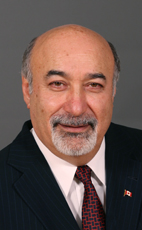
House of Commons photo

Crucial Fact

  • His favourite word was billion.

Last in Parliament March 2011, as Liberal MP for Scarborough Centre (Ontario)

Lost his last election, in 2011, with 32% of the vote.

Statements in the House

Parliament of Canada Act September 25th, 2003

Mr. Speaker, I am so pleased. I actually led my hon. colleague into asking me this question and I am glad he picked up the bait.

I will answer the first question. The member from Hamilton indeed said we would eliminate the GST, I do agree with him. But she also did the honourable thing and resigned, went back to the people and they voted her in again. The member knows that very well.

On this issue, as I set the trap for my hon. colleague to ask me the question, it is exactly what I have been talking about all along. If they did their research, if they looked into the matter, they would know that I had spoken to the Speaker of the House and the Clerk of the House. I as an experienced parliamentarian would never, but never, abuse my privileges.

If he had done his homework, the member would not have had the gall to stand today and ask that question. He is feeding misinformation to Canadians through that tube. If he knew exactly what the package was that I mailed out, the Speaker saw the package, the Clerk saw the package and they gave me the go ahead and said that I did nothing wrong. I have no hesitation in facing the media, in facing the House, to answer the questions, as I did. I would be glad to at any time.

I am very happy he asked me the question. I did not abuse my member's privileges.

Parliament of Canada Act September 25th, 2003

I apologize, Mr. Speaker. I was asked a direct question and I was moved in that direction because members opposite did misrepresent the GST. We are fortunate in this country because we pay 7% GST. Countries in Europe pay anywhere between 18% to 20%. The lowest I have heard of is Australia at 12%.

I say to the hon. member who said to eliminate the GST. Let us do so. Let us eliminate that revenue, but if the government does not have revenue, if the hon. member does not have an income, who will pay his mortgage? Let him forgo his revenue. Let him forgo his income and let us see how he will take care of his family.

He is like another member on the pension issue, which I will refer to, who said that no, the members of his party would turn it down and they signed off. The hon. member, who is a good friend of mine, came back several years later and said, “I have a family to look after. I have to take it”. The member opposite was one of the ones who reneged on the pension issue as well. He said that he had a family and that he had a future.

I did not want to go in that direction. That was not my intent. My intent was to point out that I believe in my heart that each and every member in the House is an honourable member. They come here with sincerity to serve the nation and to do their best. Along the way they will make some mistakes, but as is said, to err is human, to forgive divine. Canadians know how to forgive if it is a genuine mistake. When there were mistakes and misuse of money, we always came back and our Prime Minister never hesitated to say that we made a mistake and let us correct it.

I want to close by saying to Canadians out there that every initiative is being taken at all times to safeguard. On the comment the hon. member made about grabbing power from the provinces, that is another misrepresentation. When the provincial ministers get around the table with the Prime Minister, all they want to know is how they can take more power. They think Canadians are stupid, but they are not. Canadians follow this stuff. Canadians do read. Canadians do listen and Canadians know.

I remember what happened with the health transfers in the first mandate when British Columbia and Alberta were taking away medical services from people who were moving into those provinces from other areas. The federal government took the responsibility by telling them that if they wanted their transfer funds, they had to provide health services to each and every Canadian based on the Canada Health Act.

One of the principles of the act is portability. If I choose to move from Ontario to Alberta or British Columbia, I should not have to wait three months for health services. What if within those three months, God forbid, something happened to me? Why should I not be entitled to health services? Is my dollar in Ontario not the same as my dollar in Alberta or British Columbia? The federal government took the responsibility and said to the provinces of British Columbia and Alberta that if they wished those transfer funds, they must adhere to the principles of the Canada Health Act.

Who is trying to take power? Under the Romanow proposal we want safeguards, we want a council, we want checks and balances, we want a reporting system. We know the provinces do not want that. The provinces simply tell the federal government to give them the money and they will do as they choose.

That is not what Canadians want. Canadians want accountability and that is what we are trying to do. Through this initiative we are trying to provide another platform of accountability for the House.

Parliament of Canada Act September 25th, 2003

On the GST, I will answer you quite frankly. I challenge you and I would be very happy to show you in the red book. Maybe you do not know how to read, but I would be very glad to show you that the red book says specifically to replace the GST with an equally revenue generating tax.

If all Canadians are not prepared to pay the GST, then let them not have any requests for services toward pensions, toward hospitals, toward transfers to the provinces, toward security and toward airports. If that is what you want done, let us eliminate the GST, but your constituents should not have any demands for--

Parliament of Canada Act September 25th, 2003

Mr. Speaker, I was not on the order to speak. I was following the debate and listening to members' comments, especially those coming from the opposition members. I decided to stand and make some comments on the overall comments that have been going back and forth.

Most of us here, including the member who spoke earlier, have been around this honourable House for two if not three terms. I came to the House in 1993. We all came here to try to serve our nation.

I know on the Liberal side, we made commitments in our red book. We wanted to turn the corner; we wanted to get the country back on track. We wanted to get the people back working. We wanted to give the right signals to our youth by setting the groundwork for them to have a good future. We wanted to eliminate the deficit, which we did very early on. We wanted to create a good healthy economy, which we did. We wanted to create jobs, which we did. We wanted to cooperate with the provinces, which we have been doing. I will reflect on that in a moment as my hon. colleague said that all we are doing is squabbling, that we want to grab power from the provinces. I am going to touch on that point.

What has hurt me more than anything else is it is unfortunate that we in this House are doing damage to what my good friend said, the credibility and respect. We are supposed to be held at a high level of esteem. It is unfortunate, my good friends, and I say this to the official opposition, and I understand the politics of it that those members take it out to their constituents and the optics are what they are. They come here and talk about the boondoggles and they talk about CIDA, but what they do not say is that it was those members' request for funding and we brought them up during the campaign. They know when they stand in the House that they are protected and have immunity and that they can make innuendoes and say whatever they want to say, which passes through the media, but they could not say some of that stuff outside.

For example, they stood in the House and ranted and raved about the money that was lost after Sheila Fraser, the Auditor General, brought it up but they had not even read the newspapers. They referred to the editorials. Had they read the newspapers properly and had they been honest enough, what Sheila Fraser said was that the bureaucracy, the civil servants, should have been much more careful and should have paid proper due diligence. She did not blame the minister of HRDC, or the minister of CIDA, or the Minister of Public Works because the minister puts out the program. The minister does not go around handing out cheques. He or she does not go around looking at the contracts. He or she leaves that up to the administration and the staff to administer the programs. Along the way if due diligence had not been done, and I agree it has happened, things slip through the cracks.

It is unacceptable that members come to the House and say things publicly in front of the cameras and send this message back to their ridings because it is doing harm to this institution. It is degrading this institution. Members know that all of us have come here with the honourable intention to serve our country and to do the best we can. Most of the members who have come to the House have left good employment, good paying jobs to come and serve. They did not come here to earn a salary or take shortcuts. They say to read the editorials. I am saddened today because I read yet another story and the opposition tried to portray it falsely. They did not even bother to look at the facts as opposed to making statements.

Nevertheless, on the ethics counsellor we all know that going back to 1993, this party and the Prime Minister have said we are going to have an ethics counsellor. The message we are sending out is that by trying to raise the bar even higher we are concerned and we will do whatever we have to. There is a system. There is a process.

One of the members from the official opposition continuously digs, and so he should. What I ask him to do is to portray the facts as they are and not say that the minister faulted here. Let us dig a little bit deeper. Let us go below the surface.

Members of the former Reform Party which eventually changed its name to the Alliance Party came here with a holier than thou attitude. We know what has happened in the past when we talked about ethics. We did not stand up and say that they said one thing, then reneged and today they are doing another. That is not what this institution is all about.

Criminal Code September 17th, 2003

I voted in favour, Mr. Speaker.

The House divided on Motion No. 2, which was negatived on the following division:)

Canada Airports Act April 29th, 2003

Mr. Speaker, first let me thank the member for Okanagan—Coquihalla, who really stuck to the issue and got to the guts of some constructive points.

I was quite intrigued when he talked about the Canada customs services and the extra $30,000 that now will be needed. I just want ask the member to clarify whether that service was there before and there was no charge. Or is that charge a new charge that would be added? Could the member clarify that? As members of the transport committee, we are trying to seek ways, means and ideas as to how we can overcome some of these difficulties at different airports.

I do agree with him on one issue. He said that one package does not serve all. There are different needs, different airports, different sizes and different volumes. He is absolutely correct.

The last thing I want to ask him about is the x-ray machines. Were there x-ray machines there before this request? People do travel. Everyone has mobility. Given what has happened over the past little while, I cannot see any airport not having some kind of security system for baggage, et cetera. If he could comment on that, I would appreciate it.

Canada Airports Act April 29th, 2003

Mr. Speaker, I want to start off by complimenting the member from the Alliance. He is one of the best storytellers I have heard in the 10 years I have been here. It never ceases to me amaze that on any bill or any situation he has a wonderful story to tell. Good for him.

I was amazed how he went from one issue to the other. He talked about the GST. He talked about flags at airports and the incident on his desk. I commend him for that.

When we bring legislation to the House, we know very well that no legislation is ever perfect. That is why legislation is always reviewed and that is why this legislation is also being reviewed. Something we brought forward five years ago does not necessarily apply today.

When he talks about mandating today, perhaps five or eight years ago we did not have to use that word. He talked about the flag on his desk. He knows very well the dynamics of our country and what we are dealing with. The flag beside you, Mr. Speaker, speaks on behalf of all of us.

I want to talk a little about the GST. He said it is tax on tax on tax. Australia for example charges 12%. In Europe it is 18% and higher. There is a price for civility and it is called tax. It is sad and he might not want to accept it, but we need revenue to put into our health system, social programs, et cetera. If he is saying we should eliminate tax altogether, then I would like him to stand up and tell his constituents there is no more money for pensions, no more money for social programs, no more money for health care, no more money for roads, nothing, nothing, nothing. I would like him to clarify that.

I also want to comment on the amendments that he talked about. Of course if amendments make sense and are brought to committee, any reasonable person will look at the amendments, compromise and make a step forward. No one says they accept them or turn them down.

Parthenon Marbles April 1st, 2003

Madam Speaker, my thanks also to the member for Peterborough who seconded the motion. I know there have been people in his constituency from all walks of life that have supported this. I thank him.

Moving the marbles today is not an obstacle. They are housed at the British Museum. My colleague from Hamilton has visited them and described them to me. I have not seen them personally. Given today's technology, I have been told it would not be a problem to physically take them from the museum in Great Britain and house them in the Parthenon in Athens, Greece.

The Greek government is willing to get into a cooperative and sharing environment. This wealth will not be locked away. The Greek government has proposed various creative ways in which to share these artifacts. These artifacts should be shared by all humankind. It is part of our cultural heritage. What is cultural heritage today? It has no boundaries. When I was in the Orient, I was in awe. When I am in different parts of our country, I am in awe when I see the cultural diversity that we all share. We invite people to come and see them. This will unfold as well.

To answer the member's question directly, no there will not be a problem to physically take them in terms of damaging them. They have been well preserved. I congratulate the British government for having done so. I will congratulate the British government when they are returned as well.

Parthenon Marbles April 1st, 2003

Madam Speaker, let me again thank my very good friend, the Minister of Canadian Heritage, for her continuous support, kindness, and understanding of the issue. When we reached out to her, she was there front and centre.

To respond to her question, I would say that yesterday could not be soon enough. Things are moving very fast. The Olympiad is but months away. This Parliament has the means and the ways to come together. Together with our colleagues in the opposition, we would seek consensus to move this forward and get the unanimous support. If we could get unanimous support at any point in time, it would be greatly appreciated. I would like to see it done as soon as possible.

Parthenon Marbles April 1st, 2003

That is right, we lead the way in agriculture as well as in our forests and clear cutting. We find ourselves so competitive in softwood lumber that our neighbours in other countries think we are subsidizing where, in essence, we are not.

I could go on praising what we have achieved as a country. Canada is a relatively young country compared to countries such as Greece or Italy, but in that short period of time we have distinguished ourselves because we have had to make those tough decisions.

I know in these difficult moments this might be a tough decision to make. However, should we find the courage to make this decision and support this motion, we would once again send a signal that Canada can make the tough and right decisions.

I know, Madam Speaker, you have been behind this effort as well. I know how hard you have worked in terms of communicating this right across the country and in your area of Montreal. This issue has been discussed, not only in British Columbia but in other parts of our country.

I am bringing to the House the voices of tens of thousands of Canadians, and let me point out, not Canadians of Hellenic descent. If one looks at the signatures on those petitions, they are a reflection of all Canadians of this diverse and beautiful mosaic that we often describe as Canada.

I believe in my heart that at the end of the day Canada and this Parliament will do the right thing and support the motion.