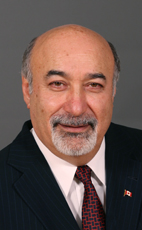
House of Commons photo

Crucial Fact

  • His favourite word was billion.

Last in Parliament March 2011, as Liberal MP for Scarborough Centre (Ontario)

Lost his last election, in 2011, with 32% of the vote.

Statements in the House

Supply February 17th, 2004

Mr. Speaker, this is exactly what he was saying.

They keep referring to the RCMP, an institution that I greatly respect and have supported all my life, and I will continue to support it, but look at what happened there. Is he telling me that the upper echelons of the RCMP knew what happened with that money? I do not think so, but it happened. That is what happened. That is what we have to get to the bottom of.

Supply February 17th, 2004

Mr. Speaker, I will close with this. I ask the member to read today's Quorum , in which a Globe and Mail article states:

According to the Auditor-General's report, the executive director of CCSB [the communications branch] decided which sporting and cultural events received sponsorship funding, issued the contracts to the advertising firms that handled the deals on Ottawa's behalf, and signed off on the invoices.

Those members keep saying Liberals, Liberals, Liberals. We rolled out the program, and in that layer, which I agree with him exists, there is some gutter, and there is some cancer that needs to be cleaned out. I ask them to work with us because they know very well, as we worked together at the public accounts committee on the privacy commission, we worked together for the betterment of the taxpayer.

Supply February 17th, 2004

Yes, let me go for it. We remember the law firm that represented their former leader, their previous leader who sits in the House today. Can we recall what happened with them paying money and with the kickbacks going back to when he was a member of the Alberta provincial government? I answer in that way. I chose not to go in that direction, but he moved me in that direction.

Supply February 17th, 2004

Speaking about hypocrisy, Mr. Speaker, that holier than thou party, and I do not want to get into specifics because I started--

Supply February 17th, 2004

Mr. Speaker, as I participate in this debate I want to thank my colleague from Notre-Dame-de-Grâce—Lachine for sharing the time with me.

On this most important issue, what I think is incumbent on us as elected representatives is to speak to the people, and we have the opportunity through this honourable House to do so. Unfortunately, what happens most of the time is that questions are asked and we are asked to stand up and respond to such an important issue in 30 or 35 seconds. What happens is that there is a little vibe and a jab, the media picks up on that, it gets exploited, and the next thing we know, we are not doing what Canadians have asked us to do.

Most recently, in the last year there have been municipal elections and provincial elections and, who knows, a federal election down the road. What Canadians have been saying consistently over and over again to all of us is to get our act together, to stop the squabbling, solve the problem and get to the bottom of it.

I want to get to the issue of the day and pick up where my colleague started off with a bit of history of what happened here. When responsible individuals, officers of Parliament and so on comment, I think their choice of words is very important. I go back to an article of May 9, 2002, when Auditor General Sheila Fraser said, “Senior public servants broke just about every rule in the book”. That is her quote. She did not say the Prime Minister, the Minister of Finance or the President of the Treasury Board. That had to with this quote, “RCMP to probe federal ad deals”, the ones that my colleague previously referred to. To quote the Auditor General again, she said, “This is a completely unacceptable way for government to do business”.

I say to my colleagues and ladies and gentlemen out there, the moment the Auditor General uses those words “unacceptable way for government to do business”, who are people going to blame? They are going to blame their member of Parliament, their minister and the Prime Minister.

On the other hand, the report said that there were firm guidelines that were set in handling these contracts. Who broke the guidelines? Did the finance minister break them? Did the Prime Minister break them? Did the leader of the opposition break them? No. It was the people who were administering the program.

I am not here to pick on anybody. I just want to get to the bottom of it, like everybody else was saying. I know colleagues over there who sit on the public accounts committee and it was their cooperative effort with the Liberals--and I commend them for that--that brought the Radwanski case to light. They got to the bottom of it. It was cooperative.

That is what the minister, the Prime Minister and the President of the Treasury Board are saying. They are saying, “Join us and let us get to the bottom of it because there has been a lot of wrong done here”. There has been a lot of Canadian taxpayers' money lost, and I agree with my colleague, who said earlier that it should go to better programs.

It does not stop there. Coincidentally, just the other day I was reading an article in The Toronto Star that said “$100,000 in bribes alleged”. The Dufferin-Peel Catholic school board asked for an inquiry. Apparently there was an HRDC program, part of the boondoggle that was discussed a couple of years ago, a legitimate program that was funded to counsel young students, young Canadians on vocational training. The article stated, “While funds went into legitimate HRDC programs, police allege false invoices were submitted to take money from the programs”.

This was a legitimate program that met every prerequisite with an identified, recognized school board. Yet some members within that group connived at how they were going to manipulate the system. What did they do? They submitted false invoices. Did the Prime Minister know about it? Did the Leader of the Opposition know about it? Did the President of the Treasury Board know about it? I do not think so.

What a coincidence. This was said here just the other day: “Groupaction faked invoices, insider says”. A senior vice-president of the advertising firm was not even aware that his name was being used and billed for services rendered. He did not even have a clue. Who was incompetent then? The Prime Minister? Their leader? The Treasury Board president? Obviously, the thief who wants to rob someone's house is not going to call and say, “I want to come over and rob you on Tuesday night. Please leave the house”.

We have identified that there have been wrongs done to Canadian taxpayers. A commission of inquiry has commenced its activities. A Quebec justice has been appointed, who wants to get to the bottom of it, just like there was a probe in 2002. As my colleague referred to earlier, there were charges laid.

As my colleague from the new Conservative Party asked earlier, are they going to be charged? We cannot charge and convict a thief unless we actually catch him or her. We are in the process of getting to the bottom of it, as was done in the Radwanski case.

What I am saying to the House in this entire debate is this: let us not prejudge. Let us not say that the Prime Minister knew, the minister knew, or the former prime minister knew. Nobody knows who knew. We are in the process of getting to the bottom of it.

I would like, as I close, to ask all colleagues to refer to page 6 of today's Quorum . There is an article from The Globe and Mail entitled “Guidelines not followed for sponsorship initiative”.

For every article, I will again quote the Auditor General, who said that “senior public servants broke just about every rule in the book”. She was not referring to the Prime Minister or members of Parliament. It was a program that was laid out. There were guidelines that were set. If the people who connived chose to abuse and violate those guidelines, let them be caught, let them be punished, and let us hopefully get the money back for Canadians.

Supply February 17th, 2004

Mr. Speaker, first of all I am pleased with the tone of this debate, as was occurring with the hon. member, but it is unfortunate that we are losing sight of what we are trying to accomplish here. I am greatly saddened because 90% of the hon. member's comments were focused around a personal attack on one individual.

Let us be very frank. That one individual, and I quote her, said that “this is the truth”. Members can say anything they want in the House but that to me is not the truth and it is unfair to quote.

The member says there is a poor relationship and asks if he will tell the people. The Prime Minister has said, with no ambiguity, “I am going to testify. I want to testify. I want to go to the nation. I want to find out and get to the bottom of this”.

I do not have any time left, but let us calm this down and do what the people want. They want all of us to get to the bottom of what happened.

Parliament of Canada Act September 25th, 2003

Mr. Speaker, there have always been watchdogs on Parliament. Members know that, whether it is the RCMP or other bodies. When those bodies have been asked to look into certain situations, they have and when they come back with rulings that the opposition is not happy with, the cacophony continues.

We did talk about an ethics counsellor in 1993. That did happen. Today the bar has been raised. Why? It is because of certain allegations. As I said before, in our country, the presumption of innocence is there, but what we have failed to do here is to be a little bit more transparent in this entire initiative.

The way that we are portraying it to Canadians is that during these 10 years there has been so much mismanagement, so much undermining, and so many little deals going on that now we need an independent person.

We are all accountable. My colleagues all know we are accountable, whether it is the franking system we use, the comments we make outside or whether it is how we use our budgets. We are accountable. There is a system in place. Let us not be portrayed to Canadians as unaccountable because we are.

The people to whom we are accountable inevitably are the taxpayers and voters. At the end of the day, let them judge the parties by marking their X and saying that, yes, they approve of them, yes, they are accountable or yes they are ethical. Only they can judge us.

Parliament of Canada Act September 25th, 2003

I just got a little bit emotional, Mr. Speaker. I know that colleagues, and I speak for them and all members in the House, are here because as I said earlier, we care.

When we talk about bringing trust back into the House, we are sending the message that none of us can be trusted. Surely that is not the case, as I said earlier. There is nothing that I am afraid of. We can have 10 ethics counsellors. I do not have a problem with that and I never did have a problem with that. No matter who sits in the House on whichever side, we should not be afraid to have one or five ethics counsellors with whatever power we give to them. He who has concern should not be sitting in the House.

All I ask, and I know members opposite can appreciate that as much as we can, is that we do the best we can. I know it is politics and we have to put up a certain portrayal to our constituents and the optics et cetera. I fully appreciate that; that will not go away. But there are some sensitive moments where we must not add fuel to the fire.

Canadians have told me and I know they have told other members repeatedly because we talked about the provinces. They have told us to come together, the municipalities, the provinces and the federal government. They have told us to get our act together. Whether we come from the west, Ontario or Quebec, we have heard it all over the country. We have been told to just get our act together. If there is a problem, fix it and stop squabbling.

We will continue to squabble if we talk about bringing trust back into the House. Trust was never lost in the House. We portray that trust was lost and that is not the case.

Parliament of Canada Act September 25th, 2003

Mr. Speaker, I thank the member for the question. I will answer it, but I think this whole debate need not even happen because it is about “bringing trust back into the House”. That is what this is all about.

Was there never any trust in the House? This is what I am so upset about. We, and I am including myself, are portraying that the House cannot be trusted.

Surely to God if we care about this nation, and I know you do--

Parliament of Canada Act September 25th, 2003

Mr. Speaker, the member is being totally inaccurate again when he says my colleagues, my constituents. The only people who commented were two members from the Alliance Party. I spoke to Mr. Rodgers who said, “There is really no story, but I am going to do something”.

In answer to his direct question of would I do it again, I would do as much as they would do, as long as we are within the guidelines of the House and our privileges. That is what we are entitled to. We would not go beyond the guidelines set before us, and that is exactly what happened here.