
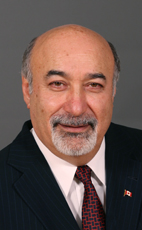
House of Commons photo

Crucial Fact

  • His favourite word was billion.

Last in Parliament March 2011, as Liberal MP for Scarborough Centre (Ontario)

Lost his last election, in 2011, with 32% of the vote.

Statements in the House

Parthenon Marbles April 1st, 2003

moved:

That, in the opinion of this House, the government should call upon the United Kingdom to return the Parthenon Marbles to Greece in order to be restored in their authentic context, as the Marbles represent a unique and integral part of world heritage and should be returned to their country of origin, before the 28th Olympiad in Athens, Greece, in 2004.

Mr. Speaker, I too would like to repeat Motion No. 318, so that not just our colleagues but Canadians who are listening today could hear the motion again because it really is something very unique that we are debating here tonight.The motion says:

That, in the opinion of this House, the government should call upon the United Kingdom to return the Parthenon Marbles to Greece in order to be restored in their authentic context, as the Marbles represent a unique and integral part of world heritage and should be returned to their country of origin, before the 28th Olympiad in Athens, Greece, in 2004.

There is a significance to the 28th Olympiad in 2004 because these are trying and difficult times for all of us on this universe. We are seeing changes, conflicts and struggles. We are asking for the liberation of people. What used to happen during the Olympiad was that everyone laid down their arms no matter what conflict or wars existed. They all went as brothers and sisters to compete during the Olympic period in a truce. This also sends a very important message.

Let me give an historical perspective of the Parthenon or the Elgin Marbles as they are known. After Greece's victory over the Persians in 479 BC, Pericles wanted to rebuild the city and make it an artistic cultural as well as a political centre. The general artistic supervision of the Acropolis building was assigned to Pheidias. It took 15 years to build. The beauty of building this monument was that every citizen had the opportunity to participate.

Let me just fast forward several hundreds and hundreds of years. When Greece was ruled under the Ottoman Empire, the then high commissioner to the Ottoman Empire was Thomas Bruce, the seventh earl of Elgin, also known as Lord Elgin. We know and history has shown that Lord Elgin was an art collector and wanted to decorate his mansion.

We are looking at a piece of art that has been distinguished throughout history. Millions of people from all over the world have visited the Acropolis to see the Parthenon. I first went to Greece as a young boy of 11 years. It did not have the impact on me as it did when I visited it about four years ago when I actually had a tour guide walk me through and describe to me in detail why building A was situated on this angle and why building B was situated on that angle. It brought to life the golden age of Greece.

It was awesome for me to stand there and close my eyes, and try to go back in history to see democracy unfold on that spot. What happened during the Ottoman Empire was that Lord Elgin asked the Pasha, the ruler of that area, if he could get permission to take the marbles or the slabs, and basically take them. There was a document signed, which was under scrupulous circumstances, and translated by an Italian. The marbles were eventually crated and shipped to England.

The argument that was put forth was that they needed to be taken for observation and preservation. For years I think we accepted that argument because there was no facility at that time in Athens to house these treasures. Today there is a modern state of the art facility that is being built beside the Acropolis to house these artifacts.

Lord Elgin shipped them to England and from what I read they did not get there safely. Eventually they were dragged from the sea and Lord Elgin decorated his mansion. He then ran into some financial problems. Even the British government pointed out that the circumstances under which Lord Elgin took these marbles were a bit questionable. The British government gave him a sum of money and in its wisdom donated them to the British museum where they are today.

The other day my colleague from Hamilton and I were talking about the marbles. He actually visited the museum and just listening to the description of what he saw made me shiver. He has lent his continuous support on this matter.

This is not just a request that I am making personally. The other day I presented in the House of Commons one of many petitions. The latest petition contained over 2,000 signatures from right across the country. I visited the campuses of the University of Toronto and York University, and students of all backgrounds said it was the right thing to do. They were happy to sign the petition. I presented petitions from right across our country asking our government to call upon Great Britain to do the right thing because the time has come to indeed return these artifacts to their rightful owners.

People made the argument that it would be setting a precedent. On the contrary, it would not. A couple of years ago Canada returned a painting to Hungary. England returned the coronation stone to Scotland. If a precedent has been set, it has been set by Great Britain, Canada and other countries.

This is not a vase, a statue or a painting, it is a very unique piece of art that we are asking to be returned. These are actual slabs that belong to a structure that is not just Greek. It is a structure that is shared by the international community. It is a part of culture, history and civilization.

The motion requests that the British government go forward into the 21st century, do the right thing, and meet the deadline of the 28th Olympiad in 2004.

We can now confirm through various documents that Lord Elgin took the marbles under questionable circumstances. We are not here to condemn or criticize that. That was a different era and time. Those were different circumstances. We are now in the 21st century.

Over and over again there have been initiatives of this nature. I would be remiss if I did not mention the efforts of the late Melina Mercouri, who was the cultural minister of Greece in the 1980s. I must congratulate all the members of the various committees in Canada, the United States, Australia and Great Britain. I would like to point out that the attorney representing the initiative in Great Britain is Bruce Tattersal, a direct descendant of Lord Elgin.

UNESCO, the international body which we all respect and abide by, has supported this initiative. It was first introduced in 1982 by the late Melina Mercouri to the council of ministers of the cultural segment of UNESCO in Mexico.

In January 1999 the European parliament ruled in favour of returning the marbles to their original owner. The resolution of the 10th UNESCO intergovernmental council to promote bilateral talks between Greece and Great Britain showed the growing interest and importance that this issue has had in the international community at large.

It is not just this House that is bringing the motion forward. The United States congress passed a resolution. Let me bring it closer to home. I want to take this opportunity to congratulate and thank the Quebec National Assembly which unanimously passed a resolution supporting the return of the marbles. We all know that it is only the federal government that speaks on foreign policy, but the fact that the gesture was made, or any gesture of this type that could be made at any level of government, is an expression of will and support. There is no question about that.

I know the Minister of Canadian Heritage has commented favourably over and over again, and I thank her for the continuous support that she has provided to this initiative. When she finds herself in international forums, she always brings this issue to the table and I thank her personally for her initiative.

What happened 200 years or 300 years ago should be forgotten. I stand in the House and ask that our country and Parliament support the motion to send the message asking the British government to return the marbles.

It is senseless for me to go on and provide pages of who said what and when it was said. The bottom line is that we not only must do the right thing, but we must do the honourable thing. Canadians have been noted to be leaders in many initiatives. We pride ourselves as peacekeepers. We pride ourselves in our high tech industry and cultural communities.

Petitions March 31st, 2003

Mr. Speaker, pursuant to Standing Order 36, I have the honour to present petitions signed by over 2,000 Canadians representing various ridings across our country. There were other petitions on the same issue presented in the past.

The petitioners today call the attention of the House to the most important issue of the Parthenon Marbles. They are asking that every effort be made to return the marbles to their rightful home in Greece where they were taken without the consent of the Greek people almost 200 years ago and, hopefully, to arrive in Greece before the 2004 Olympic Games hosted by Greece.

Therefore the petitioners call upon Parliament to urge the United Kingdom to return the marbles to where they belong, with their rightful owners and the Parthenon in Athens.

Canada-U.S. Relations March 27th, 2003

Mr. Speaker, my question is for the Prime Minister.

I have been informed that the leader of the Conservative Party yesterday was sharply critical of the President of the United States, George Bush.

Could the Prime Minister say if he agrees with the leader of the Conservative Party and the comments he made yesterday?

Assisted Human Reproduction Act March 26th, 2003

Mr. Speaker, I abstained on the previous vote but on this vote I would like to be recorded as voting with the government.

Situation in Iraq March 17th, 2003

Mr. Speaker, I do not often rise in this House and say with what great disappointment and sadness I am able to express not just my views but primarily the views of our constituents on what we have been hearing on this most sad scenario, the pending war on Iraq.

Permit me to go back to just about four years ago, when we had the war and the bombing in Yugoslavia. We had a debate in this honourable House. I remember rising to my feet at that time to say what a sad moment it was as we were leaving one century, going into the new millennium, and that hopefully we would rid ourselves of war and bring peace, prosperity, health and happiness throughout the globe. I remember that at that time we had visitors from the United States. There was a joint Senate and House of Commons committee. We had with us some guests from the United States, Mr. Robert McNamara, former U.S. defense secretary, and General Lee Butler, retired commander-in-chief of the U.S. defense department. They talked about what happened in Vietnam. They said if they only knew then about what happened back in Vietnam, they obviously would have made different decisions.

Now I would like to fast forward for a moment to what we are faced with here today. It is great that members get up. The former leader of the Alliance Party spoke very eloquently about his position and we just heard from the Conservative Party, but what everybody has failed to understand is why the UN was designed. It was designed to prevent war, not to bring forth resolutions promoting war. What has happened over the past decades, let me say to my colleagues, is that we have weakened the UN because of our own lack of contributions, financial contributions. One of the nations that has failed miserably to pay its bills is the United States of America. Sadly, those are the facts.

I have to go back in history because the past always affects the future. I remember when on Kosovo in 1998 the then NATO secretary general, Mr. Javier Solana, said that “the solution to the problem is not in signing papers, it is in compliance”. I said that I agreed with him. When the United States today insists on compliance, on enforcement, I say yes, they are right, we should be moving in that direction.

But as the former leader of the Alliance said, what a hypocrisy. I too now have to say, what a hypocrisy on behalf of the United States, because let me remind all members of so many resolutions in the past. For example, there was resolution 194 from the General Assembly in 1948 for the right of the return of the refugees to their homeland on the Palestinian issue. Year in and year out, the resolution has been brought forward and ignored. Most recently, there was the resolution on Jenin. Why did we not ask for compliance? Why did we not ask for enforcement? There were the many resolutions on Cyprus for the return of the missing people. There was the resolution asking for the illegal occupation of Cyprus to be resolved. Why are we not asking for compliance? Why are we not asking for enforcement? Why all of a sudden are we so insistent that on resolution 1441 we must have compliance? That is the irony today.

Moreover, as the previous speaker from the Conservative Party said, resolution 1441 had no mention of military action. Now today we have the gang of war: the United States, Great Britain, Spain and Portugal, the big powers of the world. What happens in Spain if there is an uprising in the Basque region and there is bombing and there are murders? Are they going to pass a resolution to say let us send the planes in, let us start bombing? No, I do not think that is the way it should be. It is very sad in times like these, especially when the chief inspector, Mr. Blix, has said repeatedly that we are making progress, that we are further ahead today than we were a month or two ago.

The international community knows it is moving in the right direction. The head of the nuclear society said that we are making progress. My question is, why did we appoint these people in the first place?

Here we have a leader in Saddam Hussein who, as I said about Slobodan Milosevic, I do not support. I would love nothing better than to see him moved away from his power throne so that the people of Iraq can start living peacefully democratically to raise their children, educating their families and creating prosperity.

These are indeed very sad moments, but I know that the moral case for immediate war crumbled when the UN inspectors reported, “No evidence of ongoing nuclear or nuclear related activities in Iraq”. There was no ambiguity in this statement. Yet Colin Powell and all the American representatives chose to put it in one ear and out the other.

Millions and millions of people right across the globe are expressing the same view. Can we all be so wrong? Can Nelson Mandela be so wrong? We all know what Nelson Mandela said. We know what Bishop Desmond Tutu said not too long ago. We know what citizens of the world said. We know what Canadians said Sunday at noon here on Parliament Hill. Give peace a chance. What chance are we asking? We are asking for the inspectors to continue doing their work.

Trying to tie terrorism with Saddam Hussein is wrong. We know that this war has nothing to do with terrorism and everything to do with vested interest; interest in oil for example and so many other interests. However, we do not want to take it in that direction. We want to create and continue supporting the body called the UN. If we start tampering with it, we may weaken it as we are doing right now. The rule of law that we talk about is often discussed here in the House

Mr. Speaker, I neglected to mention that I will be splitting my time with the member for Kitchener Centre.

It is imperative today that we allow these discussions at the UN to continue, that we permit the inspectors to continue doing their work. There were 250,000 people the other day in Montreal sending the same message: we want peace not war.

Should we prepare? Of course we should. Should we always have our guard up? Of course we should. Are we here to fool ourselves and say that nothing will happen again if we dethrone Saddam Hussein? On the contrary, we must always be on guard.

My constituents in Scarborough Centre and other Canadians whom I have spoken to are very concerned. However, if today a precedent is being set by asking for enforcement and compliance of resolution 1441, then it is incumbent upon the United States to lead the way and to lead by example and all the other resolutions that have been there will come forward again in the future. The Middle East issue is a very important issue to world peace. The Cyprus issue is a very important issue to world peace. The Kurd issue is just as important. I was reading the other day an article by Mr. Haroon Siddiqui who writes for the Toronto Star . He talks about the rule of international law. He said:

Iraq has not invaded America. It is not capable of it. It is not threatening to. Nor is it threatening anybody else. The argument that war must be waged to protect Americans from Saddam is simply not credible. Even less so is the attempt to link Iraq to al-Qaeda. If one accepts Bush's logic of invading those who, knowingly or unwittingly, financed, hosted or helped terrorists, then Saudi Arabia, Egypt, Pakistan and Qatar should be attacked long before Iraq.

We are not talking innuendo and hearsay. We are dealing with facts. We know what is going on out there. This unjustified effort on behalf of the United States that seems to have blinkers right now is unacceptable.

Churchill Heights Public School February 13th, 2003

Mr. Speaker, I would like to take this opportunity to welcome the grade 8 students from Churchill Heights Public School to Ottawa today. The students have travelled to Ottawa from my riding of Scarborough Centre to visit the Parliament Buildings and to better understand how their government functions. I will have the opportunity also to meet with them later this afternoon.

It is very important that all students take the opportunity to visit Parliament to experience firsthand how the legislative process works. As such, I encourage all my constituents to do as the students of Churchill Heights and visit Ottawa in the near future.

Again, I welcome Churchill Heights students and staff and I thank them for visiting us today. I am sure that they will leave Parliament inspired and proud to be Canadians.

Supply February 13th, 2003

We didn't think you were a cheap artist.

Health December 12th, 2002

Mr. Speaker, the member for Saskatoon—Rosetown—Biggar is once again upholding the Alliance tradition of cheap political maneuvering. Notwithstanding the facts, she argued yesterday that the Standing Committee on Health had backtracked on its commitment to discuss health care reform.

Could the chairperson of the Standing Committee on Health inform the House as to the work and the agenda of the committee?

Petitions December 4th, 2002

Mr. Speaker, I present this petition on behalf of hundreds of Canadians, not just from Toronto but from all over.

The petitioners call upon the government to request that the marbles from the Parthenon be returned to Greece. The petitioners are asking that these marbles which belong in their original form on the Parthenon be returned. They were taken away under questionable circumstances and they would like them to be returned prior to the 28th Olympiad in 2004.

Petitions December 4th, 2002

Mr. Speaker, the next petition has to do with the very important issue of child pornography.

The petitioners from my constituency and others draw to the attention of the House that child pornography is condemned by the clear majority of Canadians. They feel the courts have not applied the current child pornography law in a way which clearly protects our children.

Therefore the petitioners request that Parliament take all necessary steps to ensure that all materials that promote or glorify pedophilia or sado-masochistic activities involving children are completely outlawed.