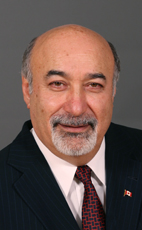
House of Commons photo

Crucial Fact

  • His favourite word was billion.

Last in Parliament March 2011, as Liberal MP for Scarborough Centre (Ontario)

Lost his last election, in 2011, with 32% of the vote.

Statements in the House

Petitions December 4th, 2002

Mr. Speaker, pursuant to Standing Order 36, I would like to present to the House a petition regarding the latest series of organized and sustained violent attacks on Hindus in Bangladesh.

The petitioners request that the Government of Canada undertake a review of the foreign aid it provides to the Bangladesh government in view of that government's record of recurring violent attacks and human rights violations and to do everything it can to protect Hindus and the various minorities as well.

Citizenship Act December 2nd, 2002

The Dutch as well, and the Brits.

She also said something that kind of irked me a bit when she said “we as a people, as a nation”. During the referendum of 1995 we went out and spoke to the nation. Let us look around the room. The member, who is moving the bill and whose ancestors are from Great Britain, is not here to diminish the honour and respect he has for his ancestors. If anything, he is building the country that he now calls home, this beautiful country called Canada, this beacon of hope to the world and this diversity that makes up Canada today, which is really where our strength lies.

When the member talks about a people and a nation, I want to remind her that when our ancestors came to this country they came to build it and share in it, which is what we are doing. Whether they went to Ontario, Quebec or British Columbia, her ancestors and my ancestors came to Canada to build and unite, not to separate.

I know my time is closing and as much as I want to refer to others, I want to at this stage, although I know I might be out of line, but because I feel so passionately about this I would like to seek unanimous consent to have the bill made votable.

Citizenship Act December 2nd, 2002

Mr. Speaker, I will start by thanking my colleague from Ancaster—Dundas—Flamborough—Aldershot, first, for the work he has put behind this private member's initiative, but more so for the thought behind the initiative.

In his proposal he has put forward two different versions, which pleases me very much personally and I know a lot of Canadians. The one version, where he makes reference to God, makes me very happy. In the other version, appreciating the diversity of our country, he does not make reference to God.

Without going into the historical aspect of it, because most members have covered that, and for the purpose of saving time, I too find great pleasure when I attend citizenship courts and see the many different people willingly coming forward and wanting to become part of the country, not just by saying that they want to live here but by taking oaths and becoming citizens of Canada and, I stress, of Canada.

I have also heard, as many members indicated today, including the member moving the bill, why they are not pledging allegiance to Canada, as we do in reverse. I too bring that message from citizenship courts that I attend in the greater Toronto area.

As most members here are very experienced parliamentarians, they know that in today's changing and trying times no legislation ever written is perfect. It is written with good intent and good thought and along the way, as time and circumstances change, we make amendments.

I remember growing up as a young boy when we sang God Save the Queen every day at school. Even today, according to the circumstances, I get goose bumps when I sing that song. I look forward to those opportunities. At the Remembrance Day services, for example, in Scarborough it is part of our activity, and I am very pleased for that.

We also did not have a flag some years back and today we have the maple leaf. We made those changes. God knows, maybe 10 or 20 years down the road we will possibly make some other changes according to how our country changes.

I came with a thought to talk to Bill C-203 but as the debate unfolded I guess I was provoked a little by the Bloc Quebecois member who referred to the European Union. Let us look at the European Union. When the president of the European commission, Mr. Prodi, first took office he said that within the confederation called the European Union the Italians would never stop being Italian, the Portuguese would never stop being Portuguese, the French would never stop being French and the Greeks would never stop being Greeks. It does not take their identities away because they fall under the European Union.

Cedarbrae Collegiate Institute November 21st, 2002

Mr. Speaker, I would like to take this opportunity to welcome the grade 12 history students from Cedarbrae Collegiate Institute in my riding.

The students have travelled to Ottawa to visit the Parliament Buildings and, of course, to get a better understanding of how the government works. I had the opportunity to meet with the students. I also have visited the school on many occasions in the past.

I believe it is very important for all students to take the opportunity to visit Parliament and experience firsthand how the legislative process works. As such, I encourage all my constituents, and all Canadians for that matter, to do the same as the students from Cedarbrae Collegiate Institute, to visit Ottawa in the future.

Again let me welcome the students from Cedarbrae Collegiate and thank them for visiting us here today. I am confident they will leave Parliament Hill feeling inspired and proud to be Canadians.

St. Lawrence School April 25th, 2002

Mr. Speaker, I would like to take this opportunity to welcome the students from St. Lawrence School to Ottawa today. The students have travelled to Ottawa from my riding of Scarborough Centre to visit the impressive parliament buildings and, of course, to see firsthand how their government works. This experience will no doubt be an enriching addition to what they have already learned in the classroom and will leave a lasting impression on them for the rest of their lives.

I have had the opportunity to visit the school on occasion and speak with the students as to how government works. I believe it is imperative for Canadians of all ages to visit the capital and bear witness to the legislative process at work. As such, I extend an invitation to all my constituents to do as the students of St. Lawrence School have done, which is to visit our capital and the parliament buildings.

I again welcome the students of St. Lawrence School and thank them for visiting us in Ottawa today. I am sure this visit will leave an everlasting impression and make them proud to be Canadians.

Criminal Code April 15th, 2002

Mr. Speaker, as we close this debate, let me take this opportunity to thank the members who spoke to Bill C-429. I will close by referring to some of the words that my good friend from the Conservative Party said. He said it has created dialogue. This really is the intent here.

The member of the Alliance who spoke earlier said that there was a previous initiative from the Alliance party and that there will be another coming from that party. As well there was one from my colleague from Haldimand--Norfolk--Brant, along with my own. I also appreciate the words from the parliamentary secretary as well.

When members refer to the legislation that is in use in the United States, I agree. What the Americans did though was brought forth legislation which was challenged. If we go back, there were certain acts at that time of defacing, destroying and burning of American flags. The Americans brought in legislation even though the law had been challenged and struck down. Today or in the most recent years I do not think one sees that type of activity unfolding in the United States.

Should we have legislation in place or make amendments to the criminal code? It might be challenged and struck down, but between now and then a certain message would put out that this type of activity would not permitted. If it was challenged, then we could approach the challenge at that time.

The most important thing for me, and I know I speak for many members in the House and for many Canadians, is that the dialogue has commenced and the issue has been raised. Rest assured the issue will continue to be there and will keep coming back. I will be the first person to say that my private member's initiative is not perfect, but it is a start and it is something on which to build.

I would like to thank all hon. members. I will not use the tactics of asking for unanimous consent. I refuse to do that. I brought forward Bill C-429 knowing that I would commence dialogue with all parties, so that the voices of my constituents and of all Canadians could be heard on the floor of the House. Members also could rightfully express the pros and cons of this type of an initiative, and I fully appreciate that. I think all of us have learned something today. As other members come forward in the future, I am confident that we will learn more.

I thank all my colleagues who participated in this debate.

Criminal Code April 15th, 2002

moved that Bill C-429, an act to amend the Criminal Code (destruction of national flag), be read the second time and referred to a committee.

Mr. Speaker, I will take the opportunity as we open this debate to clarify for everybody andthe audience out there as well what the bill is all about and what the intent is of Bill C-429. Through this initiative I am trying to make a change to section 56 of the criminal code, which would state as follows:

56.1(1) Every one who, without lawful excuse, wilfully damages or destroys in any manner, burns, defaces, defiles, mutilates, tramples upon or otherwise desecrates the national flag is guilty of an offence and liable on summary conviction--

That is really what we will be debating here today. Within the initiative are two subclauses, one for a first time offence and one for a second offence. I will not elaborate on them but I will explain what the exception is within this initiative. It is as follows:

56.1(2) No person is guilty of an offence under subsection (1) if the person disposes of a national flag described in subsection (3) because the national flag has become worn, soiled or damaged.

That is the exception.

I also feel obliged to talk about the definition of national flag, as was asked of me during the subcommittee presentation I made in regard to what this includes and what it does not. I would like to clarify that now. The bill states as follows:

56.1(3) In the present section, “national flag” means the national flag of Canada, the official flag of a province or territory in Canada or the national flag of another country.

As members know, this is not an issue that is coming before the House for the first time. Not too long ago, my colleague from Haldimand--Norfolk--Brant debated this same issue in the House. We talked about the merits of bringing forward such legislation. I am also well aware that another colleague, from the Alliance Party, the hon. member for Souris--Moose Mountain, has a similar bill before the House. Why am I saying this? It just goes to prove to colleagues and the nation as a whole that this is something that we and our constituents have been talking about. It is not a partisan issue. It is not whether it is the Liberals, the Conservatives, the Alliance or the NDP: This is an issue that affects each and every one of us, Canadian or not, citizen or not.

Let me also point out, especially to my colleagues in the Bloc who have asked certain questions about the definition, that sometimes we do something and realize a month or a year down the road that we should make an effort to fine tune, refine, et cetera. I went further with this initiative than previous initiatives did to make sure that we would include all the flags representing, first, Canada and then each and every province and territory. That of course satisfies each and every Canadian no matter where they live.

It seems so appropriate that my bill is before the House today, just two days before we will be celebrating the 20th anniversary of the charter and the repatriation of the constitution. I cannot help but relate this debate to why we have the charter.

In past debates I went further and said how we make laws to protect various parts of our environment, to protect us as individuals. We make laws to protect nature, to protect endangered species, to protect our waters and to protect our children. As well, I know that there is now an effort underway by all party members in the House to ask that the criminal code be tightened with respect to child pornography and the Sharpe case in B.C. We are not happy, and rightfully so, with that, so what are we doing? We are taking a specific law that is in the criminal code and tightening it up, hopefully. What are we doing here? We are trying to create something that is not there.

As we are about to celebrate the charter, I want to take the opportunity to ask my colleagues and Canadians from coast to coast, what the charter does for us. The charter is meant to protect people from overzealous government actions and oppressive laws. The charter guarantees that certain fundamental rights will be protected, including freedom of expression, religion and association; the right to a fair trial; minority language protection and equality rights; freedom from cruel and unusual punishment; and security for person. I underline for person. Why do I underline that? We make laws to protect us. Who will make the law to protect our national symbol that cannot speak for itself?

It is okay to proudly display our national symbol when we are at the Olympics. We have taken it into battle. Our peacekeepers proudly display it. It is recognized proudly throughout the world. However it also seems to be okay to take the flag and burn it. I do not agree.

What are we doing as a people? The charter is there to protect persons. If that is the case and laws are made to protect people, then the people have an obligation to make laws to protect national symbols, to protect endangered species, to protect the environment, et cetera. As the debate unfolds today I encourage people to add their voices.

We know the bill may not be pursued beyond this debate but at least we are kick-starting the debate. I hope other people who will be speaking in the House will express that view, as Mr. Alexandre Cyr did in his letter to me not too long ago.

Mr. Cyr was a Liberal member of parliament from Gaspé between 1963 and 1984. He sent me a letter saying “Keep plugging away. Good work”. He also sent me a copy of the pledge to the Canadian flag, which reads as follows:

To my Flag and to the country it represents, I pledge RESPECT and LOYALTY

Wave with PRIDE from sea to sea and within your folds, keep us ever UNITED

Be for all a symbol of LOVE, FREEDOM and JUSTICE

God keep our FLAG

God protect our CANADA

If God is there to protect our flag then we have an obligation to make sure that the means and the ways are in legislation to protect this symbol that cannot speak for itself.

Some members and some governments might not wish to pursue this thought today, but when the charter came in 20 years ago there was much criticism. I read in the paper just the other day how all of a sudden the percentage of support for our charter is growing. It is at the highest it has ever been. It is over 92%. Young Canadians today are saying that it is a good thing and a right thing. If we had asked the same question 20 years ago I am willing to bet others would have said, no, that it did not do this and it did not do that or it is too much of this and too much of that.

By commencing this dialogue today through my bill, Bill C-429, I am hoping that the debate will carry across the country and that people who genuinely care will send in their letters to the minister to move ourselves emotionally.

I have often heard that while there was an initiative in the United States, it was contested. How many other laws do we have today that are being contested and or changed? Does that mean we should not try? If Marconi, Edison or some of the previous inventors had not tried we might not have some of the technology that we have today.

I am not saying the bill is perfect. Maybe some of the language has to change in the future but I am willing to bet that if the minister of justice in any government moves forward on this at some point in time down the road we will find the way.

It pains me to see certain demonstrations. I believe in people's right to demonstrate but I do not believe they have the right to destroy private property while demonstrating, such as a window display or a car. If people wish to demonstrate they should make their placards and demonstrate. The flag, our national symbol, is not what people demonstrate for or against.

It is not only post-September 11 that has caused us to be more concerned. It has caused us to be more concerned but we had demonstrations pre-September 11. We saw what happened in the battle in Seattle. We saw what happened at the conference in Quebec and other parts of the world. Flags were being burned. All that does in my view, and I am sure I speak on behalf of the majority of Canadians, is raise rhetoric and animosity and cause people to move apart as opposed to gathering around the table and creating dialogue for resolution.

Mr. Speaker, I know you will remember well when the then right hon. prime minister John Diefenbaker brought in the bill of rights in 1961. It was the right idea at the right time. It was a different world and we had different thoughts. We did not have this global village in which we now live. We did not have the World Trade Organization, the G-7 and G-8. We did not have all these forums. We also did not have the hostility we have seen in most recent years on earth.

I commend Mr. Diefenbaker for bringing in the bill of rights at that time but it was not part of the constitution. As a result it did not have the supreme law of the land to back it up. It was the right thing. It started something and perhaps that is why we are here today. By bringing forward the charter we all of a sudden took it a notch higher: more protection, more rights.

I commend former Prime Minister Diefenbaker and all my colleagues who in the past spoke to the bill introduced by my colleague from Haldimand--Norfolk--Brant. I know there is another bill coming from the Alliance Party and I commend it for bringing this type of private initiative forward to the House.

I hope each and every member in the House as well as those who are in committee or in other offices will read Hansard tomorrow or the next day to see my comments and the comments of others that will be put on the floor over the next little while.

I hope the machinery that is there will find the means and the ways to bring forward some kind of legislation that will send a signal to those who wish to demonstrate that, yes, they can demonstrate but that they should honourably protect the dignity of our first symbol, that being the Canadian flag, and each and every flag that represents our provinces and territories because they too are reflective of Canadian citizens who live in different parts of the country. They too deserve as much respect as our Canadian flag.

Greece March 22nd, 2002

Mr. Speaker, each year March 25 marks Greek Independence Day. It is a day when Canadians of Hellenic descent will be celebrating the anniversary of the liberation of their former homeland from 400 years of occupation by the Ottoman Empire.

In 1821 the Hellenes revolted against their oppressors and embarked on their successful war of independence. On this day Hellenes across the country will commemorate a dark period in Greek history when Hellenes lived under the rule of the Ottoman Empire, but they will also celebrate the courageous spirits of their ancestors such as Kolokotronis, Bouboulina and Karaiskakis to name a few. They successfully fought in order to restore the democracy and freedom that was lost to them for so many years.

As Greek Independence Day is observed we must also take note that Cyprus still remains occupied as a result of an aggressive and illegal Turkish invasion, and it is imperative that the Canadian government encourage Turkey to resolve this issue that undermines the democratic principles our ancestors fought so hard for. In the 21st century it only makes sense that Cyprus becomes united and free.

Criminal Code March 19th, 2002

Mr. Speaker, I am very pleased to have this opportunity to add my voice to the debate tonight because we are talking about a symbol and symbols that speak on behalf of not just the country but on behalf of us.

I want to compliment my colleague from Haldimand--Norfolk--Brant for bringing forth Bill C-330. It has given us the opportunity, as other members have and as he has, to express our views on a most important issue. This is not an issue that is just being discussed today. It has been discussed for many years.

The member for Pictou--Antigonish--Guysborough gave us a couple of illustrations. He also referred to section 430 of the criminal code with respect to mischief to property, and rightfully so.

Let us be very frank. We have heard over the past several months, certainly post-September 11, how our world has changed and how things have changed. We have seen pre-September 11 and post-September 11 demonstrations and we have seen people react in different ways.

The G-20 meeting was held in Ottawa several months back. We have all grown up and we live in a wonderful country, a free and democratic society that gives us the opportunity to demonstrate and express our views. Many people called my office to tell me of the property damage, of window displays being broken during the G-20 meeting in Ottawa, and of the things that happened during the APEC meeting in British Columbia some years back. They wanted to know why people who wished to demonstrate needed to commit violent acts and destroy property just to express a certain view.

That goes to the heart of Bill C-330. What Bill C-330 states, in my opinion, is that people should demonstrate and they should express their views, but the flag, our symbol, does not deserve to be torn, desecrated, burned, trampled on or whatever. I believe that is what my colleague is saying.

There have been several initiatives. I am glad the member's bill is being debated. I know the Canadian Alliance has a similar bill. I have one as well. The committees which select what is votable and what is not, chose, in their wisdom, and I question that, not to make the bill votable because of section 430 of the criminal code.

We make laws to protect nature, and so we should. We make laws to protect endangered species, and so we should. We also make laws to protect ourselves as individuals. As time goes by these laws are amended, fine tuned and changed.

We are living in a different world. We all agree to that. We are now seeing initiatives like Bill C-330 which my good friend has brought before us. In his wisdom he is saying that things have changed and that we must make changes to the criminal code.

We need to send a message that we will not tolerate the desecration, the destruction, the burning, et cetera, of a symbol that cannot speak. We are the ones who hopefully can put some legislation in place to speak on its behalf.

I am pleased we are having this debate because it gives us a chance to express ourselves. However I am greatly disappointed because no firm initiative has been put forward to make amendments to the criminal code as the proposal is saying.

In flipping my paper, I cannot help but refer to a letter I received not too long ago from a former member of parliament, Alexandre Cyr, the member of parliament for Gaspé from 1963 to 1984. He wrote a letter to thank us for the initiatives he heard about and to encourage us.

I find it very puzzling that so many people are saying this and the 301 members of parliament elected by over 30 million people cannot come together. This is not a partisan issue. We either stand up and believe in what we say or we do not. I am disappointed that this effort by my colleague and others will only go as far as providing this opportunity. I am sad to say that it will not come to a successful end.

I do not buy the fact that there were provisions in section 430 that referred to mischief to property. That addresses a certain aspect of destroying and defacing property but does not specifically address the national symbols that represent Canada, such as the maple leaf or the various provincial flags that represent the provinces and territories. It is high time that we collectively found room in our hearts to make changes.

I speak on behalf of my colleagues from Haldimand--Norfolk--Brant, Scarborough Centre and I am sure others when I say that we will continue to lobby to make parliament understand that we have to send the signal out that this symbol does not deserve desecration and that we will speak on behalf of this symbol through whatever legislation or amendment.

Supply March 12th, 2002

Mr. Speaker, first I want to congratulate the member on her 13 years of service.

It was totally unfair to all members of the House who come here to work diligently when she said that nothing happened. There were 100,000 Canadians on the lawn of Parliament Hill after September 11. There was prayer breakfast in the West Block. The room was packed with all members from the House praying together.

It is shameful, with her experience, the holier than thou attitude that she portrayed with the cacophony that she expressed today. I was saddened to hear her degrading it. She should be ashamed of the negative message she is putting out to Canadians.