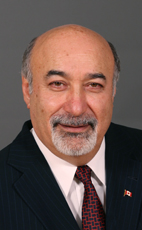
House of Commons photo

Crucial Fact

  • His favourite word was billion.

Last in Parliament March 2011, as Liberal MP for Scarborough Centre (Ontario)

Lost his last election, in 2011, with 32% of the vote.

Statements in the House

Greece March 14th, 2001

Mr. Speaker, it is a pleasure for me to rise today to welcome, first and foremost, a good friend, and second, a parliamentarian from Greece, the Deputy Minister of Foreign Affairs who is visiting our capital city and Canada.

Never before have the relations between Canada and Greece been better, both on the cultural side and the economic exchange side. We welcome the deputy minister to Ottawa, where he can see that the voices of 30 million people are heard right here. I welcome the deputy minister. It is good to have him here.

Supply March 13th, 2001

Mr. Speaker, I enjoyed listening to the member's comments. He spoke so eloquently.

However, I want to turn the clock back to maybe 1995 or 1996. We all care for our society and our youth. As I have often said, if there is one crime it is one too many.

I am glad the member talked about non-partisan politics. In his closing remarks he referred to juvenile behaviour. I want to point something out to the member and ask for his comments. As a private member some years back I brought a private member's initiative forward on parole request and making parole request contingent upon successfully completing a rehabilitation program. During the last election they talked about parole being a right, not a privilege.

It was one of the saddest moments in my tenure in the House when the then Reform Party did not give its unanimous consent on that effort of mine. Today, six years down the road, we have shown on this side that when good policy comes forward, we support it.

Permit me to give one example. When the Conservative member brought forward a very good idea with respect to shipbuilding, we supported it on this side. When good initiatives come forward, we go beyond our party politics and support them. Why did those members opposite not support my effort back then on parole?

Auberge Grand-Mère March 12th, 2001

Mr. Speaker, the member keeps bringing up names and names. If any credibility can be applied it is to the RCMP which came out and unequivocally clarified its position in answer to the leader of the Progressive Conservative Party. The leader of the Progressive Conservative Party said that it appeared the decision was acceptable and that there was no wrongdoing. He said that he accepted the decision by the RCMP based on the facts.

Bibi Zaman February 27th, 2001

Mr. Speaker, I am pleased to stand in the House to recognize an outstanding Canadian and a constituent of mine, Ms. Bibi Zaman. Ms. Zaman founded the Canadian Centre for Women's Education and Development. With the help of 10 volunteers, the centre offers a range of services that assist women in getting back on their feet, including helping them escape abusive relationships.

Bibi says “I want to empower women to take their lives into their own hands for the benefit of their children. This is my life”. Bibi has run this organization on a volunteer basis since 1990 and has spent thousands of dollars over the years to cover the expenses of this organization, which also offers a medical clinic. The clinic is also staffed by volunteer doctors.

She also hopes to set up a free legal clinic in March. Bibi has been chosen, along with 59 other Canadians, to be recognized by the Governor General with the Governor General's Caring Canadian Award. As Bibi's member of parliament, and more important her friend, I wish to congratulate her.

Atlantic Canada Opportunities Agency February 26th, 2001

Mr. Speaker, I overheard the member for Medicine Hat who said we should just eliminate it. Their complaints is a sign of their weakness, not their strength.

We will continue to support Atlantic provinces. We will create thousands of jobs there. Unemployment has gone down by 3%. These are good programs, but they do not want to talk about the 88% success rate. All they want to talk about is the 12% we are trying to straighten out.

Atlantic Canada Opportunities Agency February 26th, 2001

Mr. Speaker, let me point out that ACOA is not under investigation but the recipients. It is important to note that ACOA upon getting information referred these cases to the RCMP. That is the kind of work ACOA does.

Let me point out that 61,000 jobs were created in Atlantic Canada as a result of programs which the Alliance Party, as it said during the election, would have eliminated.

Business Development Bank Of Canada February 26th, 2001

Mr. Speaker, it was said in the House over and over again by the ethics counsellor and the RCMP that there was no conflict. This party just simply does not get it.

Fuel Price Posting Act February 21st, 2001

Mr. Speaker, I rise on a point of order. When the debate started I heard my name used as seconder. I would like it noted that such is not the case. Perhaps that could be addressed on the books and the hon. member could find somebody else to sponsor the bill.

Employment Insurance Act February 13th, 2001

Mr. Speaker, I have congratulated the other Chairs. However, this is the first time I can congratulate you on your new assignment.

Throughout the debate today we heard members from both sides of the House talk about the technicalities of the debate, the statistics, the hours, the payments, the clawbacks, et cetera. What I would like to do is talk a little about the contributions to the employment insurance program. Then I want to go back 40 to 50 years and talk about where the program was then, where it is today, how it has changed, the purpose of it and why we had to make changes to it after we came to government in 1993.

As you will recall, Mr. Speaker, you were a member of parliament at that time as well. We did a mass review of overhauling the system. At that time, my colleagues from Brampton Centre and from Parkdale—High Park and I worked together to modernize the program.

The member from Calgary West made some comments which I would like to respond to. The member of the Bloc from Mercier also made some comments with respect to the program. I say to my colleagues that it is appropriate that we take this opportunity, not just to talk about the bill itself which will go to committee and changes will be made, but to tell the audience out there what the EI premium is all about.

I want to start out by saying that in 1993 the EI premium was pegged at $3.30 per $100. That is what Mr. Mulroney and the current leader of the Conservative Party left us with. Over seven years that premium has declined to $2.25 per $100, as was mentioned earlier by my colleague from Peterborough. If we add those pennies, as someone called them, which are well over $1.05 per $100, and we look at the two million people who have found employment since 1993, they add up to billions of dollars.

There is a fundamental difference here that the opposition refuses to acknowledge. In 1993 Canada had an unemployment rate of 11.4%. Today, thank God, we have an unemployment rate of 6.5% or 6.6%. In the last seven years over two million people have come back into the employment factor of the equation. What does that mean? Simply put, prior to 1993 there were two million people taking money out of the system. That is why the system was in a shambles. Now over two million people are putting money into the system.

Fortunately, today we are in the position of having surpluses with which we can reinvest, surpluses that unemployed people have an opportunity to access. Earlier the member from the Bloc talked about higher education. These surpluses go toward helping our youth get higher levels of education, or retraining, or perhaps to become a computer programmer, or an engineer or a graphics designer.

Many people have a problem when they talk about the EI contributions. As a former employer part of my obligation was to make contributions to the Canada pension program and to the unemployment insurance program. I am willing to bet that most of the members in this place, as well as the average Canadian, drive a car and own a home. They buy some form of insurance. I am tired of hearing comments from the opposition, such as those made by the member for Calgary West. He said that we were robbing the people. The member referred to the pages, which was uncalled for.

I drive a car. Year in and year out I pay an auto insurance premium. I wish never to have an accident. I have insurance for when and if I need to access it. Nobody is paying into this employment insurance program with the intent of accessing it.

There are people in the Atlantic provinces, Ontario, British Columbia and other parts of Canada who unfortunately are seasonal workers. There are single mothers in Ontario, Saskatchewan and other parts of Canada who work part time to subsidize whatever incomes they have so they can buy boots for their children for the winter. Perhaps they wish to subsidize school programs which are being cut right, left and centre in Ontario, for example. Are we going to penalize single mothers or single fathers who are trying to provide for their families? Surely not.

The member for the Bloc said earlier today that we are righting the wrong. I remember my father saying that to err is human, to forgive divine. Today we are trying to change that. Today we are saying that maybe there was a mistake. During the election campaign the Prime Minister, when was in the Atlantic provinces, said that we would correct it. That is what is happening today. We are making the adjustments to this program through Bill C-2.

I have a problem when I hear the opposition talking about the surpluses. I will go back to buying insurance. If a person is a good driver, his or her insurance premium over the years will be reduced to some degree. We contribute to the EI program and draw from it. However, if the EI system is being continuously used then surely there will be some provisions to offset that in some form or another.

It said in the 2000 monitoring and assessment report that in the year 1999-2000 about 400,000 jobs would be created. Time will tell once the statistics come out.

Let us look at those 400,000 new primarily full time jobs. There will be 400,000 people who will no longer be accessing the system. They will contributing to it. No one would have thought seven years ago that we would be in this enviable position today talking about reinvesting in our country, reinvesting in higher education for our youth and reinvesting in health programs.

They talked about the Canada pension program. Yes, there has been a slight increase. When this government took over it knew that it had to do something about it. The previous Conservative government and the leader of the Conservative Party refused to take the responsibility. They had an opportunity to make those changes and come to an agreement with the provinces, but they chose not to. They were afraid to. We made that decision with the provinces. Yes, there has been a small increase, but when we compare the decrease in EI contributions as opposed to the increase in Canada pension contributions, I think it is a pretty fair deal.

What Canadians out there need to know is that any premium increase to the Canada pension program has to be done with the agreement of all provinces. The government alone does not have the right to make that increase arbitrarily. I am taking this opportunity, without going into the guts of Bill C-2, to tell Canadians this story so they will know that.

People talk about the surpluses. I am very happy to stand on this side of the House, as a representative of the government, to say what has been done with the surpluses and to say that we are not robbing Canadians. It is a fair and equitable system, a system that has been in place since 1940 to support Canadians.

In closing, I encourage all members to support this new and changing legislation.

Speech From The Throne February 9th, 2001

Madam Speaker, I withdraw what I said. The then Reform Party is today called the Alliance. I will state what I was asked during the election. The member has taken me off track what I wanted to say. Maybe I can put it on record right now.

Those members go out during the election and make statements that they are a new party. If they are prepared to say that they were then the Reform Party and have simply changed names, I could understand. I have every right to refer to what it was called then and to what it is called today. I am sure the hon. member will agree with me on that.

Nevertheless, I was referring to an interview that took place of the member for Medicine Hat last night by my good friend Mike Duffy. I appreciate Mike Duffy is an astute reporter and asks the right questions. The member for Medicine Hat had difficulty. He said that he talked to his executive committee before the election. I challenge him to read in Quorum today where it states that the executive did not know:

The president of Solberg's constituency association said Wednesday he was unhappy with the decisions of Solberg and Grey. “They've done what I call a popular politician's manoeuvre”.

It is a populace party. I am concerned right now with the talk out west that has to do with separatism. Animosity and concern exist. There is talk coming out of B.C. from the new Alberta separatist party.

That is the issue that upsets me as a Canadian. Instead of reaching out, there is a task force that will look into it. I am concerned that the task force might provoke emotions. We are trying to bring the country together, but in the end we will have done nothing but maybe split it further apart. One comment made by the 10 West Group was: Why are Canadians not like Americans?

We do not hear the state of California, Texas or New York saying they will separate, every time they get upset and do not agree with Washington. Maybe that is the difference. Maybe we should just take the word out of the Canadian vocabulary.