
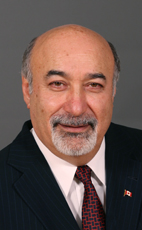
House of Commons photo

Crucial Fact

  • His favourite word was billion.

Last in Parliament March 2011, as Liberal MP for Scarborough Centre (Ontario)

Lost his last election, in 2011, with 32% of the vote.

Statements in the House

Speech From The Throne February 9th, 2001

Madam Chair, I want to advise you of two things. First, I will be sharing my time with the member for Gatineau. Second, and just as important, I take this opportunity to congratulate you, Madam Speaker, on your new responsibilities. I am confident, from the way you have worked in the past with colleagues from all parts of this Chamber, that you will treat us very fairly.

I am actually very glad that as we close the debate I have the opportunity to respond after listening to what has gone on since the throne speech. Before I do that, I want to take this opportunity, my first opportunity after the election, to express my gratitude and my appreciation to my constituents of Scarborough Centre, who for the third time decided, in their wisdom, to show their confidence in me through their vote and permit me to be here to carry their voice to Ottawa.

At the same time I would like to thank my campaign team and the many volunteers. I want to point out with respect to volunteers that we are celebrating the International Year of Volunteers this year. I was blessed to have volunteers from all parts of our society. It was a thrill for me to see both the young and the old participate, especially the young, who came to offer their knowledge and whatever time they had. I say a great big thank you to them.

I also say a great big thank you to my family: my wife Mary, my three children, Irene, who is now married to my new son-in-law Tony, and my sons Paul and Daniel, who participated as well. The family closeness we have gives me the opportunity to be here and speak on behalf of my constituents.

I have listened to the debate over the past little while and to question period and I am not going to go into a lot of the details of what the throne speech had to say, because we have heard it over and over again.

I want to talk a bit about what was discussed during the debate. All hon. members did not strictly focus on what was said in the debate, for example the points the throne speech brought forward in terms of what we are to do during this session and some of the programs we are to support: the youth programs, the health programs, research and innovation, et cetera.

Before the election call we went to the people of Canada and made a statement. We said that should we be re-elected these were the things we would like to do and these were the programs we would want to implement.

In my view we put our necks on the line. Canadians had clear choices to make. They knew what the Liberal team, headed by the Prime Minister, was planning to do over the next mandate. If they were not pleased with those proposals, they could have voted us out. However they chose not to do so. If anything, the results speak for themselves. They chose to return the government and the Prime Minister with an even bigger majority than we had in 1997, almost equal to the majority we had in 1993.

What does that tell us? It tells us that during our statements on programs and in debates with candidates in the election in my view there no ambiguity in what we had to say. We were telling Canadians, because it was of great concern at that time, what would happen to the system we all cherish, the system that separates us from most other countries: our national health care system.

We said that the government would stand firm to make sure that all Canadians, no matter where they find themselves, no matter in what part of the country, would be protected.

Also prior to the election we made a commitment. We had an agreement with the provinces. All the provinces came on board and agreed to the transfers that will now be implemented. I was very pleased to have had the opportunity to talk about that commitment.

I was very pleased in the last election, and I want to do it again, to turn the clock back. In order to appreciate where we are today, we have to think and realize where we came from. It was very appropriate then, and I believe it is now, to reflect back for a moment.

In 1993, when we assumed government, unfortunately we inherited a mess. The country was in a mess, sadly to say, but I am pleased to say that we have turned it around. We had a deficit of over $42 billion that was out of control. We had a debt that was rising continuously and we had no control over it.

We had an unemployment rate of 11.4% or 11.5%. The youth were discouraged, not knowing what tomorrow had in store for them. Seniors did not know whether or not their pensions were secure. The list went on.

Reference has often been made to red book one, “Creating Opportunities”. In 1993 we went to the people with that book. We put down in writing, and it was unprecedented at the time, what we intended to do should we be elected, so that people could come back to us in a year or three or five years to keep us to our promises.

One commitment which has been raised over the last week or so during the debate was the so-called GST. I take this opportunity to read from the red book, because the media clips that were picked up printed only half of a paragraph or a comment. Opposition members, as is their privilege to do so, will only say what they want to say but not complete the sentence.

I will read exactly what was said on page 22:

A Liberal government will replace the GST with a system that generates equivalent revenues, is fair to consumers and to small business, minimizes disruption to small business, and promotes federal-provincial fiscal co-operation and harmonization.

The heritage minister might have changed her position on something, but she did the honourable thing. When she was told to resign, she did so. She went back to the people, and the people at that time had an opportunity not to return her but they chose to do so.

Members from the then Reform Party, today's Alliance Party, made some provocative statements with respect to members' compensation and pensions. They said never. Last night I was watching my good friend Mike Duffy interview the Reform Party member for Medicine Hat.

Speech From The Throne February 9th, 2001

Mr. Speaker, I did not have a chance to congratulate you on your new duties so I take this opportunity to do that.

I listened very carefully to the member. He talked about seven years of continuous economic growth. I was very happy to hear him acknowledging that. He also talked about providing jobs and opportunities.

Could he comment on how we work in the House of Commons in terms labour training programs that we were more than happy to transfer the to the provinces because they knew what programs they needed in their respective provinces. Was that not a good move on the federal government's part?

Supply February 8th, 2001

Mr. Speaker, I listened to the comments of the member from the Conservative Party. It was a character assassination or a witch hunt. He can confirm what I say by going back to Hansard . He went on and on with allegations that supposedly the Prime Minister said in a meeting to the representative from the bank, that he would like him to look favourably on the issue. Further the member said that he could not say what was said in that meeting. If they stand to state their position, let them state it firmly as they did during the election campaign.

The leader of the Conservative Party sent a letter; the leader of the Canadian Alliance Party sent a letter; and the ethics counsellor responded to them. They did not let it go during the election, as they state here. They did not leave a cloud hanging over it. After the election they pulled it back. It continued. We can read in today's Quorum about the inquiry.

They are not being fair to the Canadian people by making these innuendos and allegations. They are not being fair by saying one thing one moment and contradicting it in the next moment. It is total hogwash.

Employment Insurance Act October 19th, 2000

Mr. Speaker, let me thank the hon. member, my good friend from Davenport, for his question.

As well as the hon. member, a number of members in this House have received expressions of concern from the public about recent proposals outlined for mergers that could lead to increased media concentration in Canada. I am referring in particular to the recently announced proposal of CanWest to acquire control of Hollinger Corporation as well as the proposed BCE/Thomson and Quebecor/Vidéotron transactions.

I would like to take this opportunity to mention to the member and to the House that the competition bureau has primary responsibility to review mergers in order to determine whether they will have an anti-competitive impact in our country.

I can assure this House and the member that if serious competition concerns dealing with matters such as price or other economic issues are identified, the bureau will not hesitate, and I emphasize that, to immediately take appropriate action under the Competition Act to remedy these concerns.

The competition bureau is an independent law enforcement agency. As part of its analysis it will rely upon factual information brought to its attention by market participants as well as the input of industry and economic experts. These matters are assessed on a case by case basis and it is impossible to make any generalizations about the possible outcome of the bureau's review.

A fair, efficient and competitive marketplace indeed provides consumers with lower prices and greater product choices and it of course encourages companies to innovate and to offer new products.

Obviously many mergers also have a positive impact on the marketplace. However, there have been a number of well-publicized mergers in recent months, as the member very eloquently stated, where the competition bureau has found it necessary to intervene in order to remedy these issues that have come before us. These have involved major industries such as groceries, waste, propane, tobacco and cement—

Canada Health Care, Early Childhood Development And Other Social Services Funding Act October 17th, 2000

Mr. Speaker, I have just a brief comment. When the member talks about not listening, one of the main reasons we are moving so aggressively on the bill is that the vast majority of Canadians told us to forget our political alliances and get this thing done, get it fixed. The member is also forgetting that tax points were transferred to the provinces.

Let me close with saying why we want to move the bill forward. We are concerned about their position. The member from Calgary, the finance critic, stated unequivocally that he supported private health care. Their current leader, while a member of the provincial government, advocated private health care. As long as we are in government that will not happen.

An Act To Incorporate The Western Canada Telephone Company October 17th, 2000

I am glad the member for Peace River is talking about taxes. If we do not have the money, we cannot support the system, lower the debt and lower the deficit at the same time. That is voodoo economics. That is skidoo mathematics.

The government took a very responsible position, headed by the Prime Minister, the Minister of Finance, the Minister of Industry and the new Minister of Industry. We made those tough decisions in a compassionate way. Yes, we created a lean government but it was not a mean government. We went to the people with commitments and promises we have kept. We are very proud.

The member touched upon payroll contributions. In 1993 they were pegged at $3.30 per $100. My colleague sits on the industry committee with me. He is a great participant with whom I have enjoyed spending time on the committee. They prefer to refer to payroll contributions as taxes, but as a former employer I call them contributions, as did the former leader of the Reform Party.

It is on record year after year that payroll contributions have been going down. Members opposite fail to accept this and ask why we have revenue. Let us talk about revenue. In 1993 we had 11.4% or 11.6% unemployment. We were having to put money out to support these people. Today we have over two million people working who are not taking out of the system but who are paying into it.

They talk about revenue and economic growth. I stand here proudly as I look at the Secretary of State for International Financial Institutions, the Parliamentary Secretary to the Minister of Finance and the minister responsible for northern development who has invested in the north and created jobs. These people are working hard to put people to work.

The hon. member talks about tax equality. When I go to the doctor and I have an ache in my arm, he will start from that point and work his way. We did everything within our means to deliver compassion to the nation. I stand proud that the high tech industry the member talked about is growing by leaps and bounds.

There has been the creation of 2,000 21st century research chairs across country. The United States has MITs. Can we imagine having 2,000 MITs across our country? That is what it is all about. The government and the Prime Minister chose not to build monuments for the 21st century. They chose to invest in the future of the country, our youth, by creating the Canadian millennium scholarship endowment fund which is preparing our youth of today for the economy of tomorrow. That is one of the best investments we have made.

Let me close by saying that we have followed a very balanced approach. This is reflective of what we are doing by modernizing legislation permitting Canadian companies to compete locally and internationally. The member for Peace River referred to provincial barriers. I am hopeful in the future and with their co-operation we can move toward working with the provinces to bring down interprovincial barriers so that we can have mobility.

With our health care system we have sent a very strong statement to Canadians across the country that the Liberal federal government is adamant about protecting health care. It will enforce the Canada Health Act. It has put its money where its mouth is and we intend to continue in that direction.

In closing let me thank all the parties that co-operated to fast track Bill S-26 for the good of the country, for the good of Canadian people and for the good of Canadian companies.

An Act To Incorporate The Western Canada Telephone Company October 17th, 2000

Mr. Speaker, yes, we have a Minister of Industry and allow me to offer my congratulations this morning.

I was very pleased that the Alliance Party member for Peace River expressed himself on the bill. We all heard him speak in support of the bill. It is really a housekeeping bill as he clearly stated. On our side we fully appreciate the fact that there is good co-operation on the bill. He referred, for example, to the BC Tel act, which was enacted in 1916. We certainly have to modernize things, and that is what we are trying to do.

He touched upon some of the most important issues. I will not go into the nitty-gritty, but through Bill S-26 we are trying not only to modernize but to create a level playing field so that telecommunications companies have an opportunity to compete, to remain strong and to grow. Not only will they offer excellent service but at the same time will create opportunities for Canadians locally and abroad.

I thank everyone for co-operating in moving the bill forward. It is also important to take this opportunity to talk about some issues with which we are faced today.

The member for Peace River touched upon some very important points. He talked about technology and how we had moved forward. I stand here proudly as the Parliamentary Secretary to the Minister of Industry to talk about our connecting Canadians program and our computers for schools program which put our country above every other nation. We are probably the most connected nation in the world, offering high speed Internet and low cost. As Canadians we feel very proud of it.

The member raised one very important issue. He talked about how we had better policy to deal with our international partners than we do within the provinces. He is right.

The federal government cannot simply stand and say it wants to do something. Provincial jurisdiction has to be respected. We have to work with our provincial partners. I know the member agrees; we have talked about it personally. I am sure he feels that by working together we will slowly, hopefully, overcome those barriers as quickly as possible for the good of each Canadian.

I will touch upon some of his points. He talked about companies and people moving. In a global economy, in the global village we live in, there is a lot of mobility. There is a great shortage of high tech people in Canada because it is one of the fastest growing industries.

Not too long ago I read an article in the local papers in which applications had been put out for lab technicians. About 80% of the individuals who applied were Canadians wanting to come back to Canada for several reasons: the fact that we have invested in research and development and that we have made some very positive steps in the last budget in how we treat, for example, our stock options in terms of capital gains, which the member for Peace River so eloquently touched upon.

We know what has clearly been addressed in the budget in terms of how we address options to motivate people to invest in our country. That has been happening in a very healthy way. Steps have been undertaken.

All statisticians and pundits out there, not us, have been saying that we are going to lead. We have been leading the G-7 in economic growth and in job creation. We were the first to balance our books and we were the first ones to show a surplus.

Just the other day I read in an article a comment made by Mr. Klein, the premier of Alberta. He is now basking in the surplus he has. He is now reinvesting it back into his province, and I am glad for that. He said Alberta did not want to go back to 1993 or 1994 when it had to make tough decisions. Now he is able to reinvest in his province and he is able to give out some bonuses, as did the premier of Ontario, for example. That is their prerogative.

It is important at this stage to talk about the tough decisions that we as a government had to make in 1993. We had a growing deficit after nine years of the Conservatives not being able to meet one of their budget targets. We had a growing debt that was out of control. Thanks to the Canadian people we carried out our commitment and balanced the books. We are lowering the debt consistently, and now we are in the same position as Mr. Klein, thank God, to reinvest in our country. Part of that reinvestment is looking at the high tech sector—

Grants And Contributions October 16th, 2000

Mr. Speaker, the member is just not listening. I think the minister not once, not twice, but three times has said repeatedly that with the situation and the position it is in it is inappropriate to answer. Hopefully they are professional enough to understand that.

Young Entrepreneur Awards October 16th, 2000

Mr. Speaker, today I am delighted to pay tribute to a special group of young men and women who have joined us on Parliament Hill today. They are the winners of this year's young entrepreneur awards.

The awards, which are sponsored by the Business Development Bank of Canada, are designed to honour Canada's most successful young entrepreneurs, 30 years old and younger. There are a total of 13 winners representing each province and territory. They provide an excellent example of what can be achieved through the entrepreneurial spirit and innovative approach in business. These men and women embody what it takes to succeed in today's fast moving world of commerce. In short, they represent the new generation of Canadian business leaders.

As such, I congratulate them and wish them continued success.

Canadian Tourism Commission Act June 12th, 2000

Mr. Speaker, it is always a pleasure to be able to stand in the House to talk about successes. I am referring to successes that we achieve when we all work together in partnership for a common goal.

The proposed act before us will confirm the advantages to Canada that flow from co-operation among partners working together to address issues of national importance.

Bill C-5, an act to establish the Canadian tourism commission, is another example of this government delivering on its promises. Hon. members are being asked today, for example, to approve the creation of a new crown corporation. If the House agrees, much more than a new corporation will be established. By supporting this bill, members from all sides will be telling Canadians that the federal government has the ability to work co-operatively to produce significant economic benefits for every region of our country.

Tourism is a very unique sector. Although it is led by the private sector, it contributes to Canada's public policy objectives and melds national, regional and, of course, local interests.

Improved partnering between the private sector and governments will result in a greater impact on our target markets in the face of much sharper international competition, for example. Already one of our country's largest industries, tourism, generates thousands of jobs and economic growth in every part of our country, in every province and territory, in aboriginal communities and and many municipalities. Let me point out that last year alone the sector brought in more than $50 billion and employed well over half a million Canadians right across our country.

I would also like to point that out that this sector is essential to regional development plans of governments at all levels. As hon. members can see, the success of tourism sectors and public policy are very much intertwined.

Next, let me comment on the Canadian Tourism Commission and its successful partnership between the private sector and government.

It was the tourism industry's call for improved partnerships that was a key factor in the Prime Minister's decision to establish the original commission in 1995. The private sector contributed so significantly to financing and marketing activities that the original projections for partnership contributions to match federal core funding were very soon exceeded.

The partnership has endured and matured, and the proposed act to turn the commission into a crown corporation will solidify this partnership and provide the conditions for which it can continue to prosper.

The creation of the crown corporation is the result of consultation, negotiation and agreement, let me point out, among all the partners, many of whom sit on the commission's board of directors.

As hon. members know, the purpose of creating the crown corporation is to equip the commission with the legal, financial and management tools that it needs to carry out its mandate even more effectively. Currently, as a special operating agency, it cannot fully operate as it must, using for example private sector management and accounting practices.

First, crown status will give the commission the increased financial flexibility it needs as a marketing agency with strong international competitors.

Second, crown status will give the commission greater flexibility in managing the human resources required to respond to the marketplace and its partners needs.

Third, as a crown corporation the commission will have an even more effective board of directors. The management of the commission will no longer be split between Industry Canada and the board. Under the proposed act the board will manage all the affairs of the commission.

Hon. members can see what can be achieved when there is a willingness to work together and co-operate. Here is an example of government making a vital contribution while respecting and expediting the work of the private sector partners who are taking the lead on this.

We have a winner on our hands here: The small and medium sized businesses that make up the tourism sector benefit. The government's job and growth strategy is continuously advanced to create jobs for Canadians. The new corporation will further demonstrate our commitment to the renewal of federalism.

Of course, all Canadians support tourism. Domestic travel accounts for 70% of the sector's revenue. Every year, in ever greater numbers, Canadians are discovering their home, thanks in large part to the broad marketing efforts of the commission in collaboration with its partners. Beyond the mere addition of dollars and cents, we are richer for this, as we learn more about the geographic and cultural diversity that our country has to offer in the various regions. This should be encouraged on all fronts.

In closing let me say that I am confident that my colleagues here will understand and know the effectiveness of Bill C-5. I look forward to their support on this bill.