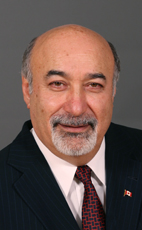
House of Commons photo

Crucial Fact

  • His favourite word was billion.

Last in Parliament March 2011, as Liberal MP for Scarborough Centre (Ontario)

Lost his last election, in 2011, with 32% of the vote.

Statements in the House

Kosovo April 12th, 1999

Mr. Speaker, the hon. member who sits with me on the foreign affairs committee knows very well where I stand on these issues.

I merely took this opportunity to outline some of the dangers in this approach. NATO has decided, spearheaded by the United States initiative, to use these types of tactics. I am simply saying I feel that there was some room to take the agenda a bit forward.

I do not believe that we have exhausted every possibility. I believe that by taking the moves we did we in essence allowed Milosevic to consolidate support. As the member mentioned earlier he has gained popularity unwarranted. When I saw earlier on television the youth from Serbia standing there as human shields and demonstrating I was sad. Instead of those youths holding high school, college or university in their hands, they are holding up target images. I think mothers and fathers should be busy providing for households.

If these are the tactics that are unfolding, so be it, but I believe there is a political solution.

Kosovo April 12th, 1999

Mr. Speaker, let me begin by thanking my colleague from Scarborough—Agincourt for sharing his time with me.

Today as I stand to participate in this debate let me just say from the outset that it is a very sad moment. When we, as representatives, go to the people during campaigns, we go to the people promising to improve our society, improve our nation, take care of the deficit, create jobs and improve the future for our children. We often say, for example, that our youth is our future. If we indeed believe in that then today I say with great sadness that we are killing that future whether it is here in Canada or somewhere in Europe, in Serbia or in Kosovo.

I want to participate in the debate by going through some of the events that have occurred over the past couple of months in the House and in committee.

In a joint session not too long ago of the Senate and the House of Commons, we had representatives from the United States, specifically Mr. Robert McNamara, former U.S. defense secretary; General Lee Butler, former commander in chief of the U.S. defense; and Dr. Thomas Graham, Director of International Security Programs, Rockefeller Foundation.

They wished they could have known then what they know today when they were spearheading the U.S. activity and effort in Vietnam. They came to Canada today to applaud us on our initiative and our report in terms of ridding society of all the nuclear warheads that are out there.

I hate to see what people like General Wesley Clark and others are going to say maybe 20 years down the road. Are they going to come to Ottawa and say “what a grave mistake we made back then with the Kosovar situation?”

The people in Kosovo, like any other people on this globe, deserve to live in peace. They deserve to raise their children. They deserve to give their youth the opportunity that my children and so many other children have here and all over the world.

It was sad when my colleague mentioned seeing the barbed wire that I also saw. It brought back images of some documentaries I saw about the holocaust. I said that this was another holocaust happening. There were people in the former Yugoslav Republic of Macedonia having cellular phones passed over to them so they could get in touch with their relatives to see if indeed their lives could improve.

I told Mr. Aragona in the foreign affairs committee a little while ago that being in Europe was their responsibility. My colleague from Scarborough—Agincourt touched on the fact that unless one knows the people, the history, the diversity and what happened 200 or 300 years ago, it is difficult to address the problem. I refer to 1994 when the military came before a joint committee to give us an update of what was happening in the conflict in Bosnia-Hercegovina.

What did our military say? It said it was not sure if the Croats were killing the Croats and blaming it on the other guys, or if the Serbs were killing the Serbs and blaming it on the other guys, or if the Muslims were killing the Muslims and blaming it on the other guys. General MacKenzie to this very day is admitting this. There is confusion as to who was doing what.

I am upset that unfortunately these atrocities are happening today. My colleague touched upon the early 1900s and how sad it was the way we started this century. Now we are starting to use the words genocide and ethnic cleansing, et cetera. We started the century with the ethnic cleansing that took place in the early 1900s.

Earlier another colleague talked about the middle of the century and the genocide of the Jews, sadly. Here we are about to close the century with what? More genocide and more ethnic cleansing. What a shame to all of us who live on the planet including me.

We talked about Rwanda. I want to take this opportunity to show the leadership taken by this country and this Prime Minister. He did not hesitate for a moment. He took the bull by the horns to address that horrible situation. Later they said they should have done more. It was as Mr. MacNamara and General Lee Butler said: “Gee, we erred back in Vietnam”.

Earlier my colleague from the Conservative Party said that there must be war and I asked him why. There is a political solution. If the will is there we can find a solution.

As I suggested earlier and will suggest now, I firmly believe that the United States has to work to bring the Russians to the table. They can provide leadership, given the alliances and relationships with the Serbian people historically. It is an opportunity now.

I heard the Serbian deputy prime minister on television not too long ago say “Please stop the bombing; we want to talk”. Why are we not calling them out on that? Maybe he is misleading us all. Who knows? Given the loss of life on both sides, why do we not bring them to the table to see what their intentions are? If they are prepared to deal in good faith then let us advance it in a positive way. If they are not and they renege then I believe we should consolidate with the Europeans and all the Balkan regions.

I am glad my colleague from Hamilton put me at ease. When I heard about the uranium I was concerned, not because of the people in Serbia but because of the people in Italy, France, Greece, Albania and all over that region.

When Mr. Aragona, head of the Organization for Security and Co-operation in Europe, was before the foreign affairs committee, I asked him a few questions which I will repeat in the House. By moving in as aggressively as we are, I believe we are setting a very dangerous precedent. We know there are other hot spots around the globe today. We see what is happening with the Basque region. We see what is happening in northern Italy with the separatist movement. We see what is happening in Corsica. I heard on the news that up until about eight months ago the CIA had the KLA on a terrorist list. Maybe it has changed. Maybe it has been baptised. I hope it has but I do not know.

Let us try to hypothesize. What happens if bombs go off in Corsica or in the Basque region and innocent people are killed? Does that mean that NATO will suddenly move in and bomb these people? I hope not.

We are setting a dangerous precedent. NATO is showing today that it is not listening. When it was trying to sort out an agreement in France all I heard was Madeleine Albright saying “We are going to bomb”. Who is “we”? Is it the United States or NATO? Why was Mr. Solana not the spokesperson on behalf of NATO? With the Americans it seems to be Dodge City and Gunsmoke all over again: shoot first and ask questions later.

I support my government. It is trying to do the right thing. As the Prime Minister said earlier today, not to choose is wrong. We must choose. We as Canadians have set an example, historically speaking. We have been in Cyprus. We have been all over the world. We have a reputation, as a colleague from the Conservative Party said, second to none. We owe it today to that reputation to once again spearhead an effort to find a political solution for the benefit of all these people.

Kosovo April 12th, 1999

Mr. Speaker, I will make a comment and ask a question.

I listened to the hon. member's presentation. A good portion of it covered our military in terms of equipment. He talked about the Sea Kings and about replacements. I truly empathize with what he said. We should not in any way put our military in danger whether it is rescue or military services on the ground.

When he did touch upon the debate before us today he spoke specifically about there having to be a war. He talked about “a rise in his popularity at home” in referring to Milosevic. I would like to comment on that. How did this individual's popularity rise? There have been killings on both sides, including innocent children and people on the Serb side. We must admit that, irrespective of what CNN says. When somebody sees their children, brothers or nephews being killed, they might not like Milosevic, but they are going to bond together. Unfortunately this is what is happening. That is why I believe his popularity has gone. I do not know if the member agrees or not.

About the second point that there has to be war, why must there be war when right now we are seeking a political solution in my view? In order to seek this political solution, does the member agree that the Russians have to come to the table and the Americans must find the will? Does he agree with this to really move forward?

Liver Disease March 23rd, 1999

Mr. Speaker, I wish the hon. member's mother a happy birthday. I am pleased to inform the House that March has been declared help fight liver disease month by the Canadian Liver Foundation. It is estimated that one in 12 Canadians will at some point in their lives contract a liver or biliary tract disease.

Liver disease is the fourth leading cause of death by disease in Canada. It is a serious health concern that has no prejudices, affecting men, women and children of all ages and races.

The mandate of the Canadian Liver Foundation is to reduce the impact and incidence of liver disease through research and education. The foundation's 30 volunteer chapters across the country are a valuable source of information for those with liver disease and their families.

I therefore ask all members of the House to join me in honouring the Canadian Liver Foundation, especially its volunteers, during help fight liver disease month.

Canada Cord Ceremony March 11th, 1999

Mr. Speaker, I rise today to recognize a group of young women from my riding of Scarborough Centre.

The Canada Cord Ceremony was recently held for Pathfinders who achieved this award in 1998. For those who are not aware, the Pathfinders are part of the Girl Guides of Canada, and the Canada Cord is the highest award which is earned by successfully completing levels which emphasize experiences with the community, the world, and leadership, among others.

I want to congratulate Katherine Atkinson, Cheryl Brown, Gayle Brown, Lisa Gasson, Heather Goodyear, Jeanette Jackson, Lindsey Kirchner and Andrea Nyhuis on receiving the Canada Cord award.

I commend these young women on the time and effort they put into reaching their goal. With the recent celebration of International Women's Day, these young women are perfect examples of the dedication and participation that women indeed contribute constructively to our society for a better tomorrow.

United Alternative Convention March 2nd, 1999

Mr. Speaker, as I was flipping through the channels on my television this past Saturday, what did I see but Rodrique Biron as a prominent speaker at the united alternative love-in. Not only was he given a high profile job, that of introducing the leader of the Reform Party, but in his speech he emphasized strongly how he was a card-carrying member of the PQ and BQ, two movements committed to the breakup of our country. He was received, let me say, with a standing ovation. What hypocrisy. Not long ago, we must remember, the Reform Party said no more prime ministers from Quebec.

In my view the Reform Party has not yet realized that we have an electorate that is sophisticated and tuned in to government and specific party initiatives and policies. With the Reform Party's antics and outrageous statements it seems it certainly has the knack for underestimating the public's intelligence.

All I have to say, Mr. Speaker, is you can change the clothes, you can do the makeover, but you cannot change the person. Reform is Reform is Reform, otherwise known as the flat earth party.

The Budget February 17th, 1999

Madam Speaker, I was quite surprised when the member for Medicine Hat stated only about $11.5 billion and the rest are unaccountable for.

He touched upon an issue that is so important to all of us, and I know it is important to them as well, which is the investment in our future, our youth, our future scientists, researchers and what have you. He failed.

Does the member not agree that the $240 million to support development of the Canadian institutes for health research will help the future scientists and researchers stay in Canada? Does he not understand that the $200 million to the Canada Foundation for Innovation is a worthwhile investment? Does he not understand that the money going to support our soldiers is a worthwhile investment? Does he not understand that $190 million to better meet the health needs of the first nations and Inuit communities is a good investment?

I could go on and on but time is short. That is where the rest of the money is going.

Points Of Order February 16th, 1999

Mr. Speaker, my reference was not to the hon. member for York South—Weston—

Points Of Order February 16th, 1999

Mr. Speaker, absolutely, as I did earlier.

Points Of Order February 16th, 1999

Mr. Speaker, you asked me on a point of order to withdraw the words, and I did.

Let me clarify. It was not in reference to the hon. member for York South—Weston. It was more so to the articles in the newspaper following—