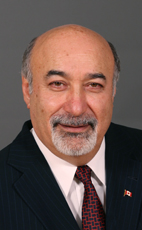
House of Commons photo

Crucial Fact

  • His favourite word was billion.

Last in Parliament March 2011, as Liberal MP for Scarborough Centre (Ontario)

Lost his last election, in 2011, with 32% of the vote.

Statements in the House

Leader Of The Opposition October 23rd, 1998

Mr. Speaker, I rise today to express my absolute disbelief of the actions of the leader of the Reform Party during the 1995 referendum.

It has been revealed that while the federal government along with ordinary Canadians from across our country were fighting tooth and nail to keep our country together, the Reform leader was scheming to take advantage of a separatist win.

United States Ambassador James Blanchard recently revealed that the Reform leader approached him and other foreign governments with a plan to dismantle Canada after supposedly a separatist victory. This is inexcusable.

It was the Reform Party that was so indignant when it learned of the former Bloc Quebecois member's letter campaign to solicit Canadian armed forces to join a new Quebec. What a hypocrisy. In front of the cameras it denounces a separatist cause but behind the scenes it works to undermine the federal government's effort to keep the country together.

The Reform leader's thirst for power seems to have no boundaries, not even the boundaries called Canada. Shame on him.

National Sports Centre October 19th, 1998

Mr. Speaker, this past weekend I had the privilege to represent the Minister of Canadian Heritage at the Athletes Can conference in Vancouver in British Columbia to announce the creation of the National Sports Centre, greater Vancouver.

With this partnership program, the federal government and Sports Canada are contributing $250,000 in 1998-99 and $350,000 for every year thereafter.

The unique feature of the Vancouver Centre will be its delivery of coaching development services and its partnership with Victoria National coaching institutions.

Of interest is that the centre will also become part of the National Sports Centre of British Columbia, which will co-ordinate programming among five existing centres and two national sports centres in Vancouver and Victoria.

By investing in these programs we are not only supporting our athletes today but supporting an investing in our youth today and our athletes of tomorrow.

Saeed Baghbani June 11th, 1998

Mr. Speaker, I rise today to congratulate a young constituent in my riding of Scarborough Centre.

Saeed Baghbani is just 14 years old but he has already reached the pinnacle in the Canadian karate world. In 1997 Saeed became the Ontario karate champion and on May 6, 1998 Saeed went on to win the gold medal in the Canadian national karate competition. Saeed will now go on to represent Canada at the Pan American Games which will be held in September 1998 in Argentina.

In addition to these impressive accomplishments, Saeed has been selected as the best athlete for 1997-98 at Wexford Collegiate Institute in Scarborough.

I want to congratulate Saeed on his terrific accomplishments and wish him well with the upcoming games in September. This young man represents the great things that our youth can achieve with the proper support and encouragement. It is exactly the environment that our government is striving to create for young Canadians now and in the next millennium.

Congratulations, Saeed.

Ecumenical Patriarch May 25th, 1998

Mr. Speaker, it is an honour and a privilege to welcome to our capital city His All Holiness, the Ecumenical Patriarch, Bartholomew the First, spiritual leader of all Orthodox Christians worldwide. This is indeed an historic visit for it is the first time in the history of Christianity that an Ecumenical Patriarch visits Canada.

His All Holiness is the 270th successor to the Apostle Andrew. Since his ascending to the ecumenical throne on November 2, 1991, he has tirelessly pursued the vision of his enthronement message which is spiritual renewal, orthodox unity, Christian reconciliation, interfaith tolerance and co-existence, protection of the environment and a world united in peace, justice, solidarity and love.

Known to Europe as the Green Patriarch, His All Holiness has taken the lead among all religious leaders in his concerns for the environment. We here in Canada not only applaud but support this endeavour wholeheartedly.

Time does not permit me to go on in great detail about his achievements but let me just say in closing we welcome him to Canada and I am sure his stay will be a memorable one.

North Korea April 27th, 1998

Mr. Speaker, my question is for the Minister for International Co-operation.

Efforts are continuing worldwide to address the severe food shortages in North Korea. Could the minister tell us and the House what Canada's efforts are in this area?

Woburn Collegiate April 21st, 1998

Mr. Speaker, I rise today to congratulate a group of students from my riding of Scarborough Centre.

The Woburn Collegiate robotics team recently competed in the U.S. first robotics competition in Orlando, Florida. This competition is a national engineering contest that immerses thousands of high school students from over 150 schools in the exciting world of engineering and robotics. Woburn is the first and only Canadian team to ever compete at this competition and was very proud to carry the Canadian flag and represent our country.

The Woburn Collegiate robotics team produced an excellent robot for the competition and was awarded a prestigious judges award. Let me point out that only 15 of 166 teams received such an award, proving indeed that Canadian students are among the best in the world in science and technology.

I take this opportunity to congratulate the students and the teachers of Woburn CI on their hard work in reaching this terrific goal. I also thank the Secretary of State for Children and Youth and the Minister of Human Resources Development for their assistance with this worthwhile project.

Greek Independence Day March 25th, 1998

Mr. Speaker, for Canadians of Hellenic decent March 25 signifies one of the most important days of the Hellenic heritage. On March 25, 1821 the revolutionary trend for national independence burst out in a massive revolution that swept away the Ottoman empire which had occupied Greece for well over 400 years.

With the support of the allied forces of Europe, Great Britain, France and Russia, Greece was recognized as an independent state. For most people the struggle for independence represents a triumph of justice and liberal values against slavery and brutality. For others the massive Greek revolution exemplified the values of classical Greece and Christianity against the darkness of occupation.

Nevertheless, the contributions of people like Lord Byron of England, George Jarvis, Edward Everett and an array of scholars and ordinary people made the supreme sacrifice in the name of independence, liberalism, justice and, most of all, freedom.

Knowing very well how we Canadians value our rights and freedoms, let us join together in celebrating Greek Independence Day, March 25, 1821.

Budget Implementation Act, 1998 March 24th, 1998

Mr. Speaker, I thank the member for his question which I listened to very carefully. He basically asked if we would turn over the funds in the millennium fund for the province to control. Absolutely not.

The provinces have jurisdiction over secondary and junior education, which is fine. But this post-secondary education program will have the rubber stamp of the federal Government of Canada whether it is the Liberals of today or whoever else it may be tomorrow.

This is not targeting part of the clientele as the member quoted. This is targeting Canada's future, Canada's youth to make sure that when they want to access funds, the funds will be there to allow them to get the education and the academic skills they will need. As we have said before, a good education is the best equalizer.

Privilege March 24th, 1998

Mr. Speaker, my privilege arises from question period when the member for Winnipeg Centre asked a question and he was left alone. But in a response from the minister of labour on pay equity I commented and so did my colleagues around me. He expressed himself with language that is uncalled for in this House, unnecessary, vulgar and—

Budget Implementation Act, 1998 March 24th, 1998

Mr. Speaker, I appreciate the opportunity to participate in the budget debate.

First of all, let me congratulate the Prime Minister for his leadership on this issue and of course the finance minister for his fortitude and the vision he has shown toward leading us to a balanced budget.

Most important, I take this opportunity to congratulate and thank the Canadian people because this is indeed their budget, their reward. All their hard work has paid off in a balanced budget; 1998 marks the first time in 30 years that a federal Government of Canada has journeyed into this area. Before we get to the facts and figures, I want for a moment to outline how we got to where we are today by taking us back to 1993.

When I was first elected in 1993 the deficit was $42 billion and the country's finances were in disarray. This meant high interest rates and of course fewer jobs for all Canadians along with lower revenues overall.

This led to a very dismal economic situation. Our future did not look good but the people in 1993 gave us a mandate because we gave a very clear message of what we wanted to do. We also told them at that time that it was not going to be easy.

In the fall of 1994 we introduced a framework for a better economic policy, a guide that would dictate just what this government was going to do, how it was going to do it and what it was not going to do.

The 1995 budget put that framework into action. All of us took the plunge at that time. The 1995 budget set the country on a course of fiscal responsibility and government renewal. We all knew that these decisions were not going to be easy.

The reduction in government spending was unprecedented in Canadian history. The budget not only overhauled how government works but what government does.

We reduced program spending from $120 billion to $108 billion. In short, the 1995 budget initiated that overall departmental spending be cut by 19% in three years.

The 1995 budget also made it clear that subsidies would decline by 60% in three years. The government made the move to privatize, for example, commercialized government operations where it felt feasible and very appropriate.

As I stated, we changed government operations as a business for future generations. We responded to the need for more than an effective system of provincial transfers. For example, the Canada social transfer made it possible for the provinces to be more flexible and respond to the needs of the people rather than the flexible rules that existed in the past.

Each province has different needs. However, the conditions of the Canada Health Act were and still are being maintained. As the Prime Minister emphasized just the other day on television, health is one issue that we are adamant on maintaining for all Canadians. For this government these conditions remain fundamental and non-negotiable.

We also decided in 1995 to make some very different choices. We chose to work in favour of a strong economy and a stronger country. Many governments have known and talked about the need for reform and renewal. Our government chose to stop talking and to start acting. It was very tough but we made it happen and here we are today.

For a moment let us fast forward to 1998, the first budget of the new mandate. The economic recovery was indeed remarkable. In 1993 the deficit was $42 billion. Who would have believed we would be sitting here today talking about a zero deficit, a balanced budget? We have been applauded not just within Canada but beyond our country.

In 1993 the unemployment rate was 11.4% and growing. Today, when we look at the more recent statistics, it is almost 8.5% to 8.6%. If we start breaking that down regionally, in the greater Toronto area it is even lower than 8.5%. I believe it is just over 7%. Calgary, for example, is looking for people to hire today.

Also in 1993 interest rates were at an all time high. They were definitely in the double digits. They are now hovering around 7%. Not too long ago they were even as low as 6% to 6.5%.

The burden of debt in 1993 was very unmanageable. Now, with a zero deficit, we can start chipping away at the debt. Anybody who can add one and one will know that we first had to address the deficit before we could start addressing the problem of the debt.

The 1998 budget puts in place the debt repayment plan. We have actually paid down $13 billion in market debt in the past year alone. In the next three years we predict that we will be able to bring down the debt by an additional $9 billion.

The economy is now on the move upwards and growing. On the average in 1997 the economy had an overall growth of 3.5%, the best pace since 1994. In fact, our economy has managed to climb its way out from the financial basement of the G-7 to being number one and applauded worldwide.

Job creation has rebounded very strongly since 1993. More than one million jobs have been created since 1993. This is not according to what we as politicians are saying or what people are saying. This is according to what the statisticians are saying and the people who are working out there today.

Consumer confidence is back and strong. Canadians are feeling very confident about their economy and about their country as a whole. With this balanced budget we are finally able to introduce initiatives that will leave more money in the pockets of all Canadians who have worked so hard and have been so patient with us and this government. That was reflected with the return mandate to continue the programs that were commenced in 1993.

The government has kept its promise to reduce taxes once the budget was balanced. We know that in 1993 we inherited payroll contributions of $3.03. Since then they have been going down steadily to about $2.70 where they stand today. The 1998 budget has targeted tax relief to those who need it the most, low and middle income Canadians. As I said, by July 1998, as the budget states, almost 400,000 low and middle income individuals will be removed from the tax rolls and an additional 4.6 million taxpayers will pay less income tax.

Let me stress that in Ontario alone 91% of all taxpayers will benefit from tax relief. Catherine Swift, president of the Canadian Federation of Independent Business, said: “Putting more money into people's hands is good for the economy”. That is what this budget has commenced doing.

Very clearly there are modest tax reliefs right now but it is only the first step, as the finance minister and Prime Minister have stated, and as we all have been stating.

As our economy continues to improve taxes will be reduced even further. This year's balanced budget alone means we can again start investing in our future, particularly in the areas that Canadians have told us are their priorities.

More than 80% of all new spending will go to health and education through increased transfers to the provinces. The 1995 budget made some very difficult decisions with regard to health. We did not have many choices at that time. Our backs were up against the wall. In 1998 we had a choice and we chose to follow the recommendations of the national forum on health and increase the Canada health and social transfer cash floor from $11 billion to $12.5 billion, an additional $1.5 billion on the forum's recommendation.

This measure will provide the provinces with an additional $7 billion in cash over the next six years to fund health care, education and social assistance. It is now up to the provinces to make the choices of how they spend their moneys.

Will they continue to cut funds from health care in order to keep their election campaign promises of tax relief? In Ontario alone the Tory tax cut agenda will reduce provincial revenues by $4.8 billion per year. This is more than five times the $850 million a year in federal transfer cuts to that province. Canadians should realize that the province's insistence of blaming the federal government for all these woes is of course a convenient way of detracting attention from their program.

Another choice the federal government has been given with this year's balanced budget is to introduce the Canadian opportunities strategy.