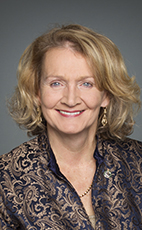
House of Commons photo

Crucial Fact

  • Her favourite word was vessels.

Last in Parliament September 2021, as Liberal MP for Kanata—Carleton (Ontario)

Won her last election, in 2019, with 43% of the vote.

Statements in the House

Veterans Affairs May 4th, 2016

Mr. Speaker, the hon. member mentioned that this process was started back in 2011, and from 2011 to 2014 nothing happened, a good three years. We have been in government for six months. I have talked to a lot of veterans about the proposed Afghanistan memorial and I heard no support for it. I heard a fair bit of criticism from the veterans who felt they were not consulted, and what they wanted in a memorial was perhaps not what was in the plan.

We are doing it differently. We feel we need to talk to these veterans. We feel their opinions and their contributions to this memorial, to its design, to its location, are important. We are going to do it differently, but we are going to do it right.

Veterans Affairs May 4th, 2016

Mr. Speaker, I am pleased to have the opportunity to answer the question from the hon. member.

I know first-hand, and I could not agree more. The men and women of the Canadian Forces quite simply did an extraordinary job in Afghanistan and their contribution deserves to be commemorated appropriately.

Commemoration is a key pillar of the mandate of Veterans Affairs Canada. As the member is well aware, Canadian veterans and those who died wearing Canada's uniform have made invaluable contributions to the development of our country as well as to our peace and security. Commemorative programs and events help to ensure that the memories of these achievements and sacrifices are preserved.

The minister has said in the House that he is committed to ensuring that the memorial to Canada's mission in Afghanistan gets built, but it will be done in a timely and respectful manner. The national memorial to Canada's mission in Afghanistan is indeed a priority in the department's plans and priorities.

More than 40,000 members of the Canadian Armed Forces who served in Afghanistan will be remembered in a meaningful way, as well as the hundreds of other Canadians who also bravely performed their duties in this theatre of war.

We will ensure that the memorial is built and it will be built in an appropriate location, a location that will allow Canadians the opportunity to pay their respects to those who served.

Commemorating our veterans' sacrifice is important to this government, but there are many ways in which a grateful nation can acknowledge, pay respect, or show appreciation for sacrifice. Monuments are important, but providing the resources by which veterans and their families can enjoy a secure future with quality of life is equally important, if not more important. This government committed in budget 2016 another $3.7 billion to provide veterans and their families with the care and support they deserve.

In addition, as we all know, nine Veterans Affairs offices across Canada will be reopened and a tent will be created in Surrey, B.C. We are increasing front-line staff and the number of case managers who will be working with our veterans and their families. This will give them access to the assistance they so desperately need and so rightfully deserve.

Canada is entering an important period of commemoration and there are a number of commemorations on the horizon. July of this year commemorates the 100th anniversary of the Battles of the Somme and of Beaumont-Hamel, and next year Vimy Ridge.

Without question, the world is better and safer because of the efforts of Canadians on the field of battle and in peace support efforts. Lasting recognition of those efforts, such as the memorial that we are discussing today, is vitally important. We must ensure that current and future generations have places where they can gather in remembrance to honour the sacrifice made on our behalf.

Veterans Affairs April 22nd, 2016

Madam Speaker, I appreciate the question because it is about making sure that this government consults and gets out there, gets the right information, and gets the advice it needs in order to make the right decisions.

Right now, because of the inaction of the previous government, the list of work that needs to be done in Veterans Affairs is huge.

We need to talk to all these different groups of people to find out how to prioritize all this work that needs to be done.

Veterans Affairs April 22nd, 2016

Madam Speaker, I thank the hon. member for the question. It is an excellent question, because this is something I really want to share with the rest of the House.

The Minister of Veterans Affairs wants to find out what the issues are for veterans. He wants to give veterans the opportunity to come to Ottawa to sit down with the people and share that information. In the past, that information had been controlled. I am going to sit down with all of these six groups, and we are going to find out, and we are going to—

Events in Brussels March 22nd, 2016

Mr. Speaker, like all Canadians, I was shocked and saddened to hear of the terrorist attacks in Brussels this morning.

People at the airport and on the subway were victims of attacks carried out by terrorists who do not share our values of freedom, democracy and respect for humanity.

Today, I offer my sincere condolences to the people of Belgium, especially the families, friends and communities of those who were killed or injured.

As many of us know, Brussels is not only the capital of Belgium, but it is also the home of the European Union and NATO.

Having spent four years serving with NATO myself, I know the amazing work being done every single day by these great organizations which the people of Belgium host and support with generosity and much good will.

As allies and friends, Belgians should know that all Canadians are standing shoulder to shoulder with them today.

Well Wishes March 7th, 2016

Mr. Speaker, recently, residents across Ottawa and the national capital region were saddened to hear that Stu Schwartz, perhaps best known as Stuntman Stu, had been diagnosed with leukemia.

As a local radio host and public-address announcer at the Canadian Tire Centre, Mr. Schwartz is the voice of the Ottawa Senators in my riding of Kanata—Carleton. However, Mr. Schwartz does not just use his voice for radio and announcing Senators' goals. He is a community activist speaking out on behalf of anti-bullying campaigns and is involved in numerous charitable causes in this city, including charities that provide support for young cancer patients and their families.

I know all members will join me in thanking Mr. Schwartz for his tireless and inspirational community activism and extend our best wishes in his fight against leukemia. We are with Stu.

Canada's Contribution to the Effort to Combat ISIL February 23rd, 2016

Mr. Speaker, we need to ask a question here. If ISIL is everything the member just said it was, if it is a true evil, if it has committed unspeakable atrocities, if it has committed acts of war and trafficked in violence, hate, and fear and wants to conquer the world, why did the previous government provide 600 soldiers and 8 airplanes? Which is it?

If it is indeed this threat to the world, if it is indeed committing this kind of evil, then the member is right that it demands a greater contribution from Canada. In 2006, we went into Afghanistan and we took 2,500 troops there. It was not a token. We knew that what was happening in Afghanistan was serious, and we stood up to the plate and did something about it.

Again, it comes back to that experience. We saw how to make a success out of Afghanistan, and we are suggesting that we move the same way forward here, that the next phase of this operation is to provide the stability that can contribute to the rebuilding and reconstruction efforts that will follow over time. We are going to lead that direction toward stability.

Canada's Contribution to the Effort to Combat ISIL February 23rd, 2016

Mr. Speaker, I want to ask the good members of this chamber if they believe in learning from experience.

In 2011, the previous Conservative government sent the Canadian Armed Forces to wage an air war in Libya against Gaddafi. The Conservatives had no follow-on plans, zero follow-on plans, for stability, governance, reconstruction, or rebuilding. There was nothing.

What is happening in Libya now? Libya has fallen into complete chaos. Because of the power vacuum that was created when Gaddafi was deposed, groups like ISIL have moved in and taken control. Canada bears some responsibility for that mistake.

We have seen what has happened. We are now in another war, which started in Iraq when the Americans made the mistake there, the first time in 2003, and we are back there now. We saw what happened in Libya with no follow-on phases, and we see what is happening now. We cannot afford to make another mistake.

There needs to be leadership when it comes to these follow-on phases, and sometimes, yes, they are not the things that garner the most attention. However, this stability phase Canada is providing the leadership towards is what is going to contribute to the long-term success of any mission to secure and safeguard all the progress we have made to date.

We need to look around and see where we have been successful, and we need to look around and see where we have not. In Afghanistan, we had a plan for combat, stability, and reconstruction. We are doing all right there, and we need to look at those examples.

Canada's Contribution to the Effort to Combat ISIL February 22nd, 2016

Mr. Speaker, what are the next steps when it comes to dealing with the number of refugees coming from that part of the world?

Canada's Contribution to the Effort to Combat ISIL February 22nd, 2016

Mr. Speaker, for me, this issue is about learning from past mistakes. Our government sent Canada to lead the air campaign against Libya in 2011. For those who listened to General Vance on the weekend, he reiterated that he thought there would need to be military action in Libya once again.

Back in 2011, we destroyed the Libyan power structure and created a vacuum. We created a vacuum because we had no follow-on plan. All we were going to do was go there and destroy things, but we had nothing designed for what the next steps were. Now look at what has happened. Four years later, we are talking about having to go back into Libya again. We do not want that to happen again in Iraq. It happened the first time in Iraq in 2003. We are back in Iraq now, but we are going to have a follow-on plan, because that is what we need in order to create long-term stability. Carrying out the air campaign and leaving is just not good enough.

Our CF-18s made significant contributions, of course, but now Canada has a vision and wants to focus the coalition to make sure it follows through with these long-term plans.