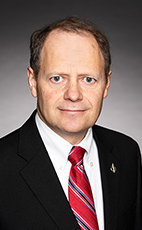
House of Commons photo

Track Kevin

Your Say

Elsewhere

Crucial Fact

  • His favourite word is conservative.

Liberal MP for Winnipeg North (Manitoba)

Won his last election, in 2025, with 58% of the vote.

Statements in the House

Pharmacare Act April 16th, 2024

Madam Speaker, many years ago, the Province of Saskatchewan implemented a policy and a program that ultimately led, in good part, to the national government recognizing how important it was to develop a national health care system.

As a direct result, over generations now, we have benefited from Canada's system. However, many people advocated, over the years, for a pharmacare component. What we are seeing today is historic legislation that would lead us to achieving that particular goal.

This is something that is universally shared across the country. People residing in every province understand and have faith in the Canada health system, whether they are in Winnipeg, Toronto, Montreal, Vancouver, Halifax or any municipality in between. There is a great deal of support for the federal government to be involved in health care. That is why we have the Canada Health Act.

Does the member not believe that Canada has more of a role to play than just being an ATM?

Pharmacare Act April 16th, 2024

Madam Speaker, it is really important to look at the contrast between what the Government of Canada, the Liberal Party, and the Conservative Party are espousing. We are the only party that is espousing the national health care system that Canadians have grown to love for generations now. What we are talking about is expanding it and looking at ways we can complement the national health care system by bringing in a pharmacare program or at least taking a good step forward. That is what we are proposing.

The Conservatives, on the other hand, are proposing to kill it. They are proposing that the federal government should not play a role in many aspects of health care. I believe that the Conservative Party is doing a great disservice to Canadians. Can the member give a clear indication as to why the Conservative Party does not believe pharmaceutical care has the role to play in Canadian health care that Canadians want it to play?

Government Response to Petitions April 16th, 2024

Mr. Speaker, we request a recorded division.

Government Response to Petitions April 16th, 2024

Mr. Speaker, pursuant to Standing Order 36(8)(a), I have the honour to table, in both official languages, the government's response to one petition. This return will be tabled in an electronic format.

While I am on my feet, I move:

That the House do now proceed to the orders of the day.

Pandemic Day Act April 15th, 2024

Mr. Speaker, it is a pleasure to be able to rise and add a few thoughts in regard to the pandemic observance day that is being proposed. I would first like to acknowledge both my colleague and the Senate of Canada for coming up with the initiative and the idea of designating March 11 as pandemic observance day.

We have so many days, weeks and months that are recognized for all sorts of different reasons. When I think of March 11 being pandemic observance day, I see that as a positive thing. We all went through a great deal during a very difficult time. We are talking about a worldwide pandemic during which so many people died, because the pandemic did not discriminate.

There is a lot to be learned from the last pandemic. Seeing that designation here in Canada would allow individuals, whatever their background, their career choice or understanding of the issue, the opportunity to have that day as a day on which to highlight the concerns and issues that maybe they encountered during the pandemic, and to briefly provide comment in regard to what actually took place.

We all know about the worldwide pandemic and the individuals, non-profits and governments here in Canada, with a team Canada approach, that took on the pandemic. I am very proud of many of the things we were able to do here in Ottawa to support and have the backs of Canadians. It is something that we will no doubt continue to talk about into the future, about the government's role and how the national government worked with provincial entities, how the Prime Minister, for example, originally on a daily basis, provided a briefing for Canadians, and the financial supports that were put into place, whether it was for small businesses through the wage subsidy programs and loans, or the CERB program, which literally helped millions of Canadians to have an income.

There was a great deal of co-operation that took place with different levels of government and different political entities. We had Liberals, Conservatives and New Democrats, and governments at all levels working together, recognizing the needs. We often hear about mandates. Some of the mandates were at the federal level, and others were at the provincial level. There was everything from curfews to the wearing of masks to restrictions of businesses and so forth.

There was the creation of programs that were put into place to have the backs of Canadians in all regions of the country. That is one aspect that could be reflected on, on a future March 11.

Then there is the whole idea of heroes, individuals who really stepped up to the plate. I am thinking of first responders and our health care workers. I think about other individuals. We often think about our health care workers and recognize the amazing work they did, but I also think about public transit drivers and taxi drivers. People were going into those vehicles, and those drivers continued to provide a public service. I think about the long haul truck drivers who continued to provide the essential groceries to our stores, as well other types of consumer products, whether it was toilet paper, which was a challenge at the very beginning of the pandemic, or other supplies.

There were so many individuals, non-profits and governments whose actions made a huge difference for Canadians as a whole.

We had our military step up. We had organizations like Red Cross that stepped up. After mentioning those two, I think about our seniors in care facilities, where there were huge concerns about the outbreaks and the number of deaths, and so forth. It was an all-encompassing, holistic approach for the different sectors of society. We had private companies that managed to keep people employed, even when it was challenging in terms of the type of work they might be able to do. They did not want to let people go or fire people, recognizing the impact that would have on the economy.

We had some businesses retool and start production of some materials needed during the pandemic. In hindsight today, there was a great deal of effort by so many people in every capacity of society that enabled us, ultimately, to get out of the pandemic in a relatively positive fashion. In comparison to other countries around the world, like the United States or many of the European countries, Canada did reasonably well. That was, in most part, because people recognized what we needed to do, came to many different tables in many forms and ultimately made a difference. As a direct result, lives were saved. Not as many hospital expenses were incurred. The family unit, in good part, was protected as much as possible. We were able to get some sort of normalcy back in a quicker fashion, depending on the area of the nation. Some provinces had more quarantine types of issues than others.

I think recognizing March 11 as the pandemic observance day would be a positive thing where many people in many ways could reflect upon the pandemic. I think of all the different types of special days, weeks or months that we, as the House of Commons, have taken a position on and have said that we support. We have done quite a bit of that.

I suggest that recognizing a day to observe the pandemic would be of great value to Canadians. For school systems, professional organizations, working environments and governments to have that day would provide an opportunity to talk about it in the hope of ultimately moving forward. It would keep Canadians better informed, going into the future, about some of the very basic issues of medical attention and making sure things like vaccinations are done when necessary. In fact, I just recently had a constituent talk about shingles and the vaccines for shingles. The level of heightened awareness about a series of different medical issues is a direct result of the pandemic. I think there is a lot to be learned.

I would encourage all members to get behind this and to give their support to Bill S-209.

Committees of the House April 15th, 2024

Mr. Speaker, I am wondering if the member could provide his thoughts on the G7 leaders' statement on Iran's attack against Israel:

We, the Leaders of the G7, unequivocally condemn in the strongest terms Iran's direct and unprecedented attack against Israel. Iran fired hundreds of drones and missiles towards Israel. Israel, with the help of its partners, defeated the attack.

We express our full solidarity and support to Israel and its people and reaffirm our commitment towards its security.

With its actions, Iran has further stepped toward the destabilization of the region and risks provoking an uncontrollable regional escalation. This must be avoided. We will continue to work to stabilize the situation and avoid further escalation. In this spirit, we demand that Iran and its proxies cease their attacks, and we stand ready to take further measures now and in response to further destabilizing initiatives.

We will also strengthen our cooperation to end the crisis in Gaza, including by continuing to work towards an immediate and sustainable ceasefire and the release of hostages by Hamas, and deliver increased humanitarian assistance to Palestinians in need.

Does the member support what the G7 leaders have said?

Privilege April 15th, 2024

Madam Speaker, I rise to quickly respond to a question of privilege raised by the member for St. Albert—Edmonton respecting the allegation that the Minister of National Defence misled the House and the procedure and House affairs committee. I respectfully submit that this was not the case and that the House has the testimony that proves the minister was truthful with the House and the committee.

The question raised by the member for St. Albert—Edmonton concerns whether an Issues Management Note, an IMU, that was sent by CSIS was read by the minister. It was not received by the minister. While the minister had made an assumption about why he did not receive the IMU, that does not obviate the fact that he did not receive the IMU. The director of CSIS confirmed to PROC that the process that was put in place to share secret information with the minister did not work.

On June 1, 2023, the minister appeared at PROC and was asked by the member for St. Albert—Edmonton about the IMU. In response to the question, the minister stated:

Allow me to clarify that the information was not shared with me. It was authorized by CSIS to be shown to me....I would leave that question as one that perhaps you might want to put to the director....I was never notified of the existence of that intelligence, nor was it ever shared with me.

Mr. Vigneault and Mr. Stewart both acknowledged that the system to send intelligence information via an IMU to the minister did not function. Mr. Vigneault confirmed this fact at least four times over the course of his testimony. On June 13, 2023, at PROC, Mr. Vigneault stated:

Here, in this specific case, the minister was very clear: He did not get the information. It means the process that was put in place...did not, in this case, work.

...it is incumbent upon us, ourselves, his office and the Department of Public Safety, to find the right tool to put in place to make sure that critical information is seen by the minister.

I think this is one of the key measures that we need to put in place, to have this ability to adapt our processes when they're not working.

On October 19, 2023, Mr. Stewart stated at PROC about the failure of the system to ensure that the minister received the IMU, “The first question I answered was about the situation that occurred in the spring or summer of 2021. I think we identified the problems with the system that the agencies used to share information.”

It is clear that the minister's statement that he did not receive the IMU is corroborated by Mr. Vigneault and Mr. Stewart. Moreover, Mr. Vigneault and Mr. Stewart both confirmed to PROC that neither of them had orally briefed the minister on the content of the IMU. On June 13, 2023, Mr. Vigneault stated, “Madam Chair, I did not have any specific discussions with [the minister] about that note.” On October 19, 2023, Mr. Stewart told the committee: “I did not brief [the minister] about the IMU.”

On October 24, 2023, the member for St. Albert—Edmonton asked the minister whether there was any contradiction between Mr. Vigneault and the minister's statements. Here is the exchange:

[The Member for St. Albert-Edmonton]: Minister, can you explain why your testimony was flatly contradicted by the director of CSIS?

[The Minister]: With great respect, it was not contradicted. In fact, I sincerely believe it was the director's intent that the information be made available to me.

Unfortunately, the steps were not taken by CSIS or by the Department of Public Safety to make that information available to me. I had no way of knowing that they had a secret they wanted to tell me.

Under every other circumstance...the director of CSIS would advise my office they had information to brief me on. He would advise my office they had information they wished to share with me. I would then go to a secure room where that information was shared.

In some other circumstances, I was actually asked to attend the CSIS office in Toronto where that information would be briefed to me, but it did not take place in this circumstance.

On October 24, 2023, the member for Mégantic—L'Érable questioned the minister about an assumption he had made about why the information in the IMU was not provided to him. To which the minister stated:

All I can say with absolute certainty is that it was never shared with the minister—me—at the time.

Again, I don't question what Director Vigneault's intention was, but the execution was unsuccessful because the information was never shared with me.

At no time, either in committee or in the House, did the minister state anything other than he did not receive the IMU. The minister may have made an assumption as to why he did not receive the information, but there was never any doubt that the information did not get to him.

Finally, the member for St. Albert—Edmonton seems to be taking a creative approach to raise a question of privilege in the House in the context of a supplemental report to the 63rd report of the procedure and House affairs committee. Page 154 of House of Commons Procedure and Practice states:

If, in the opinion of the Chair, the issue raised relates to privilege....the committee can proceed to the consideration of a report on the matter to the House.... It should clearly describe the situation, summarize the events, name any individuals involved, indicate that privilege may be involved or that a contempt may have occurred, and request the House to take some action.

This is clearly not the case with the 63rd report of the procedure and House affairs committee. A review of the proceedings on the matter at PROC do not reveal any evidence that clearly led members of the committee to conclude that a breach of privilege had occurred in respect of the minister's testimony. In fact, we can see no reference to a potential breach of privilege or that any contempt may have occurred in the committee's report. The only reference to such allegations is made in a supplemental report by the Conservative Party.

Page 995 of the House of Commons Procedure and Practice states in relation to supplemental reports:

Committees are not responsible for the content of these opinions. They are not, strictly speaking, part of the report. The authors of these opinions alone are responsible for their content.

If the matter the member was raising was, as he suggests, a clear contradiction of testimony that amounted to a breach of privilege, there would have been reference to this in the report. It is not in the report for the simple reason that there was no contradiction on the matter. The minister did not receive the information contained in the IMU in question, either in writing or orally, and that remains a clear fact of his statements in the committee and in the House.

There is no basis to find a prima facie question of privilege in this matter.

I thank the Speaker and the members of the House for their attention.

Committees of the House April 15th, 2024

Madam Speaker, I appreciate the member's drawing our attention to the humanity of the issue. I have a very good friend, Kourash, whose partner died on the flight, and it is important, when we take a look at the issue and the depth of it, that a standing committee have an opportunity in the calling of witnesses and have a great deal more time. I like to think that at times, in a very apolitical fashion, a committee can be very effective at coming up with recommendations.

When I look at how the matter was raised today, that is one of the biggest problems I have, because I do not want to see it turned into a political game. That is one of the reasons I suggested that, at the very least, what should have been considered was an emergency debate, and if not an emergency debate, then to leave it with the standing committee, where proper research and justice could be done for all those Canadians who have very real anxiety.

Questions Passed as Orders for Returns April 15th, 2024

Madam Speaker, I ask that all remaining questions be allowed to stand.

Questions Passed as Orders for Returns April 15th, 2024

Madam Speaker, if the government's responses to Questions Nos. 2372 to 2378, 2383, 2385 to 2391, 2396, 2398 to 2400, 2402, 2403 and 2409 to 2415 could be made orders for return, these returns would be tabled in an electronic format immediately.