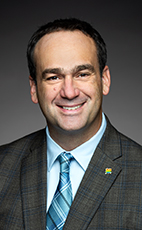
House of Commons photo

Track Mark

Your Say

Elsewhere

Crucial Fact

  • His favourite word is conservatives.

Liberal MP for Kingston and the Islands (Ontario)

Won his last election, in 2025, with 63% of the vote.

Statements in the House

National Defence Act October 15th, 2018

Madam Speaker, this might be slightly outside the scope of the discussion today as it relates to our military justice system, but I will say that when we get into any situation where we cannot try cases because of the fact that we do not have enough justices currently sitting on the bench, then we definitely need to ensure that the vacancies are filled.

I have great confidence in the Minister of Justice and her ability to exercise due diligence to make sure that people are appointed in a timely fashion so that we do not continue to experience the problems that the member suggested.

National Defence Act October 15th, 2018

Madam Speaker, as I have said before, I am not overly familiar with that particular case. I absolutely look forward to learning about it more so that we can have this discussion when the bill goes to committee. Having said that, I strongly believe there are always opportunities to improve the legislation, to adapt it, and to make the necessary changes. That is what our committee process is for. I look forward to working with the member for Selkirk—Interlake—Eastman when we get to that stage so that we can have those discussions and see where we can improve upon things.

National Defence Act October 15th, 2018

Madam Speaker, I thank the hon. member for Davenport for sharing her time with me today.

I stand today in support of Bill C-77, which would bring important changes to Canada's military justice system, including greater support and new statutory rights for victims of service offences.

During today's debate, I will focus my remarks on one specific aspect of the legislation: the proposed reform to the military's summary trial process. These changes would enhance the efficiency of the military justice system. They would preserve the current responsiveness of the system in maintaining discipline, while simplifying the process of dealing with more minor breaches of military discipline.

Our military justice system is unique and necessary. It contributes significantly to the ability of our armed forces to achieve its mission here at home and around the world. It does this by assisting military commanders in maintaining discipline, efficiency and morale.

In Canada we hold our military members to a high standard, a standard which is also different from what we expect from a civilian. These men and women not only serve our country,they also represent it within our borders and abroad. Their discipline affects not only the operations of the Canadian Armed Forces, but also our reputation as a great country throughout the world. They are expected to conduct themselves accordingly. They must reflect the best of us. In times of peace and armed conflict, the foundation of military efficiency and excellence is an adherence to law, a commitment to discipline and obedience to authority. Rules must be obeyed. The chain of command must be respected. Breaches of military law must bring consequences for the greater good of the military and all Canadians.

Serious breaches of military discipline are handled by courts martial. This would remain unchanged under the proposed legislation as courts martial would retain the sole jurisdiction over service offences. However, Bill C-77 would change and improve how minor breaches of military discipline are handled. It would replace the current summary trials process in the Canadian Armed Forces with a new system of summary hearings to better ensure minor breaches are heard and ruled on in a fair and timely manner.

In Canada we take pride in being a global leader in the development of a fair and effective military justice system. Bill C-77 demonstrates that continuing commitment by enhancing the rights of victims and the efficiency of our military justice system. Historically, summary trials have made up over 90% of all tribunals and courts martial have made up the remainder. This system was established under military law to ensure justice in respect of minor service offences. The proposed summary hearing process seeks to enhance the efficiency of the military justice system. It would do so by creating a process which deals with minor breaches of military discipline quicker and more simply.

The new process would be non-penal, non-criminal in nature. It would focus exclusively on minor breaches of military discipline. Hearings would be conducted fairly, more rapidly and by a wider range of military officers. The summary hearing process would maintain the current responsiveness and enhance the overall operational effectiveness of the Canadian Armed Forces. It is about ensuring that we, as a country, adapt with the times and continue to respect the guidance the Supreme Court of Canada provided us some 25 years ago. At that time, it noted, “To maintain the Armed Forces in a state of readiness, the military must be in a position to enforce internal discipline effectively and efficiently.”

The proposed reforms would also show trust and confidence in our military leaders. By improving the chain of command's ability to address minor breaches of military discipline, we would contribute to improving the efficiency of the system and the operational effectiveness of our armed forces.

It is important to emphasize to this House and Canadians that these new summary hearings would focus exclusively on minor breaches of military discipline. These minor breaches would be called service infractions and would be created in regulation. They would not be considered criminal offences and would be dealt with at the unit level. They would be punishable by one sanction or a combination of sanctions, including reduction in rank, reprimands and deprivation of pay. More serious breaches of military discipline, known as service offences, would continue to be tried under our system of courts martial.

To further increase efficiency, the officers who conduct summary hearings would have an extended jurisdiction so that they are able to conduct a hearing for persons of all ranks as long as the officer conducting the hearing is at least one rank higher than the person charged.

The Supreme Court has affirmed on a number of occasions that our military justice system is necessary to meet the needs of our Armed Forces. It falls to the government of the day to ensure that the military justice system is configured to help ensure the highest standards of conduct and discipline. This is required so that our Armed Forces are ready at all times to act decisively and effectively in service to their country.

Military justice must evolve just as civilian justice changes with the times. The proposed changes I have outlined today are about making the military justice system simpler, more effective and more efficient. They are about ensuring that minor and serious breaches to discipline are dealt with in accordance with their respective character.

The new summary hearing process would help ensure discipline and preserve morale at the unit level by issuing sanctions that are corrective in nature but do not involve detention or a criminal record. It would allow the chain of command to address minor breaches fairly and more rapidly, which in turn would contribute to the operational effectiveness of the Canadian Armed Forces.

In summary, Bill C-77 would create a faster, fairer and more flexible process to handle minor breaches of military discipline, a process that reflects our Canadian values while supporting the unique needs of the Canadian Armed Forces.

Since launching the new defence policy, “Strong, Secure, Engaged”, our government has been improving support for the Canadian Armed Forces and the men and women who serve. Bill C-77 would further contribute to an effective military that is ready to defend and protect Canadians at home and abroad. This is a good law, and I look forward to seeing it passed by this House.

Multilateral Instrument in Respect of Tax Conventions Act October 15th, 2018

Mr. Speaker, I want to give the member for Carleton an opportunity to answer this. I am going to make the question as simple as possible to follow up on the last one, because I know he is very good at doing that during question period. He wants a direct question so that he can get a direct answer. I am going to ask the direct question that he did not answer from the previous question.

Why did he and the Conservative Party vote against cutting taxes for the middle class and increasing taxes for the 1%? Why did they vote against it? I would like an answer to that question.

Standing Committee on Human Resources, Skills and Social Development and the Status of Persons with Disabilities October 3rd, 2018

Madam Speaker, I want to thank the member for Mississauga East—Cooksville for bringing forward this extremely important motion. I also want to congratulate him for bringing it to the House rather than straight to committee, as has been suggested by one of the NDP members.

The reason I say that is because when a motion comes before the House and gets the authority and sanctioning of the House to then proceed to committee, it has the full weight of the House behind it and it signifies to the committee that this is an important subject matter for the committee to undertake, given that the House has endorsed it.

Getting to the member's motion specifically, this is the exact kind of motion we need at this time when it comes to the trades. We have heard the statistics about shortage in trades, obviously in the GTA but throughout Canada. In fact, throughout North America and parts of the G7 countries are experiencing these shortages.

Mike Rowe is an American TV personality who used to have a show called Dirty Jobs. It was about visiting various job sites and trying to highlight what it was like to have a job in the trades.

Unfortunately, a lot of the stereotypes that come about as a result of having a job in the trades, as not being quite on par with other jobs, have developed over time and have brought us to where we are. I think back to my grandparents who came here from both Italy and Holland.

Comprehensive and Progressive Agreement for Trans-Pacific Partnership Implementation Act October 3rd, 2018

Mr. Speaker, I want to start by thanking the member for Abbotsford for his work on this. I think it is fair to say that this process started under the former government. The Liberal government took over that process.

Together, through the work of both parties, we were able to produce a good result for Canadians at the end of the day. There is nothing wrong, every once in a while, with saying that we agree on something, that we are supportive of each other and that we are working for the same goal.

Towards the beginning of the hon. member's speech, she said that we are trying to ram this through the House, yet moments ago the member just voted in favour of a time allocation motion on this. How can the member say that the government is trying to ram it through the House when she was supportive of a time allocation motion to force a vote on this?

Comprehensive and Progressive Agreement for Trans-Pacific Partnership Implementation Act October 3rd, 2018

Mr. Speaker, I particularly liked to see how the parliamentary secretary highlighted the fact that Canada is a trading nation and that we have so many trading partners. Canada is the only country with free trade agreements with every country in the G7 because we respect and appreciate the fact that trade relationships are important.

Given the climate and the political environment that exist today, I am wondering if the parliamentary secretary can comment on how important it is to make sure that we continue to diversify our trading relationships so that we have many different trading partners as opposed to an approach where we would just be doing our primary trading with one partner.

Business of Supply October 2nd, 2018

Madam Speaker, I get along quite well, I think, with the member for Selkirk—Interlake—Eastman. We are on the defence committee together. Most of the time I can agree with him.

However, I took great exception to one comment he made. That was when he referred to the sympathies from this side of the House as “so-called sympathies”. When I hear the stories of what happened to Tori Stafford, I immediately think of my three children, my 14-year-old, my two-and-a-half-year-old and my two-month-old. It absolutely pains me to think of what it would be like if I were in that position.

I can say wholeheartedly that at least as it comes from me, my sympathies are genuine and real, as I imagine those are from the rest of this side of the House. I would ask the member to withdraw his comment that the Liberal sympathies are “so-called sympathies”.

Business of Supply October 2nd, 2018

Madam Speaker, in the discussion that has ensued today about the transfer of Ms. McClintic from a maximum security facility to a medium security facility, the Conservatives have been talking about a medium-maximum security facility as though there is some kind of hybrid model that exists between a medium-security facility and a maximum-security facility, when in reality, on one property there may be both medium- and maximum-security facilities, but the inmates are treated differently within the different units. The reality of the situation is that this individual is in a medium-security facility now.

Would the member at least agree that there is a clear distinction between a medium-security facility and a maximum security facility and that there is no hybrid somewhere in between?

Business of Supply October 2nd, 2018

Madam Speaker, when the member asked a question earlier, he commented on the fact that he was unaware that in 2014 under the Conservative government the change had happened from maximum to medium security.

I also want to tap into his wealth of knowledge and information from his time as a parliamentary secretary. No new policy has come along that has set a new scenario for the transfer of this individual. The policy that created the environment for this transfer to occur has been around for quite a while and this Liberal government never changed it.

Given the member's extensive knowledge on policy, could he tell me how we could change the policy so that this does not happen with somebody else in the future?