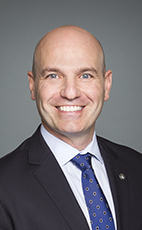
House of Commons photo

Crucial Fact

  • His favourite word was conservatives.

Last in Parliament October 2019, as NDP MP for Skeena—Bulkley Valley (B.C.)

Won his last election, in 2015, with 51% of the vote.

Statements in the House

Business of Supply June 1st, 2017

Mr. Speaker, there is a range of things I would like to ask my colleague from Alberta.

Maybe I will focus in on the issue of confidence—and I would suggest it is overconfidence—that my friends on both the Conservative and Liberal sides have with respect to the National Energy Board itself.

The government brought an expert panel together to review what is going on with the National Energy Board, which has had its problems. Let us admit the obvious. The energy east pipeline hearings had to be shut down. The Kinder Morgan hearings had to be suspended. Both were because of conflicts of interest. People who were being placed on the National Energy Board to review the pipeline had previously worked for the pipeline companies themselves. That is called a captured regulator, where the regulator becomes too close, too forgiving, and approving of those it seeks to regulate. It does not work.

In that expert panel's report, it said that the National Energy Board faces a crisis of confidence. It went on later to say that, for a generation to come, Canadians have lost faith in the National Energy Board.

When Conservatives and Liberals agree on their terminology of social licence, that somehow the public is on board, one would have to question how they define it. There are 17 lawsuits out against this decision. The mayors in the regions most impacted by this pipeline are unanimous in their opposition. The first nations that the member talks about are misrepresented. I deal with many of them. When someone signs an agreement to discuss, it is not an agreement to the project itself. That is what has been misconstrued continuously.

I have a very simple question. We cannot rely on the NEB process. The current Prime Minister promised British Columbians and Canadians that he would review the pipeline under a valid process. He himself admitted that the one that had been put in place by Mr. Harper was inefficient, ineffective, and did not build the public confidence needed to have social licence.

The process is the same one that Harper had. This Prime Minister used it as well. Under all that review, there was no evidence put forward that a diluted bitumen spill could actually be cleaned up. Does my friend have any evidence to offer the people of Alberta, British Columbia, or anywhere in Canada that when a spill of diluted bitumen happens, in salt or fresh water, it can actually be cleaned up?

My Conservative colleagues want me to hurry, because they actually know the answer. It is no.

Business of Supply June 1st, 2017

Madam Speaker, the Liberal Minister of Natural Resources started his speech earlier by saying that he was in the uncomfortable position of agreeing with the Conservatives, and that he had some soul-searching to do. That is strange, because Liberals so often agree with Conservatives when it comes to pipelines.

If the expert panel that the Prime Minister appointed to review the National Energy Board came up with the following conclusions: that the public has fundamentally lost confidence in the National Energy Board, and that there is a “crisis of confidence” with respect to the decisions that are being made because the public overwhelmingly feels that the National Energy Board is a “captured” regulator. That means it is too close to industry and is too often approving whatever it is that industry wants, leaving the public out.

If that is the situation and the promise was clearly made by the Prime Minister that in order to get that social licence, we have to restore and renew the NEB on this project before it gets approved, what situation do we have now? He went into British Columbia a week after the election and said that British Columbian voters, 60% of which voted for parties against this pipeline, were wrong.

What message is this Prime Minister and his silent Liberal MPs from British Columbia actually sending to the people of my province?

Business of Supply June 1st, 2017

Madam Speaker, I think there has been some progress. The Conservatives mentioned the term “social licence” today in their motion. To be fair, this was a term that the Conservatives dismissed for a long time as airy-fairy and non-existent. However, they have put it in their motion today.

We may disagree on the definition of “social licence”, because with 17 lawsuits against this pipeline and overwhelming opposition in Vancouver, Burnaby, and many places along the route, it would tricky to say there is the broad consensus that the Prime Minister has talked about.

The Prime Minister did in fact go to British Columbia, on May 19, 10 days after the B.C. election, where 60% of voters in that province voted for parties opposed to this pipeline. My Conservative federal colleagues might not like that, but it is true. The Prime Minister said that all of the people who voted for those parties have it wrong.

This is my specific question. The member mentioned water and the importance of water and fish to British Columbia. This is a raw export pipeline. It is a diluted bitumen pipeline. We have no known way of cleaning up a diluted bitumen spill in water. Is this not a concern to his constituents? Is there any remedy he is aware of that if there were such a spill, we would be able to clean up even a drop of this stuff?

Democratic Reform May 31st, 2017

Mr. Speaker, the Prime Minister got elected on a clear promise that we can all recite by heart, that 2015 would be the last election under first past the post.

When he betrayed this promise and said, “This was my choice to make and I chose to make it”, his awkward attempt to be strong showed him to be just plain wrong. News flash: it is not up to him. It is up to Parliament and Parliament alone to make this decision.

Will Liberals stand up to make every vote count and keep their promise to their constituents, or will they follow the terrible example set by the Prime Minister and betray their commitment to Canada?

Committees of the House May 30th, 2017

Madam Speaker, I thank my esteemed colleague from Richmond—Arthabaska for the work that he did in committee.

After holding consultations and hearing the testimony, the Prime Minister said that he preferred a system that works very well for the Liberals. It is incredibly unbelievable.

I believe, as do all the intelligent Canadians who cheerfully participated in the consultations, that the government is being hypocritical and cynical. That is why I am asking my Liberal colleagues to make the right choice when it comes time to vote. We heard from many witnesses over the course of this process.

The fact that the Prime Minister said he had a personal preference, which was not supported by the experts, shows just how cynical he is.

Committees of the House May 30th, 2017

Only, Madam Speaker, if “by consensus” he means that the Liberals have to agree, and that the Prime Minister's Office has to agree. That is what consensus seems to be. Consultation is a very important thing, but it must be done with integrity. We did the consultation in the member's riding. More than 70% of his constituents answered a poll saying that they wanted this promise to be kept. Twenty Liberal ridings were polled, and this was the answer. We also know, by the way, that proportional voting systems around the world deliver better policy on economics and on the environment.

Here is a piece of gum. Let us go for a walk. I bet the Liberals can do both at the same time. They can move and advance forward policies that are important to Canadians and keep their promises at the same time. It is as if one excluded the other. It is as if working on housing or health care meant that the Liberals had to break these other promises. What kind of twisted logic is that? Canadians want them to keep their word. It is simple, plain; that is all.

Committees of the House May 30th, 2017

Madam Speaker, I move that the third report of the Special Committee on Electoral Reform presented on Thursday, December 1, 2016, be concurred in.

At the outset, Madam Speaker, I will let you know that I will be sharing my time with my colleague from Rosemont—La Petite-Patrie, who has done excellent work on this file and is joined by tens of thousands of Canadians who have also contributed their hearts, their ideas, and their hopes and aspirations into this issue, into this most fundamental idea that, when we vote for something, we would get it; that when we put our ballot in the ballot box expressing our wish for the future, which is what a vote is, and there has been a promise made, the promise will be kept.

We have watched the long and somewhat tortured saga of the story around electoral reform in the government for many months, 18 or 20 months or more, in which we had the opportunity to do something. We still have that opportunity to do something quite remarkable in restoring the hope and trust that Canadians have in their politics, in their governance, and in their way of doing things here in Parliament.

Perhaps what we are attempting to do here today with this vote on the electoral reform committee's work is to have Liberals keep their promise. Some have said that is one of the trickiest jobs in politics. The evidence is quite strong that this is a hard thing to do sometimes, yet I have a great amount of hope, shared by many Canadians, that this can be done. The reason many of us got into elected office in the first place was to be able to lift up our communities, to keep our word when it is made, and to not break promises casually.

That has not so far been the case with this particular issue, but let us walk through the timeline, because it is quite a story and it takes a bit to get through. The Prime Minister, as a candidate and then as Prime Minister, made a very clear commitment again and again—hundreds of times, in fact—that the 2015 election would be the last election under the first-past-the-post system. He made it so many times that Canadians can recite it themselves, and it was not just the Prime Minister, but every Liberal who stood for office, and every Liberal who was elected was elected on that promise.

We in the New Democrats, the Conservatives, the Bloc, and the Green Party moved in good faith forward on this exercise not out of any sense of naïveté or lack of information, but simply because a promise so clear, so black and white, repeated so often by the leader of a country, ought to mean something. This issue is clearly about electoral reform itself, about the idea of making every vote count from all Canadians regardless of where they live in the country. That is an essential part of this conversation, so that people do not have to vote strategically or cynically or out of fear, but simply vote for what they want, vote for the candidate they want and have that vote mean something.

We know that virtually all successful democracies around the world have evolved their way of voting over time to make votes more effective, to not have situations like we did in the last election where 18 million votes were cast, but less half of them actually went toward electing anybody in this place. The average vote required to elect a Liberal MP was 38,000, another 20,000 to elect a Conservative, more than 20,000 to elect a New Democrat or Bloc, and 600,000-plus votes to elect a single Green member. Clearly, with a range of 38,000 to 600,000, even a small child can understand the unfairness of that system.

We moved ahead and struck the electoral reform committee, made up proportionally, by the way, of how Canadians actually voted in the last election. The committee worked well. It toured every province and territory in the country. It held open microphones and town halls, listening to every expert we could call here in Canada and around the world about the best way to move Canada forward to make that promise a reality, the promise the Prime Minister made, the campaign commitment that New Democrats had, that the Green Party ran on, that 63% of the members in the House ran on, a solemn commitment to Canadians. We produced the most comprehensive report on our democracy in this country's history. That is not bad.

Unfortunately, the government's first response to it was unbecoming, if we can say that, yet we persisted. Suddenly with a cabinet shuffle and a new minister, there was somehow a mandate letter delivered from on high, breaking that promise, as if somehow mandates come out of the Prime Minister's Office as opposed to where they really come from, which is the electorate, which is voters. That is the only place, and it should only ever be that place. For all my friends in the Prime Minister's Office, it is good to remember that. It is good to remember who this place actually works for--not some unelected adviser to the Prime Minister, however long they have been friends, but the people who actually elected people to the House.

The evidence was overwhelming in support of proportional representation. Everybody on the committee could understand that because it was so clear. Ninety per cent of the experts who testified said that if we wanted to make every vote count, if we wanted to make the will of voters properly expressed in the House of Commons, we needed a proportional system.

There are many choices under that rubric of different systems that would work for Canada, rural and urban, making sure that our various geographies and our orientations as a country are respected. Eighty-eight per cent of Canadians who came to those open mikes, wrote to the committee, or filled out our online survey, also expressed support for a proportional system. Ninety per cent of experts and 88% of Canadians who came forward expressed support, yet when the promise was broken, quite cynically, the excuses that the Prime Minister then rolled out on the forthcoming days were extraordinary and somewhat disturbing.

First, there was the fearmongering. “Hope and hard work” was a slogan in the election. Now, the Prime Minister chooses to use more of a fear tactic on this, that extremists would get in if we allowed for a proportional system. The Dutch just proved that not to be the case. An extremist was running for the leadership of their country and it was proportional representation in that vote that kept him from seizing power in that alt-right fashion.

Then it was the global instability. Donald Trump, I think, is what he was referring to. I will remind my Liberal colleagues that Americans use first past the post.

Then there was this notion that there was not a broad consensus, because 90% of experts and 88% of Canadians was not enough. Then a fellow from Kitchener decided to start an e-petition, no. 616, which I sponsored and brought forward to the House. It contained 132,000 signatures, making it the largest petition in Canadian history to come forward, and it said that this was critical and needed to move forward.

After all this, a cabinet shuffle, a broken mandate, and a broken promise, the Prime Minister said, finally, “It was my choice to make and I chose to make it.” In an effort to, I think, appear strong, the Prime Minister proved himself to be fundamentally wrong. It is not his choice to make. It is Parliament's choice to make.

I know from my Liberal colleagues that many of them sent apology letters to their constituents, wrote op-eds in the local newspaper, saying, “It breaks my heart that we had to break this promise. I'm very sorry. I really wanted to see this happen.” I know my Liberal colleagues never had a vote on this. I do not think they ever stood in caucus and said, “Who's in favour of betraying this promise? Who wants to keep it?” Parliament has never had a vote on this. Parliament has never had the opportunity to weigh in on this initiative, on this effort, on this ability to keep a promise of the 63% of us who are in the House, and to make every vote count.

By moving this report, we allow that vote to take place. We allow the conversation to move ahead. We allow, finally, hopefully, a table to be established at which we can negotiate with the government, as negotiations have gone on in British Columbia recently, maybe successfully. We will find out in a few hours about the idea that when 60% or more of the electorate want to go in a certain direction, politicians who are smart and have that core ethic understand that they should listen.

Hope springs eternal. I was coming up the steps of Parliament today, passing all these school groups that are coming in, the thousands of young people who come to this place. We just saw a bill introduced through the “Create Your Canada” process from my colleague, the member for Vancouver Kingsway. The Prime Minister, in the last campaign, I think very effectively, spoke to young people. He also spoke to Canadians who had grown cynical and tired with the last government. He said that we should hope for more and we should expect more.

I was on liberal.ca this morning, seeing if the promise to make 2015 the last election under first past the post was still there. There it is, under the title of “Real Change”. It says that the Liberals would use evidence-based decision-making and that the Conservatives had lost the faith of Canadians because they had broken their promises.

Here is the opportunity for the government to make good. I held more than 20 town halls and events in the last six weeks, all across the country, coast to coast. We talked to Canadians. They are not as cynical as some of the people in the Prime Minister's Office. They are more hopeful. They expect and want more from their government. They want this to happen. They support the evidence that we, as a committee, heard: that we can make every vote count, that we can have integrity in our politics, and that we can hold ourselves up to a higher standard.

I look forward to the support of my Liberal colleagues because I know in their ridings that I visited over the last number of weeks, their constituents want this as well.

Government Appointments May 19th, 2017

Madam Speaker, we also learned yesterday that the Prime Minister's closest adviser and long-time friend, Gerry Butts, met with Meilleur before she was even nominated. She admitted that this was an unfair advantage. I guess it is still who you know in the PMO.

Officers of Parliament do not work for the Prime Minister, and they certainly do not work for the Prime Minister's Office. They work for all members of Parliament on behalf of Canadians. A watchdog cannot do their job with a cloud of patronage and partisanship hanging over their head.

Out of respect for this position, will the Liberals do the right thing and withdraw her name from consideration?

Government Appointments May 19th, 2017

Madam Speaker, the lengths these Liberals will go to help out their friends: A lifelong Liberal and donor to the Prime Minister's own leadership campaign is their surprise choice for an independent commissioner.

This Prime Minister has been under more investigations than any other prime minister in Canadian history, including Harper, Chrétien, and even Brian Mulroney somehow.

Yesterday, Madam Meilleur admitted that she may have to recuse herself from investigating the Prime Minister because of these donations. Imagine, a commissioner who cannot investigate.

Was this the Liberal plan all along, or just some happy coincidence?

Government Appointments May 16th, 2017

Mr. Speaker, the Prime Minister clearly has a conflict of interest problem. Not only is he currently under an ethics investigation, but his solution to the whole mess is to ask his own House leader to appoint a new ethics watchdog to investigate the Prime Minister. The Liberal House leader, who will likely stand and defend the Prime Minister's ethical challenges yet again, is being asked by her boss to choose an ethics commissioner to investigate her boss. Apparently Joe Volpe made the short list.

The Liberals likely cannot spell “conflict of interest”, let alone understand it, so how in the world can the House leader claim to do this job with any credibility whatsoever?