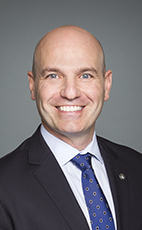
House of Commons photo

Crucial Fact

  • His favourite word was conservatives.

Last in Parliament October 2019, as NDP MP for Skeena—Bulkley Valley (B.C.)

Won his last election, in 2015, with 51% of the vote.

Statements in the House

Business of Supply June 2nd, 2016

Mr. Speaker, I thank my friend from Ajax, the parliamentary secretary, for his comments and his efforts over the last number of months in trying to work with parliamentarians, as I do with my colleagues in the Conservative Party, the Green Party, and the Bloc Québécois to move this forward.

One of our challenges is that it has been a number of months. The electoral reform needs to work with some sense of urgency, simply because Elections Canada needs to have in place, well before the next election, any changes that are coming to the voting system in order first to inform Canadians and also to conduct the vote fairly.

To the specific question of the hon. member about those groups that are not often reached by parliamentarians in traditional politics, I think of social media. I think there should be reaching out and certainly the committee has to travel. The committee has to get out of Ottawa, get out of the bubble and hear from Canadians, and not just those with a vested interest in the voting system, but those who care to participate more fully in our democracy, a number of the groups that he and I both just mentioned.

Business of Supply June 2nd, 2016

moved:

That a Special Committee on electoral reform be appointed to identify and conduct a study of viable alternate voting systems to replace the first-past-the-post system, as well as to examine mandatory voting and online voting;

that the Committee be directed to issue an invitation to each Member of Parliament to conduct a town hall in their respective constituencies and provide the Committee with a written report of the input from their constituents to be filed with the Clerk of the Committee no later than November 1, 2016;

that the Committee be directed to take into account the applicable constitutional, legal and implementation parameters in the development of its recommendations; accordingly, the Committee should seek out expert testimony on these matters;

that the Committee be directed to consult broadly with relevant experts and organizations, take into consideration consultations that have been undertaken on the issue, examine relevant research studies and literature, and review models being used or developed in other jurisdictions;

that the Committee be directed to develop its consultation agenda, working methods, and recommendations on electoral reform with the goal of strengthening the inclusion of all Canadians in our diverse society, including women, Indigenous Peoples, youth, seniors, Canadians with disabilities, new Canadians, and residents of rural and remote communities;

that the Committee be directed to conduct a national engagement process that includes a comprehensive and inclusive consultation with Canadians, including through written submissions and online engagement tools;

that the Committee be composed of twelve (12) members of which five (5) shall be government members, three (3) shall be from the Official Opposition, two (2) shall be from the New Democratic Party, one (1) member shall be from the Bloc Québécois, and the Member for Saanich—Gulf Islands;

that changes in the membership of the Committee be effective immediately after notification by the Whip has been filed with the Clerk of the House;

that membership substitutions be permitted, if required, in the manner provided for in Standing Order 114(2);

that, with the exception of the Member for Saanich—Gulf Islands, all other members shall be named by their respective Whip by depositing with the Clerk of the House the list of their members to serve on the Committee no later than ten (10) sitting days following the adoption of this motion;

that the Committee be chaired by a member of the government party; that, in addition to the Chair, there be one (1) Vice-Chair from the Official Opposition and one (1) Vice-Chair from the New Democratic Party, and that, notwithstanding Standing Order 106(3), all candidates for the position of Chair or Vice-Chair from the Official Opposition shall be elected by secret ballot, and that each candidate be permitted to address the Committee for not more than three (3) minutes;

that the quorum of the Committee be as provided for in Standing Order 118, provided that at least four (4) members are present and provided that one (1) member from the government party and one (1) member from an opposition party are present;

that the Committee be granted all of the powers of a standing committee, as provided in the Standing Orders, as well as the power to travel, accompanied by the necessary staff, inside and outside of Canada;

that the Committee have the power to authorize video and audio broadcasting of any or all of its proceedings; and

that the Committee present its final report no later than December 1, 2016.

Mr. Speaker, I am pleased to share my time with my colleague from Beloeil—Chambly today.

It is also a pleasure for me to speak to the motion. It is lengthy, but it is important, for many reasons. It is because of all of the issues that parliaments and governments face. Whether it is the economy, the environment, first nations, international relations, or war and peace, they all rest upon the foundation of our democracy, which is how Canadians vote governments in and out.

The motion that New Democrats have put forward today is to begin a process, in a fair and constructive way, to allow us to come to a fair and constructive result for Canadians, to modify it in an historic fashion. We have not to this point ever altered our democracy or changed the way that Canadians go forward and express their hopes and wishes to this fundamental nature.

The commitment from the Prime Minister after the last election was that it would be the last one run under the unfair first-past-the-post system. New Democrats have long advocated for this position, as have our colleagues from the Green Party. We believe this is an opportunity that we must take and we must get right.

The essence of what New Democrats have proposed, and we put this to the government and to the public back in February, was to construct a committee that is charged with this historic task based essentially on the will of Canadians. It was to take the results of the last election, which was just eight months ago, and construct the committee based on how Canadians expressed their desire for how Parliament would look.

May I be so bold as to suggest that a good electoral system would also be somewhat proportional, in that it would reflect the will of Canadians. This is the case in most successful democracies around the world. They use some element of proportionality in their voting, so that when a party acquires approximately 20% of the vote, their parliament is made up of about 20% of people from that party. If the party gets 40%, then it is 40%, and so on.

What we have right now under first past the post is a system whereby this majority government, the previous majority government, and many in our past, were able to essentially obtain 100% of the power while acquiring less than 40% of support from Canadians, and that is of those who participated. When we look at the broad section of Canadians writ large, it can actually come down to 25%, or less, of voting-age Canadians voting in a government that then acquires 100% of the ability to pass whatever legislation it wants. It can do that sometimes in a draconian manner, by instituting closure on debate, shutting down committees, or by using quite a bit of force in the Westminster parliamentary system that we have adopted.

At its core, the idea for us is to include a notion of sanctity in what we are doing. It is that no one party in this place can act unilaterally when changing our voting system. We think that would be a very bad thing. There were some precedents in Canadian history that the government would never change the voting system in any fundamental way without the support of another party in Parliament. We do not want those changes to be partisan in nature, in a sense favouring one party over another. Canadians would look upon that with suspicion. When the previous government moved what it called the fair, we called it unfair, elections act, it moved it without the support of any other party in the House. In fact, in our view and in the view of many Canadians, it sought to disenfranchise very particular groups of Canadians from voting by requiring new voter identification, which Elections Canada said was not necessary. That was an unfortunate breaking of precedents. We do not want to repeat that.

The new government has said it does not wish to go down that path. The committee, as we proposed it, would ensure that would not be possible. The original proposal from the Liberals in striking this committee would have allowed them to have a majority of seats on the committee, and therefore a majority ability to pass any reforms they want without the support of any opposition party.

The committee, as we have constructed it, based upon the will of Canadians, would require the parties to work together. I know that might be a radical concept. There is often a lot of division and partisanship. Partisanship is a part of the House of Commons. It is a part of electoral politics, and, if done well, with passion and integrity, it can be of benefit to the country.

However, partisanship for its own sake often undermines good ideas. It often undermines the integrity of this place. What we hope for, and what we have constructed in this committee, is to allow other parties to require other parties to seek support from one another, to say that no one party in this place has all of the right ideas for the problems that we are seeking to fix, and that the challenges that are in our electoral system will be fixed by us collectively, together. That is what Canadians want, that is what we believe Canadians need. The committee system that we have put forward allows us that, because if the process is fair it greatly improves the chances that the outcome will be fair, but if the process is skewed and biased, then unfortunately there is too great a chance that outcome would also be skewed and biased.

There are so many groups across the country that have been working diligently, some of them for decades, on improving our electoral system in Canada. I am thinking of Fair Vote Canada, Leadnow, the Broadbent Institute, the Dogwood Initiative, and Avaaz. Even columnists from The Globe and Mail, to Andrew Coyne, to other left wing radicals as the Conservatives like to say, have been long urging us to evolve our electoral system into this century, even evolve it from the last century.

It seems to me that there is an opportunity in front of us to do something novel, to be innovative, and to be courageous about the way we go about this conversation, while recognizing our own interests in this conversation, to put the interests of Canadians first, and to allow Canadians to have a greater voice in this. The committee would seek to hear from traditionally unrepresented and under-represented groups, such as first nations, women, young people, people living in poverty, and people with disabilities, who have almost in all cases in every election been dramatically under-represented at the polls and in the representation that we have in the House of Commons.

There is no silver bullet in this conversation. There is no perfect voting system out there that will achieve all things for all people. We understand that. However, certainly we can improve on a voting system that was invented before we invented the lightbulb and on a voting system that allows 39% of voters to produce 100% of the power. Certainly we can diminish that when voters go into the ballot box they are told they simply have to vote strategically, that they should not choose their first choice but their second or third choice in order to stop the thing they fear most. We believe that when voters step into the ballot box it is an expression of hope for the future, it is their will for the future, that they want to express to themselves, to their neighbours, and to their family what they want to see in the world, what kind of government they would like to see. A good electoral system and a good voting process allows that connection to be much stronger than what we have here today.

I represent northwestern British Columbia, an incredibly beautiful and powerful place. One of the great advantages I have in this honour of representing Skeena—Bulkley Valley is I often get to attend first nations events, ceremonies, and traditions. At one event, I was with the Haisla in Kitimat. During the course of this very long, important naming feast when a number of Haisla were acquiring important names, one of the elders got up to speak. Slowly, as he was progressing through his comments, one after another Haisla from his house group got up to stand very quietly and respectfully behind him. After a certain amount of time there must have been more than 100 or so folks standing behind this elder. I turned to a friend of mine who is Haisla and said, “I don't understand fully what's happening here, what this represents.” She said, “In our tradition, when his house stands behind him, what they're saying is that all of the words he speaks, it is as if they have spoken. The commitments he is making, they also make.”

I often think what if we held that type of tradition here in this place, that first and foremost we always sought to represent the voices of those who stand behind us from all of the parts of this country that we represent, with the divergent views that we represent, those of us wishing to express the best of ourselves, the best of this country? I think that would allow us to avoid some of the traps we fall into as politicians, as members of Parliament, where that high road is so hard to maintain, that road of speaking with integrity as our friends, our families, and neighbours would like to speak with and do speak with, because that is at the heart of what this country is: a conversation about respect and about differences. The committee process we have put forward today, and the eventual result in a better electoral system, is an effort to honour that, to respect the very best of this country.

Petitions June 2nd, 2016

Mr. Speaker, I have a petition from a number of my constituents in northwestern British Columbia calling upon the government to initiate a national palliative care strategy.

The petitioners have great concerns about the physician-assisted death legislation that, since the induction of this petition, has now passed through many stages of Parliament and in the Senate. They are concerned about the dignity of life. They are concerned that Canada still lacks a palliative care strategy so that we may care for our aged in their time of need.

Democratic Reform June 1st, 2016

Mr. Speaker, for months Liberals have been asking for ideas about how best to change our democracy, yet every time I, my friend from Rosemont—La Petite-Patrie, and New Democrats have offered solutions, the Liberals have rejected them.

Canadians are growing concerned and expect that when Parliament passes any new voting system, it must have the support of other parties in this place.

Today, will the minister take a first and important step and agree to change the Liberal-dominated committee to one that is fair to all members of Parliament and the millions of Canadians we represent?

Democratic Reform May 31st, 2016

Mr. Speaker, after wasting more than seven months, the Liberals are now actually openly talking about failure when it comes to democratic reform. The minister has said over and over again that she wants to work with other parties, so here is a radical idea. How about the Liberals actually work with the other parties to get this job done?

Canadians watched the Liberals stack the deck using their false majority and evasive answers to simple, straightforward questions. Here is one more for the minister. Are the Liberals actually willing to change the way Canadians vote unilaterally, yes or no?

Democratic Reform May 30th, 2016

Mr. Speaker, if that were the case we would have to ask why Liberals stacked Liberal members on the committee picking the new voting system. Details matter, and Liberals have proposed a system in which Liberals could unilaterally change our voting system.

On the weekend, the minister said she is looking forward to, and I quote “broad support”. Two-thirds of the House were elected on a promise of electoral reform. Some have accused the minister of damaging the credibility of the process with her platitudes and vague answers to straightforward questions. Therefore, we implore the Liberals to answer this one simple question. Are the Liberals actually willing to go it alone and unilaterally change our voting system, or will they require the support of at least one recognized party in the House?

National Strategy for Safe Disposal of Lamps Containing Mercury Act May 30th, 2016

Mr. Speaker, I was worried for a moment. I am sure it was a good question, too. We will have to find a way to get it on the record. Perhaps our friend can offer a speech on the bill.

New Democrats will be supporting Bill C-238. We think it would go some measure toward doing some important things for our environment, which Canadians are rightly concerned with. It is a deeply held belief and value by Canadians that as we go about our daily lives, feed our kids, light our homes, and go to work, we do not want to be doing harm.

At the heart of the legislation is a notion around a principle that is often not applied when we pass legislation and laws in this place. It is a notion, which has been long-standing, called the precautionary principle. It suggests that before we go out and bring a new product or chemical into the world, we should look at all the best available evidence to understand if there are any impacts or exposure to the environment that would bring risk to the environment or the health of Canadians.

Clearly around issues of mercury or any of the highly classified toxins, as we innovate and try to get that green economy, products that use less energy, that are less wasteful in a whole bunch of different ways, it is important to take the full life-cycle costs and the full understanding of what it is that we are buying, producing in our factories, and bringing in from overseas.

The bill would move us in that direction. However, there is a couple of concerns that we have but they are concerns that can be addressed as the bill moves through. One is around the element of education. We know that changing the way we recycle and use products is important, but a key element in that is that consumers have full knowledge and full participation in whatever program we are trying to initiate.

The bill is interesting in that the federal government does not really have jurisdiction to direct provinces, territories, and municipalities to do one thing or another with their waste streams. We can offer some guidance. We can have some encouragement. We can bring in laws that restrict the use of certain products.

However, in terms of recycling, in terms of the reusing of certain products, what the bill seeks to do is three things. One of them is set up a national strategy. We know, and we have been told, that Environment Canada is engaged in producing such a strategy. This would be encouragement for the department to get on with it.

It is not news that mercury and other toxins are highly lethal, not just to humans but to a lot of things that humans care about, like the planet, fish, birds, and all the rest of that. It is curious that we have gone so long, and there have been some delays by previous governments in introducing legislation. My understanding is that as we have been exporting a lot of this harmful material south of the border into their recycling facilities, there is not a lot of enthusiasm to continue to have that stream going to the United States and other countries. It is a good principle that Canada takes care of its own garbage and pollution. This seems like a basic understanding and value that we would all share.

I suppose, as my friend from Dartmouth—Cole Harbour has said, this is the beginning of a conversation with provinces and territories. In my experience, they sometimes like to have that conversation in advance of legislation being brought forward, but it is a big task for a single member of Parliament to take on, to try to engage with all the provinces and territories. However, that is going to be vital. Oftentimes if our partners at the provincial and territorial level feel like an initiative is also their idea, they are much more enthusiastic about participating and going through the process. If they feel like it is Ottawa imposing an idea, that can have the opposite reaction.

It is curious, simply because when we have dealt with other issues from the government, it has had very long and strenuous consultation processes, sometimes to the point of frustration. John Manley used to talk about constipation through consultation. There can be a tendency within governments that when it is not sure how to proceed, it continues to consult and consult and never really does anything. Ottawa loves to study things.

I am encouraged that there is an initiative in here that says we should go forward and do something. There is maybe going to have to be some extra energy put toward the consultation side, particularly at the municipal level. For those of us in the House who have engaged in municipal government, they have very few resources, and by that I mean money, to deal with a lot of issues. Their budgets are often strained. They cannot, as the federal government does and the previous one did, run massive deficits. It is just not available to municipal governments.

One of the first questions I am going to get from councillors, town councillors, and mayors is, “How do we pay for this?” If this is going to end up on their bottom line, they want to be able to participate and do it right, but they also want to ensure they do not bear all the costs. That is a completely fair understanding of the situation.

We also see in the bill that there would be a report-back mechanism, and I believe it would be in two years. There would be an ability for us to have a sense of where the strategy is going and whether it is working. One of the things that I would encourage is that we would have some clear metrics designed, if they are not already in place in the legislation, so that reporting back is not anecdotal or subjective but is quite objective and fact-based. What is the level of mercury hitting the landfills right now? What is the expectation of the legislation in terms of reducing that pollution? Are we able to achieve those targets, and if we are off, why are we off? That accountability is important to Canadians because they have too often heard large ambitions from governments that are left relatively vague. When it comes time to see whether the thing worked, there is no way to actually hold government to account because the measures were never put in place.

My friend from Dartmouth—Cole Harbour talked about the need for environmental leadership, and we agree that for far too long, on the broader issue of the environment, the federal government has been absent or heavy on the rhetoric but very light on the action. Probably no issue underlines that fact more than the issue of climate change, where we have seen, in fact, a lot of leadership from the municipal, provincial, and territorial levels but an absence of that here in Parliament where it has been a frustrating 30-year process of trying to deal with the issue of climate change and carbon pollution into our atmosphere.

As my friend from the Liberal side noted earlier, some will come to this debate and say that it is only costs. This is a cost to consumers. It is going to be a cost to the economy. It is going to hurt the creation of jobs and only cost consumers and taxpayers. I would argue that this is an example where, if we look at the full cost of what is happening, there is a cost already being borne on municipalities and provinces, in trying to deal with these toxins, like mercury. There is a cost to consumers and Canadians directly through their health care.

I was just with a friend this past weekend, when I was back home in Smithers, who is dealing with mercury contamination issues, yet his exposure to them was never through his work. The doctors have looked back and realized that it was from playing with old discarded light bulbs, as many of us did as kids playing Star Wars and busting them up with no knowledge that we were being exposed to something like mercury, which can bioaccumulate. That means it can continue to stay in our systems decades after exposure. My friend is facing serious health consequences now. It may be through diet, which is also a concern, but it was actually just through exposure as a young person.

All this is to say that when addressing any issue and looking at any product, any chemical, any toxin, we look at the full life-cycle of the product from cradle to grave. We look at how we are taking care and being responsible consumers, and how it is when the government puts forward legislation it is seen through a lens that is clearly understood by Canadians and is accountable to Canadians.

This is not what this bill is, but I would greatly encourage the current government to apply the same principles it has in the legislation to things like climate change and reviewing industrial projects, such as mines and pipelines, so that we have a clear accounting for what that precautionary principle is and we have a clear accounting of what the true costs are of any government decision. It would not be some vague subjective notion but something that people could hold the government to account on.

If they are going to approve an oil pipeline like Kinder Morgan to Vancouver, what are the Liberals actually taking into account? This would not be some sort of subjective “we looked at climate change”, but what the actual contribution upstream and downstream is, and what the full life-cycle cost of any decision that we make is. Canadians make these decisions all the time. If they put funds into their kids' education program, they try to understand what the full costs and benefits are. As a government, we should run ourselves as a household, and as many families do, understand what the full cost of any activity or inactivity might be.

I thank my friend from Nova Scotia for his bill.

National Strategy for Safe Disposal of Lamps Containing Mercury Act May 30th, 2016

Mr. Speaker, I thank my friend from Dartmouth—Cole Harbour for his piece of legislation.

To reply somewhat to my friend from the Conservatives, I think there is always a cost to action. There is also a cost to inaction. The cost of inaction on dealing with dangerous pollutants is severe and can be quite life threatening, and certainly costs our health care system a lot of money if people are exposed to these chemicals.

We have consulted in B.C. about this issue, and certainly in my riding. One of the gaps, which is significant, for his initiative to become successful is around education. A lot of Canadian consumers often do not know and appreciate what is in their consumer products. We find that some of the federal regulations around what goes into our products are somewhat weak. I have not yet read it in the hon. member's bill, but I am wondering if there are any education components to it. Simply implementing the requirements for recycling initiatives are good on their own, but without consumers actually bringing the product to the right place at the right time, all is for naught.

The hon. member has contemplated calling for a kind of national strategy. However, has he also called for some sort of national education process so that consumers and Canadians can be better informed, not only about the products they choose, but what to do with them once they are done with them?

Democratic Reform May 18th, 2016

Mr. Speaker, we have a historic opportunity to finally get rid of first past the post, but Canadians are growing increasingly worried and disappointed with the government.

The minister claims that she wants to work together with opposition, then Liberals shoot down exactly every idea we give them. She claims she wants to be non-partisan, then Liberals stack the deck on the committee choosing the new system.

Let us have a clear answer to a clear question. Will the minister respect the millions of Canadians represented by the opposition and agree not to pass any changes to our electoral act without the support of one of those parties, yes or no?

Natural Resources May 17th, 2016

Sadly, Mr. Speaker, the man who ran to be Prime Minister on such bold progressive promises would not even recognize the politician sitting in the Prime Minister's chair today.

The Liberals swore on a stack of Bibles to fix the Conservatives' failed environmental assessment process. The Kinder Morgan pipeline is exactly the kind of project that needs a serious and credible environmental review. This is a Conservative pipeline under a Conservative review process with just a Liberal fig leaf hiding over top of that fact.

Where are all the B.C. Liberals who promised to do things differently? Will just one B.C. Liberal stand up today and justify the unjustifiable?