
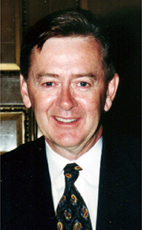
House of Commons photo

Crucial Fact

  • His favourite word was federal.

Last in Parliament May 2004, as Canadian Alliance MP for Calgary Southwest (Alberta)

Won his last election, in 2000, with 65% of the vote.

Statements in the House

Aboriginal Affairs June 1st, 1995

Mr. Speaker, the Liberal red book contained promises which led to unreasonable expectations on the part of the aboriginal people. In Quebec, the Band Council of Kahnawake, with the help of Frank Vieni, one of those in charge of Indian Affairs during the Oka crisis, has presented to the Department of Indian Affairs a land claim asking for millions and even billions of dollars. The co-ordinator of the project for the department, Kate Fawkes, said that the document contains some real breakthroughs.

Is it the policy of the department to encourage claims of such a large scope when it knows quite well that it will be impossible to meet those expectations?

Aboriginal Affairs June 1st, 1995

Mr. Speaker, the government's mismanagement of aboriginal affairs in British Columbia has now brought tempers to a boil at Douglas Lake. The Upper Nicola Band is blocking the road to the Douglas Lake ranch and the RCMP is worried that someone will get seriously hurt or killed.

The blockade is just the tip of the iceberg. What we do not want are three or four Okas in B.C. this summer, yet the Minister of Indian Affairs and Northern Development refuses to address this and other similar situations.

What is the government prepared to do to resolve the standoff at Douglas Lake before things get out of hand?

Bosnia May 31st, 1995

Mr. Speaker, Canadians do not just want to be consulted. Canadians want to have a say in key decisions that affect the lives of the forces in Bosnia. Canada invented peacekeeping. We have been major players in every key UN peacekeeping mission. Our soldiers have taken on some of the most dangerous assignments in the former Yugoslavia.

The fact that Canada has no real decision making position in actions that have a direct impact on our soldiers is completely unacceptable to the House and the Canadian people.

If the government is insisting on staying in Bosnia, a decision with which we profoundly disagree, will the minister at least insist on membership in the contact group as a condition for remaining?

Bosnia May 31st, 1995

Mr. Speaker, we are not arguing about semantics but about the substance of the situation.

The major NATO allies are deploying reinforcements in the Balkans. The secretary-general of the United Nations is proposing to change the mandate and UN soldiers are being asked to play a more aggressive role in that part of the country.

Our peacekeepers have become peace enforcers, a role which goes against the original mandate and for which they are not properly equipped.

Given that our role is changing, no matter what words the minister wishes to use to describe it, and that the lives of Canadian soldiers are being placed at greater risk, will the government now demand a place for Canada in the UN decision making contact group?

Bosnia May 31st, 1995

Mr. Speaker, yesterday the Prime Minister said that Canadian peacekeepers were not in the former Yugoslavia to make war with anybody. Unfortunately that view is not shared by the Bosnian Serbs.

They have declared the 320 UN hostages, including 55 Canadians, to be prisoners of war. They have declared that all agreements with the United Nations are null and void.

In response, NATO is calling on the UN to beef up its mandate and the contact group is asking for the power to aggressively attack the warring factions. The UN is at the brink of a protracted war with the Bosnian Serbs.

Will the government today formally acknowledge that the peacekeeping mission in Bosnia is over and that our soldiers are now being asked to play an aggressive peacemaking role in that region?

Bosnia May 30th, 1995

Mr. Speaker, what continually disturbs us about this discussion is the fuzziness of the government's criteria for remaining and the fuzziness of its strategy in this troubled part of the world.

I will ask the minister again a very straight question, one Canadians want answered. If the government has decided Canadian peacekeepers are to remain in the former Yugoslavia, with their lives even more at risk because of the escalating dangers, will it be conditional on the government's being given a place in the UN contact group, yes or no?

Bosnia May 30th, 1995

Mr. Speaker, to many observers it appears the UN mandate is shifting. If the government simply passively accepts those shifts, the public will want to know what that means for Canada.

In March the government sent our peacekeepers back to Bosnia without a clear mandate, without firm criteria for staying or withdrawing and without a voice in the decision making contact group.

If the government insists on staying under conditions of military escalation will it now insist on being given a place at the table with the United Nations contact group? In other words, will that be a condition which must be met if Canadian peacekeepers are to remain?

Bosnia May 30th, 1995

Mr. Speaker, in the last 24 hours the UN's mandate in the former Yugoslavia is being shifted from a focus on peacekeeping to aggressive peacemaking.

Britain has announced it will be sending 5,000 more troops. France is committing an aircraft carrier and helicopter gun

ships. The U.S. may contribute commandos to the conflict. The UN contact group has also endorsed a plan that would give UN soldiers the power to aggressively attack warring factions.

Does the government support shifting the UN mandate in this direction, shifts which will escalate military activity in the former Yugoslavia?

Indian Affairs May 18th, 1995

Mr. Speaker, in its land claim negotiation paper the British Columbia government goes beyond land. It says that privately owned land will not be on the table. It says that aboriginal self-government will be restricted to municipal-like powers. It says that status Indians should lose provincial and federal tax exemptions once their land claims are settled.

Does the minister agree with the positions being taken by the Government of British Columbia on these issues and if not, what is the federal position?

Indian Affairs May 18th, 1995

Mr. Speaker, the minister treats this frivolously but he is headed for a disaster in aboriginal relations in the province of British Columbia.

Even his officials recognize that the federal government has raised band expectations to unmanageable levels while keeping the rest of the B.C. community in the dark. Despite memos from the deputy minister and appeals from the Assembly of First Nations, he stubbornly refuses to provide aboriginal groups and Canadians with any limits on the federal position on land claims or self-government.

I ask the minister again. Will he provide realistic guidelines for land claim negotiations and aboriginal self-government at least for the province of British Columbia?