
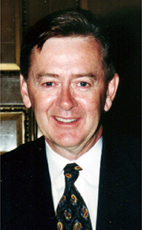
House of Commons photo

Crucial Fact

  • His favourite word was federal.

Last in Parliament May 2004, as Canadian Alliance MP for Calgary Southwest (Alberta)

Won his last election, in 2000, with 65% of the vote.

Statements in the House

Indian Affairs May 18th, 1995

Mr. Speaker, the Liberal red book promised that the government would move full steam ahead on aboriginal self-government and on resolving outstanding land claims. As predicted, this has led to unrealistic expectations on the part of Indian bands, particularly in British Columbia.

Currently a huge percentage of B.C.'s land mass is claimed by natives but the provincial government says it is only willing to negotiate on 5 per cent and that self-government will not extend beyond the powers enjoyed by municipalities.

Will the minister of Indian affairs now admit that his failure to set realistic parameters for land claim negotiations and self-government is feeding these unrealistically high expectations and it is high time for him to correct these failures?

Social Policy May 17th, 1995

Mr. Speaker, the collapse of the government's social reform program hurts not only Canadians dependent on those programs but also taxpayers.

Every member of the House knows there is absolutely no way the federal budget will be balanced unless there is social program reform and reform of social spending. If the Minister of Human Resources Development cannot lead that overhaul, then someone else in the government must be assigned the job.

With the Prime Minister prepared to provide leadership on this subject, since his government's budget is undermined by the failure of this minister to overhaul social funding, is it the Department of Finance that will now be providing the leadership for social reform?

Social Policy May 17th, 1995

Mr. Speaker, reform may be a priority as the Prime Minister says, but the fact is Canada's social safety nets are in a terrible mess.

The federal government's influence over medicare is diminishing, CPP is headed toward bankruptcy, consultations with the provinces are going nowhere, UI is unreformed and Atlantic Canadian workers are quitting their jobs to get on TAGS.

A government that proclaims to be the architect and defender of social safety nets is now presiding over the demise of those safety nets through its inability to act.

Does the Prime Minister want to go down as the Prime Minister who presided over the demise of the social safety nets or does he have a fresh new approach to social policy to lay before the House?

Social Policy May 17th, 1995

Mr. Speaker, after months and months of floundering it is becoming abundantly clear the social policy reform Liberal style is all but dead.

The Minister of Human Resources Development has failed to reform anything. His plans for a two tiered unemployment system are now on the back burner, as are income contingent student loans and TAGS retraining. Canada pension reform did not even make it to the back burner. We fear the minister is going the way of the turbot, barely clinging to the front benches by his fingernails.

Why has the minister failed so completely to provide Canadians with a new vision and plan for social policy?

National Defence May 16th, 1995

Mr. Speaker, what is really at issue is the minister's ability or inability to manage his department. The minister was the last to know about the airborne videos. He was the last to know about the high suicide rate at Valcartier. Now we have the department's senior mouthpiece attempting to bias media coverage of the Somalia inquiry in direct disregard of the minister's gag order concerning that inquiry.

When will the Minister of National Defence start to exercise the leadership of his department which Canadians deserve and expect?

National Defence May 16th, 1995

Mr. Speaker, Ms. Cardinal was hired for her present position by Bob Fowler, the former deputy minister of defence, who has been under investigation by the Somalia inquiry.

In her speech to the Media Club she went out of her way to discredit one of the principal critics of what went on in Somalia, Dr. Barry Armstrong, saying that his story did not have credence and that he had been proven wrong by an independent group of investigators. The validity of Dr. Armstrong's testimony is to be independently judged by the Somalia inquiry, not prejudged by a DND spin doctor hired by Bob Fowler.

Why does the Minister of National Defence allow his director general of public affairs to make any public statements on the Somalia inquiry when she has a potential conflict of interest with respect to the issues and the individuals to be judged by that inquiry?

National Defence May 16th, 1995

Mr. Speaker, on April 24, the director general of public affairs for national defence, Ruth Cardinal, addressed a meeting of the Media Club of Canada. She emphasized that she would tell them what is really happening in the military.

Ms. Cardinal went on to imply that the suicide rate in the armed forces was acceptable because we get our recruits from the most susceptible portion of the population and that the airborne videos came from ex-soldiers who needed cash because they had blown their pay cheques on Camaros. These are remarkable statements to be made by the defence department's senior mouthpiece.

Does the Minister of National Defence agree that these comments are completely inappropriate, and does he still have full confidence in his director general of public affairs?

Gun Control May 10th, 1995

Mr. Speaker, these allegations of deficiences in the consultative process are coming from the Attorney General of Alberta, the

Attorney General of Saskatchewan and representatives of the James Bay Cree.

What we have here with respect to gun control is yet another top down, made in Ottawa solution to a problem; the NEP, like the Charlottetown accord, like the TAGS program and a whole bunch of others. They start with an allegedly high level of consultation and high levels of support which then diminish as the provinces and the people get a look at the content and discover the flaws.

Is the minister willing even at this late date to listen and respond by incorporating legitimate concerns of Alberta, Saskatchewan, the James Bay Cree, the Yukon First Nations into his gun control proposals?

Gun Control May 10th, 1995

Mr. Speaker, when the minister introduced his gun control bill he said, as he said again today, that it was the result of the most extensive consultative process known to man. He had consulted everyone from Elvis Presley to the ghost of Mackenzie King.

The evidence is now mounting to suggest the minister's information tour was neither extensive nor substantive in many instances. He forgot the legal requirements of the James Bay Cree agreement and the provincial politicians in Alberta and Saskatchewan say the minister's consultations were a joke.

Has the minister assessed the damage that can now be done to federal-provincial and aboriginal relations if the government rams through this defective bill in its present form?

Gun Control May 10th, 1995

Mr. Speaker, on legislation that affects traditional aboriginal hunting rights, the federal government has a constitutional obligation to consult in a prescribed manner with the James Bay Cree and the native bands of Yukon.

Section 24.4.26 of the James Bay and Northern Quebec Agreement states that all regulations relating to the hunting, fishing and trapping regime proposed by responsible governments shall be submitted to the co-ordinating committee defined in the agreement for advice prior to enactment.

Yesterday it became quite clear that the Minister of Justice failed to consult the James Bay Cree or the aboriginal people in Yukon on his proposed gun control bill in the prescribed manner. According to the Liberal chair of the justice committee this makes the entire legislative process unconstitutional.

Will the Minister of Justice put his bill on hold until he has consulted the James Bay Cree and the Yukon First Nations on his gun control bill in the prescribed manner?