
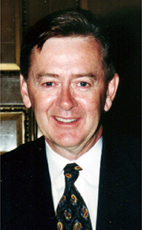
House of Commons photo

Crucial Fact

  • His favourite word was federal.

Last in Parliament May 2004, as Canadian Alliance MP for Calgary Southwest (Alberta)

Won his last election, in 2000, with 65% of the vote.

Statements in the House

Aboriginal Affairs May 5th, 1999

Mr. Speaker, yesterday the Indian affairs minister signed a treaty, which “constitutes the full and final settlement in respect to the aboriginal rights including aboriginal title in Canada of the Nisga'a nation.” This was done without a debate in parliament, without a vote in parliament, without the approval of parliament. When the minister was asked why she proceeded in this way, all she could say was “That is how we have done it in the past”, as if enough wrongs in the past make a right.

Does the Prime Minister not see that proceeding in this undemocratic way undermines potential support for this treaty and the treaty making process?

Aboriginal Affairs May 4th, 1999

Mr. Speaker, there was once a prime minister who stood in the House and said that he was terribly proud of trying to arbitrarily amend the Canadian Constitution. He too held a signing ceremony, but he neglected to consult the people or parliament in advance of the signing and he refused a national referendum. In the end the Meech Lake accord failed and that prime minister alienated and embittered the very people on whose behalf he claimed to be pushing that accord.

Why does the Prime Minister think we can go down exactly the same road with the Nisga'a people without producing exactly the same negative and divisive results?

Aboriginal Affairs May 4th, 1999

The Prime Minister increases Canada's military commitment to Kosovo without a vote or a mandate from parliament. He fails to consult parliament on the appointment of justices to the supreme court. He consistently ignores the results of democratic Senate elections in Alberta and he uses his party discipline to force his own members to vote against tax fairness and stronger measures against child pornography. Now he is taking exactly the same approach with respect to the Nisga'a treaty.

How can the government expect the Nisga'a or anyone else to respect the democratic process when the Prime Minister does not respect it himself?

Aboriginal Affairs May 4th, 1999

Mr. Speaker, the Prime Minister has been spending too much time with Castro—

Aboriginal Affairs May 4th, 1999

Mr. Speaker, today the Indian affairs minister signed a document with enormous ramifications for the Nisga'a people, the people of British Columbia and the people of Canada.

This Nisga'a treaty was rammed through the B.C. legislature over the objections of the B.C. Liberal opposition which challenged its constitutionality. Today the federal government signs it without a national discussion, without a debate in parliament, without a vote in parliament, and without a mandate from parliament.

Why would the government flagrantly violate democracy and the democratic process on such an important subject as Nisga'a?

Hepatitis C April 28th, 1999

Mr. Speaker, we do not want to hear from the government's lawyer on this case. We want to hear from the Prime Minister.

Over the last year the Ontario government set up a program and started compensating victims of hepatitis C. The Government of Quebec is contemplating the same thing.

How much longer will victims of hepatitis C have to wait before the government calls off the bureaucrats, calls off the lawyers, and does something to compensate these hepatitis C victims?

Hepatitis C April 28th, 1999

Mr. Speaker, after that vote a year ago the Prime Minister fell back on the two tier approach to caring for hepatitis C victims.

He promised financial compensation for those who got sick from tainted blood between 1986 and 1991, and he ruled out compensation for anyone outside those years.

Why has the Prime Minister broken even his limited promise and failed to pay out a single cent in compensation to any hepatitis C victim?

Hepatitis C April 28th, 1999

Mr. Speaker, one year ago today the Prime Minister crushed the hopes of thousands of hepatitis C victims. He did this by forcing his members to vote against a motion calling for compensation for all victims of the tainted blood scandal.

It has been one year. What does the Prime Minister have to say to the families of the 800 hepatitis C victims who have died during the year without any financial help?

Kosovo April 27th, 1999

Mr. Speaker, what we do not want to do is commit 800 Canadian troops to a peacekeeping role in Kosovo and then three, four or five weeks down the road have the government come back and tell us that these troops are now engaged in a full ground war because the peace agreement collapsed.

We want to make sure that these troops are committed to enforcing a peace, in other words not making war. If what the Prime Minister wants is a commitment of Canadian ground forces to peacekeeping activities only, why does he not bring a clear, votable motion to that effect before parliament?

Kosovo April 27th, 1999

Mr. Speaker, if there are no solid signs from the Yugoslav government that it is prepared to commit to a peace agreement, what is the government really committing these troops to?

If these ground troops enter Kosovo, even under the umbrella of a tentative peace agreement, is there not a real possibility that they will find themselves involved in a serious armed conflict and what we are really being asked to do is to commit ground troops to the conflict in Yugoslavia?