
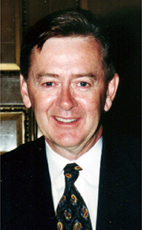
House of Commons photo

Crucial Fact

  • His favourite word was federal.

Last in Parliament May 2004, as Canadian Alliance MP for Calgary Southwest (Alberta)

Won his last election, in 2000, with 65% of the vote.

Statements in the House

The Economy December 4th, 1997

Mr. Speaker, yesterday we asked the government to face up to Canada's crushing debt load and high tax load. The response from the government was pathetic. In essence it said that it did not have to answer for high debt and high taxes.

Today a major public opinion poll shows that 89% of Canadians say that the government had better start answering debt questions now.

What precisely is the government's debt reduction target?

The Economy December 3rd, 1997

Mr. Speaker, we want to know how much debt reduction and tax relief Canadians can expect. In particular Canadians want to know when they can expect tax relief and how much they can expect.

The government is supposedly good at setting targets. The Prime Minister claims to have a target for CO2 emissions. In fact he had three of them in the last three weeks. If the government has a target for cutting CO2 emissions to 1990 levels by the year 2007, will it commit to reducing tax levels to 1990 levels by the year 2007?

The Economy December 3rd, 1997

Mr. Speaker, spending ideas are on the minds of ministers; spend the surplus on $700 lunches for bureaucrats.

The industry department is looking at how to hand grants to friends of the government. Environment wants to spend money on a way to harness the wind power of the Minister of Natural Resources.

However Canadians have other priorities. We have a $600 billion federal debt and we have the highest personal income taxes in the G-7.

Will the Department of Finance make debt retirement and tax relief its number one—

The Economy December 3rd, 1997

Mr. Speaker, these days a lot of cabinet ministers are cooling their heels in the waiting room of the finance department. They are lining up to make their pitch for spending any fiscal surplus.

We can just picture the heritage minister making a pitch for free flag poles, the justice minister looking for a few more million to hand out on airbus suits, and so forth. They have spending plans galore.

Which ministers, if any, are arguing not for spending increases but for debt reduction and for tax relief?

The Environment December 2nd, 1997

Mr. Speaker, with vague answers like that one it is clear the Liberal position at Kyoto will be just as ineffective as the Tory position was in Rio.

When the member for Sherbrooke went to Rio it was all photo opportunities and hype. It was a giant PR exercise that meant nothing. That was because there were no real consultations before they went. There was no real deal in Canada. There were unrealistic targets. There was no plan to pay. There was no plan to implement.

Why is the Liberal government making exactly the same mistake at Kyoto that the Tories made in Rio?

The Environment December 2nd, 1997

Mr. Speaker, the federal government has had three positions in the last three weeks. That is why the provinces are upset.

Another reason they are upset is that the federal government has steadfastly refused to articulate its view on what this Kyoto deal will cost. Other people are sharing their views on the cost.

The conference board says that it could cost $780 a year for every man, woman and child. BCNI estimates the Kyoto deal could cost a 2% to 3% reduction in GDP but the government will not say what its cost estimate is.

My question is for the Prime Minister. Exactly what is the federal government's estimate of the cost of its commitments at Kyoto? Does he think that this level of cost is acceptable?

The Environment December 2nd, 1997

To get serious, any greenhouse emissions deal signed in Kyoto is doomed to failure if the provinces do not co-operate.

Last month the environment minister met with her counterparts and they agreed to certain levels. Now those levels have been changed by the federal government twice. The Saskatchewan negotiators are refusing to go to Kyoto. The Government of Alberta says that it has been betrayed by the actions of the federal government.

My question is for the Prime Minister. How does he intend to force the Kyoto deal on the provinces when they feel so betrayed by the way it was developed?

The Environment December 2nd, 1997

Anything I say will be anti-climactic, Mr. Speaker.

Canada Post December 1st, 1997

Mr. Speaker, Catherine Swift of the Canadian Federation of Independent Business is calling for a permanent end to the problems at Canada Post, and we agree. Either end Canada Post's monopoly on first class mail and open it up to competition or, if it is to remain a public monopoly, replace strikes and lockouts with binding arbitration.

What precisely is the government going to do to make sure that Canadians are never faced with this type of situation again?

Canada Post December 1st, 1997

Mr. Speaker, the minister is a living contradiction of his own statements. His faith in bargaining has been misplaced and now the government is going to legislate.

Even with the legislative solution, it is going to be days before the mail moves again. Some of the old style union leaders are trying to get their members to further punish the public by blocking highways, stopping traffic on bridges and even shutting down airports.

What will the government do with these threats of illegal activity? Will the government continue to dither like it did when the mail stopped moving?