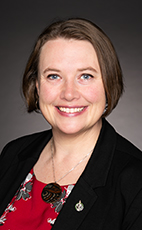
House of Commons photo

Crucial Fact

  • Her favourite word was veterans.

Last in Parliament April 2025, as NDP MP for North Island—Powell River (B.C.)

Won her last election, in 2021, with 40% of the vote.

Statements in the House

Budget Implementation Act, 2017, No. 1 May 4th, 2017

Mr. Speaker, the member and I are on the all-party caucus on seniors care, and I appreciate his work on that.

I have done over 11 town halls across my riding, specifically on seniors issues. I have heard devastating stories from seniors who are very concerned about the impacts of aging and very concerned about the cost of medication. They really support the idea of having a national seniors strategy that would start to address these issues so that they could feel comforted that they will have a positive future, one where they are not at risk of losing their homes, where they are not making decisions between housing and medication.

I would like to hear the member's thoughts on how we would not only do the socially right thing, but the economically right thing, by creating a national seniors strategy.

Indigenous Affairs May 3rd, 2017

Mr. Speaker, the Prime Minister has identified the relationship with indigenous people as Canada's most important one.

This year the government will be spending half a billion dollars on Canada 150. However, we must remember that our history is much older than 150 years, and for many, this is an anniversary of colonial accomplishment.

Can the Prime Minister tell us specifically how reconciliation efforts with indigenous people will be part of Canada 150?

Train Derailment in Woss May 2nd, 2017

Mr. Speaker, it is with great sadness that I rise in the House today.

On April 20, just days before the National Day of Mourning, our riding had a sudden and devastating reminder of the dangers in the workplace, when a train derailment killed three people and injured two more. I send my deepest and sincerest condolences to the families, friends, and workers who experienced this tragedy.

For the people of Woss, I cannot fully express my sense of heartbreak.

I want to acknowledge the emergency response efforts from the residents of Woss and the neighbouring communities, the RCMP Victim Services, BC Emergency Health Services, North Island Critical Incident Response Network, North Island Crisis and Counselling Centre Society teams, doctors, nurses, health professionals, and site leaders.

I am thankful for the kindness of the community in providing food for the workers and families and the immediate community meeting where people came together to share their shock and grief. In times of sadness, I am grateful to belong to a riding that stands together in these painful times. All my thoughts go to Woss.

Privilege May 2nd, 2017

Mr. Speaker, it has been an honour for me to do town halls, one of the things that I think is important for those of us who represent rural ridings. In my case, I have to do at least four town halls just to sort of touch the corners of my riding. It leads to a lot of travel time while I am in the riding. It is very important that we make sure we have a conversation that is meaningful about this type of reform and change, but it needs to be one that has a balance of power so that we can move forward. It is important that we talk to those small communities, because we have to represent them. We have to build the trust. We have to ask questions in this House. Sometimes Fridays are the most powerful days to ask questions for our constituents. It would be a sad loss for all of us.

Privilege May 2nd, 2017

Mr. Speaker, I thank the member for his passionate comments. I do not know if I heard a specific question in there.

I appreciate the meaningful discussion that could potentially happen and that I would like to see happen about the impacts of changing some of our procedures in this place and what that would mean for people who live in different parts of the country and serve different constituencies.

It was interesting to hear what his experience was. For me, it takes nine and a half to 10 and a half hours to get back to my community. It is certainly a long journey. I am very thankful to all the constituents who consistently compliment me on doing that work. It is an honour for me to do that.

I want to say something that is so important: it is that when we have a discussion, if we have it in such a way that there is a balance of power and we honour everyone, good things can come from that. Right now we are being asked to have conversations with a majority committee, not in the good faith and according to the good practices of people before us who made sure that when we were talking about these issues, we had consensus.

I look forward to the government looking at understanding what a consensus model is and making sure that when we have discussions, we do not say “We're just trying to have a discussion—and oh, by the way, we have all the power, so however the discussion ends, we will be the people who make the decision.” When someone has all the power, they had better make sure they have a process that makes sense for everyone.

Privilege May 2nd, 2017

Mr. Speaker, last week in the second week of our time in the riding, I had the honour of meeting and having meaningful discussions with two groups of youth. One group was the Campbell River Youth Action Committee and the other was the Canadian Parks and Wilderness Society youth. When I speak with youth, I hear again and again very intelligent questions, thoughtful discussion, and such a respectful manner. It is an honour to spend time with them and see the great energy many youth are bringing forward in our country.

In those situations, I am often questioned about this place and about the way we work here for the betterment of all Canadians. I hear questions about government and how it works with opposition and the importance of the roles in this place. Many young people seem to understand fundamentally the value of having diversity at the table, differing opinions, and thoughtful discussion. We discuss how MPs hear from constituents and how MPs voice those important realities of communities across Canada. This time we also talked about parliamentary privilege. The youth were interested in what was happening in this House and interested in what they were seeing in PROC. I had this discussion in my riding, and today I am rising to speak to this important question of privilege and, most important, the ability of each member of Parliament in this House to represent his or her constituents.

On March 22, 2017, budget day, members of this House were denied access to Parliament because the Prime Minister's empty motorcade blocked the way. The Constitution of Canada ensures that members of Parliament elected by the members of their constituency have unfettered access to this House. This is to ensure that we can do our jobs and be accountable to the people we represent. On this particular day, that was denied to two members in this place. I am honoured today to stand up and speak to why the right to access this place is so fundamental as a member of Parliament. I also want to talk about the important part of how this could have been resolved quicker, but right now we are seeing the government create an atmosphere of bad faith and having a strong bullying attitude that has led us to where we are right now. Finally, I want to address the issues of parliamentary reform and the so-called discussion the government seems to be focusing on.

When I was elected, I received my member of Parliament identification card. I read on the back that it was my parliamentary privilege to be in this place. In fact, it says, “Under the law of parliamentary privilege, the bearer has free and open access at all times, without obstruction or interference to the precincts of the House of Parliament to which the bearer is a member.” I am sure I stand with other members of Parliament in this House in saying that there is a moment almost every day in this place when I take a breath and remember what an honour it is to be here, that thousands of people in my riding of North Island—Powell River expect me to do my work here representing them, and that when I stand up to vote, I am standing with them in mind. This was denied to two members of this House who could not vote. They could not stand up for the thousands of people who rely on them to do so.

I am pleased that all members of this House are taking this issue seriously, but instead of letting the question of privilege run its course, the Liberals pursued a hostile procedure to reverse the Speaker's ruling which supported the fact that privilege was indeed breached. In doing so, the Liberals invited a procedural fight to go on with a second question of privilege coming from the opposition. They cannot on the one hand claim to work with others to reform this institution while immediately using its instruments to enforce their majority. On April 6, the Liberal government shut down debate on the question of privilege when the matter was superseded by the adoption of a motion to proceed to the orders of the day. In the long history of Parliament, this is unprecedented. It is a basic and fundamental right for all of us to sit in this House representing our constituents. On April 6, the government attempted to change this. This was from a party that campaigned on being more open, transparent, accessible, and accountable to Canadians. This is a promise that is not being delivered on.

I am a reasonable person, as I heard another member say earlier today, and I believe that this House is full of many reasonable people. When I think of having a meaningful discussion on the discussion paper I know that people in this place are willing to have this discussion, but we have to look at the reality. For the past few weeks the Liberals have claimed that all they want is a discussion about changing how our Parliament works. We agree that changes could be made. It is important to understand something that stands at the core of this meaningful conversation on this discussion paper: power and fairness.

The opposition has been clear from the very beginning. In this place when there are discussions about how we do things here, there is a commitment to consensus. This is the history of this place. It is a deep honour of the fact that the government changes and that the function of the House must allow for voices to be heard.

Red flags have now been quickly raised. The proposed changes needed to be enacted so quickly the procedure and House affairs committee could barely keep up with other ministerial requests. The discussion, as the Liberal House leader likes to refer to it, never happened. The government attempted to ram it through the committee and that failed. Now, the government has announced that it will unilaterally force through changes.

I am heartbroken about this reality. The people of my riding sent me here to speak for them and I want to do that important work. Right now I have situations where people are coming into my office on a daily basis because they cannot find a home to live in. I have people coming in because they are trying to make their small business work and they are facing challenges. This is what the people of our ridings are experiencing. At the core of the work we do here it is always about the process of how we do it. I want to work on those key issues, but if we have a dysfunctional process, we will never get that work done in a meaningful way. How can we honestly talk about reforming this place when the Liberals procedurally torpedo our first motion on privilege and disregard unanimous decision-making?

Our unified opposition with the Conservatives was never about the proposed changes. They were about the process. Changes to the inner workings of Parliament have a long history of parties putting aside their differences and finding consensus. It is not unreasonable for opposition parties to call it for what it is: a Liberal power grab. They would have never agreed to this if they were in opposition.

These are not changes meant to make Parliament better. They are meant to make Parliament better for Liberals and make life easier for the Prime Minister. As Canadians are the ones who will pay the price with a government that is less accountable, we need to stand up in the House and speak out.

Why is the government so hard pressed to pass a reform of some kind? I confess that I wonder if it is simply a cover for the failed electoral reform promise.

How can Parliament be modernized if we do not carry the wisdom of those who have gone before us? In my life, many elders have told me to not throw away the knowledge of the past for the ideas of the future. They are all of value.

The matter of parliamentary privilege is key to our Canadian democracy. I am very disappointed that this is where we are today, that this debate has been stopped by the government.

I hope that the Liberals are listening to their colleagues on this important issue and that we will soon see some respect return to the House.

I would love to have a meaningful discussion about modernization, but it needs to be fair and the power needs to be balanced. I wonder if the government House leader knows that, like me, many members in the House live so far away from this place that the only flight that gets us home is the one that leaves first thing in the morning. If we shorten the workweek and have more sitting weeks, it will mean a lot less time for me in my constituency, a time that I honour profoundly to spend with my constituents, to hear what is happening, to have those meaningful conversations.

I hope that the goodness of the people in this place will come forward, that we will see some positive action moving forward, and that we will understand the wisdom of consensus when we talk about these key issues.

Health April 12th, 2017

Mr. Speaker, the CCPA's report on poverty inequity among British Columbian seniors exposed a dark truth about prescription drug costs.

A disturbing number of British Columbians are not filling their prescriptions because they cannot afford the high cost. With little in the budget for seniors and with CETA around the corner, which will hike up these prices, the government must reduce prescription costs.

Will the government leverage our combined buying power so that together we can negotiate lower drug prices?

Yukon Environmental and Socio-economic Assessment Act April 10th, 2017

Mr. Speaker, one thing I heard loud and clear in my riding of North Island—Powell River during the last election campaign was that consultation was at the very heart of building a relationship with indigenous communities, and that simply did not happen with the last government.

It was very clear with regard to Bill S-6 that the Conservatives felt very strongly that they had consulted appropriately. My question for the member is this: if that proper process happened, why did Council of Yukon First Nations Grand Chief Ruth Massie say that there was not adequate consultation, and why was legal action taken?

Housing April 10th, 2017

Mr. Speaker, a new report by the B.C. office of the Canadian Centre for Policy Alternatives studying poverty and inequity among British Columbia's seniors offers us a daunting portrait of the situation on the ground. The report shows that 42% of B.C. seniors are currently experiencing core housing needs.

With no housing funding until after the next election, and report after report demonstrating a crying need for support now, how can the Minister of Finance tell Canadian seniors that housing is just not available?

Formaldehyde Emissions April 7th, 2017

Mr. Speaker, I would like to take this opportunity to take a personal moment. Today is my granddaughter Kwastanaya's birthday, and I am not there with her, so I would like to wish her a very happy birthday and let her know that even though I am not with her on her special day, her Ciciye loves her very much.

I am honoured to rise in the House today to speak to Motion No. 102. The motion aims to adopt regulations on formaldehyde emissions and to model these regulations on the U.S. Environmental Protection Agency's regulatory standards.

While we have been made aware of the toxic effects of formaldehyde for decades, countless governments have failed to take action by ensuring that regulations are enforced. I believe that passing this motion and strengthening Canada's enforcement of formaldehyde emissions will not only serve to benefit Canadian industry but will protect the health and safety of Canadians.

Formaldehyde is a colourless gas emitted mainly from household products and building materials. It can be present in homes as a result of fumes from household products and building materials used in the home.

In Canada, the presence of formaldehyde in the air poses a particularly dangerous risk, as Canadians spend the majority of their time indoors, especially during the winter months. Although there is a formaldehyde emissions standard for composite and hardwood plywood panels, this is simply a guideline. Compliance is voluntary. It is not enforced by Health Canada, and this is putting Canadians at risk.

The health impacts of exposure to formaldehyde emissions are significant. Formaldehyde is an irritant, and concentrations of the gas can cause respiratory problems and burning sensations in the eyes and throat, and in instances of high exposure, can even cause cancer. Those with asthma and children are most likely to become sick after exposure to formaldehyde.

For these reasons, formaldehyde was declared to be toxic in the Canadian Environmental Protection Act, 1999. Despite this, formaldehyde can still be found in composite panels made of recycled wood. These panels have many uses, such as in the construction of furniture, shelving, cabinets, flooring, and even toys.

It is important to note that Health Canada has, in fact, established guidelines for indoor air quality, but the regulations on formaldehyde emissions fall short. As I previously mentioned, Health Canada specifies a formaldehyde emissions standard for wood composites. However, this is a voluntary standard, a favoured method of regulation in both Conservative and Liberal governments in the past. It is senseless to have standards for formaldehyde emissions unless they are made mandatory.

Voluntary guidelines have put Canadians at risk for far too long. We need a firm commitment from the government that the health and safety of Canadians will be its top priority. I believe that Canada needs to take its cue from our closest partner, the United States, and finally enforce strict regulations.

After Hurricane Katrina destroyed the homes of thousands of families in Louisiana, many people were temporarily housed in mobile homes and trailers. These temporary homes were constructed using composite wood, and numerous people living in these trailers became very ill from the formaldehyde content. This resulted in several lawsuits over many years as victims sought reparation for the damage done to their health.

In response to these events, the United States government introduced stringent regulations to eliminate formaldehyde from composite wood products in 2016. These products include everything from countertops and cabinets to flooring and plywood. In December of this year, these regulations will be fully implemented in the United States. Any foreign or domestic manufacturers that want to sell or produce wood composite products containing formaldehyde will have to comply with the new regulations in only a few months.

It is also important to note that California has adopted particularly strict measures, using a phase-out approach, to reduce public exposure to formaldehyde. These regulations require that any composite wood contained in flooring products be certified as having been manufactured using compliant wood products during production.

Of course, it is important to think about the impact strict regulations may have on Canadian businesses.

Currently 13 factories in six provinces produce composite panels. Many of these factories are in rural communities, like the one I represent, and these communities depend on the economic benefits they bring to the region. These factories employ 11,500 workers and have an impact of approximately $3.4 billion for the Canadian economy. In my riding in particular, the forestry and lumber industries are key to sustaining a strong local economy.

In February, we heard from members of the House that particle panel manufacturers in their ridings would directly benefit if this motion passed.

If Canada does not harmonize its regulatory standards with those in the U.S., there will likely be a number of consequences in relation to profits and competition. As a result, we have already seen Canadian companies adopting stricter standards. Many Canadian manufacturers have adjusted their practices to comply with the regulations introduced in the United States in order to keep exporting their products across the border.

Given that just over 70% of Canada's raw panels are exported to the U.S., many Canadian companies have already changed their production standards to meet American regulations. Canadian manufacturers would be at a significant disadvantage by not adhering to these strict rules, because it would allow them to remain competitive. I am confident these new regulations will be a great asset, not a hindrance, to our lumber producers and will only serve to strengthen our local economies.

Since the motion was first presented in the House, I have been pleased to see that many of us on both sides of the aisle will be supporting Motion No. 102.

The government has a mandatory duty under the Canadian Environmental Protection Act to take action where significant health risks pose a threat to Canadians. Health officials are well aware of the dangerous risks associated with formaldehyde, and it is time for the government to take leadership and protect the lives and well-being of Canadians. Voluntary standards are not good enough. We need to pass this motion to ensure that regulations for formaldehyde emissions will be fully enforced.

We also need to ensure that our Canadian industries remain profitable and competitive with our American counterparts, and this motion will do just that. This is why I wholeheartedly support Motion No. 102, and strongly encourage all members to do the same.