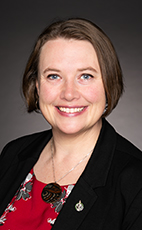
House of Commons photo

Crucial Fact

  • Her favourite word was veterans.

Last in Parliament April 2025, as NDP MP for North Island—Powell River (B.C.)

Won her last election, in 2021, with 40% of the vote.

Statements in the House

Business of Supply March 9th, 2017

Madam Speaker, we need to be talking about this. I was so happy to see the private member's bill pass yesterday, which really talked about post-traumatic stress and looked at the realities that our men and women in uniform are facing and what those challenges mean for the families.

It is true that, when troops come home who have dedicated their lives to fighting for their country, they want to make sure when they get back that the people here appreciate it, and when the government has asked them to make that sacrifice, that it is there to support them in a meaningful way. Unfortunately, in the last while, we have seen continuous cuts to veterans affairs, we have seen services on the ground removed, and we have seen more and more vulnerability for those communities, groups, and families. Absolutely, we need to do better. We hope to see the offices open and those services and supports directed to people who are veterans of this country and served us so well.

I would add that we have to make sure those services work across the country. We have a lot of rural communities where veterans are not given the services they need. We need to figure that out, because we need to support the people who have supported our country.

Business of Supply March 9th, 2017

Madam Speaker, I want to take this opportunity to express my deepest gratitude to the member for Esquimalt—Saanich—Sooke, who has been such a good support for me and who has led me to understand so much at the national defence committee, on which I participate with him. It has been an honour to represent the people of my riding of North Island—Powell River in this important work.

I also want to take this opportunity to highlight the dedication of the member for Selkirk—Interlake—Eastman to the Armed Forces, and I thank him for tabling this important motion. The New Democratic Party is proud to support it, as am I.

I am glad to have an opportunity to speak to the government's decision to take away from soldiers fighting against ISIS the tax benefit that provides them with $1,500 to $1,800 per month for the hardships and risks associated with their deployment.

I cannot express how deeply I respect the members of the Canadian Armed Forces. I know that in my own family, with several members participating in different levels of the military, it is something we hold close in our hearts, as we know it is our family and families across Canada who send their family members to represent Canada in the Armed Forces. We can never underestimate what a sacrifice that is, not only for our men and women in uniform but for the men and women who support them.

It is an honour to represent 19 Wing Comox, and it is also deeply humbling. It is the backbone of the community. It is a reminder every day of the protection we enjoy. It is also a reminder of the duty these brave men and women bring to the fabric of our country. It is a reminder of the miracles achieved, even with the constant struggles of underfunding and lack of proper equipment. I deeply admire the tremendous efficiency of the military. It is also a reminder of the close-knit families and the bond that makes Comox so beautiful. It is also a reminder of all of those we have lost.

I have had the chance to forge a relationship with the wing commander in our community. I deeply appreciate the patience and understanding, as I have been taught so much about what happens in our riding and the impact it has on our community.

The battle against ISIS is about intelligence on the ground. I am so proud of the air crews from 19 Wing Comox who are directly involved in Operation Impact, which is Canada's military contribution to the Middle East stabilization force. We are talking about the 407 Long Range Patrol Squadron, which is an integral part of 19 Wing Comox.

With CP-140 Aurora aircraft, our fighting chances are much stronger against the Islamic State of Iraq and the Levant in the Republic of Iraq. The CP-140 Aurora aircraft from 19 Wing will undertake important intelligence, surveillance, and reconnaissance missions as well as provide overland strike coordination and armed reconnaissance coordination that will provide critical information to the coalition forces. If required, they can provide search and rescue missions. As of March 4, 2017, Aurora aircraft have conducted 732 reconnaissance missions, and I am incredibly proud of that work.

Our priority in this House is to make sure that those who serve in the Canadian Forces have the training, equipment, and support they need to deal with the difficult and dangerous work we ask them to do on our behalf every day. Unfortunately, successive governments have failed to deliver proper funding to the Armed Forces to sustain the types of deployments to which they are assigned and to make sure they have the resources they need to fulfill their role and to keep themselves safe. This includes the government delivering on efficient procurement and on increasing major capital investments in the Canadian Armed Forces as a whole.

It has been a wonderful experience for me to represent my riding and the base that resides in it. I have had an incredible opportunity to tour the facilities and to meet so many people who serve us. I have been impressed by the military's flexibility, how hard the members work to make sure that Canadians are protected every day, and the pride with which they do what they do internationally. They do not give up. They make things work, regardless of how hard that may be.

It is not just about equipment. The government must also ensure adequate support services are in place for the returning troops to receive the assistance they may need. Just last night this House voted on Bill C-211 on post-traumatic stress disorder. I was very happy to see this bill move forward and have the chance to be studied in committee, so we can develop a comprehensive federal framework on post-traumatic stress disorder in Canada. This is so important to supporting our men and women in uniform, and also to supporting their families that face challenges when they come home.

Recently I had the opportunity to represent Canada at a NATO update. One of the things that I came away so proud of was the incredible reputation of the Canadian Armed Forces. We heard again and again about the willingness, the flexibility, the high level of standards and training that our men and women in uniform have. It just made me feel so proud.

We know, every day, that when we stand up in the international world, we can be proud of the people who serve this country, because they have stepped up for us again and again. I think it is so important that we need to make sure we are helping save lives on the ground now by addressing the deepening humanitarian crisis unfolding in Syria and Iraq.

Canada should be a leader in alleviating the suffering of civilians caught in this conflict. Again, what we heard repeatedly is that across the world people who are in crisis trust our amazing soldiers who stand up every day. I think it is important that we look at ways to welcome refugees coming to Canada, especially when we look at the reality of the American President backing away from his country's commitment to refugees. Canada must raise its humanitarian aid to refugee camps in the region, especially in Jordan, as the refugee crisis has continued to bring the Jordanian government and society to the brink of collapse.

This mission requires clarity. I do not know if the Conservatives, while in power, were very honest about the mission from the very beginning. They misled Canadians about our soldiers being involved in the ground combat and failed to make a case for Canada's military involvement.

Now we see the current government following in those footsteps with the latest announcement on the changes to Canada's military role. When the Prime Minister made the initial announcement, he left more questions than answers regarding our role in the fight against ISIS. With increased boots on the ground at the front lines, as the Prime Minister has indicated, we now have to see what commitment Canada has made to a larger military role with no end date and no parameters to define success. It is only right that our men and women in uniform know what they are being asked to do, and know what success looks like.

With Canadian troops deployed in conflict zones, those on the front lines engaging enemy forces should receive the extra tax benefit that previous deployments have received. Canadian troops have seen armed combat in this deployment, yet the government calls this mission advise and assist. We really need to know the truth here. If Canadian troops are engaged in combat operations against Islamic State fighters, how can the government justify taking away the combat tax benefit to our deployed troops?

I just want to close by saying this. I am so proud to see that all members around this House are going to support this motion moving forward. It is so important that, when we ask our men and women in uniform to potentially make the ultimate sacrifice, and when we ask those families to let them go to other countries and face huge challenges, we need to support them in the best way and make sure those families are provided the support they need.

Fisheries and Oceans March 7th, 2017

Mr. Speaker, the Liberal government proposed the oceans protection plan, promising a world-class spill response. People on the ground are watching.

Yesterday, the Minister of Fisheries, Oceans and the Canadian Coast Guard said that the Coast Guard and responders reacted very quickly to contain a spill and to clean up the spill. It took nine hours for the first booms and a few absorbent pads to be dispersed haphazardly and only near the fish pens.

Is this what the minister considers a quick response? If this is Canada's world-class response, we may have a problem.

Business of Supply March 7th, 2017

Madam Speaker, what we are talking about is something that is so important, which is whether we are all paying our fair share. If we are not paying our fair share, what is the recourse to addressing that issue?

What we are seeing is people negotiating internally, people with a lot of resources, a lot of wealth are saying that if they get caught breaking the rules, they will just have to reimburse it, not pay a fine.

When we look at the reality of everyday Canadians who are working so hard just to save up to pay for their kids' braces or their kids' education, hoping that when their kids get bigger they can afford a pair of shoes. These are everyday Canadian realities.

Then we have the very wealthy not paying their fair share, not being held accountable, and those resources not going into making sure that they are held accountable for when they cheat the system. We need to see the government step up. We need to see actual action. We need to see some movement. It is only right that we protect the Canadians who struggle the most.

Business of Supply March 7th, 2017

Madam Speaker, the reality for the people of North Island—Powell River who work hard every day is that they are not seeing the changes they need to see.

They want to see proper investment in their communities, in infrastructure, making sure that all of that aging infrastructure is actually cared for so that we can also see those jobs coming into our communities. They are very concerned about this cash for access that they seeing, where people with a lot of money are suddenly getting opportunities. They want to know that the government is on their side, and they are not seeing that.

The reality is the so-called middle-class tax break does not include people unless they make $45,000 or more. That is a small amount of money that they will be getting. We want to see people who are struggling every day, working minimum wage jobs, getting the support that they need.

As well, it is about seniors who are facing multiple challenges. They cannot afford their medication. The government is signing deals that make sure their medication costs are going to go up. When is it going to end?

Those costs are being downloaded on the people who need the most help, while the people who make the most are getting away with tax evasion. Shame on the government for not doing its job.

Business of Supply March 7th, 2017

Madam Speaker, I grew up in a simple home where hard work was just part of our life. My father worked in the forest industry, and my mother continues to be a psychiatric nurse. When the forest industry struggled, our family struggled but we always worked hard.

My family instilled in me a desire to ensure I always paid my fair share. My parents always told me, and I have always told my children this, not to complain about paying taxes, that this investment went into the important things like health care, highways, and helping those in need.

This is what we are here to talk about today, paying our fair share, ensuring all people in Canada are paying their part so we can build a strong country, invest in those things that build our social network, and keep the standard of living balanced in our country.

We are here today because everyday hard-working people are paying their fair share, even when it hurts. While these folks are doing their part, some with so much more are finding ways to not pay their part.

I would like to thank the NDP finance critic for bringing forward this motion, which is meant to address systemic inequalities in our fiscal system. Tax evasion, loopholes, shell companies, and tax havens are tools to avoid paying taxes. For weeks, KPMG has made headline after headline. Every couple of months we hear a similar story, creative money-peddling accountants finding a new way to cheat the system, and millionaires and billionaires finding ways to hide their money.

I want to be really clear. This money is made off the labour of someone. Their profit is at the expense of hard-working people across Canada. This is why ending tax loopholes is so important. We must look at this seriously because it is about the value of the working person. There are so many revelations that sometimes I have the urge to simply not read the articles. It is disheartening when so many people in my riding of North Island—Powell River are struggling hard every day. These stories pop up every couple of months, year after year, and we are still waiting for some real solutions.

We have all read at some point about creative money-peddling accountants finding new ways to cheat by whatever means and pushing countries in a race to the tax bottom, or pressuring the government not to take up the fight. Despite this, I still strongly think we cannot give in, that we can slowly and smartly take steps to dismantle these schemes and strengthen our Income Tax Act. This is so important. It is about the hard-working people in Canada who are paying more than their fair share, while rich people, millionaires and billionaires, are hiding their money.

I am so proud that today's motion offers some very specific examples of what Parliament should take very seriously moving forward. One example is the recent deal given to clients of KPMG, which facilitated their tax evasion, that freed them from any future civil or criminal prosecution, as well as any penalties or fines. In my riding, if people owe just a little, they are absolutely paying penalties and fines, even when it hurts them to do so.

The NDP is calling for a full investigation into the KPMG affair. Ending penalty-free amnesty deals for individuals suspected of tax evasion, a gift to wealthy tax evaders and aggressive tax avoiders, should seriously be considered. Enough is enough.

Another example is changing the corporate tax rules that allow for the use of shell companies, which serve no economic purpose other than to protect the wealth of the ultra rich. It plays an important role in large scale money laundering activities. At the heart of the Panama papers was the law firm Mossack Fonseca, which managed more than 300,000 companies over the years. This is unacceptable.

This debate is also a great stepping stone to this year's debate on the budget because of the opportunities and priorities of the budget and what they can do for all of us.

First, this is an opportunity for the finance minister, by addressing these special credits and loopholes that cost the government more than $100 billion in forgone revenue per year. If even a portion of this sum were recuperated, it could pay for a national pharmacare program, a national child care program, and upholding equal care for first nations children. We are still waiting for that amount of money to be provided for children who are suffering across our country.

Second, budgets are about priorities. In my riding of North Island—Powell River last week, I participated in the Coldest Night of the Year walk. I was tremendously pleased that so many from the community of Campbell River, across the riding, and other communities came and fundraised. They know the reality of people who do not have homes, or do not have appropriate food, or struggle every day just to survive.

It is so important to remember the people who pay their fair share and fight hard just to survive every day when we see what is happening with tax loopholes and tax evasion. I am very keen to take a close look at the proposed measures in due time to ensure fairness, including fiscal fairness, is finally taken seriously. Canadians deserve that.

The Liberals have not taken tax fairness very seriously in the past, and it is time to change that. If we take a step back for a moment, we see two parties in the House defending their sad record. They will share vast amounts of numbers, like the amount invested in the Canada Revenue Agency, recapturing funds, along with many fairytales, but Canadians are not fooled by these smokescreens. They know that lost revenue is due to misguided priorities and discarded promises.

One of the broken promises has to do with the stock option deduction. After promising during the last election campaign to fully tax individual stock option gains exceeding $100,000, the Liberals announced they would leave it untouched after they formed government. Again, hard-working Canadians are paying their fair share every day. It is only reasonable for us to hold to account those who are not paying their fair share.

We have now learned of intense lobbying by Bay Street CEOs, who benefit greatly from this measure, to keep the loophole open. At some point, we have to make the decision, and I hope the Liberal government will actually take steps toward ensuring that not only hard-working Canadians pay their fair share, but that the CEOs of companies pay their fair share as well. This loophole benefits the ultra rich, yet successive Liberal and Conservative governments have given up billions of dollars in tax revenue over the past three decades due to this loophole. The Liberals' flip-flop on the stock option loophole shows the influence that powerful insider lobbyists have on the government's policies.

The people who have influence on my priorities are the people who I serve in North Island—Powell River, people who work really hard every day, who have had to face the challenges of a changing economy, seeing a resource-based economy, watching as forest companies struggle, and watching as trees are shipped out of the riding. They want more of those good-paying jobs in their communities and they want to ensure they are not paying more than their fair share when other people are not paying what they should be.

The government's systemic acceptance of tax fraudsters and their entities is enabling them to cheat the system. Our system allows every citizen to contribute equitably to public services and social programs. If they do not, every Canadian is cheated.

In its 2016 annual report, Oxfam blamed tax havens on income inequality for much of the widening gap between the rich and the poor. Canadians want better health care, community infrastructure, good jobs, and for us to tackle climate change. Instead, the Liberals are maintaining tax loopholes that benefit Canada's wealthiest, while leaving most Canadians behind.

Seniors are making choices among heat, medication, and housing. Families cannot afford day care or even the toonie it takes to send their kids on school trips. It is time everyone pay their fair share and stop leaving the burden on the people who work the hardest and struggle the most.

Fisheries and Oceans March 6th, 2017

Mr. Speaker, Canadians deserve to know what went wrong on Sunday, when 1,500 litres of diesel spilled from a fish farm on the B.C. coast. This spill threatens the biodiversity of our coast and first nations' traditional food sources. As my constituents watched, horrified, many questions remain unanswered. Our coastal communities will live with the impacts of this spill for a long time to come. Will the government please update Canadians on its response plan?

Systemic Racism and Religious Discrimination February 15th, 2017

Mr. Speaker, today I rise to speak on Motion No. 103, racism and religious discrimination. I sincerely wish I could go to the heart of the matter, to speak on the intentions of this motion. Sadly, I rise today amidst a growing campaign asking members of the House to reject the motion.

I want to address some of the concerns now, stand up, and speak truthfully. It is unfortunate that there is so much misinformation surrounding Motion No. 103. There is a growing world where alternative facts are presented as reality. It is very important that we take our responsibilities seriously to understand the motion before us today. However, so-called media venues are bending facts and creating an environment of fear that can create hate. I hope all members of the House stand against so-called alternative facts that are based in fear and not in fact.

These truth-bending facts have promoted fear that this motion would suppress freedom of speech, emphasize one religion ahead of another, and create a media ban, just to name a few. These are falsehoods, so let us break it down.

The “M” stands for “Motion”. Motions are symbolic in nature. They do not impose any legal obligation on the part of the government. They simply indicate to the government that they have the moral support of the House. Motion No. 103 is not even written in a format that directly suggests any clear legislative action. This motion only asks to carry out an assessment. It is asking the Standing Committee on Canadian Heritage for context and recommendations on the state of systemic racism and religious discrimination in Canada in order to reduce it.

I want to pause here, because this motion asks for context and recommendation of the state of all forms of systemic racism and religious discrimination in Canada. Asking a committee to explore the state of these important issues makes this completely in conformity with the charter. It is compliant.

As a party that supports freedom of speech, we believe that we should be encouraging a vigorous debate and discussions about issues, including Islamophobia. Some have suggested that this motion would limit our ability to debate or censure discussion. As a motion, it cannot do that, and, notably, that is neither the intent nor the consequence of Motion No. 103.

I have been very touched and inspired by the members of the Muslim community, who opened the doors of their mosques to have members of the broader community enter and learn more about their Muslim faith. This is an example of opening doors and building bridges, rather than closing doors. I would like to stress the importance of doing everything we can to protect and maintain our democracy and essential freedoms.

The reality is that Canada has experienced an increase in numbers of targeted attacks toward Muslims. The recent attack in Quebec City, where members of the Muslim community were killed and many wounded in their place of worship, is a stark reminder that we need to stand together against racism and discrimination. Any form of violence or discrimination against a specific community is unacceptable in our country.

The incidence of anti-Muslim hate crimes, or incidents reported to the NCCM, the police, or in the media, has risen sharply since 2015. That some do not seem to understand or want to understand Islamophobia is shocking to me. Are they not aware of the gradual increase of verbal attacks and attacks on property over the last four years?

It is very important that we also remind people that some brothers and sisters of the Muslim faith are visibly apparent, especially some Muslim women, in the risk that they take by just practising their faith. We are not stepping up to say, “In Canada, we will not be okay with this.” We need to do that in the House. We need to take that leadership.

Fighting against these discriminations is a profound way to protect our most cherished and fundamental values as Canadians. New Democrats hope this motion is an opportunity to reach out, give voice to impacted communities, and start a dialogue. We can build more inclusive communities.

It offers an opportunity for all parties to work together on an issue that concerns the very fabric of our country. The NDP is committed to multiculturalism and we would be pleased to play a positive role in the upcoming study.

Let us be clear. This is a worldwide issue that is broader than Trump's latest action of putting up a Muslim ban, one that is impacting Canadian citizens as we have recently seen.

In Canada, there are about 100 active white power organizations. These have been re-energized and welcome divisive rhetoric. Twitter users can self-identify as white nationalists and neo-Nazis have grown 600% since 2012, according to a new study by George Washington University's program on extremism.

Death threats, physical harm, and property destruction have become a sombre norm for many and this for partaking peacefully in Canadian society. We cannot be complacent. We cannot be fearful. We must stand together against this current global climate of hate, fear, and violence.

Our multicultural society will only flourish in a context of cultural diversity whereby religious discrimination is clearly unacceptable. Let us rather confront these types of discrimination head-on and make progress together.

This motion is about addressing the issue directly. I want to express my deepest thanks to the communities across Canada that circled the mosques in our country to provide a sense of safety when people went back to their holy place after the Quebec terror attacks. This was a true testament to Canadian values of safety and inclusion.

I thank the mosques that have opened their doors to share their beliefs with Canadians across Canada. This action is one, again, that opens doors to have conversations and to grow understanding. We cannot let fear be our guide. I hope Canadians will choose openness and curiosity instead.

In my last job, one of the things we did was open very meaningful conversations. We held dialogues and community circles, where diversity would come together and have open conversations, places where we could actually ask those questions that were sometimes hard to ask.

One unfortunate thing was when the then Conservative government took the funding of immigrant services back from the provinces. We found there was no support to continue that very important work, of working in communities one by one, to bring diverse groups together to have meaningful conversations, to build those bridges.

I hope that out of the research done at the committee, one of the things we identify is the need to give some support to those organizations that bring diverse people together to have those really meaningful conversations. That is how we build a Canada of which we can all be proud, one of which we have a long history.

Let us do that work together. I hope to see everyone stand in this place, stand up against Islamophobia and support the motion.

Systemic Racism and Religious Discrimination February 15th, 2017

Mr. Speaker, in my past work, I worked in an organization that served newcomers to Canada. A big part of what we did was work in our community around strengthening the bonds of multiculturalism.

When one lives in a community as I did in Campbell River, when somebody showed up who looked a little different, people noticed very quickly. I was always very heartened by the fact that so many people would call our office when they saw people who looked a little different. They wanted to ensure they were connected to my organization and were getting the support they needed.

It is also very important that we look at the reality that Islamophobia is a growing discrimination in our country today, and we need to address it.

How does the member think the study will impact the Muslim community, and how does she envision the study assisting the broader issues of systemic racism and religious discrimination?

Canada-European Union Comprehensive Economic and Trade Agreement Implementation Act February 13th, 2017

Mr. Speaker, I have the privilege of having not only cheese and yogourt producers but also dairy farms in my riding. They definitely came to me with this and talked about their specific concerns.

Again, the reality is that these industries create good-paying jobs in our communities. The industries are small but vigorous, and they work hard every day. It is unfortunate and very hard on these industries when we see the lack of funding that is there for them.

I will continue to work with them, but this is another issue where the government really needs to take some accountability and realize that we need to keep these businesses strong. They mean a lot in our small communities.