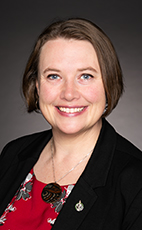
House of Commons photo

Crucial Fact

  • Her favourite word was veterans.

Last in Parliament April 2025, as NDP MP for North Island—Powell River (B.C.)

Won her last election, in 2021, with 40% of the vote.

Statements in the House

Committees of the House November 3rd, 2022

Mr. Speaker, I did note the organization and what its name was earlier. What was so important is that the stakeholders and the municipality came together to say it was an issue they wanted to address. By bringing everyone together within that community, they identified I believe about 20 veterans in their area who were homeless. They then actively created strategies collectively.

One of the things we know, especially when we sit here in a federal seat, is that we are big and we cover a huge country, but local solutions make the most sense because local people know how to work collaboratively, so it is important that, as the federal level of government, we always look at ways we can support the people on the ground. If those resources are not given to those organizations, then the actions cannot be taken in a meaningful way.

I am glad London could do this, but I think it is very important that the federal government steps up, supports these kinds of programs and looks at models that work so we can do what we must do, which is get veterans into homes.

Committees of the House November 3rd, 2022

Mr. Speaker, one of the key things we have heard from veterans repeatedly is that the transition period moving from service into their role as veterans is fraught with problems. The information back and forth is fragmented. They often carry the large load of trying to figure out how to make the system work. Therefore, the orientation of what services are available is not clear and is not done the way they need.

When we think about serving people, one of the best and important things we can do, especially when we are in a seat of government, is to listen to people who go through those transition processes, hear where the problems are and fix them. It is not to blame veterans for not being able to ask for help, but to understand that we need to provide better help. That transition period is absolutely key. If the trust is not built there, then veterans will not feel comfortable to come forward to say they need assistance.

Committees of the House November 3rd, 2022

Mr. Speaker, I will be sharing my time with the amazing member for Edmonton Griesbach.

When I reflect upon this report, I remember back to 2019 when it was initially tabled. There was a sense of urgency from all parties in the House that this needed to be a priority for the government and action needed to be taken, so it is frustrating to be having this discussion again, knowing this report from 2019 was retabled by the committee, which had been waiting for a response from the government. The committee has now received that response. However, it still does not address the key issues. When we retabled this, I wrote clearly in the supplementary report that it has been a full three years, yet very little action has been taken on this critical issue.

I think also of how many veterans I have spoken to, how many veterans have come to the House of Commons to be a witness for us and how many veterans have sat at the table at the Standing Committee on Veterans Affairs. Many times they are asked if they would serve again, and they always say yes. What surprises me as well is how many of them, when asked if they would encourage their own children or relatives to serve, say yes.

When we look at the reality of it, about 5,000 veterans are homeless now, without a safe place to live and dealing with things most of us cannot imagine, and they are still there. Even though they are there, they would still serve our country again. Their commitment to service runs that deep. It is important we remember that when we have these discussions.

Their dedication to service is so profound, and our dedication to serve should, at the very least, match theirs. Our service to veterans, as parliamentarians, is to make sure they have the best services they can, that they are accessible and that they are not waiting a long, long time for them. We have to make sure that 5,000 veterans are not going to bed tonight without a safe home to live in.

When I think of this, I think of recommendation 3 of the report, which reads, “That Veterans Affairs Canada, in cooperation with Employment and Social Development Canada and organizations supporting academic research, continue its efforts to better understand veterans’ homelessness, taking into account the overrepresentation of women and Indigenous peoples.”

It is important to research this, but at the same time, we need to figure out what is going on and do actions. I talked earlier today about the work being done in London, Ontario, to collectively identify veterans in the community who are homeless and make sure they have a safe place to live. It is important we recognize this.

We know, sadly, that of those veterans who are homeless, the number of women and indigenous people in this population is really high, when all of us in this place know that are they are still a very small part of the forces who serve us. Why is that? We need to figure out why that is. We also need to acknowledge that sometimes these groups are marginalized groups within a larger group who are even more marginalized by our systems. It is important that research is done, and that we honour that.

I come back to something else I also mentioned earlier today, which is the fact the Auditor General, in their report, was very clear that Veterans Affairs Canada does not collect data in a way that allows it to identify where the problems are. When we have veterans who do not have a home, who are waiting for the services they need and falling through the cracks, and who feel a great deal of distrust for the ministry, the department and the people who work there, we also need to look at the fact that the data is not there to provide the information to correct the problem.

What we see continuously is money being poured in, but we do not know if that money is being spent effectively because we do not know where there are bottlenecks. We do not know where the blockages are that veterans just simply cannot get through. We do not know that, and that is on the government. It is on the government to fix this core problem.

I know that we can talk about a lot of exciting things that get people really upset, but having good data means better services to veterans. I am very firm that we cannot stop talking about how important this is because a lack of data means veterans are not getting the services they deserve.

Recommendation 4 specifically talks about a “partnership with other federal, provincial/territorial and municipal organizations concerned, and with the community agencies”. In my riding, I have 11 Legions across some of the smallest communities we will ever see. The Legions are cornerstones to those communities because they provide support and services, and they create a place where a community to get together.

Those organizations want to do the work. We asked the government to take all of those stakeholders and make sure to work with them to implement an action plan, such as the national housing strategy, to actually get to the core and eradicate homelessness for veterans.

What we do know is that there are piecemeal investments under the national housing strategy in 2021. It really focuses on Edmonton and Ottawa, but it does not have any concrete plan to address this. That is a concern, and we know it can be done. Strategies can help veterans get into homes.

In fact, and I will say it again, on February 16, 2021, in London, Ontario they did just that. They did it. Built for Zero Canada, working with the Canadian Alliance to End Homelessness on the national effort to address the problem, monitors the progress of 12 participating cities. It endorsed London's claim that the city had the first Canadian community to attain the status of functional zero for veteran homelessness because the groups focused on the issue, gathered the relevant data, looked at community-focused solutions and did it.

This is a model that we could be implementing by working with communities, regions, organizations and municipalities to identify what is happening in their community and which veterans are falling through the cracks. This is important because veterans do not often complain if they are homeless. They are ashamed that they are homeless, as though it is their fault, and they do not step up to disclose it.

So many witnesses have come before us to say that often, when veterans are homeless, they will not disclose that they are veterans, so they do not even know how to connect them with those resources. They have shame and also a feeling that the department will not do anything for them. Those things need to be addressed. They need to be taken seriously, and we need to demonstrate for veterans that there are solutions and that, if they reach out for help, they are actually going to receive it.

Not too long ago, I had a family member come to speak to me about a veteran in their family. She is an indigenous woman. She spent many, many years serving this country, and now she is couch surfing. She is living on the edge because how she left was not a good way to leave. I do not have permission to share what happened to her, but it was not a good thing. She left in desperation for her own safety from the military.

Now she is sleeping on couches, and she has so much need, but no matter how much her family loves her and no matter how much they reach out to her, they cannot get her to ask for the services because she no longer trusts the system. We need to look at that. We need to own that in the House and stop pointing fingers. We need to start saying we are going to stop doing that and we are going to start serving veterans.

In closing, I want to talk about recommendation 7, “That Veterans Affairs Canada and the Royal Canadian Mounted Police...sign a memorandum of understanding to make RCMP veterans eligible for the Veterans Emergency Fund under the same terms and conditions as Canadian Armed Forces veterans.” We have heard from the president of the RCMP Veterans' Association that this has not gone into place. However people have served this country, we have to show them that, on the other side of their service, they will be respected enough to get the support they deserve. I am here in the House asking for that to be a reality because veterans have served us. We had best serve them back.

Committees of the House November 3rd, 2022

Mr. Speaker, I thank the member for his very important speech. We have worked together on the veterans committee for years and I really appreciate his dedication, especially to francophone veterans.

Earlier this year, we were honoured to go with the minister to some important places. We went to Vimy Ridge and we went to Menin Gate. Those are places where there is such a deep respect for the men and women who served Canada and who served in those places during times that none of us can imagine. What concerns me is that we hear this long-standing history of Canada failing veterans. We continue to have over 5,000 veterans today who are without homes.

Why do we appreciate their sacrifice, but we do not see the government, or the past Conservative government, recognizing what needs to happen for veterans?

Committees of the House November 3rd, 2022

Mr. Speaker, I serve with the member on the veterans affairs committee, on which I have served for many years. I was there when the first report was tabled and then retabled to get a response from the government because it did not get a response due to the election in 2019.

It is too bad that we are not seeing the numbers change. There are 5,000 veterans, it is estimated, who are still without a home or a safe place to be, and those are the people who served our country.

The Auditor General was very clear in her report. One of the biggest challenges is that there is no correct data to identify the places where there are shutdowns of services. When we look at the system, services are not being delivered and we do not know why because the data does not tell us why. That seems like a big concern.

Will the government invest in making sure that the data is there so we can identify the bottlenecks and serve veterans much more effectively?

Committees of the House November 3rd, 2022

Mr. Speaker, I thank the member for mentioning so many local organizations that are working so hard to keep our veterans in a safe place.

I wonder if the member would comment on the fact that London, Ontario is the first city in Canada to attain functional zero veterans homelessness status and how important it is for all levels of government to work closely with communities and organizations that are getting the work done, so whatever process is put forward actually works.

Veterans' Week November 2nd, 2022

Mr. Speaker, I am honoured to stand in this place on behalf of my New Democrat colleagues to recognize the sacrifices Canadians have made to pay for the freedom and democracy of our home and the homes of those in other countries. On November 11, we honour those who dedicated their lives in service for Canadians. We remember those who lost their lives in the line of duty, and we show our respect to those who continue to serve in war and peace, both at home and abroad, in protection of our rights and freedoms.

On November 8, we honour indigenous veterans. Back home in my riding on Vancouver Island, the plane of reconciliation hangs in the Comox Valley Airport. It is a unique commemoration of the substantial contributions made by indigenous veterans to Canada, who sacrificed not only their lives, but also their status and rights if they returned home. This history must not be suppressed. We must remember their bravery and their stories to ensure a better future for everyone who serves today.

As the NDP critic for veterans affairs, I am always deeply humbled and moved when I hear the stories of brave Canadian soldiers who endured significant burdens to do as they are called upon for our country. I have heard from generations of soldiers, and every single story is important for us to hear. It is in the remembering and the knowing that we do not forget.

This year, when I laid a wreath on behalf of the Parliament of Canada at Vimy Ridge with the member for Bruce—Grey—Owen Sound, I was deeply humbled by the love for Canadian soldiers in France. Driving through those communities and seeing both poppies and Canadian flags in the windows gave me a deep appreciation of the sacrifice, and the gratitude for that sacrifice.

Standing over the graves of so many young Canadian soldiers has also left me with a tremendous respect for those who wear the uniform and a deep confirmation that the cost of war is far too great. It is a cost that cannot ever be taken without the deepest of consideration. As we see the conflict of our planet, we must always consider the preciousness of every single life and the sacrifice we are asking for when we ask them to protect us. When I was a young person, my neighbours were a couple who had fled Nazi Germany. I remember Mary telling me, “We must pray for peace unceasingly.” Every year of my life, I understand this more fulsomely.

The cost of war is high, and there are many ways to remember and thank those who paid the ultimate price, as well as those who came home with wounds, which we often cannot see, but often there are ones that we can. There is also the sacrifice of those who loved them the best. Remembering is a commitment every Canadian must dedicate themselves to, and not just for a week a year during Veterans' Week, but every single day. History repeats itself unless we learn collectively and remind ourselves what sacrifice is.

Canadians from all walks of life and diverse backgrounds have served and continue to serve today, from serving in the major wars of the first half of the 20th century to fighting in Afghanistan and the Middle East, and from peacekeeping in overseas operations to helping right here at home combatting the COVID-19 pandemic, floods and forest fires. Those are the many contributions the armed forces have made.

When the call is made for them, whether it is domestically or away, I hope we in this place and every Canadian all remember the body in each of those uniforms, and that each soul has loved ones who stand beside them. They know the risk and are willing to carry it in service of our country.

Earlier this year, on May 14, our riding lost 100-year-old veteran James “Stocky” Edwards, a Canadian fighter pilot during World War II and a community touchstone. We all miss him so very much. Many soldiers from the Second World War have left us. It falls on us to carry their stories and their history, which is our history, and learn and understand the history of every task and battle put before our Canadian Armed Forces, for which they rose to the challenge.

On this Remembrance Day, to all members of the Canadian Armed Forces, past and present, I thank them deeply for their service. I thank them for getting up every day and protecting our country, both in the past and the present. I call on all civilian Canadians to take on their responsibility to learn and understand so that we remember, lest we forget.

Health November 1st, 2022

Madam Speaker, it is very clear. What all the premiers across this country are asking for is an increase to the health care transfer. We can talk about the ties that should be put on there in terms of criteria, but we know that these hospitals' emergency rooms have been closed 28 days. There have been weeks of nights where, if anything happened, these people could not access an emergency room.

Rural and remote communities deserve better. We can talk about Quadra Island, another ferry-dependent island in my community. It has had no local paramedics for 11 days. In Campbell River, hospital labs for outpatients have been closed all weekend, sending people away to get the services they desperately need, and wait times are only increasing. This has huge economic impacts on rural and remote communities as well. How do these communities attract people when they know there is not an emergency room?

The government needs to listen to Canadians, listen to the premiers and start putting more money into those health care transfers now.

Health November 1st, 2022

Madam Speaker, I am here today to talk about public health care. In this country, we are seeing public health care being undermined and falling apart in profound ways. I am seeing it fall apart in my riding in ways that I could never have imagined just a few years ago.

Before I talk about the specific issue, I want to take this opportunity to thank the health care workers, all the professionals, doctors, nurses and all the support staff around them who supported us through the pandemic.

We have heard all of the stats about having a high level of burnout. A lot of folks who were planning to work for many more years are retiring early because of the stress and because of those real concerns. I want to thank them and honour their work.

We also know that health care across Canada has reached a crisis point. For months in my riding, emergency rooms have been closing in Port Hardy, Port McNeill and Alert Bay.

For Canadians who do not know, Alert Bay is a ferry community on Malcolm Island. Receiving health care in its hospital is key because people cannot drive somewhere quickly. That is a major concern.

There have been multiple weeks of some of these hospitals being shut down and their emergency rooms being shut down all night long. I cannot imagine how terrifying it is for my constituents to know they do not have an emergency room around the corner if they desperately need it in the middle of the night.

In fact, in October, Port Hardy's emergency room was closed for 28 nights of the month. There were 28 nights with no emergency room facilities. The reason is a lack of staffing. There are not enough doctors, not enough nurses and not enough people to provide those essential services.

In this country, we are watching our national public health care system fall apart at the seams. I am here to plead for my constituents. I am coming before this place to ask the federal government to step up and start doing its part.

Whenever I think of universal public health care, I think of Tommy Douglas. He was voted the greatest Canadian because of his fundamental work in public health care and in making sure that was a reality in Canada.

We have heard the stories before the system was in place of people losing absolutely everything because they had to pay for health care to try to save the lives of loved ones. Tommy Douglas said, “I came to believe that health services ought not to have a price tag on them, and that people should be able to get whatever health services they required irrespective of their individual capacity to pay.”

We know that Canadians believe in public health care. We know that any form of privatization promises only a return to everyday Canadians who rely on their individual capacity to pay for health care. I hope the government is going to stand against that.

I am tired of hearing that this is a provincial or territorial responsibility. This is a joint responsibility, one where we are seeing very clearly the premiers of every province and territory stand up. They are doing a collective ad campaign calling on the federal government to step up and pay its part. That is tremendously important. How often do all premiers agree so specifically on something?

Rural and remote communities across the country have been left behind. The federal government needs to step up and make sure there is a meaningful strategy for health care for communities like mine. They are desperately waiting.

Health October 31st, 2022

Mr. Speaker, last week, a North Island resident told me she is scared for the safety of her family because of the Port Hardy Hospital emergency room closures. There is not enough staff to keep it open. This is a crisis. Canadians cannot access public health care. Rural communities have been left behind by underfunding for health care by both Conservative and Liberal governments.

Will the government finally listen to the pleas of British Columbians for more federal funding for public health care?