
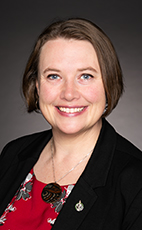
House of Commons photo

Crucial Fact

  • Her favourite word was veterans.

Last in Parliament April 2025, as NDP MP for North Island—Powell River (B.C.)

Won her last election, in 2021, with 40% of the vote.

Statements in the House

Budget Implementation Act, 2024, No. 1 May 7th, 2024

Madam Speaker, it is good to be here to speak on behalf of the amazing people of North Island—Powell River on the budget bill.

I want to acknowledge that it is really hard times. Not only in Canada but in many countries across the planet, we are seeing massive challenges during this time. I feel fundamentally that we have to raise the bar of dignity in this country so that people can live with dignity and respect, and we know that is not happening enough.

I will talk a little bit about the things I am supportive of in this budget and also share some of my concerns.

The first thing I want to bring up is the launching of the new national school food program. My colleague, the member for Courtenay—Alberni, and I were with our leader in Comox Valley. We were standing with representatives of Lush Valley, which does tremendous work in our region providing safe, local food and works with a lot of schools in the region to make sure there is healthy food provided. What they were very clear about was that they were grateful for how much the provincial government in B.C. had stood up and given funding, but they needed to see that funding matched because the need is increasing so much.

We know that young people across Canada are faced with challenges, and it is very hard to learn when one has not had breakfast. One of the things about this program that I fundamentally believe in is that it has to be accessible for everyone. When we talk about dignity, it means making sure that what one person gets the other person gets, and that there is no feeling of “you go off and eat because we know you are poor”, which is so destructive. I am really proud of the work that is being done here. I know that Lush Valley and many organizations across my riding will be grateful for this money because it will provide food in a way that is open and friendly and make sure that nobody, even these young children, lose their dignity in that sense.

I was also happy to see the health transfer grow. It is not as much as I would necessarily like it to be, but in my riding, health care is, in some cases, at a pretty significant crisis point. The provincial government has stood up and done a lot of profound and important work, but there is still so much more that needs to be done and that needs revenue.

I think of the folks in Port Hardy. I was there not too long ago, and we were talking a lot about the fact that their emergency room is closed for several hours in the night and how hard it is when people have an emergency and they have to go to Port McNeill. From Alert Bay, they have to take a ferry now instead of going to their hospital to get the help that they need.

In my riding, there are a lot of people aging, and they want to age in place. They want to age in their communities because they know one another and they support one another. That is really important, so I am glad to see this increase. I really hope it supports these people in a meaningful way. We need to see health care being taken of. We need emergency rooms open, and we need health care to be accessible. We need to make sure that it helps people stay in their communities of choice. We have a large country, which is something unique about Canada, but we need to make sure that this increase really helps.

I appreciate as well the expanding of the Canada student loan forgiveness program to pharmacists, dentists, dental hygienists, midwives, early childhood educators, teachers, social workers, personal support workers, physiotherapists and psychologists who choose to work for rural and remote regions. This is really important, because it creates an attraction strategy to show people the beautiful places to live all across Canada. However, the one thing that concerns me about this is that I do not see anything here that would maximize retention.

We know that a lot of people go to smaller communities, they live there for a few years and all too often they will leave once their student loans are paid off, in this example specifically. We need to see support in terms of retention. When I talk to health care providers, sometimes the concerns are things like not enough child care or not enough resources for them to do some of the things they really need to do. We need those services in rural and remote communities. We know that once people settle in those communities, often their lives are so much stronger because of the close connection of the community. It is unfortunate right now because what we are seeing is this constant spinning door of people coming into the community and leaving. We really need to look at retention. I am happy this was done, but I want to see more retention.

In terms of affordability, I was happy to see some of the work done around cracking down on predatory lending. We need to make sure that there is a higher level of accountability because too many people are low-income and they are going to these lending places and are having to pay such a high level of interest that they can never catch up.

I am actually hearing this about people who are providing care for seniors. They are making so little money that they are continuing to have to borrow just to make ends meet and that creates a system that we do not want. It does concern me because the other thing we know is that, in the previous budget, we saw a commitment to making sure that the people who were providing those services would get $25, at the very least. We know that the provinces and territories have not signed on to this, so something is not working to make it attractive enough.

We need to see the wages improve for people who do that care work, who go into people's homes and help them and who go into long-term care facilities and into assisted living facilities and do that important care work. We know it is largely women and unfortunately they are not being paid enough. Therefore, I am glad that there is some accountability for these lending organizations that are very predatory, because the harms can be fundamentally bad and it really leaves people grasping.

I want to thank the member for Courtenay—Alberni for his incredible work. We saw the doubling of the volunteer firefighters tax credit and the search and rescue volunteers tax credit, from $3,000 to $6,000. This is incredible. What we need to understand is that, in rural communities, they would not be able to get insurance on their homes if it were not for the amazing people volunteering as firefighters, because that creates some safety. Therefore, we have to make sure that those amazing volunteers get more. This got us to $6,000, and we want to see it even higher because we know that people who look after our communities and keep us safe need the recognition.

I am excited about the fact that we see some money going into indigenous loan guarantee programs. We need to see indigenous communities getting the supports they need to build their businesses. We know that our legislative agenda, both provincially and federally, has been to isolate indigenous communities from participating in our economy for far too long. We are still trying to overcome some of those systemic problems, so it is good to see some movement.

I was also pleased to see a bit more tax for those who are making a ton of money off of the labour of everyday Canadians. We know that there is the implementation of a 15% global minimum tax to ensure that large multinational corporations start to pay close to their fair share, wherever they do business. That is really important because it is about time that we see that.

There are some things that did concern me about this budget. I was glad that we came along and made sure that Indigenous Services did not see the big cut in funding that was predicted and being forecast. We worked really hard to make sure that funding was not removed.

I am also very concerned about the first nations funding for languages. We have heard very clearly from the First Peoples' Cultural Council that this is a big concern. For my riding, North Island College has worked with several indigenous communities across our riding to build courses so that people can come in and learn the language. That is for everybody, and it is quite profound to see both indigenous people and non-indigenous people coming to learn the language of the first people of the territory that they live on. I think of the 'Namgis First Nation, which is creating a whole cultural revolution in its region and really helping children, often who are exposed mostly, if not 100%, to their own language first for a period of time so that the language will be strong in them. I know that Tla’amin Nation near Powell River is doing a lot of tremendous work in this area as well. Therefore, it is too bad not to see that language funding there because we know that is a key part.

I look forward to answering any questions.

Budget Implementation Act, 2024, No. 1 May 7th, 2024

Madam Speaker, one thing that I admit I have concerns about in the budget is the lack of funding for first nations languages. We have heard clearly from the First Peoples' Cultural Council that this is a significant concern. For me, I think about the many communities that are working with North Island College in my region to set up classes to teach language. I think about ‘Namgis, which has a facility where they nest young people to learn the language, and Tla'amin, which is doing something very similar. Does the member share my concern around first nations languages in the budget?

Pharmacare Act May 6th, 2024

Madam Speaker, this is a place of debate. We are looking at complex issues and trying to find solutions that would better the reality of Canadians across the country. I believe and understand that bulk buying would allow the cost of medications to go down a lot.

Is there a way the member could envision a respectful process that really looks at us buying collectively, as a country, to see those costs go down, while also honouring the provincial distinctions?

Pharmacare Act May 6th, 2024

Mr. Speaker, there are three million people across our country living with diabetes, and they pay about $18,000 a year out-of-pocket. This is going to make a big difference for those folks, especially knowing that they are going to have the devices as well.

This is the first step in a model that I really believe in, which would result in collective purchasing. Any Canadian would know that, when we buy collectively, prices usually go down. Of course, that is why Canada pays the second- or third-highest medication rates on the planet.

Does the member have any thoughts on the hopefulness of the people who will finally get medication they can afford?

Committees of the House May 2nd, 2024

Mr. Speaker, I am the spokesperson on the Standing Committee on Veterans Affairs, and one of the things we just finished studying and we are now working on the report for is around women veterans. It was so interesting to hear from them about when they had that moment of making the decision to stay or to leave and what the impacts were.

One of the things I have had frank conversations about is the fact that we are not back in the fifties or the forties anymore. It is a totally different world. We need both people in the family working to sustain ourselves, so how do we make sure both people have an opportunity? Child care comes up and housing comes up. Things that matter to everyday Canadians matter to military people. Their work is very unique and we have to honour that and find ways to support them, and government needs to be a key part of that. If it is not, it is obviously never going to get done.

Committees of the House May 2nd, 2024

Mr. Speaker, I really enjoy sharing a border with the member, and we work together collaboratively on all the issues that face the military folks in our region, because it is really important.

It is important for us, as Canadians, to understand what our military does, the great work it does both nationally and internationally, and to understand that, if we do not start looking at military as a whole family, like Ombud Lick said, we could get to a point where we do not have enough people to serve our country. It could very quickly become an issue of national security.

It includes housing and includes working with families. We know a lot of spouses really have a challenging time moving from place to place and keeping their seniority in the work they do. We have to look at what military families need and do much better by them.

Committees of the House May 2nd, 2024

Mr. Speaker, I am so incredibly proud to stand here as the representative of 19 Wing and speak to this issue that profoundly matters, which is housing for the folks who serve us in the military, for those who serve us so bravely, not only in Canada, but also across the whole world.

Today, this is a concurrence motion. We could talk about the political reasons that it was used, but this one was based on a study, a motion, that just said, “Given that, rent for Canadian military personnel living on bases is increasing this April, at a time when the military is struggling to recruit and retain personnel, the committee report to the House, that the government immediately cancel all plans to increase rent on military accommodations used by the Department of National Defence.” That is the report, that one part there.

Therefore, I am here to talk about it. This is a concern for my riding. I have had a lot of time to talk to the wing commander about this issue, and I really want to thank him for his incredible work. He will only be with us until July, and I have really enjoyed working with Colonel Gagnon.

My concern is very clear. I am going to talk about 19 Wing Comox, which is on the territory of the K'ómoks First Nation, and I really appreciate the work that is happening there to build a relationship between those two organizations.

We know that the Canada Mortgage and Housing Corporation recently let us know that the rental vacancy rate for Comox is at a low of 1.4%. Of course, when one has that kind of low rental rate, one also recognizes that we have some of the highest costs of housing in our region as well. The people who are coming to our area, who are recruited into our area and who are serving in our military, are often in a very vulnerable position. That is very concerning to me.

I think it is really important for all of us, as Canadians, to understand that they need to be close to the base, because when they are called, they cannot drive two hours from their homes to get there for what they are required to do. Especially for somebody at a more entry level, the cost of rent and of housing is becoming so burdensome. We know that a healthy rental market requires vacancy rates that are between 3% to 5%, and we know that the housing on the base is simply not enough.

We are very proud in our riding, at the base there, that we have the search and rescue training facility. It has been a huge benefit to our community. We see folks from all over the country coming to get training at that facility. They are trained by some of the most amazing people I have ever met in my life, who are able to go out in dire circumstances and to save people, rescuing them from things that most of us would run away from as quickly as we possibly could. I am really happy that it is there.

They also built accommodations for the people coming to get the training, and that was very frustrating for me because I was hearing stories from so many of our serving members who could not find anywhere to live. They saw this facility built, and only people who were training were able to stay there.

Nobody begrudges that. We want to make sure that when people come and get trained, they have appropriate housing. That makes sense. However, If they do not have somewhere for the people who live there to stay, it becomes this issue of challenge that I do not think any of us want to see because everybody involved is there to train and to serve our country.

I do know, based on some conversations I have had, that some of those units have now gone permanently to people who are serving at the base, just because there is just not enough.

Again, when we ask people to serve, when they have to move from one part of the country to another part of the country, and when it costs a lot and there is nothing affordable for them to live in, we are really deterring people from providing the service that we need.

It reminds me of something I heard from the CAF ombud, Gregory Lick, at one of the national defence committees. He said to those of us who were there that how we are treating our military families is becoming an “issue of national security”. This is very concerning. This is not a direct quote, but it was similar, a paraphrase. When he said that, I thought that was great and that the whole world was going to hear it. Canada would hear that and think about what we could do differently. I just did not see the response. I have not seen it from the Liberal government, and I did not seen it, quite frankly, from the Conservative government before.

We are really underfunding the men and women who serve us. We have to make sure they have the equipment they need to do their jobs. We need to make sure they have the housing they need, and we need to support the family. When we hear things like this, it really does tell us that we need to start looking at this.

The housing needs report issued in May 2020 by the Town of Comox indicated that it was going to need 7,665 unit by 2025 to meet its needs. That is next year, and we are nowhere near that. A lot of our serving members are the people who rely on that housing.

I have written letters. I have talked to the minister about this issue. I hope he will come out and meet with me in my riding to hear the stories of our serving men and women. They need the housing and that stability. When we look at the number of people recruited into our military, we are seeing the numbers start to go down. I think part of the reason is there is not any safety of housing for people. At the beginning, military members are not making as much money, so if they are spending 60% of their income on housing, how do they fulfill their dreams in the military?

One thing I appreciate so much about representing Comox and 19 Wing is their incredible work. The folks who serve in our military, they not only do great at their work, but also do volunteer work and do great things in our community. I also want to recognize that it is the 100-year anniversary of the Royal Canadian Air Force. That is something we should all recognize in our communities and be grateful for the amazing people who do this tremendous work.

The Comox Valley Air Force Museum has been working so hard. It has a beautiful spot right by the base, where tourists come to look at planes from different wars and different times throughout the air force's history. It is a beautiful place. A lot of people go to see it, and during the Christmas season, it is decorated with lights and is quite dynamic.

In 2001, I believe, 19 Wing received a Vampire. It is a beautiful plane that is an artifact, and it is made out of wood. It has a great history, and it is so important for the Royal Canadian Air Force. We want to make sure it is displayed with the other planes. I want to thank David Mellin, who has been such an asset for me; he has kept me updated. I thank the amazing volunteers at the Comox Valley Air Force Museum who are working so hard.

The museum is raising $1 million to build a pavilion, which is basically a display case, that would surround this wooden airplane and would allow it to be accessible and to be seen outside with the other planes that can weather the beautiful Vancouver Island rainy weather. I certainly hope the government finds it in its heart to find a bit of money to support this, to recognize the 100 years of service and to recognize 19 Wing and all the tremendous work it does.

I thank my constituents, especially those who serve our country, for the great work they do and for continuing to educate me. However, what we really need to see is money for housing. We need money for housing on bases so that people can have a safe, affordable place to call home, so when they serve our country, they have that stability. If we do not do that, we are going to see fewer people offering to do this tremendously important work.

I look forward to answering some questions.

The Budget April 29th, 2024

Madam Speaker, I appreciate the work I do with the member on the veterans committee, so my question is going to be around that issue.

We have done a report in this place around marriage after 60. We know that many veterans who find love after 60 cannot leave a pension for their survivors. We also know that in 2019, the government made an announcement saying there was $150 million it would be sharing with women who were already in that circumstance. There are many very impoverished women who looked after veterans during the hardest parts of their lives and got absolutely nothing upon their passing. I was saddened to see there was no mention of that in this budget.

When is the money from 2019 actually going out to these vulnerable women?

Petitions April 29th, 2024

Mr. Speaker, I am very proud to be in the House to table a petition on behalf of petitioners from Brooklyn Elementary School and Highland Secondary School, who have signed this petition. What they are most concerned about is prioritizing funding for a national school food program. They want to see it implemented as soon as fall 2024. They have a lot of concerns about young people going hungry at school and hope to see this dealt with, including a federal component, immediately.

Canadian Environmental Protection Act, 1999 April 18th, 2024

Madam Speaker, it was a very interesting speech, to say the least. I would love to sit down and talk with the member, as a person who represents coastal communities, about the amount of plastic we see in our oceans.

He compared a friend of his who had a short-term injury to a person living with a disability.

What I am trying to get clear about is this: My mother had a stroke close to seven years ago. She is physically disabled on one side of her body. She does not have the use of the right side of her body. She uses a straw to drink because of that limitation. She uses metal straws.

There are particular people who have disabilities, who may need to use a plastic straw. I am just wondering if he could be very specific about who they are, because it felt like he was saying that all people living with disabilities have the same need, and I do not think that is the case.