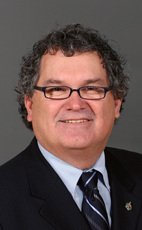
House of Commons photo

Crucial Fact

  • His favourite word was situation.

Last in Parliament March 2011, as Bloc MP for Gaspésie—Îles-de-la-Madeleine (Québec)

Won his last election, in 2008, with 40% of the vote.

Statements in the House

Resumption of Debate on Address in Reply November 25th, 2008

Mr. Speaker, I will be very brief. I have a lot of respect for the member who just spoke, and I would also like to congratulate him on being re-elected. However, he sounds a lot like a broken record these days. Repeating an idea that does not make sense does not make it make sense.

This is pretty simple: we acted scrupulously and responsibly by doing exactly what Quebeckers wanted us to do. People in every region of Quebec, including my own, told us that they had had enough of the softwood lumber conflict. Nobody thought that the agreement would be a panacea. However, doing what the member would have had us do would not have protected Quebeckers' interests.

Resumption of Debate on Address in Reply November 25th, 2008

Mr. Speaker, this allows me to answer as follows. We were elected to act scrupulously and responsibly. Acting scrupulously and responsibly means defending the interests of Quebeckers and our constituents with full knowledge of the facts. And, with full knowledge of the facts, when faced with a throne speech or budget situation, all members must consider whether it will improve the lives of our constituents, that is, the people we represent, and act accordingly. That being the case, acting scrupulously and responsibly means being very aware of the significance of a vote, but without justifying the means with an end that we wish to avoid.

This is unfortunately true of the Liberals, as we saw on many occasions. I know for certain that we do not want any part of playing with taxpayers' money and gambling with the possibility of election. We look at every situation very thoroughly and on a case by case basis. This has been true since the Bloc's inception. In fact, calculations were made recently, during the last election. The election was called based on calculations and polls suggesting that a majority government might be elected. But that is certainly not how the Bloc Québécois likes to do things.

Resumption of Debate on Address in Reply November 25th, 2008

Mr. Speaker, naturally I would first like to congratulate you on your appointment as well as congratulate all of the members who were elected or re-elected. I would also like to thank the people of the riding I represent, Gaspésie—Îles-de-la-Madeleine, and express my tremendous pride in this region. I am here for my third consecutive mandate, since 2004, to defend the interests of the people from the riding of Gaspésie—Îles-de-la-Madeleine, who care about their region and who also care about having a better future. First of all, I would like to say that my region has dreams of sovereignty. That day will come. As our late father of sovereignty, and citizen of the Gaspé, René Lévesque, said: Next time.

Countries are built one day at a time. That is what we see here. A country can also be destroyed one day at a time. Unfortunately, that is what we are seeing here today. The Speech from the Throne is a blatant display of insensitivity towards people in the regions in particular. I would like to speak about the regions. I will let those who live in cities say what they have to say. The Gaspé and the Magdalen Islands and other similar regions were expecting some form of understanding or concern for our situation, especially in terms of our current economic and financial troubles. Unfortunately, we are well aware that a Speech from the Throne is a speech of intentions. It can be as vague as vague can be. But we would be hard-pressed to find one more vague and insensitive than this.

This speech does not acknowledge in any way that people living in regions such as ours are deeply affected by decisions made here and elsewhere. I will talk about the fisheries. We know very well that this resource is exported. We know the importance of the fisheries in the area I represent. It is dependent on exports of lobster, shrimp, crab or other species. It is also dependent on certain infrastructures and on other elements that make up the famous fishing industry. These could be very well positioned to deal with the current crisis or the perceived crisis. They might even keep our region going very nicely.

I will simply reiterate certain points that I had the opportunity to present during the last election campaign. I will speak about five points. I had the chance to present a plan to better position our region. One of these plans had to do with the economy which, of necessity, requires a discussion of the state of the region, in particular its infrastructures, whether rail, marine, air or communications. The Speech from the Throne does not acknowledge such matters. It does not acknowledge the basic infrastructure needs. Whether we like it or not, regions such as ours need these infrastructures. Not only must they be appropriate but they must also be available. It is fine to have a train. However, in my area, passenger train service is only available three times per week. Thus, it is not really available. It goes by on Mondays, Thursdays and Saturdays. What happens on the other days?

The people in Matapédia have to make do with a train that runs six days a week, every day but Monday. One can imagine the logistical nightmare this creates for people who need to take the train, and God knows they do need to take the train at times.

The situation with regard to federal infrastructure is scandalous and shameful. I am talking about wharves and small craft harbours. I have been here for eight years, nearly five of them as a member of Parliament. Previously, I was an assistant. The Bloc has consistently championed the cause of small craft harbours. At one time, prior to 2000, the budget for small craft harbour maintenance and repairs was $50 million. Today, it is $100 million a year. That could give the impression that things have improved, but they have deteriorated. In fact, the department itself admits that more than $500 million is needed. The figures speak for themselves. If there is $100 million a year for all the wharves but $500 million is needed to restore them, it is like a leaky roof that is never repaired. Eventually, the roof will collapse. That is exactly what is happening with our harbours.

Economically, the regions are forgotten, neglected and ultimately cast aside in other ways as well. Federal programs such as those created by the Economic Development Agency of Canada for the Regions of Quebec have no flexibility. For regions such as ours, if a program is introduced and not adapted to the regional reality it might as well not exist, however attractive it may be in other respects. That is exactly what is happening with the Conservative government at present. Unfortunately, I do not see any indication in the throne speech that the government intends to change things. But our finance and other critics can be counted on to again raise the issue of modifying programs.

The people of my riding are also concerned about the environment. Ours is a maritime region. Changes in climate or sea level are a matter of life and death for some places, such as the Magdalen Islands for instance. That is why there is such sensitivity about this issue. Unfortunately there is not much in the throne speech, with the possible exception of the intention to protect the economy and to render the environment more economic than sustainable. They are totally missing the boat with that. That kind of thinking is really wide of the mark and once again the Bloc Québécois can be counted on to raise the issue again.

There is another reality, a very localized one, the ZIPs, priority intervention zones. These are found in maritime areas, Gaspé, the Magdalen Islands and in other places in Quebec as well. Things are now at an impasse because any little bit of cooperation there was between Fisheries and Oceans and Environment Canada is a thing of the past.

Other issues were addressed during the election campaign, particularly those relating to social programs, such as employment insurance and the guaranteed income supplement. Here again, people can count on the Bloc Québécois to continue the battle.

The final two subjects I wish to raise relate to government services. Generally, when times are tough and a government talks about examining departmental programs and budgets, the first targets, the first victims, are the so-called outlying regions. The Bloc Québécois will again be present to defend the interests of our people.

Finally, I would like to address the issue of the specific living conditions of those living in those outlying regions. It is a known fact that there is a really strong regional identity that differentiates one region from another. What is important to us is to achieve true cooperation. We will see how things progress as we go along, but unfortunately there is no sign of anything hopeful in the Speech from the Throne.

Resumption of Debate on Address in Reply November 25th, 2008

Mr. Speaker, I would like to congratulate you on your appointment.

I would also like to congratulate my colleague with whom I travelled for a few days when we participated in a mission to India related to climate change. We went to the Commonwealth General Assembly in New Delhi, where we discussed climate change and summarized the numerous problems we are currently facing and those we will face in the future.

I can quite easily imagine that the member is troubled by this situation. However, although he is worried about climate change—having participated in a meeting where many countries were worrying about the future of our planet—the Speech from the Throne still does not mention anything that would lead us to believe that the current government is worried about the situation. In fact, when the government talks about climate change, one gets the impression that it is more of an economic analysis than an environmental analysis.

I would like the member to explain how he can be open minded about climate change and still support a Speech from the Throne like this one.

Fisheries and Oceans November 25th, 2008

Mr. Speaker, all the economic stakeholders agree that during an economic slowdown, spending on infrastructure must be increased and accelerated. A Fisheries and Oceans Canada study showed that the percentage of port facilities that are unsafe or in poor condition went from 20% to 26% in five years.

Does the government realize that if it quickly updated these infrastructures, it could kill two birds with one stone? It could help fishermen and stimulate the local economy.

Transportation June 18th, 2008

Mr. Speaker, despite the promise made by the Minister of Transport, Infrastructure and Communities, there was nothing in the budget for the construction of a year-round maritime link for the Magdalen Islands, although amounts have been allocated for the Newfoundland and Labrador link. The Minister of Transport, Infrastructure and Communities is good at making promises but does not keep them.

Can the Minister of Transport, Infrastructure and Communities guarantee that the Magdalen Islands will finally, by next winter, have the permanent maritime service called for by the entire population of the Magdalen Islands?

Privilege June 17th, 2008

Mr. Speaker, I would just like to say that the member is reading very fast, and it must be very hard for the interpreters to keep up. I would ask him to consider the interpreters when reading a text. He is reading far too quickly.

April 29th, 2008

Mr. Speaker, I would like to congratulate my colleague, the parliamentary secretary, on his efforts to speak French. Bravo. I acknowledge his effort, but unfortunately, it did nothing to allay my fears about what is now happening.

As I understand it, my colleague supports an approach that is even worse than laissez-faire. I might even call it indifference with respect to what is going on right now. The minister's response in March and the Parliamentary Secretary to the Minister of Fisheries and Oceans' response today did not suggest strength of will to not only protect but also promote the development of the fishery in Quebec and the other jurisdictions. I did not sense that in his answer.

Rather, what I sensed was that he does not care about what is going on. If I had to make a prediction, I would say that if attitudes do not change, the fisheries sector will be in danger because of the current government's indifference.

April 29th, 2008

Mr. Speaker, I would like to come back to a question asked in this House on March 4, on the negotiations at the World Trade Organization and on the fisheries subsidies.

In many ways the minister's response was more than disappointing. I hope today that the parliamentary secretary's response will be a little more encouraging.

Far be it from me to use alarmist language, but the situation today is such that it is reasonable to think that it is important for the government to truly take an interest and develop a fisheries strategy, in light of the negotiations at the World Trade Organization.

Let me explain the situation we are in today. There is a text, a preliminary text, I agree, but a text nonetheless that stipulates that subsidies would be prohibited, in the event the text in question is approved or becomes part of an agreement. Under the text in question, all infrastructure, small craft harbours, would be affected, as well as everything involving fishing vessels, in terms of restoration and repair. This spells certain disaster.

Short of claiming, as the parliamentary secretary will probably do in the next few minutes, that these are preliminary texts, that the negotiations might come to an end, the government is truly burying its head in the sand and avoiding reality. I think that is absolutely irresponsible.

The responsible thing to do in this situation would be to say that a preliminary text has been circulating, that we do not like it, that we will work on it. In the meantime, however, this is an admission of failure. The text is circulating because we did not manage to get our point of view across. In our view, countries like Australia, New Zealand, the United States and others, that want to completely cut or eliminate certain subsidies from the fisheries are going down the wrong path.

We absolutely have to have a government that truly defends the fisheries, instead of simply navigating through murky waters without trying to correct the situation.

That is why I said that the minister's response was more than disappointing. I hope the answer we get today will be more encouraging.

Canada Consumer Product Safety Act April 28th, 2008

Mr. Speaker, this is in the same vein as what my colleague was saying. During question period today, the Minister of Canadian Heritage, Status of Women and Official Languages spoke about how the market ruled. Why would the market rule? What should rule is justice, a sense of responsibility and the possibility of straightening out a situation that is wrong or that has become intolerable.

There are many examples of the problems we have had with products. I remember very well. Last week, I was in my riding, and once again we had to sound the alarm. People had to demonstrate in the street. They do not do this for fun. The cod fishers who were asking for a shrimp quota were forced to take to the streets to demonstrate in order to get it. Why did this not happen three weeks earlier, so we could have avoided the stress and the demonstration?

The Conservatives seem to be fond of the wait and see approach, where they let things go and let the markets rule. They wait for problems to come up, or rather they wait for problems to make the front page. When a problem makes the front page, they will do something. Otherwise, they do not.

I wonder if my colleague agrees that there are many examples that lead us to believe there are ideological differences.