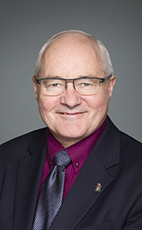
House of Commons photo

Crucial Fact

  • His favourite word was farmers.

Last in Parliament September 2021, as Liberal MP for Malpeque (P.E.I.)

Won his last election, in 2019, with 41% of the vote.

Statements in the House

Resumption of debate on Address in Reply September 30th, 2020

Madam Speaker, after those compliments by the member opposite, I really hate to say it, but strenuously disagree with him.

The fact is that there is not an Ottawa-knows-best approach. We have heard consistently from the oil and gas sector. This government has shown that it is behind the oil industry by being onside with Keystone, being onside with Trans Mountain and in fact spending money to get those resources to market.

We have consistently said that we want to work with the oil and gas industry on innovation. That industry is going to be needed for years and we are there to support those workers. Many COVID programs have supported workers who needed it during these times.

Resumption of debate on Address in Reply September 30th, 2020

Madam Speaker, there is mention of the opioid crisis in the throne speech, but the throne speech basically outlines a road map. I agree 100% with the member and with the concerns he has raised. My seatmate throughout many past parliamentary sessions was also from Vancouver. I have heard from her constantly about it.

It is a crisis. We must work with the provinces and the health agencies and put some money toward this, so we can start to put this crisis behind us.

I was originally involved with drug injection sites, so I know there are all kinds of things we have to do on the ground to deal with this, and we must do it.

Resumption of debate on Address in Reply September 30th, 2020

Madam Speaker, I will be sharing my time with the member for Chicoutimi—Le Fjord.

I am most pleased to speak on the throne speech. I do believe this throne speech, and the legislation and policy that will flow out of it, will put Canada on the right track going forward.

We are in a pandemic that seems to be gaining ground again. This is the time for leadership. The Prime Minister has shown leadership day after day. Contrary to what the Leader of the Opposition said, the Prime Minister and his government were in communication with all members of the House, and having meetings at night in conference calls with the bureaucracy. Everybody put in ideas, but the government showed that it was willing, under the leadership of the Prime Minister, to make changes that would improve policies for individuals, businesses, organizations, provinces and territories, day in and day out since the pandemic began.

The Prime Minister developed the programs. He worked with the provinces, and the provinces have congratulated the Prime Minister, time and again, on his willingness to work with them during this pandemic.

He has certainly shown leadership in terms of working with all Canadians. I heard the Leader of the Opposition say that he only wanted to work with some. No. The Prime Minister has worked with all Canadians, with all organizations and with all provinces. The Prime Minister is showing he is the leader that is needed in this time for this country to move forward. This is the direct opposite of what the Leader of the Opposition had to say.

This throne speech sets out a blueprint for where we need to go in the future. There really is no shortage of ideas. The purpose of a throne speech is to lay out the blueprint in the House of Commons and to have other ideas and criticisms come forward, certainly. I believe that, in the way that Parliament is structured, other ideas can come forward to improve on the blueprint that the government has laid out, although it is a very good blueprint.

The finance committee, in fact, heard hundreds of suggestions from Canadian organizations and individuals between April 3 and the end of June. I want to qualify that. This was a criticism that I do not believe was valid. I want to qualify that a key point made by witnesses before the finance committee is that, while future spending is essential, it must be done in a fiscally responsible way, and the Minister of Finance should certainly, at the earliest opportunity, lay out an economic growth plan. That is what witnesses were saying. I agree with that approach, and I think that would show Canadians how we are going to get there in terms of meeting the needs of the pandemic but also meeting the needs of the economy going forward.

Witnesses before the finance committee, and in my own riding and across Canada, spoke very favourably about several programs that will be continued as a result of the throne speech and the legislation flowing out of it.

The Canada emergency wage subsidy offered a 75% subsidy for businesses, and it will be extended right through to next summer. Although it is a wonderful program, I would note that it needs some tweaks. Many new businesses, start-ups, or expanding businesses that are buying out other businesses and therefore have different business account numbers with the CRA, do not qualify for the program. We have to fix that problem. Those businesses are important to our economy. They are the backbone of our economy, and we need them.

The second major program announced in the throne speech is the Canada emergency response benefit. It was very important to ensure that families had the funds to put food on the table, and had some security for their families, after jobs were lost as a result of COVID-19.

That program is rightly being rolled into an improved EI program, and is absolutely necessary, going forward. That is a commitment made by the Government of Canada in the throne speech. In fact, legislation has already been put in this House through Bill C-2 and Bill C-4 that ensures that the benefits of CERB will remain as we work to restart our economy.

For those in the tourism industry who were only able to find limited work this summer, the reduced hours, as announced, that will be required to gain EI is extremely important. The throne speech mentions it and legislation passed through here once on the Canada recovery benefit to support workers who are self-employed or not eligible for EI, the Canada recovery sickness benefit for workers who must self-isolate due to COVID-19, and the Canada recovery caregiving benefit for Canadians who must take care of a child and are unable to work. That is extremely important for people, moving forward, to help them out.

Another area we heard a lot of positive feedback and comments on is CEBA, the Canada emergency business account. The throne speech states:

This fall, in addition to extending the wage subsidy, the Government will take further steps to bridge vulnerable businesses to the other side of the pandemic by:

Expanding the Canada Emergency Business Account to help businesses with fixed costs;

Improving the Business Credit Availability Program;

And introducing further support for industries that have been the hardest hit, including travel and tourism, hospitality, and cultural industries like the performing arts.

It is important we do that, and we welcome that program, but I want to also put a slight caveat on CEBA. A number of us from all parties have been saying that the Canada emergency business account must allow personal accounts to qualify, not just business accounts. When I was farming I did not have a business account with a bank; I had a personal account and I was running about a $2-million operation. I can give an example of an individual in my riding. This construction guy with a $900,000 operation puts out three T4s and can show income tax going back years, but he does not qualify for CEBA. That is wrong. It should not just be through the bank business account. We had to fix that so that the people with a personal bank account qualify as well.

As an aside, there was the regional relief and recovery fund, established through the regional development agencies, that is basically the same as CEBA but is in the rural areas for businesses that may not qualify through the banks system. That program has run out of money. I am asking the Minister of Finance and the government as a whole to put some more funds into that RRRF so that people who actually deal with those agencies can qualify. That needs to happen.

I understand time is running down for my remarks, but I want to say I am looking forward to the work of the Government of Canada in accelerating the universal broadband funding. This is critical. We have seen through the pandemic that it needs to be done.

I am encouraged by what the throne speech said about the Atlantic loop in terms of energy between Atlantic Canada and Quebec, and how that may flow throughout the system.

We really used Canadian resources to help Canadians and build Canadian industries. I am really pleased on the environmental side that the throne speech outlines a number of opportunities for retrofitting homes and businesses, and more.

We have learned through this pandemic that we have to supply ourselves locally, and we need to move forward on that as well.

Orange Shirt Day September 30th, 2020

Mr. Speaker, you have my apologies. I had a piece of a bar because I did not have lunch.

Peter Dowling September 30th, 2020

Mr. Speaker, I rise today to pay tribute to Mr. Peter Dowling of Howe Island, Ontario, who recently passed away. Peter was a central figure in the National Farmers Union for nearly his entire life. His parents, John and Joyce, were founding members of the organization, and it was noted that Peter was “raised in the NFU”.

Peter was a tireless advocate for local foods, sustainable agriculture and small family farms. He was involved in many of the important agriculture policy battles of the day, including supporting supply management, advocating for farmers on free trade issues, opposing the introduction of rBGH hormone into our dairy system and leading the Save Our Prison Farms efforts, where he was among those who took cattle to Parliament Hill to protest the closure of prison farms in Kingston.

With his wife Dianne, he ran Doublejay Farms, now an organic farm, where he provided a ready ear for young farmers, offering advice and mentorship.

We offer our condolences to Dianne and the Dowling family.

Proceedings on the bill entitled An Act relating to certain measures in response to COVID-19 September 29th, 2020

Mr. Speaker, the member raises a very legitimate concern about broadband Internet across the country. One thing we have learned from the pandemic with people working from home, etc., is that they need good Internet access. The minister, in response to a question in question period today, answered some of what the member just asked about.

There has been greater funding put into obtaining better broadband across the country, which is starting to roll out. I will admit it may be a little too slow, but at least the government has taken the initiative to get it out there so that Canada can be more connected and rural Canadians can have the same service as urban Canadians across this country.

Proceedings on the bill entitled An Act relating to certain measures in response to COVID-19 September 29th, 2020

Mr. Speaker, the government has shown us throughout this that it was willing to listen to members. Look at how some of the original programs were designed and how they have changed.

The member opposite said that with CERB there needs to be employment incentives, and there are. There is the encouragement to go back to work. There is other programming that is not directly related to COVID–19. We can look at how the government expanded the funding for the regional development agencies across the country to be able to assist businesses to create jobs. It used the RRRF in place of the CEBA for those businesses in the rural areas that were not really dealing with the big chartered banks. The government has shown that—

Proceedings on the bill entitled An Act relating to certain measures in response to COVID-19 September 29th, 2020

Mr. Speaker, I certainly have enjoyed working with the member for Edmonton Centre on the finance committee as well. In fact, between early April and probably early June the committee heard between 300 and 400 witnesses provide their views on COVID–19.

We are in an urgent situation at the moment. The pandemic continues to evolve. We are in the second wave. We know the CERB is running out. We have an obligation as a government to move as rapidly as we can and have a fairly reasonable debate in the House. It is always better to take more time, but we just do not have the time. The need is there at the moment. The government is showing it is willing to change and adapt programs, and I am sure it would be willing to do the same with this one as we go down the road and the needs arise.

Proceedings on the bill entitled An Act relating to certain measures in response to COVID-19 September 29th, 2020

Mr. Speaker, indeed, I am pleased to speak to Bill C-4, an act relating to certain measures in response to COVID-19.

Although I did start out to speak to Bill C-2, which has the same name, I am pleased to speak to Bill C-4. I certainly agree with the ruling the Speaker just made. It is an improved bill and better addresses the needs of citizens affected by COVID-19 either directly or indirectly.

The bill, or at least some of the issues and policy flowing out of the bill, shows that this place, the Parliament of Canada, can work well for Canadians through discussions, compromise and a willingness to accept the fact that not any one party has a lock on good ideas or good policy approaches.

While this bill looks forward, I do believe it is important to take a moment to recognize how far we have come since this place basically closed down in March, when we were sent home to try to operate Parliament in a different way. A lot of programs have come out to help people and businesses weather as best they can the financial and health difficulties caused by the pandemic.

Regardless of political stripe, I believe we have to say the government acted quickly. It introduced programs that made a huge difference for the economy, for families and for businesses. It did so quickly. In terms of CERB. I do not think we would have thought it possible that the public service and the government could actually come up with a program that could handle 10,000 applications a minute. That is a pretty phenomenal feat, and I think we should be proud of that.

I went through them today and by my count there are slightly over 100 programs that have been introduced. Liquidity has been provided to the lending institutions, coordinated planning has been established with the provinces and territories, and programs have been flowing out of the Government of Canada based on discussions with the premiers, and in fact with all parties in this House. Roughly $19 of every $20 have come from the federal coffers. Some of my colleagues on the former finance committee will talk a lot about the deficit. However, it is a fact that the federal government is better positioned to carry some of that debt rather than transferring it to individuals, businesses or indeed the provinces, because our rates are preferred, and we certainly hope they stay that way.

Programs were introduced, subject to change, which is unusual. They were not introduced with a hard line that they were going to be the bottom line come hell or high water. They were introduced subject to change, recognizing there were going to be problems and changes that needed to be made. They were improved with the input of members from all parties. I doubt the public knows, but all of us in this House know that members had the opportunity to participate in daily conference calls with senior members from several departments across the Government of Canada.

Through those calls, we had the opportunity to question and discuss, and programs were improved with input accepted from all members. Members could give their input based on how they saw the programs working on the ground, whether it was CERB or any other program. They could give that input from whatever region of the country they reside in.

We must acknowledge members of the public service for participating in program development, in working long hours and participating in those conference calls night after night after night. They would explain programs and answer questions. They would sometimes take criticism. They would accept changes and make recommendations to the various ministries as a result.

We were not always successful in the issues we put forward. I know both the member for Edmonton Centre and I put forward in those nightly calls that CEBA needed to be changed to allow personal bank accounts to be considered. That still has not changed. I am still demanding that the government change that so the people with personal bank accounts and not business accounts can qualify for the CEBA or the RRRF. That needs to be done.

Members from all parties have raised that point. It should not be a program where the banks get the benefit. It has to be a program where people get the benefit. I am disappointed in how I see the banks living up to their obligations in the pandemic at the moment, because they have been provided billions of dollars of liquidity. Many of us in this House agree that change needs to be made.

I sincerely want to thank all members of the public service for their efforts under trying circumstances. They are under the pressure of a health crisis, working from home and working under completely different circumstances than they are used to.

All the programs made a difference. I can certainly say in my riding and across the country the big ones were CERB, the wage subsidies and CEBA. However, now it is time for future extensions and future improvements. That is what we have in Bill C-4. As my colleague before me mentioned, there are three main areas in this bill, three new benefits.

The first is the Canada recovery benefit, which will provide $500 per week for up to 26 weeks for workers who meet the eligible criteria. In other words, they do not qualify for employment insurance, are not employed or have a reduction of at least 50% in employment or self-employment earnings and are available and looking for work. That is important. I do not mind admitting that one of the concerns I have with CERB is I hear from too many businesses that they cannot find workers. There has to be balance here. We need to be there for people who cannot find work, but people also have to be willing to work if work is available. The changes made under employment insurance make it necessary for people to be going out there and striving to gain work.

The second major area in this bill is the Canada recovery sickness benefit. That will provide the same amount of money I mentioned in the first program. This is for workers who are unable to work at least 50% of their normal work because they contracted COVID-19, have underlying conditions, are undergoing treatment or have contracted another sickness that would make them more susceptible to COVID-19.

The third area is the Canada recovery caregiving benefit which will also provide $500 per week for up to 26 weeks per household for eligible workers who are unable to work at least 50% of their normal work and need to take unpaid leave to care for a child under the age of 12 due to school or day care closure, or a family member who requires supervised care and is unable to attend a day program.

There are changes. What I tried to outline is that a lot has happened since the COVID-19 pandemic hit this country. All parties can take some credit for those programs.

The government moved rapidly and with this bill today we see how we are recognizing some of the lessons learned from the programs we have put out there and that there needs to be other changes made. I do not have time to go into the employment insurance changes, but they are good as well. We need to debate them further and continue on improving them until we see the end of this pandemic.

Peschisolido Report September 29th, 2020

Madam Speaker, I think Canadians are very proud of what this government has done in terms of the pandemic. I think they are very proud of how quickly we acted. There were 10,000 applications a minute going through in order to get the CERB, which kept food on the table and gave people the confidence to stay home and help fight the pandemic. I talked to a lot of my constituents, a lot of Canadians, and I think that they are really proud of how the government acted with the pandemic. What the member is talking about are other side issues, which are not the issue of the moment.