
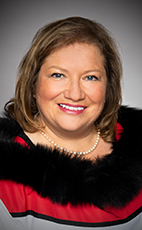
House of Commons photo

Crucial Fact

  • Her favourite word was indigenous.

Last in Parliament April 2025, as Liberal MP for Labrador (Newfoundland & Labrador)

Won her last election, in 2021, with 43% of the vote.

Statements in the House

Northwest Territories Devolution Act December 4th, 2013

Mr. Speaker, I appreciate the opportunity to rise today and speak to this important bill, Bill C-15, an act to replace the Northwest Territories Act to implement certain provisions of the Northwest Territories Lands and Resources Devolution Agreement and to repeal or make amendments to the Territorial Lands Act, the Northwest Territories Waters Act, the Mackenzie Valley Resource Management Act, other Acts and certain orders and regulations. I am proud to rise as a northerner of Inuit descent and as my party's critic for northern development, the Canadian Northern Economic Development Agency and the Arctic Council to address the bill on this occasion of importance to the people of the Northwest Territories.

The devolution of responsibilities in the Northwest Territories is a cause for celebration, not just for the people of NWT but for all of us as Canadians. Any time that we can give greater control and a greater say in the future of the people who live in certain lands and manage certain resources, we can ensure that we will have good and solid management.

The work that is happening with regard to the devolution agreement is obviously work that was started decades ago to give the people of the Northwest Territories the governance that they deserve. We can all think back to the work of Liberal Prime Minister Lester B. Pearson and his government, which established the Advisory Commission on the Development of Government in the Northwest Territories, otherwise known as the Carrothers commission.

The commission at that time consulted with people across the north and concluded in its report that they of course deserved to have the seat of their government established not in Ottawa, as it had been until then, but in the north, where people could play a much more vital role in their government and its ability to represent the people of the Northwest Territories. This established Yellowknife as the capital and moved the territorial seat of government there.

Decades later, Yellowknife has continued to blossom as the seat of government in the Northwest Territories. It is thanks in part to this important step that we can be proud today that business in the Northwest Territories is booming as well.

On the important subject of devolution, I want to point out and acknowledge before Parliament that it was the governments of Prime Ministers Jean Chrétien and Paul Martin that worked tirelessly for the devolution of the Yukon and Nunavut, and started the process of devolution for the Northwest Territories. It is a legacy that we are proud of. I am eager to continue working hard to ensure that people across northern Canada have the type of government that they want and deserve, in order to make important decisions that will affect their future.

There is a new generation of young Canadians who live in the north and who are ready to be the leaders of today. We must do everything that we can to ensure that our territories have the tools and governance that they need to empower our young Canadians and our citizens to continue to be a part of the economic driver of this country, which the north has become.

In my role as the critic for northern development, and of course as the MP for Labrador, sometimes I have to say that when I speak to the bill, I am almost a little bit envious. In my previous role as a provincial member and minister in the Government of Newfoundland and Labrador, I had the opportunity to travel to the northern regions of our country and visit people across the territories. I know that they are great people, who work hard in a very challenging climate. I can tell the House that despite all these odds and challenges, they are thriving.

The culture and entrepreneurship are such an inspiration to see first-hand. I want to encourage my hon. colleagues in the House to visit the north and see for themselves how this is such an awe-inspiring part of our country. The devolution agreement and the continued transfer of responsibility will allow the people of the Northwest Territories to take the driver's seat on the huge amounts of economic development that we are seeing.

In my own district of Labrador, we have seen the rich cultural heritage and contributions of our aboriginal people, like the Innu, NunatuKavut and Nunatsiavut. It is vital that all aboriginal peoples in Canada have a strong voice to represent them. I hope that those in the north will play a larger role in determining the future of their people as part of the bill and of the work of both the federal and territorial governments.

We all want to see aboriginal communities in the north succeed economically, socially and culturally. This agreement would hopefully empower these communities to come closer to achieving greater success in all of these areas.

As someone who was born and raised in the north, and who represents a northern district, I can certainly understand the need for autonomy in the north and the right to establish strong local government that can engage in government to government to government dialogue that would produce meaningful results. I know the frustration and reality of trying to govern without having real power and the ability to make full decisions and have full accountability. We need decision-makers to understand these realities of living in the north and that they are best served by granting the responsibilities necessary to the Government of the Northwest Territories.

We want to make it easier to conduct business in our northern regions to encourage business investment, create jobs and generate greater revenues. I want devolution to give more of these things to the Government of the Northwest Territories as well as the participating aboriginal governments. With this, they could work together to improve their social programs and social safety net. They could make decisions to invest in their local culture to attract tourism or trade and to draw new people into the area.

I am very optimistic about the future of the Northwest Territories and its devolution agreement. I am optimistic about all northern regions of Canada.

I believe that northern regions thrive when they have the guidance of good leadership. Today we have with us the Premier of the Northwest Territories, Mr. Bob McLeod, along with officials and other leaders within his government. I understand that we also have support and have been joined by some aboriginal governments from NWT.

We have to recognize that these individuals have spent years working to gain a very concrete devolution agreement to ensure that it meets the needs of the people they represent, the people they advocate and care for. I want to congratulate them on the work they have done.

I hope that despite the interference that one often sees from government that they will accomplish what they set out to do; that is, to give greater autonomy, greater powers of decision-making to the people of the Northwest Territories. I think that is what we all want to see accomplished through this particular agreement.

Northwest Territories Devolution Act December 4th, 2013

Mr. Speaker, I listened very attentively to my colleague from the Northwest Territories as he spoke to this bill. Being a northerner myself, I know there are often issues around resource development and balancing the levels of governance within aboriginal communities, the territories, and the provinces that sometimes pose challenges. However, I have seen a lot of major issues resolved simply because of the players, the strength of both the aboriginal entities and the governments that are in power to be able to do this.

I know this bill has been presented in two particular parts, but we also know that on June 25, 2013, the agreement was signed by the Government of Canada and the Government of the Northwest Territories, as well as the Inuvialuit, the Gwich'in, the Tlicho, and the Sahtu. They had agreed to sign on at that particular time to ensure that there was greater management and control within the NWT.

I would ask the hon. member today for his opinion. Does he feel that they have now withdrawn their support because of the changes that are happening within the management of the water board, or is it that the concerns being raised by these groups should just be addressed by the government?

Northwest Territories Devolution Act December 4th, 2013

Mr. Speaker, first, as members know, the Liberal Party has been very supportive of devolution agreements in Canada and has certainly worked with Nunavut, Yukon and the Northwest Territories in the past around these issues.

With the devolution of any agreement of this size and magnitude, there comes a financial responsibility to ensure the agreement is followed through and implemented appropriately.

I ask the minister today if there has been agreement with regard to the financial contributions that would be contributed as part of this and if it is satisfactory to the Government of the Northwest Territories to do the job it needs to do.

Questions on the Order Paper December 4th, 2013

With regard to National Defence, what are the details, by description and fiscal year, of the approximately $407 million in investments at 5 Wing Goose Bay since 2006, which were referred to by the Associate Minister of National Defence during debate in the House of Commons on June 4, 2013?

Officer of the Order of Canada December 4th, 2013

Mr. Speaker, today I acknowledge a good friend, and a good friend of all Canadians, on becoming an officer of the Order of Canada. The Hon. Brian Tobin has demonstrated remarkable service to the Parliament of Canada and as Premier of Newfoundland and Labrador. His extensive achievements, both political and in business life, have been recognized in many corners of the world. Known to many of us as Captain Canada, last Friday he became an officer of the Order of Canada.

Brian Tobin is highly regarded for his strong and principled leadership. As a federal cabinet minister he saw the implementation of the Oceans Act, the extension of Canadian jurisdiction beyond 200 miles, and he took a strong stance against offshore overfishing by foreign fishers, known as the turbot war.

His term as Premier of Newfoundland and Labrador was marked by important economic reforms to our industries, the constitutional amendment that ended denominational-based education and the development of the offshore oil and gas industry.

My colleagues in the Liberal caucus today are proud of his accomplishments and we say, “Congratulations, Brian”.

Aboriginal Affairs November 29th, 2013

Mr. Speaker, the AFN national chief has rejected the government's education proposal and highlighted the absolute need for a funding guarantee for first nations children.

However, the government has refused to talk about it. Shockingly, the PMO memo in the RCMP Duffy-Wright scandal complained about investing heavily in aboriginal education, saying it contradicted the government's messaging.

I ask the minister to do the right thing today and commit to equitable funding for children of first nations.

Business of Supply November 26th, 2013

Mr. Speaker, I certainly want to thank my colleague from Charlottetown for his remarks today with regard to this particular motion.

I think it is fair to say that all of us within the Liberal caucus feel very strongly that the Prime Minister should testify, under oath, in this particular circumstance. It is also quite obvious that in doing so, the same level of control would not be there for the government. Maybe that is one of the reasons it has not supported this.

I want to ask my colleague how this is playing out in his home province of P.E.I., which we know has been in the news a lot as it relates to this particular issue. What has been the opinion of the hard-working, law-abiding citizens of Prince Edward Island when it comes to this particular scandal around the PMO and the Senate?

I would also like to ask my colleague, who has been practising law in this country for quite a number of years, what his opinion would be of how such ethical practices would be looked upon by those within the Law Society or within the practice of law in comparison with how we are seeing these things dealt with within the PMO and within the government.

Ethics November 25th, 2013

Mr. Speaker, maybe I am talking about the former Conservative member, Peter Penashue, because Labradorians did not believe him, and today, Canadians do not believe the Prime Minister.

Most of the Conservative fraud squad are still being paid by taxpayers. Some have even been promoted.

Does the government believe it is acceptable for someone to transport money used to corrupt a parliamentarian, fully knowing he is taking part in an illegal act? If not, why does David van Hemmen still work for the government?

Ethics November 25th, 2013

Mr. Speaker, the Prime Minister's story keeps changing. We know that three of the senior employees were part of the Conservative fraud squad and were involved in hatching the plan between his office and Mike Duffy.

On Friday, the Prime Minister said nobody from his office, other than Nigel Wright, hid anything from him. This makes no sense. Either his staff did tell him about these criminal acts, or he is saying his whole entourage lied to him. Which is it?

Breast Cancer Screening November 25th, 2013

Mr. Speaker, I rise today to ask the government to support the growing number of Canadians who are requesting new benchmarks in mammography screening. Breast cancer remains the most common cancer diagnosis of women over 20 in Canada. The Canadian Breast Cancer Foundation reported that early detection of breast cancer through mammography screening has helped decrease the number of deaths since 1986.

Dr. Martin Yaffe at Sunnybrook Health Sciences Centre in Toronto recommends that the screening age in Canada should be moved from age 50 to 40. Several provinces have heeded those findings and have committed to taking this proactive step.

Today, I encourage the federal government to work with all of the provinces, territories, and stakeholders to ensure the age recommendations for breast cancer screening in all jurisdictions are based on the best possible evidence. Early detection means early treatment and lives saved.