
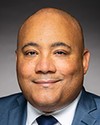
Evidence of meeting #8 for Agriculture and Agri-Food in the 45th Parliament, 1st session. (The original version is on Parliament’s site, as are the minutes.) The winning word was office.

A video is available from Parliament.

On the agenda

Members speaking

Before the committee

Proud  President and Adjudicator, Office of the Grocery Sector Code of Conduct
Léger Bourgoin  General Manager, Association des producteurs maraîchers du Québec
Lefebvre  President, Association des producteurs maraîchers du Québec
Graydon  Chief Executive Officer, Food, Health & Consumer Products of Canada
Bergamini  Executive Director, Fruit and Vegetable Growers of Canada

The Chair Liberal Michael Coteau

I call the meeting to order.

Welcome to meeting number 8 of the House of Commons Standing Committee on Agriculture and Agri-Food.

Today's meeting is taking place in the hybrid format pursuant to the Standing Orders. Members are attending in person in the room and remotely using the Zoom application.

Before we continue, I would like to ask all in-person participants to consult the guidelines written on the cards on the table. These measures are in place to help prevent audio feedback incidents and to protect the health and safety of all participants, including our interpreters.

I would like to make a few comments for the benefit of the witnesses and members before we start. Please wait until I recognize you by name before speaking or if an MP directs a question to you.

For those on Zoom, at the bottom of your screen you can select the appropriate channel for interpretation: floor, English or French. For those in the room, you can use the earpiece and select the desired language. I remind you that all comments should be addressed through the chair.

For members in the room, if you wish to speak, please raise your hand. For members on Zoom, please use the “raise hand” function. The clerk and I will manage the speaking order to the best of our ability. We appreciate your patience and understanding in this regard.

Before we start, there are a couple of things I would like to move to the end of the meeting. We need to approve a budget. I need a little time at the end for the budget, so I'll try to reserve five to 10 minutes at the end.

Today, pursuant to Standing Order 108 and the motion adopted by the committee on Thursday, September 18, 2025, the committee is commencing a study and update on the implementation of the grocery code of conduct.

I would like to welcome our witness.

With us today is Karen Proud from the Office of the Grocery Sector Code of Conduct.

As you know, you have five minutes for comments, and then we'll open it up for questions.

Welcome to the committee.

Karen Proud President and Adjudicator, Office of the Grocery Sector Code of Conduct

Thank you very much.

Thank you, Mr. Chair and members of the committee.

My name is Karen Proud, and I'm the president and adjudicator of the office of the grocery sector code of conduct. I am pleased to appear before you today to provide an update on the implementation of the code.

The office was established toward the end of March 2025 to administer the grocery sector code of conduct, a framework designed to strengthen trust, transparency, and fairness across Canada’s grocery supply chain. In the few months since, our small team has focused on building the foundations needed to bring that commitment to life.

I’m pleased to report that we are fully operational, with a permanent office, communications platform and member portal, and that we have seen strong engagement across the sector. To date, nearly 100 companies have joined as members, representing every part of the supply chain.

Since our establishment, I have participated in over 39 stakeholder meetings and 28 industry events nationwide to raise awareness of the code, answer questions, and help companies prepare for compliance. These meetings have been in addition to our educational outreach through the monthly newsletters, published guidance materials and our recent webinar. The enthusiasm and support from across the industry have been encouraging.

Our number one priority right now is to finalize the dispute resolution management process, or DRMP. This is the last major piece we need before the code can be fully implemented on January 1, 2026, and before we can begin our formal membership recruitment campaign.

Developing the DRMP has been a challenging but necessary process. We are creating, from scratch, a fair and accessible mechanism for resolving disputes, within the constraints of a voluntary, non-regulated framework.

There are real limitations on what a self-governing office like ours can require of members. The process must also remain fully consistent with the provisions of the code itself, which was developed and agreed to by industry.

Balancing these realities while ensuring that the dispute resolution management process is still credible, practical, accessible and trusted by all has taken some time, but we are close. I believe we now have the tools needed to move forward. They may not be perfect—few things are at the outset—but they are a solid foundation on which to start, and I am confident they will strengthen over time as we gain experience.

As adjudicator, I am committed to monitoring how the code functions in practice and to reporting back honestly and transparently on what is working well and where adjustments may be needed. Continuous improvement will be a defining feature of this office.

In the coming months, our focus will be on finalizing dispute resolution, launching formal recruitment, expanding our education and outreach efforts and preparing for the full implementation of the code at the start of 2026.

Mr. Chair, I want to thank this committee for its ongoing attention to the grocery code of conduct. For a voluntary framework like ours, the continued interest and oversight of Parliament is critical. It helps sustain momentum and reinforces that accountability and fairness in the grocery sector remain a national priority.

I also want to take a moment to acknowledge the vital funding we are receiving through the regional collaborative partnership program under the sustainable Canadian agricultural partnership, which is an agreement between federal, provincial and territorial governments. The funding has supported the first year of our launch. Our goal is to be fully funded through our membership by 2027. Certainly at this stage we would not be operational were it not for the support from government partners.

I look forward to your questions.

I will answer questions in English, because I'm not perfectly bilingual and it's very important for me to be precise.

Thank you.

The Chair Liberal Michael Coteau

Thank you very much.

I'll go to the Conservatives for six minutes.

Mr. Epp.

3:40 p.m.

Conservative

Dave Epp Conservative Chatham-Kent—Leamington, ON

Thank you, Mr. Chair.

Thank you, Ms. Proud, for appearing today.

I think I'll start with what the code is to do and what it is not to do. I'm asking if you can expand on that.

I'm going to read you a quote here that says, “it is important to recognize the distinction between contract law in Canada and the voluntary Code.”

Can you draw that out a bit? What's the difference between contract law and a voluntary code?

3:40 p.m.

President and Adjudicator, Office of the Grocery Sector Code of Conduct

Karen Proud

The code, as designed, is voluntary. It's the choice of members to join.

The issue between the code and contract law is.... We've been clear from the beginning that in our office we cannot supersede existing laws, whether it's contract law or other laws of the land. If two parties enter into a contract and come to an agreement together for that contract, the office cannot interfere in that contract.

If that contract contravenes the code, we are able to hear complaints related to that, but I don't have any authority to nullify or change contracts entered into between parties.

3:40 p.m.

Conservative

Dave Epp Conservative Chatham-Kent—Leamington, ON

Is the inverse true? Is a contravention of a contract then automatically a breach of the code?

3:40 p.m.

President and Adjudicator, Office of the Grocery Sector Code of Conduct

Karen Proud

No.

I mean, contracts generally deal with supply agreements. Certainly, in our case, it's supply agreements between suppliers and their retailers. Contravention of contracts falls into contract law. We are not an appeals mechanism for where there are conflicts within that contract. That falls to contract law, and there are processes that deal with that.

Should there be something in the contract...? Section 2.5 in our code of conduct says that you can't contract out of the code. If you put things in your contract that are contrary to the code, that allows people who are party to the code to complain to our office, and we will hear those complaints.

3:40 p.m.

Conservative

Dave Epp Conservative Chatham-Kent—Leamington, ON

My understanding of one of the drivers that's led to the entire value chain being at this place is the alleged existence of intimidation. How does the code begin to address intimidation between various players in the chain?

I can expand on that. One assumes immediately that's retailer intimidation upon suppliers, but the inverse, as we've heard in testimony for a couple of years, can also be true.

3:45 p.m.

President and Adjudicator, Office of the Grocery Sector Code of Conduct

Karen Proud

The code very specifically has a provision that speaks to the fact that it's a contravention of the code if there is intimidation or other factors against a supplier or retailer for exercising their rights under the code.

Again, if that sort of thing arises, people can make complaints to the office and the office will look into that. People can make formal complaints through our dispute resolution process. The office will look into that and come to a finding.

3:45 p.m.

Conservative

Dave Epp Conservative Chatham-Kent—Leamington, ON

If the fear is intimidation, is there the reality of reprisal, just by making a complaint? How does one address that?

3:45 p.m.

President and Adjudicator, Office of the Grocery Sector Code of Conduct

Karen Proud

That's a really good question, and it is something I receive frequently, especially as I'm talking to smaller grocers or suppliers.

Within our system, we have the formal dispute resolution process, which we're still finalizing. That's how the party complains. There's visibility between the parties about that complaint. It goes through a process that may, eventually, lead to an adjudication decision and a publication of a compliance issue.

We have another process, very similar to what they've put in place in the United Kingdom, in which we have created a portal whereby any one of our members can make a complaint to the office. That's a confidential complaint. We take in that information to see whether this may be something of concern with regard to a code violation, and we can follow up on that complaint without breaching any confidentiality.

Our main role, really, is to try to address these things before they become formal complaints, so there's absolutely a mechanism through which anyone can complain to us, and we will follow up and try to work that out with the other player.

There's also a third component, which is that anyone can go to talk to their industry trade association, who can then bring to the office issues that are of a systemic nature, in which a number of members are having the same problem. They can do the same: Come to the office and raise those issues with us, and we will do our analysis to determine whether we need to follow up to try to correct the issue before it becomes a formal complaint.

Dave Epp Conservative Chatham-Kent—Leamington, ON

I think you just answered my next question, which is this: What tools do you have? You just listed three. Are there any others?

3:45 p.m.

President and Adjudicator, Office of the Grocery Sector Code of Conduct

Karen Proud

Those are the processes we have in place that allow anyone to come to make complaints. The tool that the office has.... We are limited because we're not a regulated industry. We're not legislated. I can't fine people, investigate things or compel evidence, but the majority of my role is, really, trying to work with the other parties to point out where I think there may be code-related issues.

Ultimately, the stick we have is the fact that we can publish public reports, so, through the formal process, that's a notice of non-compliance, potentially, but I can also publish reports, and I intend to publish reports on a regular basis about what's going on.

3:45 p.m.

Conservative

Dave Epp Conservative Chatham-Kent—Leamington, ON

Thank you.

I have one more quick question. If you were to uncover criminality in that process, are you allowed to report it to the relevant authorities?

3:45 p.m.

President and Adjudicator, Office of the Grocery Sector Code of Conduct

Karen Proud

That would be something I'd have to discuss with our internal legal counsel. I'm not able to respond to you at this stage, but if I were aware of criminal behaviour coming up, I would consult with our legal counsel as to my duty and responsibility to report that.

The Chair Liberal Michael Coteau

Thank you.

Next, we go to the Liberals for six minutes.

MP Dandurand, go ahead.

Marianne Dandurand Liberal Compton—Stanstead, QC

Thank you very much, Mr. Chair.

Ms. Proud, thank you for being here and for the work you're doing to implement the code of conduct.

As I understand it, the wording was finalized in June and people are now working on the dispute resolution mechanism, namely the mediation board. You said there were a few outstanding questions. What remains to be settled to fully implement the mediation mechanism, and how confident are you that you will reach an agreement on this by January?

3:50 p.m.

President and Adjudicator, Office of the Grocery Sector Code of Conduct

Karen Proud

The code itself was agreed upon by all parties last year. There was a coming-into-force date that was put in the code, which was the June date, and we've been taking a transitional approach to that. As mentioned, we are working on this final governance piece, which is dispute resolution.

You have to keep in mind that it took almost four years for people to draft the code and come to agreement on the language within the code. We've been working on dispute resolution for only about six months.

I think we're very close. We've been going through drafts with an industry working group and within our board. There are just language questions as to whether it covers everything it needs to. We have what I feel is a very good draft, and it's just a matter of getting the next and, hopefully, final round of comments back from both the working group that's been working on it and our board of directors. At this stage I still feel that we can have that finalized before January 1.

Marianne Dandurand Liberal Compton—Stanstead, QC

That's great news for all parties.

Given the discussions over the past few months, do you feel that the Office of the Grocery Sector Code of Conduct will receive a large volume of complaints?

3:50 p.m.

President and Adjudicator, Office of the Grocery Sector Code of Conduct

Karen Proud

That's a good question. We don't know, off the bat, how people are going to interact with the office. As I mentioned, I have spent a lot of the last six months going around talking to different sectors, presenting at conferences, talking to individuals one on one and trying to raise awareness of the code and the importance. At every conference, I tell people that if I leave them with nothing else, my message is to please work with the office.

We know from the experience in the U.K. that at first there was a lot of reluctance to engage the office, because of the concerns around confidentiality and the potential that if somebody brought a complaint, it would be found out and there could be some reprisal.

I think it will take some time, as we start to work with different groups, for them to feel that they can bring complaints to us, that we will pay attention to them and that their confidentiality will be respected. We are prepared. If we get a lot of complaints, we have a good system in place, but I suspect that we'll see more of a trickling in than an avalanche.

Marianne Dandurand Liberal Compton—Stanstead, QC

I'm thinking in particular of small and medium-sized primary producers, who are vulnerable to the large retailers they deal with. One of the things the code of conduct seeks to achieve is a better balance of power between the various stakeholders.

Are you able to give a voice to industry associations that may represent SMEs? Is that included in the dispute resolution mechanism?

3:50 p.m.

President and Adjudicator, Office of the Grocery Sector Code of Conduct

Karen Proud

The associations have a really important role to play with the office, both in providing us with a picture of what's going on generally in the sector and identifying the systemic issues where a number of their members or their entire membership may be affected. It's very important for us that we continue that dialogue with the associations. It's also important that, as we get information through other means, we're able to check in with the associations to see if it is really a systemic issue, if it's a one-off thing or if we can get a little more understanding.

Where the association role doesn't come into play is with the formal dispute resolution process. This is where one party will bring an issue against another party. That has to be an individual business-to-business case, because of the nature of those complaints. The individual agreements may be different and the circumstances may be different. We are not set up with this code to do what I would say is a class action complaint to us. It really is individual complaints to allow the other party to respond specifically to the information. The associations can help their members in that process and can help provide information on how to navigate, but for the specific formal dispute, the associations don't represent their members in that process.

Marianne Dandurand Liberal Compton—Stanstead, QC

Do I have any time left, Mr. Chair?

The Chair Liberal Michael Coteau

You have another 18 seconds.

Marianne Dandurand Liberal Compton—Stanstead, QC

I'll give that time to Mr. Perron.