
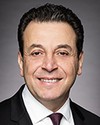
Mr. Speaker, we are here once again to consider whether April should be designated as Arab heritage month in Canada. Given the contributions of Arab Canadians to the growth of this country, since the first one arrived in 1882, I am sure this is an idea that we can all agree on.
This community, which started with just a few families, has grown to more than one million Canadians who have Arab heritage. The Arab community in Canada is not, as the media sometimes thinks, a group of people who come from one place and have one way of thinking. We are, in many ways, an example of the diversity that is Canada.
Canada's Arabs trace their roots to many countries: Lebanon, Algeria, Morocco, Saudi Arabia, Syria, Egypt, Palestine, Kuwait, Tunisia, Iraq, United Arab Emirates, Sudan, Jordan, Mauritania, Libya, Yemen, Qatar, Oman and Bahrain. United by a common linguistic root, they have different religions and cultural traditions. The popular perception may be that to be Arab is to be Muslim, but we Arabs know differently. Canada's Arabs identify as Christian, Catholic, Orthodox and various types of Protestants. The majority are of Muslim background. There are many who are a vital component of the societies of the Middle East.
These diverse communities are tied together by a common language, the Arabic language. Even if one does not understand a word, it has a melody that makes it pleasing to listen to. Arabic is spoken by more than 400 million people worldwide. After English and French, Canada's official languages, it is the third most widespread official language on our planet. It is one of the six official languages of the United Nations. When we celebrate Arab heritage month, we are celebrating the people and we are also celebrating this language. It is the language of poetry and mysticism, and of law and humour. It is a language that unites people across the Middle East and North Africa.
The rich literature that can be found in Arabic tells the story of many cultures united under a common banner. To me, that sounds like Canada. For centuries, Arabic was the language of culture and learning, especially when looking for information on science, mathematics and philosophy. Our mathematics system is based on Arabic numerals. We all know that and rarely, if ever, stop to think about why they are called that.
Arabic heritage month would be an opportunity for those of us with Arab roots to share the richness of our culture in perhaps a more deliberate way than is the case now. I must admit, I have never had a conversation about the origins of Arabic numerals and their liberating effect on mathematics that has led to so many scientific advances. Perhaps I should start doing that.
Or, maybe I could initiate discussions about the scientific advances of what is referred to as the Islamic golden age, a period of rapid scientific advancement that took place between the eighth and 13th centuries. Despite its name, the advances of this period were not brought about exclusively by Muslims. Wikipedia tells us:
Christians...contributed to Islamic civilization during the reign of the Umayyads and the Abbasids by translating works of Greek philosophers and ancient science to Syriac and afterwards to Arabic. They also excelled in many fields, in particular philosophy, science...[and theology].
Some of the notable Christian scholars of the time were Hunayn ibn Ishaq, Yusuf Al-Khuri, al Himsi, Qusta ibn Luqa, Masawaiyh, Patriarch Eutychius, and Jabril ibn Bukhtishu.
If not for Arab scholars at that time working to translate works from antiquity, from the original Syriac, Greek, Persian and Latin, into Arabic, much of the knowledge of the ancient world could have been lost forever. We owe a cultural debt to those Arabic scholars of more than 1,000 years ago for preserving so much of the world's heritage.
I could go on and talk about how Arabs have influenced architecture and medicine in ways that continue to impact us today, but members get the idea. There is so much more to Arabic culture and history than most people are aware of. Setting aside April as Arab heritage month would encourage Canadians to discover more about these people and their history.
The Arabs have always exported their culture. We can visit Spain’s Andalusian region and see the Arab influence in the architecture of the region. Does this matter in Canada? There are probably those who say that what happens elsewhere is not as important as what happens inside our borders. The truth is that Arab Canadians have made a huge impact on this country in all the areas one can imagine.
Who was the first international Canadian pop star? It was Paul Anka, a Lebanese Canadian from Ottawa. Who is perhaps our most beloved children’s entertainer? It is Raffi, whose roots are also in Lebanon. What NBA all-star is of Syrian background? It is Jamal Murray, who also represents Canada internationally. Championship wrestler Sami Zayn is a first-generation Canadian born to Syrian immigrant parents.
We Arabs are a social people, which may be why many of us are drawn to political life. We want to serve, though we do not always see things the same way. That may be why Arabs who have served in this House have done so for the Conservatives, the Liberals, the Bloc Québécois and the New Democrats. We are united in our desire to serve, even as we disagree on policies. That, of course, is the very Canadian way. We have not had an Arab Canadian prime minister yet, but Prince Edward Island has had a Lebanese Canadian premier, Joe Ghiz.
It goes without saying that one of the Arabs’ biggest contributions to this country has been in the area of business. We have an entrepreneurial spirit. Wherever commerce happens in this country, whether it is big or small, we are almost certain to find a businessman or woman of Arab descent.
All of this is to point out that it is long overdue for us to acknowledge the contribution of those of Arab heritage to the Canadian mosaic. Setting aside April as Arab heritage month would allow all Canadians an opportunity to pay tribute to a special people. As I have said before, Canada is an example of what a society can be when the people celebrate their heritage without forgetting what unites them in common purpose. Let us celebrate Arab heritage month, whoever we are and wherever we are from.