
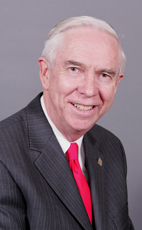
House of Commons photo

Crucial Fact

  • His favourite word was terms.

Last in Parliament September 2008, as Liberal MP for Miramichi (New Brunswick)

Lost his last election, in 2008, with 37% of the vote.

Statements in the House

Modernization Of Benefits And Obligations Act April 3rd, 2000

Mr. Speaker, for many of us in Canada this is a very difficult issue. As I came to the House this afternoon I had to put down a few of my thoughts on it. I want to refer to some very difficult situations which we as Canadians have to face.

We all recognize that with the supreme court decision, we as a government are literally being told that people who are involved in sexual relationships of the same gender should be acknowledged in terms of the benefits that might be available to them as citizens of the country. I personally feel we are offering a special status to certain groups in our society. It is a status which is outside marriage and one which is based, as the amendments would say, on conjugal relationships that are not of a traditional nature.

Nearly every religion I have studied has had a great respect for marriage. If we go back to our Biblical stories which deal with Adam and Eve, Eve came as part of a man and was made his helpmate. The two of them developed according to Christian ideas and Christian teachings a world civilization on which we as a Canadian nation have based our general philosophy. We have seen throughout Biblical teaching various aspects of different sexual relationships. In fact after the great flood in the story of Noah, there were sexual activities that were condemned by the general society in which Noah lived.

The response I have had from across New Brunswick and especially in the Miramichi, is that a great number of people are concerned about how marriage might be interpreted if we as a government accept the new standards in which people have special rights in terms of their sexual relationships. In regard to my own community, I have had e-mails, letters and phone calls and they run about 99% showing great concern about what the government is doing.

We have to realize that in terms of relationships and dependency, there are a great number of different aspects by which people are dependent upon one another. I can think of situations in my own community where two brothers or two sisters live together, or where a brother and sister have shared a household. When I look at those relationships and I consider the bill before us which amends various acts, it gives me a great deal of concern.

I have to be concerned in that the definition we write today which will be in the preamble will not really apply to all of the different acts which we are attempting to amend. I would certainly want to ensure that if we are going to write marriage into the general amendments of the various acts, we should put the same definition into all aspects of the acts that are affected by these changes.

We as Canadians have always been tolerant of all forms of relationships, but the basic concept of marriage and the family values that this country needs to develop are very important. All of us have friends and people we know who are involved in different types of relationships. But in terms of the bill which we are looking to amend various parts of the different benefits and relationships that we might have under the law, we certainly should not base it upon sex.

In the marriage vows that many of us have taken, there is no definite aspect which says that we have to be involved in a sexual relationship. Yet with these changes, we are saying that people who are involved in conjugal relationships are the only ones who will receive benefits of the various plans that our government has available.

I want to go on the record as representing my community which has great concerns with this bill. It is my suggestion that this bill should be set aside until the government can put before the House a definite concept of what other relationships might cost.

We must not in any way discriminate against other family groups who are not sexually involved but who represent a great tradition of this country. I hope all of us as parliamentarians can look at this and hopefully table this legislation until such time as we fully study the costs and benefits of all types of loving relationships that exist in the country.

Petitions April 3rd, 2000

Mr. Speaker, I have three petitions from Canadians who are concerned with the working arrangements of Canada Post drivers in rural areas. They petition parliament to repeal subsection 13(5) of the Canada Post Corporation Act.

Employment Insurance March 30th, 2000

Mr. Speaker, I am not sure if you have ever heard of the black hole. Perhaps it is here today.

In any case, in New Brunswick seasonal workers have periods of time between their EI benefits and the time their season begins for work.

I would like to ask the minister today if there are any special measures to help these people who find themselves in the black hole when they have no income for their families during that period of time.

Fisheries March 15th, 2000

Mr. Speaker, as a nation we are one of the largest exporters of fish products in the world and export to about 100 different countries. Last week in Boston, the famous Boston seafood show was attended by our minister and by representatives of our various provinces and Canadian companies.

Would the minister please update the House on how we are doing on exporting fish?

The side over there needs a lot of fish products. It would be good for them and would develop some of their brains too.

Employment Insurance December 15th, 1999

Madam Speaker, he will have his opportunity. Hopefully he will give me mine.

The employment insurance program is under continuous review. We are attempting to look at some of the problems connected with people returning to the workforce after a period of being left out. We are looking at the fact that there are certain aspects of the program which will be brought to the attention of the minister. With them she would be able to come to the House to make changes to better improve the program for all Canadians.

The motion of the hon. member certainly needs to be amended because we might be led to believe that seasonal workers were left out of the program. Therefore I move the following amendment:

That the motion be amended by deleting all words after “immediate action to” and substituting therefor the following, “review employment insurance benefits for seasonal workers”.

Employment Insurance December 15th, 1999

Madam Speaker, the hon. member's constituency has benefited more from the Canada jobs fund and the transitional jobs fund than any constituency in the province of New Brunswick. If he looks at the figures he will find that.

Employment Insurance December 15th, 1999

The hon. member read the report of our Atlantic caucus. In fact his speech reflected the need for infrastructure, the need for development of industry, the need for greater attention to the economy of those areas and, above all, the great advent of technology.

Great strides have been made in the province of New Brunswick, both with the previous two premiers and our new premier who was elected last summer. We hope he will be able to follow in the footsteps of the previous two premiers.

Tonight I want to mention that employment insurance is not simply a relationship between the government and the workers of the country. It is a three way relationship. Employers pay into the fund 1.4 times the amount put in by employees. We have to ensure that it is a joint fund administered by the government of the country. There has to be a relationship among employers, employees and the government.

The fund was changed in the early 1990s and again in 1995-96. There are certain points we all must be concerned about. The hon. member brought out a good number of those points in terms of women, the intensity clause and seasonal workers about which we are so much concerned.

Tonight we should salute people who work in our seasonal industries. We talk about the people needed in the basic resource based industries such as fisheries, agriculture, forestry and other sectors. About 40% of the country's total gross domestic product in terms of exports is from basic resource based industries. We have to be sure the seasonal workers who participate in those industries are looked after adequately.

The intensity clause is one of the most difficult. Many members on this side of the House are concerned with the definite penalty against people who participate in seasonal industries.

As the hon. member indicated, an employee draws from the program for 20 weeks. Each time he draws after that he is penalized by 1%, going down eventually to 50%, which is a direct attack upon people who are mostly involved in seasonal industries. We too are concerned about that penalty or that intensity clause.

The employment insurance program has many good parts to it. For example, I mention Nova Scotia which has a very good program for people at the lower end of the economic scale. Families earning less than approximately $27,000 a year can receive a family supplement which will amount to approximately 80% of their earned income. That is a definite, positive aspect of the changes made in 1996.

We must also look at some government programs in terms of attempting to look at areas in need of more employment. We think of the former transitional jobs fund and, more specifically today, the Canada jobs fund. I see in the House tonight a number of members from New Brunswick. I think all of us from New Brunswick benefit from the Canada jobs fund.

Employment Insurance December 15th, 1999

Madam Speaker, it is a privilege to speak following my neighbour from the north of my constituency, the member for Acadie—Bathurst, and also my good friend from Madawaska—Restigouche in the far north.

I recognize the work the hon. member has done with EI. He has travelled the country. His background has been with the labour movement. When he speaks he is certainly speaking on behalf of his constituents and the many people he has worked with in the mining sector and other sectors of the labour congress over the last number of years.

I differ very basically on some of the points the hon. member is making. His tremendous energy should be directed more toward the creation of employment, the creation of job opportunities for those people who are in need of work. We heard the speech of the hon. member. I see that you read the report of our Atlantic caucus.

Nisga'A Final Agreement Act December 6th, 1999

Madam Speaker, it is good to follow a speaker from the party opposite who has had some very bright moments in terms of first nations people in his constituency.

Earlier today we reflected on the terrible event which happened in Montreal 10 years ago with the massacre of young women by a lone gunman. As Canadians we reflect on history. Today if we reflect on our history we could go back some 400 years to the arrival of the Europeans. They came to this continent and met the aboriginal people of this country who had their settlements, their ways of life, their culture, their activities and their civilization.

In 1579 Sir Francis Drake claimed British Columbia for the English crown. Over 200 years later, in 1793, George Vancouver arrived and for the first time met the Nisga'a people of northern British Columbia.

In question period today the Minister of Citizenship and Immigration answered questions concerning the immigration policies of the country. I am not sure what immigration policies the good people of British Columbia had back in the 1700s and 1800s, but certainly the Europeans who came to that area were welcomed and they became a very important part of the British Columbia economy as we know it today.

The people of British Columbia who lived in B.C. prior to the arrival of the Europeans found themselves at a great disadvantage in terms of the relationships which eventually developed between their people and the new arrivals to that colony.

The people of northern British Columbia, the Nisga'a, the people of the Nass River and the people of Fort Simpson, where the Hudson's Bay Company set up trading in 1834, encountered a new way of life. They encountered a people who were very aggressive, who tended to push them back from their civilization and who interfered with their hunting and fishing grounds and their natural resources. As a result, today we find ourselves trying to resolve a final agreement among the peoples of the Nisga'a nation, British Columbia and Canada which will terminate this period of conflict and develop a new arrangement by which all Canadians, especially the Nisga'a people, can live in their territories with some degree of pride and respect for our Canadian nation.

The vote that was held among some 2,500 Nisga'a people living on reserve, with a very small minority of white people present, indicated that most of them supported the agreement that we are looking at today. Some 61% voted in favour of it. Undoubtedly, a few felt that it was not right. Probably more of them felt that the agreement we negotiated with them over some 20 years was not as generous as it might be. In fact, the land settlement encompasses about 2,000 square kilometres and the original demand of the Nisga'a people was for some 20,000 square kilometres.

It is interesting to note that the entire area of the Nass River which the Nisga'a negotiated is an area which is probably about one-quarter of the size of that small island at the mouth of the St. Lawrence River, the island of Anticosti. It is a small area in terms of the overall size of the province of British Columbia. To some it sounds like a lot of territory and natural resources, but without a lot of people. We hope that with this agreement those people will be able to develop an economy, an existence and an area in which they can have pride, show leadership and, above all, sustain their people and enter the economy of our country.

I heard in the House today many statements about what we are and who others might be. I would say that when we try to impose our values on others, whether they be in terms of ownership, how society should operate or our European traditions, we are not doing those people who were here before us much of a favour. They have a civilization that is thousands of years old. It is a civilization that was developed with great pride in terms of housing, artwork and the canoes they use to fish on the rivers and on the coast. Those people do not need great lessons on how we might see all Canadians fitting into one pattern.

Henry David Thoreau talked about people who listened to different drummers, who listened to different musicians, who had a different way of life. As Canadians we have to realize that there are many people in this country who cannot be made to fit a single mould.

I was very impressed to find that on the Internet there is a tremendous amount of information on the Nisga'a treaty, the Nisga'a nation and the northern British Columbia area. I ask people who are watching to consult the Internet, to look at those web pages to better understand the debate we are having tonight.

The final Nisga'a agreement reflects a different attitude than that which is reflected in the Indian Act, which has been a tremendous problem for many first nations peoples. We find that there are great restrictions under the Indian Act. The new Nisga'a agreement will mean that the people of the Nisga'a nation will develop a new type of arrangement among themselves and with our governments. That arrangement will not only deal with how they develop the fishery, mining and forestry resources. It will also mean that they may develop a system of taxation by which they may tax their own people. In the long run over a period of time, taxes will be applied both by the province of British Columbia and by the federal government in terms of income tax, sales taxes and GST.

Above all, we hope it will develop among our people in that great area of northern British Columbia near the Alaska border a sense of pride and freedom and an opportunity to develop themselves. It will show the other first nations of this country that when agreements are made, wise people sit down at tables to develop understandings and a new sense of arrangements. It might become a lighthouse of great hope by which the people of our many 600 first nations across the country may see themselves being involved in further agreements and attempt to resolve the many issues that have afflicted our country since the time when our two peoples came together.

Some members today have indicated the problems of the American west. As Canadians we can certainly be proud of the fact that in most situations in this country, the big stands like the stand at Little Big Horn never existed in terms of relations with our first nations peoples.

I know there are different opinions in the House. I certainly cannot agree with some of the opinions I have heard. Hopefully as good people we can look to the strength and the goodness in all people and with that, with the development of the best ideas and the best resources, tonight and tomorrow as we look at this treaty we can come to a definite arrangement with the Nisga'a people which will be in the best interests of all of us as great Canadians.

The Environment November 19th, 1999

Mr. Speaker, the emission of greenhouse gases from our energy related industries is a concern to all Canadians, especially in terms of our obligations under the Kyoto arrangements. I would ask the minister for an explanation in the House of what is being done in the coal industry to develop this and to make our international obligations a reality for Canadians.