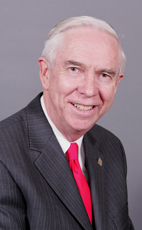
House of Commons photo

Crucial Fact

  • His favourite word was terms.

Last in Parliament September 2008, as Liberal MP for Miramichi (New Brunswick)

Lost his last election, in 2008, with 37% of the vote.

Statements in the House

Committees Of The House November 26th, 1998

Mr. Speaker, I have the honour to present the sixth report of the Standing Committee on Fisheries and Oceans regarding its order of reference of Thursday, October 29, 1998 in relation to the supplementary estimates (B) for the fiscal year ending March 31, 1999 in regard to votes 1(b), 5(b) and 10(b) under fisheries and oceans.

International Fishing Day November 23rd, 1998

Mr. Speaker, on Thursday, hundreds of young people from the Lafontaine community centre in Néguac took part in a march and in the raising of the orange flag. This was in preparation for the first international fishing day.

I was fortunate to spend some time on Saturday with the good people of Néguac in my riding of Miramichi to mark this important day. The livelihood and way of life of so many fishers have depended on the sea for centuries. However, over the past decades overfishing and environmental mismanagement have led to the problems we are facing today. Fishers from across Canada are on the Hill today to draw attention to the need to work together to protect the fish stocks of our waters. I congratulate and thank Madam Lucie Breau of Néguac for organizing these special events in my community and for all those who are here on the Hill today to celebrate with us the orange drapeau.

Committees Of The House November 3rd, 1998

Mr. Speaker, I have the honour to present, in both official languages, the fourth report of the Standing Committee on Fisheries and Oceans.

In accordance with Standing Order 108(2), the committee undertook a study of fisheries issues throughout the west coast of Canada.

Pursuant to Standing Order 109, the committee requests a comprehensive response to this report within 150 days.

Supply October 26th, 1998

Madam Speaker, I know that across this country we have a lot of different interests and a lot of different concerns. However, it amazes me sometimes that some of us in one area of the country can become such experts on someplace else. It is one of the facts in the House.

I have a question for the hon. member. I appreciate his sincerity in trying to deal with these issues. As with the previous speaker, I support the concept that we have of attempting to put together what I call small weeks or grouping of hours in areas of high unemployment.

In Atlantic Canada, in particular, we have a good number of industries that rely upon workers for very short periods of time.

I was home during Thanksgiving week and it rained every day of that week. Fishing boats go out to sea, but sometimes they cannot harvest fish every day of the week. If we want our fish factories and our smaller firms to work in Atlantic Canada we have to provide an opportunity for people to put their hours together to constitute weeks for unemployment insurance purposes.

Is the member aware of this problem and the concerns that we have? I point out to him that it was not the workers who came to us in the Atlantic caucus asking for small weeks or days to be put together, rather it was the industries in Atlantic Canada that were having difficulty providing 40 hours of employment for X number of weeks for their workers.

Perhaps he could relate to the House his concept of this problem and how he and his party would deal with it.

Fishers' Bill Of Rights October 26th, 1998

Madam Speaker, it certainly is a privilege today to join with my colleagues in the House to debate the motion of my colleague, the hon. member for New Brunswick Southwest, who represents a riding that is very much involved with the fishery.

Only about a week ago our provincial newspaper had a very lengthy article on the tremendous resource that we have in the Bay of Fundy. I am sure that the member, who is from that area, is very much concerned about the future and the longevity of the fishery for all of us in Atlantic Canada.

It is curious today that we are talking about a so-called fishers' bill of rights. If we go back, historically, we find that in the last 200 years rights have been developed for a very significant group of people.

I think of the original bill of rights and the work that was done by the American colonists when the United States was set up as a new country in this hemisphere. Then, of course, with the French revolution we had the declaration of the rights of man.

Also this week we have to reflect upon the stamp that came out only this past month recognizing a fellow New Brunswicker, John Humphreys, who was instrumental in writing the special human rights declaration for the United Nations. I am sure New Brunswickers are proud that the stamp was issued. We are certainly proud that a New Brunswicker received international recognition for his work on human rights.

In Canada, of course, we have our own human rights legislation. However I question the necessity for a fishers' bill of rights because across this country there are many different sectors of the economy. If this House is going to try to develop bills of rights, maybe there should be one farmers. They probably deserve a bill of rights because one of the first occupations on this earth was agriculture. Maybe some of our friends from that sector could have a farmers' bill of rights. We could go on and on to identify different groups that should certainly have rights. I think of animal rights. Maybe the member opposite should be thinking of a fish bill of rights.

In the last 25 years fish have had a very difficult time on our globe. As a very good source of protein, we find that many emerging nations or nations in difficulty have looked upon the waters of this earth as supplying protein for their people. As a result, the fishing industry, and fish in particular, have been under great stress. In the 1980s Atlantic Canada suffered great difficulties with the decline of the groundfishery.

My colleague from the west coast might worry about coho salmon. They too might need to have their rights protected. If we do not have some protection for these species soon our entire economy in terms of the fishery will be in difficulty.

I have certain concerns with the bill in terms of this group of people. I know that fisher people are a very important part of our economy. As a government we have attempted to regulate and to show fisher people that they have a responsibility to sustain their industry.

Through regulation and hopefully co-operation the various fisher people can work along with the Department of Fisheries and Oceans to ensure that our fishery has a future.

The House should also recognize that with the decline of the east coast fishery and the problems on the west coast we have developed programs to assist those areas. The fisher people who have difficulties will have an opportunity to take part in programs to get assistance with training and to improve habitat, as we have done on the west coast with the salmon fishery.

On the east coast, as the member opposite from Halifax would certainly agree, we have developed good programs to make sure that people in the fishing industry can receive some assistance when fish become scarce.

If we look at the fishery in the great province of Newfoundland we find that today the resource from the sea is bringing more money to that province than it did during the best years of the groundfishery.

We are looking at alternate species. The fishermen may develop other aspects of fishing and sales for those fish, which will enable them to continue in their home communities. However, we have to be concerned with what has happened to the good people on the east coast and those who have encountered serious difficulties as a result of the economy.

We have to remember that fish have traditionally been very available. However, today we have to be concerned with the fact that we have to sustain the fishery.

I would suggest that the member is a bit off base in terms of trying to develop a charter of rights for fisher people. The minister has brought forward a committee to look at partnerships in fishing, to try to develop a co-operative venture between those who are out on the water and those sitting in offices trying to regulate the fishery.

We have to remember that fish are a public, not a private resource, and the Government of Canada has a definite responsibility to see it continue as a satisfactory industry.

In my riding of Miramichi the first minister of marine and fisheries in the original Government of Canada in 1867 was Peter Mitchell. We have watched over the years what has happened with the fishery since the time of Peter Mitchell. We have to be concerned with what our responsibilities are.

I know the member who brought forward this bill is concerned with his own area. He is very much involved with the area of southern New Brunswick. He needs to see that DFO and the fisher people work co-operatively to continue the fishery there. But I think we have to be more concerned as members of this government and people, in general, about our responsibilities to the fishery so that it can continue.

As chairman of the fisheries committee I would not support a bill for a particular charter of rights for one particular group. I would be more concerned with supporting the concept that we have responsibilities as a government to see that the fishery works well, that it works co-operatively and that it works in the best interests of all Canadians.

Tourism May 26th, 1998

Mr. Speaker, the hon. member for Egmont has asked us to join with all islanders in celebrating the 125th anniversary of that province's joining Confederation.

Tourism is important to New Brunswick, to P.E.I., to Nova Scotia and to Newfoundland. Will the secretary of state responsible for ACOA explain to the House what ACOA is doing to assist tourism in Atlantic Canada?

Donkin Mine March 19th, 1998

Mr. Speaker, Atlantic Canadians and in particular the people of Cape Breton Island are very much concerned about the statements and allegations being made by the member for Bras D'Or.

Today I would like the Minister of Natural Resources to explain to this House and to the good people of Cape Breton Island the future of the Donkin mine, in particular their employment with Devco.

The Budget March 10th, 1998

Mr. Speaker, there is an old saying in a book on statistics, which I think was written by Lord Ashley, that figures lie and liars figure. Some 14 million Canadian families are being offered some degree of tax relief. To try to assume that each Canadian family has $6,000 of debt on average may be correct, but it is really not a fact. Hopefully, as big corporations such as our banks and other groups improve and contribute more to our economy we will see that overall general debt being reduced.

The Budget March 10th, 1998

Mr. Speaker, certainly the levels of unemployment among our youth are of great concern, but in terms of our goals, I think all of us should aim toward seeing that everybody who wants to work is able to get a job. We cannot really set 5%, 4% or whatever the structural amount might be. We eventually have to provide an opportunity to every Canadian who wants to participate in our economy to have work.

The Budget March 10th, 1998

Mr. Speaker, it is always good to hear my hon. friend because I think he has almost as many facts as the computer that sits near my desk and we have to judge them accordingly.

We have to recognize that some 700,000 or more new jobs have been created and that we have a great number of new taxpayers. That is what this government is all about. We are out there trying to get more Canadians employed. I mentioned that some 9% today are unemployed. I would like to see that figure at 5%. With that, our revenues would increase accordingly. We would be able to restore more people working in terms of our economy, building a greater confidence in their ability to invest and to purchase goods. We would have a tremendous economy. The hope is there as we approach the 21st century.