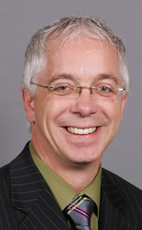
House of Commons photo

Crucial Fact

  • His favourite word was quebec.

Last in Parliament November 2006, as Bloc MP for Repentigny (Québec)

Won his last election, in 2006, with 62% of the vote.

Statements in the House

Official Languages October 7th, 2003

Mr. Speaker, here is an example of the language used in ads on Human Resources Development Canada's website, “L'équipe de demoiselles est intéressées par des individus mûrs et responsables”.

After 35 years of operation of the Official Languages Act, how can the Minister of Human Resources Development justify posting such poor and demeaning translations on its website? Will respect ever be shown for French in her department?

Official Languages October 3rd, 2003

Mr. Speaker, I will preface my question to the President of the Treasury Board with this quote, “National Defence, like the 182 other institutions subject to the Official Languages Act, must report to the Treasury Board Secretariat each year.” I was not the one who wrote that; it was Diane Allard, Special Assistant to the President of the Treasury Board for official languages.

In the latest report, it is clear: at National Defence, they do not respect the law. How does the President of the Treasury Board intend to go about doing her job and enforcing the law? I address my question to her.

Official Languages October 3rd, 2003

Mr. Speaker, this week, the President of the Treasury Board demonstrated how badly she has been overtaken by events in the Radwanski affair. The same incompetence is evident when it comes to official languages.

In point of fact, how was the President of the Treasury Board able to ignore the alarming signs of non-respect for the Official Languages Act in the recent annual reports of the Department of National Defence?

Supply September 30th, 2003

Madam Speaker, I understand very well what my NDP colleague means.

Indeed, if we look at the federal election turnout rate, we see it is dropping rapidly. In 1988, it was 75%; in 1993, 69%; in 1997, 67%; in 2000, 61%. We have dropped 14 percentage points over the last 12 years, At 1% a year, as I said in my speech, the government needs to wake up and come up with some new ways to encourage participation.

I will try to give a more direct answer to the question: why am I somewhat hesitant to support the idea of a referendum. If one reads the motion, what is called for is first a referendum, second a commission to consult the public, and third, a deadline of 2006.

Right off, the process is being made unwieldy. Besides, we have too often seen referendums where rational logic has been buried or bulldozed—if I can put it that way—by arguments that are totally far fetched and had nothing to do with the debate.

In this instance, the question to the people in a referendum will be, “Do you wish to be consulted on an alternative voting system?” Then, the yes and no sides will start arguing. The no side will say that, if you vote yes in the referendum, you will no longer have the right to vote and no longer know your member, which will open the door to al-Qaeda cells. We will hear all kinds of nonsense, which I feel will interfere with our perfectly legitimate consideration of the voting system or the current electoral system.

That is why I think that giving three years to hold a referendum, consult the public and get conclusive results is to set the bar very high. I am therefore hesitant about the idea of a referendum.

I have no problem with having a study to confirm the existing voting system or change it. As I said, if the findings of this study confirm that, in terms of culture, people, our desires and wishes, the existing system is the best, at least we will be somewhat reassured.

If, afterwards, we are told that a certain type of proportional system should be phased in, then we can ask ourselves questions and perhaps hold a referendum. We should do that after, not before, and say, “Here are the findings. Do you agree with them?”

I think that it is putting the cart before the horse to say that there will be a referendum to ask the public whether it wants this to be examined. As far as the principle of the motion is concerned, that of considering it, we have no objection.

Supply September 30th, 2003

There was a minor problem that was resolved by that state's supreme court. However, they have a good system. Obviously, they will not correct this. They will even elect Arnold Schwarzenegger; wonders will never cease.

The United States is therefore an important democracy that still uses the first past the post system, as does Canada and Great Britain. There is also France which has a two round, first past the post system.

It is important to point out, however, that this system is losing speed and is less and less popular throughout the world, particularly in democratic countries. For example, in 1993, New Zealand traded its first past the post system for a mixed system. I suppose that this was preceded by a study. It is not likely that the President or the Prime Minister of New Zealand one day decided that, “Tomorrow morning, we will have a new system”. New Zealand conducted studies and decreed, in 1993, that the new electoral system would be a mixed member proportional system to better represent voters.

Great Britain plans to reform its electoral system in the near future. The inconveniences of the American electoral system are offset by the fact that the government is formed independently of the party with the majority in Congress, and also by the fact that there are only two major political parties; obviously, the first past the post system encourages a two party system by eliminating other parties.

Canada is therefore trailing other democracies in terms of electoral reform. A study or consultations are needed to see how much our system could be changed. And if, upon the completion of the study, we decide to keep our system, we will at least have identified its main weaknesses.

Many people will say that, when it comes to models of representation or electoral systems, the first past the post system is the lessor of all evils, so we should keep it. They also say that it is the simplest. However, just because it is the simplest does not necessarily make it the best.

In conclusion, I believe that if the government wants to be prepared for the requirements of the future, for a drop in voter turnout, it would be well advised not to necessarily accept a referendum—with a little good will this motion could surely be corrected or amended—but to accept that there must be a study on the current voting system.

Supply September 30th, 2003

Mr. Speaker, I was not particularly surprised by the comments of Liberal members, but I am grateful for the motion introduced by the hon. member for Regina—Qu'Appelle.

However, before I read the motion, I want to talk a bit about the Liberal Party's opposition to this motion. It is rather easy to identify its reasons for opposing this motion.

There is some pretty deep thinking involved here. The party in power thinks that if this is the best country in the world, with the best electoral system in the world and the best government in the world, then nothing should be changed. Except that I will shake up the Liberals a bit by advising them to read a certain UN report—wake up everybody—because we are no longer the best country in the world. Our rating has slipped. The Liberals are so used to being the best that they ensure we are also the best at scandals and fraudulent activities. To this end, they exaggerated and extrapolated their obsession with being first at everything. This is true when it comes to politics, expect that, at some point, we need to slow down. Other people should do that. The courts will rule too on their waste and spending habits, on the somewhat less elegant ways they compensated their friends or those to whom they gave money, later asking for 12% back. This was the case in some provinces or some organizations. Fortunately, that way of doing things has been rectified.

So it is understandable, but perhaps we should look at reality in 2003 and say that examining a position does not necessarily mean one admits to being “the worst”. There is some place between the “best” and the “worst”. Do not worry; if we study this, there will be no problem.

But this debate is on the motion of the hon. member for Regina—Qu'Appelle, who appears to have been making this a personal issue for a number of years. Permit me to read the motion:

That this House call upon the government to hold a referendum within one year—

I like this part of the motion better.

—to determine whether Canadians wish to replace the current electoral system with a system of proportional representation and, if so, to appoint a commission to consult Canadians on the preferred model of proportional representation and the process of implementation, with an implementation date no later than July 1, 2006.

Personally, I think it would have been much better to ask for the creation of a committee that would hold public consultations and report back in 2006. For reasons I do not understand, they want to make the process more complicated. But it is hard to be opposed to the principle.

We could hardly oppose it, for one simple reason: in Quebec—another distinction or difference—we have not been afraid to engage in this debate and have been doing so for more than 40 years. Mr. Speaker, I realize that you are very knowledgeable about the political parties and politics in Quebec. I am not telling you anything new, but this might be new to a few members in the House.

Over the years, the various political parties tried many times to introduce proportional representation. It was under the René Lévesque government that the process went the furthest with Minister Robert Burns and his excellent deputy minister, Raymond Faucher.

At the time, there was a public consultation process. A bill was also introduced in 1984 concerning territorial proportionality. It was defeated by the caucus after having been supported by the Premier and the leader of the opposition.

So much for transparency in democracy. The Premier and the leader of the opposition agreed, but the caucus defeated the motion for territorial proportionality. At the time, the leader of the opposition was Claude Ryan.

In February—this is a little like what the member for Regina—Qu'Appelle is asking for—estates general were held on electoral reform. Countless stakeholders offered their views. These estates general travelled throughout Quebec and there was a large meeting with more than 1,000 people. People were able to discuss which electoral system they preferred or thought to be best suited to the reality of a modern Quebec.

The Liberal Party is currently reviewing the issue and a bill should be introduced during this term. However, there is a small problem. The Liberal Party made a campaign promise to introduce a form of proportional representation for the next election, but after the election they said it would be for the next election, in other words, in five or six years, and that they would review the issue in the meantime.

Forty years might be a long time, but at least we are tackling the issue and working on improving the system. When the government is ready, the work will have been done.

What the Bloc Quebecois appreciates is that the motion by the hon. member for Regina—Qu'Appelle does not call for the change to be immediate. That is why we are surprised to see the Liberal's opposition. What we are being asked is to be ready when the time comes, when the change needs to be made.

For example, when we proposed that a commission be set up to address a single currency, they said “Look at the Bloc members. They want us to have the U.S. dollar.” That is not it at all. As they say, when the train pulls into the station, we need to be ready to get on board. So it is better to study the question before something gets imposed upon us. The same goes for proportional representation.

Are we going to wait until we have a federal election turnout of 42% before we address the question of why people do not get out and vote? There is perhaps a defect or shortcoming in the way MPs represent their electorate. Perhaps there is a shortcoming in the amount of work MPs who are not in cabinet do. Perhaps there is a shortcoming in the present electoral system.

If we study this system and reach the conclusion that the system we have is the best, then we stick with it. But if we are confident that the present system is the best, we should not have any problems about comparing it with other hypotheses so as to be able to state at the end of the process that the status quo should prevail.

We are so confident that we do not even want to talk about it; we want to hide it, set it aside, save it. What a great show of confidence.

It seems to me that we are clearly in favour of introducing some form of proportional representation. There lies the question. A form of proportional representation does not mean a uniform system across Canada. There may be a middle ground somewhere. At the very least, there are elements of the proportional system that could help enhance democracy and the representation of citizens in the House of Commons.

Because of the first past the post system, political parties that do well in an election sometimes get blanked out. We find that unfortunate.

This proportional system could have been put forward or examined at the time when the reform of the electoral system was dealt with in committee, along with the new ridings and the appointment of returning officers.

There is also a flaw in the Canadian electoral system in that 100% of the 308 returning officers are said to be appointed by the governor in council. The Chief Electoral Officer—and if ever there were a non-political officer, it is he—has requested the authority to appoint returning officers, through a competitive process, which the government party refused, of course.

In committee at the time, I argued that there should be no hesitation. I am convinced that there are competent Liberals. They may not all be competent, but there must be a few who would go through the competitive process and keep their jobs. However, the Liberals are so sure that their returning officers are good, competent and hard-nosed that they will not consider having a competitive process or proportional representation. That is what I call confidence.

In our internal documents, we have noted that the proportional system is an approach that should be part of a larger effort to enhance political institutions and parliamentarians. The confidence bias the public has for Parliament may be a solution. Under Bill C-34, the ethic counsellor will not be the only one resolving the whole world's problems, but this study could also provide a solution.

We support the principle while at the same time saying that our ultimate goal is to represent the people of Canada well, as long as we in the Bloc Quebecois are here. Our ultimate goal is not to improve the system so that it can be used for another 125 or 150 years and work to our advantage. On the contrary, we want to get out of it following a winning referendum on sovereignty.

However, on the other hand, as long as we are in the system, it is very much to our advantage to ensure that voters in Quebec are recognized in a Parliament whose electoral system could be modernized.

The most important part of the NDP motion concerns public consultations. Bogus prebudget consultations are held. On major international agreements, the Standing Committee on Foreign Affairs and International Trade holds consultations that are, more often than not, not very serious. And, moreover, when it comes to something as important as the electing representatives, nothing is said about the way in which public representatives are chosen.

The Bloc Quebecois supports this motion primarily in terms of this need for consultation. Such consultations would lead to an exchange of ideas on the issue and would lead to future replacement models that could work in Canada.

However, we question doing this so early in the process. Studies were doubtless undertaken by various committees, or studies could be undertaken before launching this consultation, to allow people to discuss, using concrete examples, as we heard earlier in this House, those countries which have a different electoral system from our own but which are not necessarily banana republics. There are other countries and other electoral systems.

In representative democracy, the way that representatives are elected is extremely important, since this mechanism translates the public's wishes into the number of seats each party obtains.

There are two major types of voting systems: majority voting and proportional voting. In the majority system, constraints related to governance dominate, while in the proportional system, constraints related to representation are predominant. There are mixed systems as well, aiming at a solution lying somewhere between the two, and that, I think, is what Canada should look into.

Each of these types is divided again according to voting methods. Thus, even though we are in a majority system, there are different kinds of majority systems.

At one extreme, there is the first past the post majority system, the one used in Canada, the United States and Great Britain, the preferential system, as in Australia, and not so far away, there is the two round system used in France. In the last election in France, the importance of the two round majority system became apparent.

On the other hand, in the other type of voting systems, there are proportional elections that can be absolute, as in Israel or the Netherlands, that is with one huge electoral district, or moderate proportional systems with larger or smaller districts, as in Norway, Switzerland and Belgium, with a much higher rate of participation.

We are dealing here of countries with a recognized democratic system, countries that are not in the third world, democracies that could reasonably be taken as inspiration for improvements to our system. From another point of view, some say no, our system is so good that we do not even dare to compare it with others.

Finally, there are mixed systems that combine elements of the majority and proportional systems, for instance those in Germany, New Zealand, Japan, and Russia. There are variations in the mixed systems too. They can be of the reciprocal type, as in Germany and New Zealand, where the seats attributed proportionally are intended to compensate for those filled by a majority. That is one model we might consider as suitable, or at least which might provide Canada with some inspiration.

In contrast, in Russia and Japan, it is a mixed cumulative system, and the element of compensation is lacking. When correcting any failings of the current system, we must not make voting more complex for the voters, thus pushing them farther away from their representatives; we must ensure that they at least understand who their member of Parliament is, and that there are no more ridings and no more party representatives. Thus, if this study is done, one priority must be to maintain the close link between the voter and his or her representative.

There is no sense in trying to correct a problem by creating an even bigger one. That is why I am describing systems that exist in other countries. I think that if we implemented this in Canada, it would have to be done slowly and in stages, to allow the public to properly understand the improvements that we want to see made to the current electoral system.

Of the 53 most stable democracies—in other words, where democratic elections are held at regular intervals, countries with at least 3 million inhabitants and a multi-party system—there are 25 that have proportional representation, 15 that have a first past the post system and 13 with mixed member proportional. Consequently, we can deduce that there is no magic recipe or miracle formula.

If out of 53, there are 25 with proportional representation, 15 with first past the post and 13 with mixed member proportional, that means that culturally and politically, people have to identify the system that best suits them during the development of their country, and that electoral systems can evolve, as society does.

The first past the post system may still be used—this was pointed out earlier by the Liberals—in many major democracies, such as the United States. But we must not forget that George W. Bush was elected with a 50% participation rate and that roughly 50% of those people voted for him. Therefore, roughly 25% of the Americans elected their president.

In this regard, there was a minor problem in a state where his brother was governor.

Canadian Broadcasting Corporation September 26th, 2003

Mr. Speaker, the parliamentary secretary's convoluted answers satisfy neither the public nor the employees of the CBC. Her government must provide a real answer.

After the recommendations by the Standing Committee on Canadian Heritage regarding the need for stable funding for the coming years, after the promises made by the heritage minister this past March, what real explanation can there be for this further $10 million cut?

Canadian Broadcasting Corporation September 26th, 2003

Mr. Speaker, this past March, the Minister of Canadian Heritage told us that, following on the $25 million cut to the Canadian Television Fund, the government would be investing in the CBC this year instead of the public sector television fund.

How then can the Minister of Canadian Heritage explain the $10 million in cuts that have been announced, in light of her expressed intent to invest in the CBC?

Acadians September 19th, 2003

Madam Speaker, to start with, I would like to congratulate my friend and colleague from Verchères—Les-Patriotes for giving us once again the opportunity to discuss this historic tragedy, but also for his hard and ongoing work on the issue of the deportation of the Acadians and the recognition of an historical fact.

Whether we agree or not with the motion, we can all agree that it is the exemplary result of the kind of work a member can do when he believes in an issue and works on it in a professional manner. I am convinced that if I were to ask for the unanimous consent of the House to recognize this fact, I would undoubtedly get it.

For over three years now, the member for Verchères—Les-Patriotes has proven that a member of the House of Commons can use his powers, capacities and responsibilities to put forward, debate and implement a bill or a motion that can make a difference in our society. It is to his credit, and I congratulate him.

To my friend and colleague from the Canadian Alliance who mentioned in his speech that he was opposed to asking for an apology, I say that I am in agreement with him, up to a point. However, this is not what the motion is about. He may have misread it. The member for Verchères—Les-Patriotes is in no way asking for an apology.

We are very surprised by the comments made by the Canadian Alliance member, since, last time, members of that party voted in favour of a similar motion. However, today on a motion that is not all that different, they are presenting opposite arguments. They might have the opportunity to explain why during the next hour of debate.

I am a lot less happy when I hear the member for Laval East using arguments, which I would call partisan and fallacious, to show her opposition to the motion. I find it sad. I believe that if there is one thing that must unite us all, wherever we sit in the House, it is private members' business.

When dealing with government bills, it is quite normal for government members to feel bound to support them,

We are dealing with private members' business, and some members are playing petty politics and saying we are separatists and they do not like us. It seems to me that, from time to time, we should rise above that.

I think that if we keep on foster the population's mistrust toward behaving this way, we will only enhance the population,s mistrust toward politicians. When we deal with a motion on a non-partisan subject like this, this kind of comment is inappropriate. Whether or not we agree with the Canadian Alliance, we have to admit that it took the high road, that its arguments made sense and were well reasoned.

When people who are criticial of politics and refuse to vote are asked why they take this stand, they answer by giving examples like the comments of the Liberal member for Laval East. We can and we should behave differently, all the more so since she told us in a previous speech that the three traditional pillars of the Acadian economy are fisheries, agriculture, and forestry.

The hon. member said that agriculture was still a way of life in Acadia and that people get up early to pick potatoes. This is an insult to a whole people and even to this Parliament.

The hon. member also said that she cannot support such a motion because Canada is a sovereign country. I beg to remind her that Canada's head of state is the Queen of England.

I will also remind her that we have a governor general as well as lieutenants-governor. Yes, we signed the Statute of Westminster in 1931, if I am not mistaken. And yes, we still have ties with Great Britain.

I will remind the member for Laval East that all our laws must receive royal assent. I hope I am not telling her anything that she does not know already, because she has been here for some time.

Some people made comments to my friend, the member for Verchères—Les-Patriotes, to the effect that apologizing means living in the past and that this is not right.

I will the backgroung to Motion No.382 to show how partisanship was set aside to respond to concerns expressed and to present a motion that would be acceptable to as many members as possible.

I will read to you the first of these motions, calling for the recognition of an historical fact that I believe is undeniable.

On March 27, 2001, more than two years ago, Motion No.241 read as follows:

That a humble Address be presented to Her Excellency praying that she will intercede with Her Majesty to cause the British Crown to present an official apology to the Acadian people for the wrongs done to them in its name between 1755 and 1763.

We have heard all sorts of arguments, mainly from the Liberals and the Alliance, saying “We do not agree to ask for apologies”. We said, “Fine, we will amend the motion. We will change it to try to satisfy you”. We have even tried to find a new mover so that the nasty separatist argument would no longer apply. We have taken out the words “ to present an official apology” and replaced them with “...a humble Address be presented to Her Excellency praying that she will intercede with Her Majesty to cause the British Crown to recognize officially the wrongs done to the Acadian people ”.

We are not asking for money or for apologies. We do not want to find a culprit. We only want an official recognition of an historical fact. At the time, for reasons that do not seem very valid, the motion was defeated.

However, the member for Verchères—Les-Patriotes has two main qualities: tenacity and perseverance.

He came back on February 6, 2003, with Motion No. 238, which read as follows:

That this House officially acknowledge—

Because, at that time, it had been determined that it was not the responsibility of the Governor General to take action.

—the harm suffered by the Acadian people from 1755 to 1763.

We were not asking for apologies. We were not accusing anyone. We were just asking for an official acknowledgement. We were presented with the same arguments all over again; for example: one should not dwell on the past; one should look toward the future; this is being moved by separatists. So the motion was defeated.

The Société Nationale de l'Acadie then created an expert panel to review the issue.

The member for Laval East said that the member for Verchères—Les-Patriotes went around, implying that he stirred things up. I am sorry, but when a member of Parliament goes somewhere to consult and work and when his efforts lead a society to create an expert panel to study a motion, that member is not visiting as a tourist.

Such arguments are cheap shots. I am sure we would all agree that such a comment is rather nasty.

After the consultations, the last motion is now being brought forward. It reads as follows:

That a humble Address be presented to Her Excellency praying that, following the steps already taken by the Société Nationale de l'Acadie—

This does not come from separatists.

—she will intercede with He rMajesty to cause the British Crown to recognize officially the wrongs done to the Acadian people in its name between 1755 and 1763.

All members who spoke here in the House have reminded us of what happened during the deportation; that is why I did not do so; I believe we all know and recognize those events.

Should we live in the past? People say that it is not a good thing. But if a person or a group of individuals who fell victim to some injustice or tragedy want healing, if I may use that expression, if they want to rise above their pain and suffering, an official acknowledgement by those who caused that injustice will allow them to take action, turn the page and continue to grow, as the Acadian people have shown they are quite capable of doing.

Taxation September 19th, 2003

Mr. Speaker, they take the prebudget consultations so seriously that the future prime minister has refused to participate.

The finance minister was waiting for instructions from his future boss. He got them yesterday from Montreal, where the member for LaSalle—Émard said in a speech that he wanted to make debt reduction his priority, and at the same time invest in education, health and municipalities—all of which are under provincial jurisdiction.

Does the Minister of Finance think it is realistic to pay down the debt at such a rate without seriously impinging on the financing of social programs?