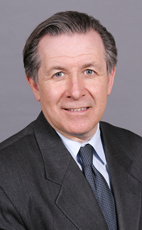
House of Commons photo

Crucial Fact

  • His favourite word was industry.

Last in Parliament September 2008, as Liberal MP for Algoma—Manitoulin—Kapuskasing (Ontario)

Lost his last election, in 2008, with 33% of the vote.

Statements in the House

Telecommunications Act October 19th, 2005

Mr. Speaker, I do not want to restate what I said to the member for Abitibi—Témiscamingue about the gun registry, but it is a good point. There is a three year review that we all agreed to and should my forecast on that be wrong, hopefully I will be here for members to hang me out to dry on that one, but we should be okay.

As far as an existing business relationship, the CRTC, as it goes through what is expected to be a 19 month process from the passage of the bill to the establishment of the first day of operation of a do not call administration, will include in that timeframe consultations with the industry. It is hard to give a precise definition of an existing business relationship. In fact we do not want to tie the hands of the CRTC or of Parliament because of something we had not thought of, and it often happens that we did not think of something. We want to provide good guidance. The notion that one and a half years for some kind of a purchase, a contract, a lease, some kind of significant relationship, and six months for ordering a catalogue or making an inquiry is fair for now.

Telecommunications Act October 19th, 2005

Mr. Speaker, there is no comparing the gun registry experience with what I expect to be the case with the do not call registry. We are talking about a system where a consumer on behalf of a household simply registers the phone number online with no personal data required. Only a minimum of information would have to be provided to verify that indeed it was that household. My understanding is that anything beyond the phone number will thereafter be erased. It is very simple to register online or to call a 1-800 or toll-free line.

Right now, the telemarketing community, as a group, as an association or as individual members, maintains lists. I do not recall that any of them indicated that their costs now were exorbitant. If we make a reasonable assumption based on the experience of the telemarketers who maintain individual lists and imagine what the situation might be for national lists, if reasonable measures are made and good sense prevails, which I believe it will, we should not see an explosion of costs.

I respect the member for representing his community and Proximedia but I would ask him to reassure the telemarketing company that there should not be any surprises, that it will find its business that much more efficient because this will have eliminated people who do not want to receive calls or people who most likely would not wish to buy the products that are being offered.

It is a good question, but I would ask the member to reassure his constituents that there should be no problem.

Telecommunications Act October 19th, 2005

Mr. Speaker, I am pleased to participate at this stage of the debate on Bill C-37, an act more commonly known to create a do not call list for the country.

I want to commend all members of the Standing Committee on Industry, Natural Resources, Science and Technology for an excellent piece of work. I am honoured to chair that committee and I can only say that our ability to work is only because we have cooperation on all sides. The government's willingness, as brought forward by the parliamentary secretary, to look at amendments and the good amendments that were brought forward by all members, especially the critics from the three parties, all provided the House with a better bill to deal with here today.

The bill is not perfect. I do not know if we ever find a government bill that is, but we have struck an excellent balance. I know certain groups or persons may not be entirely happy with it, referring to the comments by the member for Windsor West and others. However it was the amendment of the member for Windsor West which, if I recall correctly, changed the five year review to a three year review. At the three year review, hopefully any serious or minor problems we may have created can be dealt with.

I believe the bill would balance the needs of the marketplace to sell its goods and the needs of consumers who are entitled to privacy in their dwellings. The day is long past where we see door to door salesmen. I do not think anybody here can remember the last time a Fuller Brush salesman was at their door. The times have changed and now the equivalent of the door to door salesman is the telephone telemarketer.

When door to door salesmen go up to a door there could be a sign saying “No solicitors”. I do not think it means lawyers. I think it means no peddlers, no door to door salesmen. That is a clear message to the salesman not to knock at that door. In the telephone marketing business, they need to have the equivalent of that sign on the door and that is what the do not call registry will do.

The registry would in no way impair the ability of telemarketers to conduct their business on behalf of their clients. As the member for Montmagny—L'Islet—Kamouraska—Rivière-du-Loup said quite effectively, it would reduce the set of calls that the telemarketing company has to make and therefore the percentage of successful calls on behalf of clients will go up because they have taken out a lot of people who do not want the calls and who are not likely to be potential customers of the caller. I think certain efficiencies would be brought to the industry that would be welcomed. We did hear great support from the telemarketing community. We have found that balance.

When I have been the recipient of a nuisance telemarketing call, I have gotten into the habit of politely asking the person to take me off the list. I do not recall ever having a call back from that particular company again. However I am away from home so much, as my colleagues are, that maybe the chances of a telemarketer finding us at home are low.

That said, the bill would simply extend the right of every citizen to be taken off a particular company's or telemarketer's list and creating a centralized list.

However it was important that we consider some exemptions and most particularly, which all parties supported, was an exemption for non-profit organizations. I know the member for Edmonton—Leduc was very effective in bringing forward what I thought was a very balanced approach. Suggestions were made to make the exemption for non-profits much broader, resulting in being more difficult to administer. It is now defined as a list based on the Income Tax Act, which should be, for the do not call administrator, a much easier system to administer.

We also made sure that businesses that had existing relationships with customers could contact those customers for a year and a half after the last significant commercial interaction and six months if it were a relatively minor interaction such as ordering a catalogue.

With those two exemptions for business, I think a balance has been struck. I know there was one particular businessman from British Columbia who contacted all of us. I know his member for Esquimalt—Juan de Fuca spoke to me about his concern. I respect his concern but I think, in balance, a year and a half was the right amount, at least for the first three years of the system.

Concerns were raised too about the cost. I understand from the CRTC's presentation that it is estimating about a $2 million one time implementation cost. The ongoing costs will be taken care of by the telemarketing community, those who do the calls, because they will essentially pay the administration of keeping their lists up to date. There should not be a serious ongoing cost to taxpayers. Since this is a cost that these companies have now in maintaining their own lists, now they can simply allocate those resources as a contribution, I presume, to a national do not call list.

I hope the House will deal with the bill expeditiously. There seems to be a consensus to move forward, notwithstanding a desire for some tweaking here and there, but on balance it is a good bill. It should be dealt with here and I hope expeditiously in the other place so that consumers can have the protection of their privacy to which they are entitled so that each consumer can make his or her decision on whether they shall be subject to the calls from telemarketers, people who wish to sell them a good or service.

Carmen Provenzano September 29th, 2005

Mr. Speaker, this past July my friend and our former colleague, Carmen Provenzano, suddenly passed away. He was Sault Ste. Marie's federal member of Parliament from 1997 until 2004. He was a loving husband to Ada, a caring father to their children, a devoted member of the community, a hard-working MP and a great friend. His funeral mass was a wonderful testimony to his life.

Carmen will be missed but in many ways he will be remembered, including through the recent establishment of the Carmen Provenzano Memorial Cup to be given to the Sault Ste. Marie or Blind River team that does best in each of the Northern Ontario Junior Hockey League seasons.

Whether it was fighting to save the Sault's Algoma Steel Plant, working to ensure FedNor funding northern Ontario as our caucus chair, fighting effectively behind the scenes to advance community projects or doing the countless smaller but important things he did for his constituents, he will be fondly remembered as a man who loved his family, his friends, his community and Canada.

May my friend rest well and enjoy his place in paradise.

Gasoline Prices September 26th, 2005

Madam Speaker, I appreciate the comments from the member for York—Simcoe. I would not have enough time to comment on everything he raised. He wanted to get on the record and I appreciate that is his job. Let me pick up on two things he said.

He mentioned farmers. Certainly there are farmers on Manitoulin Island and in the Highway 11 and Highway 17 areas of my riding. It occurred to me last Thursday as I listened to the committee testimony that I referred to earlier that there will be some suppliers of services that will need to pass on their very significant new transportation costs. Farmers are among them.

I do not know if governments can be involved in this. However, I think our society has to accept that for those sectors of the economy for which transportation, and therefore fuel costs, are significant, the passing on of a cost does not bring with it a penalty. In fact, those who purchase these goods must be prepared to accept that the suppliers of these goods have a need to pass on some of these costs.

We need our farmers. We need the forestry sector. We need all sectors of the economy to survive and thrive in this beautiful country of ours.

I am not sure this can be regulated. I am hopeful, with the encouragement of governments at all levels, that the passing on to the next level in the chain of transportation costs can be done in an orderly and managed way.

Finally, on competition, I think the petroleum monitoring on which the former chairman from St. Catharines led us would go a long way toward helping that.

Gasoline Prices September 26th, 2005

Mr. Speaker, as we begin on the first day of the return of Parliament this fall, my mind is first brought to the fact that we are going to be here most of the next three months until just before Christmas. We will be away from our ridings more and will certainly be away from our families. We know that we will all miss our families and there is the work that awaits us every weekend when we get home to our ridings.

I do not want to miss the chance while we have the member for St. Catharines here in the House to acknowledge that he led the committee when it wrote the report published in November 2003, which led the way on a recommendation that the Government of Canada establish an agency, which the committee report refers to as a petroleum monitoring agency. It was an all party agreement, although the then Alliance Party, now the Conservative Party, issued a dissenting report not agreeing with the consensus of the committee that there should be some kind of monitoring agency. I am confident that the government is looking at some form of monitoring, so I want to extend congratulations to the member for St. Catharines on his leadership at that time.

I would also like to acknowledge the participation of members of the House in a very interesting, all day, special meeting of the industry committee, on the morning, afternoon and evening of last Thursday, September 22. The member for Vancouver Island North, who is here debating tonight, is an important member of that committee. He sat with us all day long. The member for Yukon, the member for Wellington—Halton Hills and many other members participated in an all party meeting, which I thought was a very good opportunity not only for parliamentarians but for Canadians at large to get a better understanding of how the oil industry works.

We started the meeting with the idea of what happened over recent weeks when the gasoline prices went up so high. More recently we have seen them moderating somewhat, but they have not gone back to their August levels, at least not yet. We hope they will.

We heard from about 25 witnesses. I would like to thank them publicly, at least as many of them as I can get on the record. We had witnesses from the industry, from Ultramar and Petro-Canada and from their associations. We had witnesses representing the independent petroleum marketers, some of the small gas stations we see in our small communities, such as McDougall Fuels in my riding of Algoma—Manitoulin—Kapuskasing. We heard from the Association québécoise des indépendants du pétrole, an organization based in Quebec.

We heard from finance and natural resources officials. We heard from the Competition Bureau. We heard from experts, including the Conference Board of Canada. By the way, the Conference Board has done its own studies and has come to its own conclusions on the oil industry in Canada. I will let the testimony on the record speak for itself.

We heard also from the Canadian Federation of Agriculture, the Canadian Federation of Independent Business, the Canadian Trucking Alliance, the Air Transport Association of Canada, Option consommateurs and the Sierra Club of Canada. We heard from the Consumers' Association of Canada, the Canadian Taxpayers Federation, L'essence à juste prix, the Canadian Renewable Fuels Association, Iogen Corporation and the Coalition pour la défense des consommateurs de carburant du Saguenay-Lac-Saint-Jean.

We heard from a wide variety of witnesses who gave us a very interesting perspective, but we are not there yet. It is obvious to me. I am just the chairman of the committee and I am speaking only for myself at this point. We have not reported, but I expect that after hearing from the ministers we have invited to appear over the meetings ahead and from the other witnesses, the committee will report to Parliament in the weeks ahead based on the desire of committee members to wrap things up. I am sure it will not be months. It will be just a matter of a few weeks, I hope, but there were almost as many suggested solutions as the number of witnesses we heard.

It is not easy to paint a clear picture of what is going on. It is a very complex industry. One of the things I was struck by was the razor thin balance between supply and demand for energy in the form of carbon fuels: gasoline, diesel, heating fuel and so on.

We heard that the refinery capacity in North America was pushing 90%-plus and that a new refinery has not been built in North America for about 30 years. We have to ask ourselves why. I am not prepared to come to any conclusions. The Competition Bureau commissioner, Ms. Sheridan Scott, reported to us that there is an ongoing study. Even though they reported on retail level allegations of collusion in the past, they are continuing their work. I believe partly in response to the independent fuel retailers they are looking somewhat at the wholesale level of gasoline in the gasoline supply chain right now.

Let us not prejudge what they will conclude, but we all know as members here that our constituents are frustrated. They do not understand why the retail price of gasoline in Kapuskasing is so much higher than it is in downtown Toronto. They do not understand why the price on Manitoulin Island is so different than it might be even in Sudbury, a drive of only an hour and a half to two hours.

Those who drive trucks, particularly logging trucks in the forestry sector, know how difficult it is to pay for the fuel to carry the logs to the pulp and paper mills. They are frustrated. They look to us to provide answers. Whether governments are to blame or not for the high prices of gas is really irrelevant. The consumer, the citizen, the taxpayer simply wants to know what is going on and what can be done about it.

For example, just before I went to the meeting I received an e-mail from Mr. Makela, who is the proprietor of Lauzon Aviation near Blind River in my riding. He has a small bush plane business. I am sure the member for Vancouver Island North has small charter companies and bush plane companies in his riding. These folks have to pay the going rate for aviation fuel and it hurts. Clearly, this is a partisan place that we operate in, but I only hope we can work together for a common goal not only to provide answers to our citizens but to come up with some clear-cut initiatives that will ease the pain and burden.

Gasoline prices today are a challenge. In a rural riding like mine, everybody has to drive any distance to get to one service or another. I have a riding of 110,000 square kilometres. We have to drive somewhere to get many of the services, even if it is to go to a hospital. There is no question about cutting back on driving. If people have to go to a doctor, they have to drive to the doctor. There is no public transit option for my constituents. We hear this frustration and we have to find some answers for them.

As important as gas prices are, I am looking with some trepidation to the winter months and the possible cost of heating fuel, whether it is traditional oil or natural gas, because other forms of energy will get sideswiped in all of this. Energy all combined rises and falls as one piece of the sector rises and falls. I have a letter from the Canadian Gas Association which tells us that gas prices will go up. Hopefully they will not go up unreasonably, but I think we can expect that they will go up.

I am particularly concerned, as no doubt are all of my colleagues in this place, about people on fixed and low incomes, those who are more vulnerable in society. We think of our seniors. I am hoping that the government will find its way to do something to assist the most vulnerable in our society this winter should heating prices be more than manageable.

I am also hopeful that there will be some measures to help our trucking industry or small businesses that are dependent upon fuel prices. The government cannot do everything.

As my colleague from Mississauga South mentioned, a 1¢ cut in the federal excise tax or GST is equivalent to $400 million per penny. If we look at the U.S. its prices for retail gas are lower than ours, but it does not have medicare. I am sure if those citizens added the cost per month of their universal medicare to the price of gas, our prices would be comparable.

I want us as a government to watch out for those who are vulnerable in society. Let us move aggressively toward more efficiency in our lives, whether it is at home or in transportation. Let us be sure we keep that commitment to municipalities to share the gas tax for their infrastructure.

Agriculture June 23rd, 2005

Mr. Speaker, my question is for the Minister of Agriculture and Agri-food.

Several months ago the government announced the closure of four science sites including the Kapuskasing Experimental Farm. I realize the government wants to ensure that money for science is spent on research and development and not on unnecessary maintenance and other overhead costs.

On May 17 at the agriculture committee the minister said he intends to conduct a broad review of how agricultural science is conducted and to look for possible partnerships with the provinces, universities, research centres, and others.

Could the minister update the House on this very important issue?

Committees of the House June 16th, 2005

Mr. Speaker, I have the honour to present, in both official languages, the seventh report of the Standing Committee on Industry, Natural Resources, Science and Technology in relation to Bill S-18, an act to amend the Statistics Act.

Petitions June 16th, 2005

Mr. Speaker, I rise on a point of order. I am going to ask the House once again, now that we have had clarification. The Standing Committee on Industry, Natural Resources, Science and Technology earlier this morning passed Bill S-18. I am asking the House to revert to reports from committees for a moment.

Committees of the House June 16th, 2005

Mr. Speaker, I rise on a point of order. I would like to ask the House for unanimous consent to revert to reports from committees. Earlier this morning the industry committee adopted Bill S-18. I am wondering if I could report that to the House.