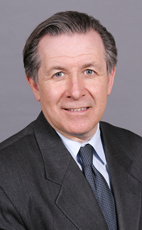
House of Commons photo

Crucial Fact

  • His favourite word was industry.

Last in Parliament September 2008, as Liberal MP for Algoma—Manitoulin—Kapuskasing (Ontario)

Lost his last election, in 2008, with 33% of the vote.

Statements in the House

The Budget May 10th, 2006

Mr. Speaker, before I start my remarks, I would like to follow up. The debt grew quite large under the administration of the Conservative government of Mr. Mulroney. Under our administration, the debt as a percentage of GDP dropped from 68% to 38%. That is a substantial accomplishment. We started out, as my hon. colleague from Egmont said, with a $40 billion plus annual deficit. In fact, this is a great segue for my own remarks.

My own very large and beautiful riding of Algoma—Manitoulin—Kapuskasing in northern Ontario, some 110,000 square kilometres, is an area filled with creative people, about two dozen first nations communities and Métis people. We have tourism, forestry, mining and a potential for the future, which is fabulous. However, the budget, introduced for the first time by the government a few days ago, is one without any vision. In fact, when I was contemplating whether it was a vision that was a bad vision for the future or whether there was any vision at all, I really was not certain.

Let me just build a bit on some of my colleague's remarks. We should consider what our administration did over the last 12 years with the national unemployment rate. In 1993 it was at 11.5%. Now it hovers in at just over 6%. I mentioned the huge drop in the debt burden of the country. Employment insurance premiums dropped from over $3 per $100 of earnings back in 1993 to now under $2 per $100 of earnings. It is a fabulous boost for small business and workers across the country.

I could go on and on. In fact, a very important statistic is that Canada's foreign debt as a percentage of GDP dropped from 45% in 1993 to only 17%. We were able to put the books of the country in shape for the first time in a long time, I think eight successive surpluses. Thankfully, the Conservatives now are the beneficiary of a great set of books. We encourage them to use those funds wisely. Do not bring us back into deficit. That would be the worst thing for the future of the country, and I worry about that. Conservative governments in the past have proven to be fiscally incompetent.

For example, Conservative governments in the U.S. have proven themselves to be fiscally incompetent. The competence that the Liberals brought to the financial affairs of the country is a model for the world. Ask our G-7 and/or OECD colleagues about that. That is not even to mention inflation.

Over the time that we were in office, inflation was brought under control. This was not done just by the government itself. Nor can the new government take all the credit for what it does, bad or good. It does involve a lot of other people. Canadians worked hard, along with us over the last 12 years, to accomplish what was accomplished.

I would like to go back to the division thing. What really concerns me is that the budget is much more about short term expediencies, what will happen in the months ahead. I am, as are my colleagues, more than ready to face the electorate at the appropriate time.

I mentioned that I had roughly 24 first nations in my riding. We had the Kelowna accord, an accord that was signed, sealed and delivered by the premiers of the provinces and territories, by the aboriginal, Métis and Inuit leadership and by the prime minister of the day. To see that accord tossed out the window is a damaging for the relationship between Canada and its aboriginal peoples.

Our aboriginal people deserve respect. They deserve to be at the table. It was a historic meeting in Kelowna where provincial, territorial, national and aboriginal leaders were together for the first time. They made breakthroughs that were historic. I really hope that the very small down payment that the government made in its budget is followed up with further action and a commitment to follow through on the over $5 billion that was committed to in Kelowna. We are really counting on that. We will give the government the benefit of a little more time, but it is barely 20% there on that commitment.

I am worried about our regions. There was no mention that I recall about regional economic development. In northern Ontario--

The Budget May 10th, 2006

Mr. Speaker, I listened with interest to my friend across the way. My suggestion would be that 10 minutes may be more than enough to deal with the good things in this budget, but we would need a lot more than 10 minutes to deal with the bad things in this budget.

I am not sure if he does his own income taxes, but a lot of people go to H&R Block and other organizations to have their taxes done. With great respect to the family that he referred to that claimed it was going to get a $2,100 tax break with this Conservative budget, I find that hard to believe.

Is he actually aware that a tax credit is really not in our pockets what it is says it is on a piece of paper? For example, with a $500 tax credit for sports programs, take about 15.5% of that, and we would get $78 or $80, something like that.

I am wondering if the member is aware that the dollars in the budget that the treasurer talked about, or I should say the finance minister, but I guess at one time he was a treasurer in Ontario, and not that good at it, actually, not that I recall, but those were the Mike Harris government days in Ontario. This budget is very much like if somebody promised to hit me on the head with a 2x4 and kept his promise, I do not think I would be very happy. I am just wondering if my friend across the way is aware that a tax credit is really not worth what it says it is? It is actually worth about 15% of the amount, or 15.5% because there is a tax increase in this budget.

Industry April 27th, 2006

Mr. Speaker, I have a very important question for the Minister of Industry. The people of Sudbury are enthusiastic about the friendly takeover of Falconbridge by Inco. Northern Ontario and all of Canada will benefit greatly from the creation of a Canadian based, truly global mining champion.

Now that the Competition Bureau has approved this major transaction, will the government, as did the previous Liberal government, express its unequivocal support for this exciting made in Canada transaction?

Agriculture April 6th, 2006

Mr. Chair, I cannot disagree with the comments of the member for Battlefords--Lloydminster. I cannot disagree with the importance of helping the agriculture industry to diversify. The member went on at length about the potential for ethanol. We have heard some really good ideas and we have to share those ideas, but at best that is a mid-term and long term objective. It is an objective that we have to strive for, but I would bring him back to the present moment, the days and few weeks ahead. We had evidence in front of the House of Commons yesterday. Ten thousand farmers are really having a difficult time. My colleague knows that. There is no disagreement here on that fact.

As was mentioned by the member for Wascana, there is a precedent for dipping into a current year's surplus to create an ad hoc assistance program. The previous government has done that. We left the new government with a tremendous set of books, thanks also to the member for Wascana and his predecessor.

Could my colleague talk about the urgent need for help for our farm community?

Agriculture April 6th, 2006

Mr. Chair, I want to tell my fellow colleagues on both sides of the House and all Canadians that even though I represent a northern Ontario riding, agriculture is very significant throughout northern Ontario. We may not have a supply managed sector as large as the member for Glengarry—Prescott—Russell or the member for Madawaska—Restigouche but when I meet the dairy farmers in my riding they are as passionate as their constituents are about a very important sector of agriculture and, of course, all of agriculture is suffering these days.

Before I put a question for my colleague I want to take a moment to thank the constituents of Algoma—Manitoulin—Kapuskasing for their support in the last election. As all of us have said to our constituents, we will work hard, as I will, to represent them, not only in serving them throughout the riding but here in Ottawa as well.

I commend my colleague, the member for Madawaska—Restigouche, who came to Parliament in 2004. He is one of our dynamic new members of Parliament with a great future. He spoke passionately about the supply managed sector in his riding. Later on, if I have a chance to take a turn in the speaking rotation, I will talk on a broader range of agriculture issues but right now I will focus my attention on supply management.

I have a letter that was given to me by Mr. Keith Emiry, the secretary of the Manitoulin - West Sudbury Dairy Producer Committee. I met with him a few weeks ago and I would like to quote from a March 11 letter, which may be information that has been supplied to other members in the House. It states:

WTO talks will continue this spring and Canada's supply management agriculture sector continues to meet with the new government to ensure that our voice as a valuable economic sector will be heard. Canadian government officials need to continue their support of our trade policy and its strong defence of supply management production at this critical juncture in trade relations.

He goes on making a very excellent point. I think the most important item among the several requirements they have in order that supply management survive is that dairy and poultry be listed at the WTO as a sensitive product category. I think members may be aware of that.

He goes on to talk about the flexibility to achieve zero tariff reductions and recognition of the market access Canada has already given up over the past years.

I wonder if on any one of those, but particularly the sensitive product category, the member could expound a little bit more about that and again underline the importance of the supply managed sector in his riding and all of Atlantic Canada.

Vimy Ridge April 6th, 2006

Mr. Speaker, on April 9, 1917, 100,000 Canadian troops in World War I, from all regions of Canada, battled solidly entrenched enemy soldiers at Vimy Ridge in France and won.

Over the previous three years, 200,000 allied soldiers died in failed attempts to take this strategic battleground. The Canadian corps, by their extraordinary efforts, planning and tactical execution, took Vimy Ridge. On that day, nearly 4,000 Canadian soldiers lost their lives and thousands more were wounded. This battle is now considered a turning point in the first world war.

At Vimy Ridge, Canadian soldiers fought shoulder to shoulder for the first time in international battle under the Canadian flag and under a Canadian commander. This victory has become known as the day when Canada truly became a nation, and it earned for Canada a signature on the Treaty of Versailles.

April 9, this Sunday, is now an official heritage day in Canada as a result of the enactment of former Bill C-227. This coming Sunday, April 9, will be the 89th anniversary of the great battle of Vimy Ridge. I therefore invite all members of Parliament to participate in local Legion events to honour this important day.

Lobbyists November 23rd, 2005

Mr. Speaker, considering the importance of the issue, can the Minister of Industry inform the House about the role of the Registrar of Lobbyists and his vision for the future of the Lobbyists Registration Act?

Softwood Lumber October 25th, 2005

Mr. Chair, the member raises several excellent points. Rallying the Canadian public to this cause is a very interesting proposal because there are so many issues in the lives of individual citizens.

His riding, like mine, is a very large rural area. He knows how difficult it is sometimes to get the attention of rural issues in the cities. Thankfully, we have this chamber this evening, and other times, to bring to the attention of the larger population the issues of rural Canada. Even though our mills are in rural areas and our forest workers are in the bush, Canadians should know that the corporate head offices of these businesses, which employ many people, are in the cities. There are many jobs in the cities supported by the rural enterprise and undertakings of the forestry sector.

To rally the public, I would welcome his ideas. I am sure the government would welcome the ideas of all members on how to rally and engage the Canadian public in this cause. We see Canadians get excited about an Olympic gold medal game or about some other international event such as the Terry Fox runs every September. Those are important. To rally Canadians around this cause, we in this House are doing our part. We call on the industry, the unions and the communities involved to help us in that regard.

More important, to get the attention of the American consuming public and the American legislators, he suggested we maybe need to find new and innovative ways to do that. As it is to engage the Canadians on it, we do need to find innovative measures for our American friends. It seems to me that average American citizens, just because of the nature of their news, are not as engaged with the international community as Canadians typically are. That is not a fault of the Americans. That is the structure of their news information.

His idea is that we need to stand on the steps of the federal and state legislatures in the U.S. and inform consumers directly, much like our Prime Minister did in New York a few weeks ago when he laid it out clearly. He was criticized by some members for speaking out and pushing the envelope on what kind of things Canada would need to do if its major trading partner did not obey its agreement. This would include looking around the world for other opportunities where we can find stability in our trading relationships, maybe with others who would not as likely take us for granted.

The member's comments are very appropriate and we should pay attention to them.

Softwood Lumber October 25th, 2005

Mr. Chair, I totally reject the basis of the member's questions and comments. First, the government, since first being elected in 1993, has shown nothing but leadership. The fact that there was an agreement in place that expired should tell the member there was leadership. Why was the agreement there in the first place, and prior to that a memorandum of understanding?

I am trying to put as positive a tone as I can on his question and comments, but the present Minister of International Trade and his predecessors have tirelessly worked on the file without stopping, as have the present Prime Minister, who I commend highly, and our previous prime minister. It is understood that the forestry sector is among the largest exporter of Canadian goods of any sector in the country. Why would we not pay as much attention to that file as anything? It is that important to us.

I totally reject the idea that we were sitting on our laurels. In fact, nothing but the opposite of that is the case.

Just because the negotiations and discussions are held in Washington or Ottawa, not in front of the media, does not mean things are not happening. I am sure that if there is a chance to ask the trade minister at some other time what he has done, and he has told the member before, he will remind the member that this issue is a decade's old issue.

The special interest lobby group in the United States has been at this, without stop, since the inception of this problem generations ago. For us to imagine, in a Pollyanna fashion, that they will go away belies the fact that they will not go away. That is why we need to find a solution that is permanent and impermeable, so the special interest group in the U.S. cannot break through and continue to harass our Canadian industry and the people who work day in and day out in our ridings across the country.

Softwood Lumber October 25th, 2005

Mr. Chair, I am thankful for the opportunity to say a few words as we debate a very important issue not only to Canada, but in particular to the area that I come from in northern Ontario.

It struck me as I listened to the excellent speeches this evening that we are surrounded by some very beautiful carved wood in this place. It also struck me that we have for too long taken for granted in our society the valuable role in our economy and in our culture and communities that the forestry sector has played and continues to play.

When times are good, it is easy to put aside this very important sector and not worry about it. As has been the case for a number of years now, and especially over the last months, weeks and days, we are reminded of how important this sector is to our economy, to our communities and to all of us, not only as individual consumers of wood products, but as members of a society whose very roots are in our natural resources, much of that being in wood.

I am also struck by something else. Those who may be watching this debate on television might see that there is a certain partisan aspect to this debate. Quite frankly, that may apply only to the ways that we each would solve the problem we are having with our American neighbours over the softwood lumber issue. In truth, there is no partisanship when it comes to the fundamentals of the debate. All members of the House agree that this problem has to be resolved. We have to continue to remind our American neighbours that they have before them the right decision that they should be making. We all agree that the forestry sector is important to our economy and that unanimously we want this situation solved.

Different parties would accuse the government of doing this or that or not doing enough in one area or another. I can assure the House that our Prime Minister, our international trade minister, our foreign affairs minister, the parliamentary secretary in particular, all those who are implicated in this important file have worked very hard, very diligently. Whether it is this government or governments past, whether it was a Liberal government or a Conservative government, they have worked hard to try and get this issue resolved once and for all. It is not an issue that only goes back a few years. This issue goes back decades.

I would like to put before the House that as important as the lumber industry is to northern Ontario, in fact my grandfather moved from Papineauville, Quebec in the 1890s to the Massey area. As a young man, my grandfather Arthur St. Denis became involved in the forestry industry and that was his livelihood throughout his life.

There are many aspects to this issue, but we are in unison on the need to get it resolved. I would like to take this opportunity to imagine that I was speaking to Condoleezza Rice who was in Ottawa. She is Mr. Bush's most senior cabinet member on foreign affairs. In fact, I am not sure if she is watching. I hope she is, but if not, I hope her officials and members of the U.S. embassy are watching.

I would like to tell her that this problem with the Americans is causing tremendous difficulty for many of the small communities in my riding and for the workers who work in the plants, and for the families of those workers. Those people work hard every day. They like to earn an honest paycheque, bring it home to feed their families, to educate their children and to have a good life.

Those people understand bad weather. They understand that forest fires cause problems for their sector. They understand that machinery breaks down. They understand all kinds of things that come along to disturb their enterprise, their workplace, just as farmers expect from time to time that sadly, there are going to be droughts or floods. These are the unfortunate parts of having a business. What these workers do not expect is a good neighbour to be disturbing their workplace in a serious way.

I call upon Ms. Rice to consider the plight of the families, whether they are in Hearst, Opasatika, Nairn, Thessalon, Chapleau, Dubreuilville, or any of the number of small communities in my riding that depend on the forestry sector. In fact I would like her to come and visit one of these communities to see what it is like first hand.

Sadly on the other side of the border there is a special interest group which is a very small group and in fact if the Byrd amendment is applied and a payout of some of the $5 billion is made, it is going to end up in the hands of a very small number of people, a couple of dozen companies and individuals. The American consumer is not going to benefit. The American taxpayer certainly is not going to benefit. It is a net zero benefit to the vast majority of Americans and Canadians. Continuing on this line that I am speaking to Ms. Rice, it is patently unfair.

In Canada we like to play by the rules. We expect those whom we trade with to play by the rules as well. In fact I would suggest that our American friends, and they are our friends and neighbours. We are not going anywhere. We have to live together. We have to cooperate on this continent along with Mexico. We have to make it work. Whether it is softwood lumber, wheat, steel or security, it does not matter; we have to make it work. We are not going anywhere.

I say it is unfair. The message that Americans are sending to others around the world is a bad message. Should other countries be contemplating making a deal with the Americans in light of this situation, I do not know. I would be wondering about that. We call upon them to be fair.

I would point out to Ms. Rice that there is all-party support for getting this issue resolved once and for all. Notwithstanding that there are different ideas on how this is done within our country, we all agree on the ultimate goal.

I would tell her that the Minister of International Trade was in my riding in September. He spent the day visiting the little village of Hallebourg near Hearst to meet with stakeholders. Later in the day he visited Elliot Lake and those along Highway 17 from Espanola and Thessalon that are involved in this sector. What he heard consistently was not to negotiate with the Americans until they make a very serious gesture on the $5 billion that they are holding illegally. I think they would prefer to see it all. Perhaps there is a little bit of wiggle room, but we want a very serious gesture from our American friends on those duties that are being held.

I would probably conclude by saying to Ms. Rice that regardless of what we do on our side of the border, I support the notion of providing a loan guarantee to the industry as it awaits the return of the improperly held tariff dollars in the U.S. Whether it is half, one-third or two-thirds, I do not know, but our government should advance some reasonable proportion of those dollars to the industry. I will trust our ministers and our Prime Minister on how we do that. I would say to Ms. Rice that U.S. consumers are suffering.

It is very interesting that a lobby group or a special interest group in the U.S. in the cement industry is doing the same thing to the Mexicans on cement as we see another group doing to us on softwood lumber. It is nothing more or less than protectionism, and not protectionism because they are worried about all the Americans, only because they are worried about a couple of different special interest groups.

I would say to her that if there is rhetoric on both sides, that is the nature of politics I suppose, but we have a greater responsibility to our kids and grandkids to create a North America that is a good place to invest, a stable place to invest, a place where our children and grandchildren can grow up and have careers and families and so on.

The Americans might say that over 95% of our trade goes without problems. I would say, so what? The 5% that has problems is a serious 5%. I would be happy to earn 5% if I had some money in the bank. Five per cent is a big number.

In conclusion, I want to commend all members. It is great that we debate how we take care of business on this side of the border. I know we are sending a unified message to our friends to the south that yes, in times of crisis, whether it is a disaster in New Orleans or a disaster here, we know we can count on each other, but that aside, we have to take care of this piece of very important business for the good of everybody on this continent.