Mr. Speaker, I have the honour to present, in both official languages, the sixth report of the Standing Committee on Industry, Natural Resources, Science and Technology on Bill C-37, an act to amend the Telecommunications Act.

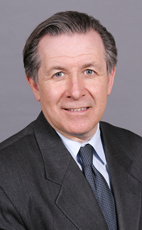 House of Commons photo
Lost his last election, in 2008, with 33% of the vote.
Committees of the House June 13th, 2005
Mr. Speaker, I have the honour to present, in both official languages, the sixth report of the Standing Committee on Industry, Natural Resources, Science and Technology on Bill C-37, an act to amend the Telecommunications Act.
Committees of the House May 9th, 2005
Mr. Speaker, I have the honour to table, in both official languages, the fifth report of the Standing Committee on Industry, Natural Resources, Science and Technology, concerning the certificate of appointment of Jean-René Halde to the position of president of the Business Development Bank of Canada.
Quarantine Act May 5th, 2005
Mr. Speaker, I also would like to say that while my colleague just behind me was newly elected last June to the House of Commons, he has a long experience in the provincial legislature and a distinguished career indeed. I appreciated and enjoyed his remarks on this important legislation.
I would like to ask him a philosophical question. It is hard for us to imagine being quarantined. It is hard for us to imagine that terrifying impact on the quarantined individual or family, whether they are quarantined at an airport, a hospital, a home or wherever the case may be.
Let us try to imagine ourselves in their shoes. It must be a time of great uncertainty and a time of great trepidation. Not only are they in those moments facing the uncertainty of their own health, but they are also facing the uncertainty of what the health system and the rules and regulations will do to them.
However, let us put ourselves in the shoes of the community at large. It is important that the health of the community at large also be protected. While we can look with great sympathy upon those who are quarantined by necessity, and we should, that quarantine has the effect of protecting the larger community.
As we so often see in society, we have to balance the needs and the rights of the individual against the needs and the rights of the community at large. That is why it often requires great wisdom to draw the dividing line between what circumstances or actions of an individual have consequences for the larger community and when the larger community must take action.
I know it is a bit of a philosophical question and I know that this legislation attempts, and I think attempts well, to find the balance between those two extremes: the needs and the quandary facing the quarantined person and on the other hand the need of the community to protect itself, as we saw with the SARS outbreak, as the member spoke about in his last response, and the avian flu. We can also think back to long ago and smallpox epidemics and polio and so.
These do not come without consequences to the community and to individuals. I wonder if he could talk about that balance between the needs of individuals and the needs of the community when it comes to matters such as these.
The Environment April 18th, 2005
Mr. Speaker, my question is for the Minister of Industry.
After years of discounting the science behind climate change, official opposition members would have us believe that they have experienced a deathbed conversion on the need to address climate change and the Kyoto accord.
The Leader of the Opposition has referred to Kyoto as the worst international agreement this country has ever signed. His environment critic has called the accord a great socialist plot.
Would the minister inform the House as to the seriousness of the government's plan to address climate change and the sincerity of the johnny-come-latelies opposite?
Committees of the House April 14th, 2005
Madam Speaker, I have the honour to present, in both official languages, the fourth report of the Standing Committee on Industry, Natural Resources, Science and Technology, relating to the certificate of appointment of Peter D. Clark to the position of executive director of the Standards Council of Canada.
Forestry March 24th, 2005
Mr. Speaker, my question is for the Minister of Industry. As hon. members know, the mountain pine beetle is devastating the forests of British Columbia and the infestation has now moved into the province of Alberta. The Minister of Industry has recently promised to start delivering results on this issue within 90 days.
The member for Cariboo—Prince George has wrongly accused the minister of breaking this promise and being unable to deliver on this commitment.
I would like to ask an important question on behalf of all Canadians, especially those in British Columbia and Alberta. Would the minister please inform the House as to measures--
Civil Marriage Act March 24th, 2005
Mr. Speaker, I am pleased to join this debate on Bill C-38, a bill to redefine marriage. I listened very carefully to my colleague across the way, the member for Portage—Lisgar. He and I and others on both sides of the House each come to this debate from different perspectives. We are for the most part well experienced in life, with good levels of education. This debate proves that well-meaning people on both sides can come to different conclusions. For me, this underlines the importance of continuing to have respect for each other's position.
I have come to a very different conclusion on Bill C-38, which I plan to support and have planned to do so for quite a long time, since the courts made it very clear that this was a matter of the Charter of Rights and respecting rights in our country. I understand that there are different views and that we have come to our conclusions differently. For me, it is about tolerance and recognizing that our friends, neighbours and sometimes even family members who may be homosexual are equal citizens in our society and that we have a Charter of Rights which is a model for the world. I would hope that other countries would look at our Charter of Rights and be prepared to adopt it. If they can improve it, so much the better. Certainly, it stands now as a model for the world.
I would like to take my few minutes in the chamber to discuss some of the issues raised by my constituents, and I respect all of them. Many have written letters and I am in the process of responding to each and every one of them. One of the questions that comes up often is, are the courts deciding for Parliament what we should be doing as parliamentarians? My immediate answer to that is, no. It was Parliament that adopted the Charter of Rights. We expect the courts to interpret the various laws of the country, whether it is at the federal or provincial level. In the case of the Charter of Rights, we have asked our courts to do, in this case and in many others, the work of interpreting that for us as real life situations come forward.
The courts in eight of the provinces and territories have come to the conclusion that to deny access to a civil marriage for same sex couples is contrary to the intent and spirit of the Charter of Rights. It is incumbent upon the Parliament of Canada to avoid balkanization of laws with respect to the definition of marriage and to act so from sea to sea to sea there is a consistency of definition.
The courts are not deciding for us. They have helped us in this case and other cases in interpreting the Charter of Rights. It is now for us to respond appropriately, and the government through Bill C-38 is doing that.
Many of my constituents say that they do not have a problem with same sex unions, but why call it marriage. The courts have made it very clear, and I agree, that marriage has a certain definition in society, whether it takes place in front of a justice of the peace or a ship's captain or whether it is in front of a religious official. To the two people being married, marriage has a certain important connotation. It usually and should imply a very romantic and loving relationship between the two people involved. I know sometimes marriages take place for convenience or for the purpose of assembling property. That has happened throughout history and it may happen from time to time even now. However, for the most part, people look to the institution of marriage as a reflection of their romantic and loving commitment.
I say to my constituents that we must distinguish that the institution of marriage belongs to society. It has been part of humankind's history from time immemorial. In fact, the churches were not always involved in the administration of the contracts and marriages between two people.
Let us distinguish between marriage which takes place in civil society at large and marriage which takes place in the churches. In fact, here in Ontario and in Canada generally, church officials are licensed by the provinces to actually administer the legal aspects of marriage.
For me, marriage is an institution owned by all of society. There will be those for their personal reasons who will choose to be married within a civil context by a justice of the peace or public official. I do not think it is proper to say that one group of society, that heterosexual couples only have access to an institution which by its nature belongs to all of society and that same sex couples can only have something called a union, because by definition marriage has come to have an important connotation in our society.
To those who would say that marriage is traditionally known as an institution involving opposite sex persons, traditions evolve. Churches evolve. My own church has evolved tremendously over decades and centuries, and I expect that it will continue to evolve. Maybe even some day there will be married priests or women priests. I think many Catholics look forward to that day, quite frankly, but others may not. It is in the nature of organizations that there are different points of view. Different points of view can easily exist under the same roof or within the same tent.
Traditions should not tie our hands. They should be sources of celebration. Traditions should allow for the expression of respect within a family, within a community even though within that community there may be differences of opinion. Just think of how the traditions of Christmas 50 or 100 years ago were celebrated compared to how they are celebrated today. I do not know that the traditions of Christmas now, which, sadly, include a lot of shopping, were the case 50 years ago, but some would argue that is part of the traditions of Christmas. It is not a tradition of Christmas that I look forward to quite frankly, but some people do.
Traditions are things that reflect society's evolving habits and attitudes toward things that go on around us. That because something is traditional it should not change, to me is a very weak argument. We have to look beyond simply preserving something only because it is a tradition.
We have to look at whether overall society is getting better because we are opening ourselves up to a broader application of rights and a greater degree of tolerance. I believe that in so doing, in being more tolerant and open in society, we are making our society better not only for ourselves but for our children and grandchildren as well.
Interestingly enough, I have four adult children and none of the four has any problem with this issue whatsoever, but there would be other members of my family, more of my age or older, who might disagree with my position on this. That does not change the good relations in our family. It is a reflection of our country that we are able to have this disagreement on an important issue of rights. When the bill is passed, which I hope we will have done by June, we will continue to deal with the other important issues of the country as we are doing now, including this one. We will continue to take care of the very important business of the nation.
My friend from Portage—Lisgar mentioned that some church officials are worried about losing their right to choose whom they marry. It is a fact now that religious officials of the churches and their communities decide whom they marry. I know in the Catholic church for example, the church will not marry divorced Catholics. I am not aware of the Catholic church ever being forced to marry a divorced Catholic and I do not foresee, whether the bill passes or not, or had the issue been before us or not, that would ever change.
I do not believe the passage of Bill C-38 changes that piece of the paradigm whatsoever. In my opinion, the right of churches to choose whom they marry will continue indefinitely. In fact, it is that same Charter of Rights which guarantees that the churches can in their realms choose certain activities which in civil society may be seen as discriminatory. We have designed a Charter of Rights which allows the churches to decide whom they marry, whom they ordain and so on, whereas in civil society we do not allow ourselves quite that same degree of flexibility.
I look forward to others participating in this debate and the bill being resolved in a timely fashion and with continued great respect.
Canadian Livestock Industry March 8th, 2005
Mr. Speaker, first, in response to the member's second point, she referred to the Canada-U.S. relationship. My colleague a few seats behind also talked about the same point.
I certainly am not one prepared to accept any linkage between any decision on ballistic missile defence. To be perfectly honest, I am sure the federal district judge in Montana would hardly be aware of that debate. The confluence of events is extremely unfortunate, but I believe that there is absolutely no linkage whatsoever. I think it would be more of an insult to our U.S. neighbours to even suggest that there was any kind of connection whatsoever.
At all times there will be issues of concern between our two nations. We are powerful allies and powerful trading partners, but we also have very strong issues on each side of the border. I do not think that the Canada-U.S. relationship will suffer any more than it has at any other time during the ongoing debates we have over one issue or another.
As to the farm improvement loans program, I am aware of the policy. I have to defer to the hon. member for her knowledge of her own province of Saskatchewan. It is not a program that I have a lot of personal experience with. I do know that it was part of the expenditure review program outcomes which netted the federal government in the order of $12 billion in funds which could be allocated to other Canadian priorities such as health care. I will leave it to her to pursue her interest in that subject.
Canadian Livestock Industry March 8th, 2005
Mr. Speaker, before I begin the substance of my remarks, I would like to commend those who spoke this evening from the other side and from our side. In particular, I would like to mention the efforts of the Minister of Agriculture and Agri-Food and his parliamentary secretary, who have worked tirelessly, as have their predecessors, on this file since the first case of BSE was discovered. There is no question that all Canadians and parliamentarians want to see this file successfully closed with the opening of the border to live Canadian cattle.
Unfortunately, it remains closed in spite of the best efforts of the U.S. administration, including commitments by U.S. President Bush and matched commitments on the Canadian side to see the border open. Insistent and consistent efforts were made to ensure that a science based solution to the problem was found.
As has been aptly explained by my colleagues, our American friends are seeking a reopening of the border with Japan based on sound science. We ask nothing more and nothing less for our own Canadian producers.
I wish to echo the comments of Canadian producers and others. Canadian producers, be they beef producers or producers of any other commodity are among the best farmers in the world. They manage their farms within one of the safest food systems in the world, and we should be very proud of them. The fact that the government has responded with vigour and with substantial financial assistance should not go unnoticed, which it seems sometimes it has by opposition parties.
The problem with the U.S on softwood lumber is a major problem for my constituents in my northern Ontario riding, as is the problem with beef for beef farmers in northern Ontario. This may be a surprise to my colleagues across the way. My northern Ontario riding in central Algoma, the North Shore area, the Manitoulin Island area and the Highway 11 area from Smooth Rock Falls to Hearst, has a large number of cattle farmers who, like farmers out west, have been very seriously hurt by the closure of the border.
I prefer not to say too much about the Montana district court decision, but I hope a solution can be found for the file on the case of the trade in beef. As we search for solutions in softwood lumber and other commodities, we ask our American neighbours to manage trade based on law, on science and on best practices, not based on regional parochialism.
I am very pleased to join my colleagues tonight to participate in this important debate. The issue of BSE and the continued closure of the U.S. border to Canadian livestock is an issue that is very dear to the hearts of many Canadians, not just those working in the livestock industry.
The government and opposition parties in the House have all taken the opportunity at one time or another in the last two years to focus attention on this important matter, and tonight's debate is another welcome opportunity to address the issue.
It is not the first special emergency debate on this. I recall participating before. I recall the minister staying all evening, not just once, but several times in the past to ensure that the message got out, as it should. The government is working hard on the file and is doing its best.
The livestock industry is part of our proud history as a nation. Looking back, it is an industry that played an important role in the settling of the Canadian prairies more than a century ago. At the same time, the livestock industry is also an intrinsic part of our present and of our future.
As everyone knows, Canadian beef is renowned worldwide for its quality. It is synonymous with top quality.
This industry has been a major component of Canada's foreign trade. In fact, Canada exported more than $4 billion in beef and cattle products in 2002, which makes it the third largest beef exporter in the world. It may be a surprise to a lot of Canadians that Canada is the third largest beef producer in the world. We hear so much about beef from Argentina and other South American countries, as well as Mexican and U.S. beef, but considering the population of Canada is certainly not the third largest in the world, being the third largest beef producer is significant and speaks to the importance of the industry to Canada's economy as a whole.
In fact, as a country Canada actually generated a trade surplus in beef products of $3.2 billion, nearly 6% of its total trade surplus. I believe that was last year. Clearly this is an extremely important industry not just for livestock producers but for all Canadians. It is an industry that has developed an international reputation for excellence.
In light of the reaction of other countries to the discovery of a case of BSE in May 2003, the industry is paying a very high price for events totally beyond its control.
Last September the Minister of Agriculture and Agri-Food worked in close consultation and collaboration with the provinces, territories and the industry and announced a $488 million package to reposition Canada's beef and cattle industry. Restoring Canada's position as a global leader in premium beef exports is a key component of the industry strategy. The government committed $37.1 million in new money as part of a repositioning strategy to intensify our activities dealing with international market access issues related to BSE.
I would like to underline the minister's efforts in not only designing and promoting the repositioning strategy, but it is a strategy that makes a lot of sense regardless of one's perspective. The slaughter capacity, which used to be much higher, over the years for a number of reasons was reduced and it is necessary that it be re-established. We should hit a 30% increase by the end of the year and hopefully much more than that over the next few years. We hope we never experience a closure again once the border is reopened and that we are never so dependent on trade in live cattle with the U.S. again.
With the 2005 budget the Government of Canada announced that an additional $17.1 million will be available within the $488 million strategy to reposition Canada's livestock industry to further increase domestic slaughter capacity through the loan loss reserve program. I believe the minister announced that Farm Credit Canada would be actively engaging itself in that program.
We have taken vigorous action. The Minister of Agriculture and Agri-Food has taken part in trade missions in different parts of the world in an effort to get borders reopened to Canadian cattle.
That is not all. Additional budget initiatives will be of assistance to cattle producers. For example, $104 million over the next four years will go to the Agricultural Marketing Programs Act to expand the cash advance program and to broaden access to include livestock producers. Certainly reopening the U.S. border to Canadian livestock and beef products from animals of any age has been a priority. We intensified our efforts in other parts of the world, particularly Asia. We have seen positive results, for example, in China and Hong Kong.
Again the efforts of the government and the minister to engage existing foreign markets and potential new foreign markets and discussions on diversifying our trade in beef are laudable. They have already gained results. The dividends for those efforts are yet to come. Our efforts have been paying off as more countries come to recognize the efficacy of our science and to reopen their markets to Canadian meat products.
In addition, we have earmarked $80 million over two years to resolve the issue of removing specific risk factors from animal feed.
The United States Department of Agriculture has acknowledged this fact. The President of the United States has acknowledged the fact that Canadian science is good science. We must not lose sight of the fact that Canadian producers and our food safety system is virtually second to none in the world. Unfortunately, science is not the only factor at play in the international decision making process.
Certainly Canadians know our beef is safe. The Canadian food safety and inspection system in place was sufficiently robust that the BSE infected animal was detected and removed before it reached the human food chain.
In an effort to support our livestock producers, beef consumption in Canada rose by 5% when BSE was discovered in 2003.
Canadians have clearly shown their support for our livestock producers. Governments in Canada have also clearly shown their support for our cattle producers.
We can all be sure that these efforts will continue. We must and will continue to support our producers as we move forward to resume trade, strengthen our domestic capacity and ensure that the industry is sustainable for the future.
We must support our producers, and we will continue to do so as we move forward to resume trade, strengthen our domestic capacity and ensure the future sustainability of the industry.
I would like to commend the beef producers again in my riding of Algoma—Manitoulin—Kapuskasing. I have met with many of them since this issue arose back in 2003. They are facing tremendous challenges. The dairy farmers are facing the tremendous challenge of what to do with the cull cows.
I would like to extend to them my fondest hope, which I am sure joins their hope that this issue with our U.S. neighbours will be resolved soon and in a way that will see the full recovery of the industry over as short a term as possible. At the same time, I am sure I share with them the desire that our capacity to process and slaughter our own cattle will be expanded and that that expansion will be achieved over as short a time horizon as is possible.
I will now give up my place on the floor and allow someone else a few minutes before the evening is over. I would again commend all members for their efforts here tonight and other times in showing their support for not only the cattle producers, but for all farmers right across this great country of ours.
The Budget March 8th, 2005
Mr. Speaker, I disagree with the premise of his question that there is a linkage. There is no more linkage than we have with the court in Montana.
The notion that the American President and administration sit around waiting for Canada to do something in order to find ways to respond is a little ridiculous. Our American neighbours have much more important things to be concerned about than the timing of decisions.
However, let me say this about ballistic missile defence. I am very proud of the decision that our Prime Minister has made on behalf of the country. It is very important that we remain a sovereign nation and if it is in Canada's interest, as he said, to make a decision to stay out of ballistic missile defence, then that is the right decision as far as I am concerned.
There is in my view absolutely no linkage between the two. The member and his colleagues have tried to create a linkage where none exists. I do not blame them for trying. I believe their efforts will fail.
When all is said and done, our American neighbours will run their country as they see fit. We will run our country as we see fit. We will cooperate on hundreds and perhaps thousands of large and small issues.
If the member's point were true, then we would not have seen the softwood lumber issue to be such a problem as it has been for decades. It is mystery how the American system seems to work and it has nothing to do with Canada's decision to not participate in BMD.
In fact, the member must not believe President Bush who said himself that he respected Canada's decision and he is pushing himself as is his administration for the opening of the border which we all agree should have been opened a couple of days ago. It did not, but we all hope that it will be very soon.
We, as the member does, all support our beef farmers. I have a number in my own riding on Manitoulin Island and the north shore, central Algoma. We all wish that this will be resolved very soon. As to a linkage, none exists.