
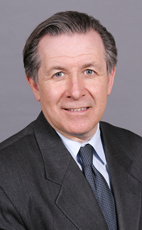
House of Commons photo

Crucial Fact

  • His favourite word was industry.

Last in Parliament September 2008, as Liberal MP for Algoma—Manitoulin—Kapuskasing (Ontario)

Lost his last election, in 2008, with 33% of the vote.

Statements in the House

Committees Of The House June 10th, 1999

Mr. Speaker, I have the honour to present, in both official languages, the fifth report of the Standing Committee on Natural Resources and Government Operations. In accordance with its mandate under Standing Order 108(2), the committee has considered forest management practices in Canada as an international trade issue and has agreed to this interim report.

I want to point out that the committee intends to continue this work in the fall, having had a chance, first, to visit British Columbia.

I would like to take this opportunity to thank the members who participated. They did a terrific job. I would also like to thank our witnesses, as well as our clerk, Richard Rumas, and our researcher, Jean-Luc Bourdages, for the excellent work they have done in support of the committee's work. I emphasize that this is an interim report. More work needs to be done, but our committee felt that the facts about Canadian forest harvesting practices need to known in the international marketplace, as well as the fact that Canada is a world leader in forest management practices.

With that, Mr. Speaker, we wish you a great summer.

Canadian Environmental Protection Act, 1999 June 1st, 1999

Mr. Speaker, I know in a couple of minutes we have to break for the vote. I would like to be on record, as I will later when we vote, as being in support of Bill C-32. It is a very important step in the history of improving the relationship between people and the environment.

There is a famous Chinese proverb which says that a journey of 1,000 miles starts with the first step. This is not a first step. Previous governments over the years have tried to deal with the needs of society and the needs of the environment.

The bill certainly is not perfect. Maybe it will take generations for us to find the best way to deal with the environment, but it is important that Bill C-32 pass and that this very important step be taken.

My northern Ontario riding includes the north shore of Lake Huron and the eastern shore of Lake Superior. It is a beautiful area. It is important to my constituents that strong, effective environmental legislation be in place. I have confidence that Bill C-32 will be that important step which my constituents need as we enter the next millennium.

Many of my communities depend on the forestry and mining sectors. At all times we have to balance the need for jobs and economic development with the needs of the environment. We cannot go back to the days when the population was small, when numbers were few. We are where we are. I believe that Bill C-32 provides us with the best balance possible at this point in time.

I encourage my colleagues across the way to support the government in this initiative.

Canadian Environmental Protection Act, 1999 June 1st, 1999

Mr. Speaker, I rise on a point of order. I do not wish to interrupt the hon. member, but he has made reference to the Reform Party's blue book. I wonder when he is finished using it for his speech if he would be so kind as to table it so that all hon. members could—

Canadian Environmental Protection Act, 1999 June 1st, 1999

Mr. Speaker, I listened with interest to the member's speech and particularly to the part where he talked about a project in South Africa, which I think is an excellent example of public and private partnership.

Yesterday evening I had a chance to attend the state dinner hosted by the Prime Minister for the President of Colombia. I happened to be sitting beside a gentlemen and his wife who live in Bogota and own a small coffee plantation. These individuals are from a well established family. The gentleman was telling me that the U.S. based Smithsonian Institution is prepared to certify plantations such as his because he is willing to invest money in his plantation to assist with the migratory bird problem, a problem resulting unfortunately from deforestation in the tropical areas of South America.

In line with the member's comments, I thought it was an excellent example of economy and ecology working together to provide a better situation, not only for our animal life but for human beings as well.

The certification of his plantation by the Smithsonian Institution will allow this individual to sell coffee at a higher price because it will be certified by the institution. Resources will then be available for this man to invest in his plantation to improve the trees and the husbandry of the plants for the benefit of the migratory birds who need that type of forest cover.

I am wondering if the member could comment further on that type of partnership. Does the member believe that Bill C-32 will not allow that kind of thing? I believe it will.

Committees Of The House April 20th, 1999

Mr. Speaker, I have the honour to present, in both official languages, the third report of the Standing Committee on Natural Resources and Government Operations.

In accordance with its order of reference of Monday, March 15, 1999 the committee has considered Bill C-66, an act to amend the National Housing Act and the Canada Mortgage and Housing Corporation Act and to make a consequential amendment to another act, and agreed on Thursday, April 15, 1999 to report it without amendment.

In tabling this report I wish to thank all hon. members for their co-operation.

Kosovo April 12th, 1999

Mr. Speaker, I am pleased to have this opportunity to ask a question of my colleague and friend, the member for Portneuf.

He made a number of excellent comments. Early in his remarks he wondered why he was participating in this debate. He was lamenting the fact that it will not conclude with a vote. He wondered if this was all a masquerade.

As I listened to his comments he proved to me that he did deserve to be here and to make these comments. Listening to him I learned something, as I am sure others in the House and those watching did. Indeed, he has proven the opposite of his point. In fact his contributions this morning have been very valuable to the discussion, notwithstanding that at the end of the day there may or may not be a vote. In this case there will not be a vote.

I would like to ask him a question which relates to getting from A to B . He talked eloquently. He brought me right into the home of an ethnic Albanian in Kosovo who was watching television, heard a knock at the door and was asked to move out within 10 minutes. That is an experience that none of us, I am sure, have ever had and hopefully will never have. It is difficult to imagine. However, by imagining it, it is possible to feel the moment of terror and tragedy which those families suffered.

Does he believe, should President Milosevic never agree to some terms of settling the conflict, that it may be necessary for NATO and Canada as a participant to involve ground troops in order to make peace in that region? Does he believe that Milosevic and his thugs should be arrested so that the international criminal court can deal with them and make room for the Kosovars to return to their homes? They will not be able to move back unless there is peaceful space for them.

If there is yet no agreement, does he think today that it might be necessary to send in ground troops to make space for the refugees to return to their homes?

Kosovo April 12th, 1999

Mr. Speaker, I thank my colleague across the way for his remarks. He gave an excellent synopsis of some of the more recent history and certainly laid out a desirable plan for all of us to consider.

If all attempts to get Mr. Milosevic to the negotiating table fail and if it appears that he will not negotiate or agree to anything because he has some sort of national death wish, would the member agree that it may be necessary for ground troops to enter the Kosovo region and not Serbia proper to arrest those who are perpetrating horrific crimes against ethnic Albanians? Ultimately, if there is a war crimes tribunal, many of the accused will be or will have been in the Kosovo region

Would the member agree that while the air campaign is ongoing it may be necessary to enter Kosovo to arrest and push back Milosevic's henchmen to create room for the return of the refugees? Would he consider that might be a possibility?

Kosovo April 12th, 1999

Mr. Speaker, I thank the hon. member for his speech. I appreciate the comments he made.

The question I wish to put to him is well at the top of my own mind. What is the distinction, if any, between peacekeeping and peacemaking? Too many people use those words interchangeably. That is okay. It may be their interpretation of those words, that they are the same, but in my own mind they are different words.

If we go back a couple of thousand years, a great person referred to peacemakers as blessed. Blessed are the peacemakers.

Does the hon. member have an opinion, and I am sure he does, on what distinction, if any, can be made between peacekeeping and peacemaking? Would he agree that peacekeeping comes after peacemaking? When there is an armed standoff in a community or city, before there can be peace to be kept, the police may have to go make some peace. Then they will maintain the peace after.

I think this is where I am coming to in my own thinking on this. In the absence of a decision by Mr. Milosevic to make an agreement, we may have to go and make some peace. That is the essence of our debate. We understand fairly well Canada's role as a peacekeeper. What is Canada's role as a peacemaker?

Kosovo April 12th, 1999

Mr. Speaker, regardless of how we got to where we are, I wonder if the member understands that Mr. Milosevic does not appear to be using any normal rules of engagement in this conflict and, in particular, in the efforts of his regime to remove the ethnic Albanians from Kosovo. Would he not agree that it would be in the definition of peacemaking to go into the Kosovo region to arrest or at least push back the gangs, the henchmen of the Milosevic regime who are perpetrating his evil designs?

If there is no agreement in the near future, would the member not agree that it might be reasonable and necessary to use ground troops? Would it not be in the order of peacemaking to arrest or push those henchmen out and make room for the resettlement of the Kosovars in their homeland?

Kosovo April 12th, 1999

Mr. Speaker, I am pleased to have the opportunity to clarify my own thinking on the subject. If, and I want to underline the little word if, it becomes necessary for NATO to involve troops on the ground, I do not believe we should be entering Serbia proper, Serbia proper meaning excluding Kosovo. We should continue the air offensive there as part of ongoing efforts to shut down Mr. Milosevic's military machine.

The member used the right word. Ground troops, if needed, would be undertaking humanitarian involvement, if it is possible to have a humanitarian military involvement in Kosovo. They would clear space, as I said in my speech, to make room for the Kosovars, the ethnic Albanians, to return to their homes. Our ground action would be limited to Kosovo, to push back or arrest, if we can do that, the military gangs operating in that province.