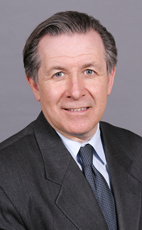
House of Commons photo

Crucial Fact

  • His favourite word was industry.

Last in Parliament September 2008, as Liberal MP for Algoma—Manitoulin—Kapuskasing (Ontario)

Lost his last election, in 2008, with 33% of the vote.

Statements in the House

Home Renovation Industry October 2nd, 1998

Mr. Speaker, I inform the House that the minister responsible for the Canada Mortgage and Housing Corporation is announcing that October is renovation month.

This occasion is the perfect opportunity to showcase innovative techniques and celebrate the professionalism of the home renovation industry in Canada. This industry generates $20 billion and thousands of jobs each year. We also want to ensure if Canadians decide to renovate their homes that they are successful.

This year the Canadian Home Builders' Association and CMHC will feature Canada-wide activities focusing on consumer education and protection under the theme: do it right, work with a professional renovator.

I also point out that CMHC Canadian housing information centre, the largest housing resource centre in the country, has extensive resources available to assist homeowners and renovators with their renovating needs.

Mining Hall Of Fame April 23rd, 1998

Mr. Speaker, I would like today to congratulate the newest inductees into the Canadian Mining Hall of Fame located in Elliot Lake in my northern Ontario riding.

This year's inductees are very special as they not only highlight mining's very significant contribution to our economy but its importance to research and development in Canada and the mining industry's success around the globe.

This year's inductees are: Anthony Barringer, whose company was a major centre for mining research and development in Canada; Benjamin Taylor Bell, the founder of the Canadian Institute of Mining, Metallurgy and Petroleum; Gerald Hatch, for his enormous contribution to the advancement of metallurgy and leadership in multidisciplinary consulting services; Stephen Ogryzlo, for his mining successes around the world; Murray Pezim, for his discovery of northern Ontario's Hemlo gold camp; and Franklin Pickard, for his leadership and vision in guiding Falconbridge to international prominence.

I call on all members of the House to assist me in congratulating these builders of Canada's world class mining industry. I encourage everyone to come and visit the Mining Hall of Fame in Elliot Lake.

Immigration March 31st, 1998

Mr. Speaker, I have a new example of misinformation, courtesy of the Reform Party. Reform's pamphlet on immigration contains many examples of incorrect figures and facts to mislead Canadians.

The letter from the leader of the Reform Party states:

In March 1998 an advisory group appointed by the Minister of Immigration met in Ottawa to examine the policies and legislation governing immigration to Canada.

The minister was holding hearings in Ottawa in March, not the advisory committee. The letter from the Reform leader further states:

The official opposition requested an opportunity to contribute its own recommendations, but was denied access to the advisory group by the minister.

It was the minister who was holding hearings, not the advisory group. The minister decided not to hear from any MPs because they already had access to her in the House.

Immigration March 26th, 1998

Mr. Speaker, my question is for the Parliamentary Secretary to the Minister of Foreign Affairs.

If recent reports are any indication there appears to be a crackdown on Canadians entering the United States. In British Columbia we have a very important gateway between Canada and the U.S., one that is very important to the B.C. economy.

What efforts are being made to ensure that Canadians continue to enjoy a friendly reception at the U.S. border?

Budget Implementation Act, 1998 March 24th, 1998

He says no. If he had been there, he would have felt much different about it than his comments would indicate.

The Liberal Party because it represents the vast majority of Canadians in its thinking I suppose takes the best of socialist ideas and the best of conservative ideas and brings those better ideas together in a moderate balanced approach to governing this country.

I take issue with the NDP attitude toward corporations. I am in favour of fair and appropriate taxation for corporations, including banks. But the NDP have this idea or socialists in general have this idea that corporations are people. They are not people. Corporations are owned by shareholders. Those shareholders are average Canadians, their pension funds, and in many cases union pension funds. Corporations are owned by people. Those same people are voters. They are smart enough to know that if we tax a corporation to death, then of course the jobs will be lost that go with that corporation. There has to be a balance. We cannot have a taxation regime that moves jobs out of the country.

If it is all about creating jobs for our citizens I would put the record of this government in front of any person anywhere in the world with pride. We are not there yet. I will concede that. But we are on a track in this country that is the envy of the world. I would take our prospects over the prospects of any other nation for the months and years ahead.

Budget Implementation Act, 1998 March 24th, 1998

Mr. Speaker, I listened carefully to my friend's comments. I have a lot of time for the member but when it is all said and done he is still a member of the NDP which is no reflection on his character at all.

The member made mention of the Liberal convention this past weekend. I was there as one would expect. It was a wonderful convention, probably one of the best national conventions on record of any party.

It clearly demonstrates again that the Liberal Party, unlike other parties represented in this House, takes policy initiatives seriously in co-operation with Liberal members from coast to coast. It is a very positive creative process. There is no question in my mind that the Prime Minister, the cabinet and the government do listen. I am not sure if the hon. member was at our convention. He may have been, I do not know.

Budget Implementation Act, 1998 March 24th, 1998

Mr. Speaker, I appreciate the member's question. I have a high regard for his opinion.

Certainly over the period of 1993 until now I have had a couple of questions on taxation, no question about that. However, it certainly is not the issue that he thinks it is which is the one in his riding in B.C. He may want to speak to the B.C. government about that because the rate of federal taxation in Ontario is the same as it is in British Columbia.

He suggests that our tax rates are the highest in the industrialized world or something along those lines. I understand, when we factor in our universal medicare, payroll taxes, sales taxes and so on, we are in the middle of the pack when it comes to the industrialized nations.

Budget Implementation Act, 1998 March 24th, 1998

Mr. Speaker, I appreciate the question from the member for Richelieu because it gives me an opportunity to clarify something.

When I said I believe strongly in the importance of the federal government, because of its national view, to be engaged with individual Canadians and their communities, this does not mean the provinces do not have a very strong and important place in that partnership.

As the member suggested, it was an evolution of a federal government through the coming together of the provinces over the generations. However, the federal government was created for a purpose. The provinces clearly saw that it was important to have a national view.

I will take issue with the millennium fund. This fund is in no way interference with the provincial jurisdictions over education. The millennium fund will put much needed money in the hands of students who will themselves choose to apply to a particular college or university for their—

Budget Implementation Act, 1998 March 24th, 1998

Mr. Speaker, it is with pleasure that I join the budget debate. This debate comes at a very interesting time in our country's history, inasmuch as all of our citizens know we are approaching the end of a millennium and the beginning of a new one.

It is heartening for all of us, even for our friends across the way, to know that this government has been able to put the finances of the country on such a firm footing that we are now the envy of countries like Japan, who only wish they could find themselves in the situation we now find ourselves in.

Imagine having inherited an annual deficit of $42 billion. In a short period of time, from 1993 to February 1998, this government has been able to balance the books, to eliminate the deficit and to give all Canadians, either as private citizens or as business people, a sense of renewed confidence, a renewed vision for all, as we end this millennium and prepare for a new one.

I have just a word about my riding because it will help put into context some of my comments. My riding of Algoma—Manitoulin, a northern Ontario riding, is roughly the size of New Brunswick. It contains a beautiful major part of the Boreal forest, sections of the Great Lakes of Huron and Superior, numerous First Nations communities and communities that were founded either as railway towns, forestry towns or mining towns which today have, for a number of reasons, evolved into renewed communities, communities that hope for great things for themselves and for young people. While I will acknowledge there are challenges ahead, there will always be challenges. It is incumbent on us as elected representatives and as a government to respond to our local leaders and our citizens with vigour, vision and energy.

As I travelled throughout my large riding, I go into these communities with a sense of pride knowing this government has been a caring government. This is a government which has listened to the voters and has, as its first priority, getting our finances in order. We know that ensuring the sustainability of our social programs, our health care system, our pension system depends on having a strong financial base. To the credit of the Prime Minister and the finance minister this has been done in a very careful and caring way.

I am the chairman of the Standing Committee on Natural Resources and Government Operations and it is our intention, as an all party committee, to pursue a study done in the last Parliament called think rural. It was very important in this last budget, as in previous budgets, that rural Canada receive the attention it deserves.

The federal development agency in northern Ontario called FedNor was due to expire next March but has been renewed at an annual funding of $20 million a year indefinitely. This program which is an important program for economic development in northern Ontario can now depend on long term funding. Its programs can now become more responsive to the needs of business and communities.

In addition, the Canadian rural partnership which is a $20 million program will spend $5 million a year over the next few years. It will be designed to allow local non-profit groups, municipalities and their leaders to come up with new and innovative ways to make sure rural Canada has the best and every opportunity to stay up with our urban neighbours.

It is all too often the case but a fact of economics that with the recovery we are seeing in our economy it is natural that our urban areas feel it first. We are seeing tremendous progress when it comes to job creation. The last report which indicated an 8.6% unemployment rate is the lowest we have seen in decades. I will grant that it is not low enough but I believe we are going to see that rate of unemployment drop continually over the months and years ahead.

I intend to speak with local leaders about the Canadian rural partnership initiative and that will give us an opportunity to pilot some projects in our rural areas which will help prepare our rural communities for the next millennium. The economic growth we are seeing in our urban areas will also, as it should, include our rural areas. We are seeing that happen.

Much depends on initiatives taken at the local level, be it municipal leaders or business leaders. It is incumbent on the government not to be out telling local communities what they should do but rather to listen to ideas and where appropriate help them get their ideas off the ground.

Some would argue that government has absolutely no place when it comes to being involved with either the private sector or local government but I disagree strongly. The federal government with its national vision can and should certainly be there to partner with local communities.

Take for example the long term vision of this government for pharmacare or home care. A budget of $150 million has been set aside for local areas to create and experiment with new ideas to deliver pharmacare or home care. This is part of a national evolution toward universal coverage of pharmacare and home care. This is very important to me. It is one thing for a federal government to have a vision, but it has to be prepared to partner with communities and local leaders who must deliver that vision at the end of the day to the grassroots level.

I believe it is wrong to think the federal government is limited to international and military affairs and so on. We have a very important place at the local level, especially as we see the provinces moving away from engagement with local leaders and their communities. We have seen this happen with Ontario.

When it comes to rural Canada, the government has committed to making sure through the Canada access program, CAP, and SchoolNet that all our communities, their schools and libraries are hooked up to cyberspace through the Internet. In the very near term we will see that every community is hooked up.

In addition to the specific initiatives for rural Canada such as FedNor, the Canadian rural partnership initiative, SchoolNet and CAP, a government that can keep interest rates and inflation down, that can keep our exchange rate with the U.S. in particular at a stable state is a government that is helping not only urban Canada but rural Canada. A rising tide raises all boats. It is unrealistic to expect that rural Canada can do well if our cities are not doing well or that our cities can do well if our rural areas are not doing well.

We are all in this together. Whether it is improving the literacy rate of Canadians, whether it is ensuring that our pension programs are secure for the future, which we have done, whether it is providing important tax cuts to selected taxpayers at the low and middle incomes levels, whatever the initiative, I believe this government has put people first. We are prepared to listen. My constituents can count on me to listen to them.

The Budget February 26th, 1998

Mr. Speaker, there have been concerns that FEDNOR, which is Canada's economic development agency in northern Ontario, could cease to exist as of next year. This government listened and renewed its commitment to northern Ontario in last Tuesday's historic budget.

Can the Parliamentary Secretary to the Minister of Industry inform the House on the steps which will be taken to place FEDNOR on stable and secure funding into the next millennium?