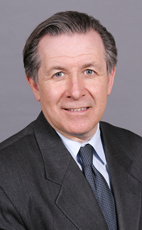
House of Commons photo

Crucial Fact

  • His favourite word was industry.

Last in Parliament September 2008, as Liberal MP for Algoma—Manitoulin—Kapuskasing (Ontario)

Lost his last election, in 2008, with 33% of the vote.

Statements in the House

Alcohol And Drug Abuse February 18th, 1998

Mr. Speaker, on February 25, 1998 former Canadian heavyweight boxing champion George Chuvalo will bring his crusade against alcohol and drug abuse to the town of Blind River in my riding of Algoma—Manitoulin.

Mr. Chuvalo will speak with students of W.C. Eaket and Jeunesse Nord high schools to impress upon them the dangers associated with substance abuse and addiction.

Mr. Chuvalo is an impassioned advocate who has lost three children and a wife to drug abuse. His emotional presentations on this subject have been successful in changing many lives and have led to a greater understanding of the importance of speaking frankly about the dangers posed by drugs and alcohol, especially for our youth.

I wish to congratulate Tim and Joanne Caddel, constituents of mine from Algoma Mills who have been instrumental in building the community support necessary to welcome George Chuvalo to Blind River.

While in Blind River, Mr. Chuvalo will be presented with special recognition for his efforts in raising awareness of the national problem of drug and alcohol abuse.

I ask all hon. members to join me in saluting the efforts of George Chuvalo and those of Tim and Joanne Caddel of Blind River.

Supply February 10th, 1998

Madam Speaker, I listened carefully to the hon. parliamentary secretary. As always I was impressed with the logic and concise nature of the arguments he put forward against the motion before us today. Among the many good points he made, he made it quite clear that we must at all times in this very civilized country rule ourselves in accordance with the rule of law.

It would seem to me that an avowed separatist would want to pursue a strategy to achieve his or her objectives which are in accordance with the laws of the land. After all, in the case of a favourable vote in accordance with a good clear question, he or she would want the international community to recognize that decision.

Could the parliamentary secretary elaborate a bit more on the importance of the rule of law in any civilized society, particularly as we might unfortunately at some time face another referendum in Quebec on the question of separation? Why is it so important to remind all Canadians and all Quebeckers that we must at all times conduct ourselves in accordance with the rule of law?

Ice Storm 1998 February 5th, 1998

Mr. Speaker, upon hearing about the terrible ice storm in eastern Ontario, Quebec and New Brunswick, Canadians in all regions pulled together to help the victims of the largest natural disaster in Canadian history.

Many of my constituents in the northern Ontario riding of Algoma—Manitoulin also helped, including the Manitoulin Rotary Club which organized a firewood drive. Staff and students at Manitoulin Secondary School, Randy Noble Trucking, McDougall Construction and Taylor Sawmill helped with the collection and preparation of the wood which was then transported to the ice storm victims in Kemptville, Ontario, with the assistance of Manitoulin Transport. Wood that could not be shipped will be auctioned off by the Rotary Club and the proceeds donated to the relief effort.

Elliot Lake businessman Réjean Cyr donated and loaded 100 cords of firewood from his logging business. The wood was shipped to St. Jean-sur-Richelieu free of charge by Genessee Rail One and Canadian Pacific Railway.

Canada has always enjoyed a reputation as a generous and caring nation. During this recent crisis, Canadians such as those in my riding and others from coast to coast to coast displayed why this is so.

Income Tax Amendments Act, 1997 February 3rd, 1998

Mr. Speaker, inasmuch as this is my first opportunity to speak to the Chamber in 1998 I wish you and my colleagues in the House the very best for 1998. I look forward to a very productive year in parliament.

Bill C-28 is another example of a caring Liberal government. In the measures included we see numerous initiatives to make our tax system fairer. We agree we have a way to go, but it is under the leadership of the prime minister and the government that we are able to bring forward effective changes which little by little will bring us to a point where Canadians will feel their tax system is fair. All participants in the economy will be giving what they can and receiving what they need.

The bigger message in the legislation is that the government is prepared to show leadership despite some very mixed messages that we hear from the opposition.

I could not help but notice, in listening to the previous speaker, that on the one hand the Reform Party might want the federal government to get out of many areas of jurisdiction in which it has traditionally been involved.

For example, the social system, the health system and the post-secondary education system as Canadians know are funded partially by federal transfers to the provinces. The Reform Party would begrudge any involvement by the federal government in any of those areas.

It says that sometimes but I also hear that the federal government should be involved. I happen to be one who believes the federal government has a rightful place in the three great pillars which constitute the social aspect and the social democracy in which we live: education, the social welfare system and health. I would in fact rather see us more involved than less involved.

Bill C-28, in exhibiting our desire to be fairer with all Canadians, is an indication that we would like to be fairer in our relationship with the provinces and ideally with municipalities in delivering very important social programs.

Let us consider the announcement late last fall wherein the federal government offered to the provinces an increase in what is called the Canadian health and social transfer. The amount of funds to be transferred under the cash transfer to the provinces was to be increased to $12.5 billion. In combination with the tax points the provinces have it would certainly give the provinces the flexibility and the funds they need to deliver effective health, education and social services.

I travel quite a bit across my large riding of Algoma—Manitoulin. I know, speaking for a moment about the health system, that great change is taking place in Ontario which is being felt very graphically in rural Ontario. Small rural hospitals of varying sizes in places like Elliot Lake, Thessalon, Wawa, Hornepayne and elsewhere certainly need the province of Ontario to come forward with a vision.

Without wanting to criticize any province, it is important that the vision at the provincial level be guided by a national vision so that Canadians from coast to coast can feel that they are indeed Canadian regardless of where they live. The services to which they have access should be the same regardless of income level or the region in which they live.

Recently I had a chance to travel in central and northern British Columbia. Some of the rural health issues there are almost identical to the health issues faced by smaller communities in rural northern Ontario.

Many of my colleagues and I believe the federal government should have a stronger place in the areas of education, health and social services.

I am not suggesting that we should take away any authority from the provinces, but initiatives such as the prime minister's millennium scholarship fund are examples of how the federal government can show leadership in partnership with students in this case and with the provinces.

Too many challenges are facing the country for us not to have a national vision in such important areas as health, education and social services. Citizens around the world look at Canada and wish their countries were like Canada. First they see how we have traditionally cared for each other.

We cannot stay still. We have to keep improving our nation. We have to keep improving the place that each of our citizens has in this great nation.

When any federal government in Canada looks to the future—and in this case it is the Liberal government—it has to be a future where the national vision is reflected appropriately throughout the regions and the provinces.

In some cases there must be special recognition of particular circumstances in a region. However no citizen, be they of Nova Scotia or British Columbia, should feel they do not have adequate and full access to the values and benefits of being Canadian.

When we talk about health we must first talk about the health of the economy. If it were not for the fact the government was capable of dealing with a massive deficit that it inherited when it was first elected in 1993, there would be no opportunity or reason today to be debating what we can do with our health, educational and social services systems.

We need to ground all these programs, all these values, in a strong and healthy economy. The federal government at all times must show leadership. In showing that leadership we have been able, in partnership with Canadians who have joined in the sacrifice, to turn an important corner in the history of our economy.

When interest rates remain at historic lows it is a benefit to citizens, to consumers. It is also a benefit to the provinces which in their own right are dealing with their deficits. As my colleague suggested, and rightly so, the best tax break we can provide to Canadians is low interest rates. Those who need it the most will benefit the most.

I emphasize the government has exhibited month in and month out that it is a caring government. It displayed that throughout the last parliament and will continue to do so throughout this parliament as we approach the next millennium. A caring government attempts to balance the needs of all citizens regardless of their station in life.

I encourage my colleagues on all sides of the House as we enter the first months of this new parliament to consider that Canadians want a strong central government. My constituents have told me that time and again. They do not want an overbearing federal government which dictates to the provinces and to others what it thinks is right. They want a strong central government which is willing to lead, willing to listen, and willing to act on a consensus when a consensus is reached. They do not want a government which sits around, dithers, hems and haws, and waits for something to happen.

Canada is the best country in the world because past governments, mostly Liberal governments, have responded to the best of what is Canada and to the very best of what it is to be Canadian. We will continue to do that. Certainly there will be a few bumps along the road. From time to time we will make mistakes. I am sure we would all agree with that. By and large the greatest thrust of our progress will be for the benefit of all Canadians.

I certainly support the prime minister in his initiative on the millennium scholarship fund. I believe we need to be directly involved more and more with Canadians when it comes to health, education and social services. I do not want to take anything away from the provinces, but I believe the provinces need a strong federal government that is willing to guide, lead and preserve from coast to coast to coast the best of what is Canada.

Committees Of The House November 27th, 1997

Madam Speaker, it is my pleasure on behalf of the Standing Committee on Natural Resources and Government Operations and an honour for me to present the first report of the Standing Committee on Climate Change as we prepare for the Kyoto conference in Japan.

Our committee undertook several weeks of hearings with representatives of industry, NGOs and private citizens to hear their concerns as we prepare for discussions in Kyoto.

In presenting this report, I want to thank all committee members, our very capable clerk and researcher for their efforts to support the committee's work.

In tabling this, I want to point out that the title of the report is “Let's get the Ball Rolling.” The main point is that we have to get started on dealing with climate change, regardless of our views on science or how we get there. We have to agree on getting started.

I am proud of this report and I recommend it to all hon. members.

Environment November 7th, 1997

Mr. Speaker, global climate change presents one of the most significant challenges the world has ever faced. Reducing greenhouse gases will take a concerted and co-operative effort by the world's nations when they meet next month in Kyoto, Japan to reach an agreement to solve this problem.

Our government is consulting with many stakeholders in advance of the Kyoto summit so that Canada makes a solid, balanced and positive contribution through realistic and attainable goals on greenhouse gas emissions.

While the issue of global climate change is a challenging one, it also presents a number of important opportunities for Canadian companies and know-how.

Canada has long been a leader in the development and export of environmentally sound technology. The worldwide effort to reduce greenhouse gases will result in a growing foreign market for Canadian expertise abroad and the creation of jobs at home.

As chairman of the House of Commons Standing Committee on Natural Resources and Government Operations, I look forward to studying ways of assisting Canadian companies and workers to benefit fully from the opportunity this challenge presents.

Canada will be a full and co-operative participant in the worldwide drive to control the emission of greenhouse gases. Future generations deserve our best efforts.

Petitions October 29th, 1997

Mr. Speaker, the second petition is from constituents in the city of Elliot Lake in my riding who are concerned about the nuclear weapons that still exist in the world and ask that something be done about it.

Petitions October 29th, 1997

Mr. Speaker, I have several petitions to present today.

I have dozens and dozens of petitions from my riding from people who are concerned about the decision made last year in Ontario concerning women being allowed to be in public bare breasted.

The petitioners call on the federal government to take measures to deal with this issue.

Income Tax Conventions Implementation Act, 1997 October 20th, 1997

Mr. Speaker, I think I am getting through. I appreciate this exchange for no other reason than now some members opposite are asking themselves what is the difference between an investment and a tax.

When they talk about the super RRSP, they talk about people investing. They do not talk about the rate. I will tell members what the rate will be. The rate will be something like 13% to 15% and they use the word investment in their private super RRSP of the individual Canadian.

If it is an investment for their super RRSP, it must also be an investment, at a much lower and reasonable rate, in the Canada pension plan. Clearly my colleague across the way, and I believe he is or was an accountant, should know that an investment is something which gives you a payback in the future. I expect he, along with other Canadians, will be able to get Canada pension payments back when he retires.

I am really glad that my colleagues across the way are getting a little anxious about this. I have a sense that some understanding is coming into their minds on the issue. It is nice to be holding a flashlight for them.

An investment, for the benefit of my colleagues across the way, is something that provides a repayment in the future. They along with their colleagues in other parties will understand the very big difference between a tax and an investment. Payments to CPP are an investment.

Income Tax Conventions Implementation Act, 1997 October 20th, 1997

The litany of tax measures he talked about were things his own party called for. They go on and on about the CPP increase being a tax. If we throw enough mud at the wall some of it will stick.

By way of a reminder, it is an investment. We still do not know what the super RRSP rate of the Reform Party will be. Some say it will be 13% to 15%. How can they unfavourably compare that to 9% plus is beyond my comprehension.

I think they only have to look at their own program to understand that the government, in a very responsible, very people oriented and caring way, has implemented changes to the tax system which will lead to more fairness and the closing of loopholes.

At the end of the day it will lead to greater confidence by investors outside the country and investors domestically on what they should do to invest in the country. At the same time it will create more confidence among workers, seniors and everyone else in society who believes this is the best country in the world and it will remain so.