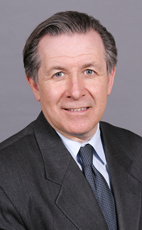
House of Commons photo

Crucial Fact

  • His favourite word was industry.

Last in Parliament September 2008, as Liberal MP for Algoma—Manitoulin—Kapuskasing (Ontario)

Lost his last election, in 2008, with 33% of the vote.

Statements in the House

Committees Of The House April 23rd, 1997

Mr. Speaker, I have the honour to present, in both official languages, the 13th report of the Standing Committee on Finance.

This report is the first report of the subcommittee on international financial institutions relating to the development and effectiveness of World Bank lending programs.

I would like to express my appreciation to my colleagues on the subcommittee.

This interim report begins the study of what can be done to ensure that World Bank lending and its programs meet the needs of the world's poor and satisfy the concerns of taxpayers in Canada and elsewhere in the developed world.

Petitions April 17th, 1997

Mr. Speaker, I have the honour to present a petition signed by approximately 100 citizens of my riding of Algoma, mostly from Elliot Lake and Blind River.

The petitioners are concerned that 30,000 nuclear weapons exist on earth at the present time. They quote former UN Secretary-General Boutros Boutros-Ghali as follows:

The most safe, sure and swift way to deal with the threat of nuclear arms is to do away with them in every regard.

Inasmuch as Canada is a part of the non-proliferation of nuclear weapons agreement, the petitioners believe that we should pursue negotiations in good faith and take effective measures that will lead to the cessation of the nuclear arms race at an early date and to nuclear disarmament altogether.

Mining March 6th, 1997

Mr. Speaker, I acknowledge the tremendous efforts of six pioneers who were inducted on January 22 into the Canadian Mining Hall of Fame located in Elliot Lake in my riding of Algoma.

These Canadians are Robert Boyle, Walter Curlook, Walter Holyk, Alfred Powis, Franklin Spragins and Joseph Tyrrell. Clearly it is through the efforts of people like these that many small and some remote communities are able to enjoy the high technology and environmentally sustainable development associated with mining today.

In particular Walter Holyk provides an excellent example of this pioneering spirit. His innovative theories on the genesis of volcanogenic massive sulphide deposits led to the discovery of the Half Mile deposit in New Brunswick, Nanisivik on Baffin Island and, most notable, the Kidd Creek deposit near Timmins, Ontario. On behalf of all members I congratulate these inductees on their impressive accomplishments.

The Canadian Mining Hall of Fame in Elliot Lake is worth a visit. I invite all members to enjoy this first class site.

Excise Tax Act February 10th, 1997

We cannot get from A to B all the time by drawing a straight line. That is the simple way to look at problems. Sometimes one has to go over hurdles and around obstacles. That is what we are doing as a government. We are tackling the issues that face us each step of the way as we move toward the goal of harmonizing these two levels of taxes.

What are the benefits to Canadians? Let us start with the business sector, particularly small and medium size business. Now each of these businesses faces reporting both federal and provincial sales taxes, two sets of records and the possibility of having to be audited by two separate levels of government. Many businesses are operated by one or two people. They are very small operations where every hour spent on government red tape is an hour taken away from productivity, an hour taken away from selling more goods or providing service to their customers. To the extent that we can reduce the time commitment that any business person, especially the small business owner, has to government paperwork is something that we are adding toward the productivity of this country.

Therefore, I do not understand how the opposition can argue on one side, as it said in its minority report, that we should get to a harmonized situation, but on the other side it says that we should not tackle each step along the way with bigger creativity and determination. That is what leadership is all about and that is why I believe Canadians give us their support in October 1993. I trust when they look at the government closely again in the next election campaign they will feel that our leadership is what this country needs.

No government is perfect, there is no question about that. If we were perfect it would be the first time, I am sure, that any government in the world was perfect.

Besides the elimination of red tape, consumers will not only benefit from the fact that the costs of running a business will be reduced, but over time it will be reflected in the prices because the small business operator will be able to cut down his or her costs.

I happen to be one who believes in tax included pricing at the retail level, but tax included pricing with full disclosure on the receipt at the cash register. We heard, over and over again, that the concept of sticker shock or counter shock was hurting consumption. Canadians will like the idea that they can see something on the shelf that is priced at $10, go to the cash register, put down $10 and know that they have paid the full amount due for that commodity.

On the receipt will be disclosure of the amount of harmonized GST and PST that is in the product. That is fair. It will have the

positive impact on consumers that we need to have in this country to ensure the fullest level of employment possible.

We have been accused of saying that we would totally abolish, scrap the GST. I refer colleagues across the way to page 22 in what I call the well read book. Page 22 says that we will move toward harmonization of the provincial and federal sales taxes. That is what I said in my campaign. That is what I said door to door. I never varied from that commitment. As a member of the finance committee, along with my colleagues on this side of the House, we are taking steps in that direction.

It is the job of the opposition to try to divert attention but the fact remains that a responsible government knows that people cannot take $15, $16 or $17 billion of revenue and throw it out the window. A responsible government also does not promise to have a broad base tax cut that it knows cannot be afforded at this time-

Excise Tax Act February 10th, 1997

I am very sorry that he is leaving. I am very sorry that he will not be with us after the next election by his own choice. I have a great respect for him. However, his memory is as good as mine. He knows what the minority report of the Reform Party stated. It stated that Reformers supported the concept of harmonization. However, one cannot believe in a concept if one does not always believe that one has to go through tough steps to get to that final resolution.

Excise Tax Act February 10th, 1997

Mr. Speaker, I am pleased to have the opportunity to participate in the report stage debate on Bill C-70. We are focusing on the harmonization of the provincial sales taxes and the GST in most of the Atlantic provinces.

It is important at this time, in view of some of the comments we are hearing from the other side, to review the big picture again. If we step back we can understand why harmonization of the GST and the provincial sales taxes where they exist is a laudable and extremely important objective.

It was a very interesting experience for me as a member of the Standing Committee on Finance to take part in the many weeks of

study and hearings on options and alternatives to replace the GST. This was in the spring of 1994.

The finance committee is an all-party committee. It listened to Canadians from coast to coast, here in Ottawa and in each of the provinces. They were asked some tough questions and in all cases they gave very honest and frank responses to the challenge of what was the best alternative to the GST.

Members of the other parties know that over 20 alternatives to the GST were studied. The vast weight of the evidence provided by the witnesses indicated that there was no other alternative that could be better than harmonizing the provincial sales taxes with the federal GST. The weight of that evidence was so great that even in the provincial campaign of 1995, the then leader of the Ontario PC party, now premier, Premier Harris, indicated his strong support for harmonizing in Ontario the PST and GST. The story we hear from Ontario now is a little different.

I do not want to impute motives, but the fact is I agree with its campaign promise that harmonizing the PST and GST in Ontario would have many benefits for small, medium and big businesses, for consumers and for provincial and federal governments that I do not know why we are hearing such a fuss from the opposition.

Among the many things we heard in the testimony, much had to do with red tape. We all hear from taxpayers and businesses that there is too much government red tape at all levels. Therefore, the fact that the government has taken the initiative to tackle a challenging problem, the harmonization of these two levels of sales taxes, is something for which all Canadians will be grateful. Certainly the witnesses we heard from at the finance committee told us in no uncertain terms that it was the goal to aim for.

There was no question that there were going to be some challenges along the way. As my colleague from Carleton-Charlotte reminds me, when that finance committee, ably led by the MP for Willowdale, reported, the Reform Party was on record as supporting the notion of harmonizing the provincial sales taxes and GST.

Elliot Lake November 28th, 1996

Mr. Speaker, I rise today to speak about the great things that are happening in Elliot Lake in my northern Ontario riding of Algoma. Known as the jewel in the wilderness, Elliot Lake has undergone an amazing transformation in the past few years, moving from a city dependent on uranium mining to one with a diverse economy, a growing population and a renewed sense of optimism.

Innovative efforts like the ongoing mine decommissioning research and Elliot Lake's retirement living program, which has attracted thousands of new residents to the area, have heralded the dawn of a new day for Elliot Lake.

Due to focused and concerted efforts on the part of Mayor George Farkouh, Elliot Lake city council and other community leaders, a number of promising economic diversification initiatives have been launched which should attract new and promising enterprises to the area.

We must build upon the successes to date to ensure this positive trend continues. I call upon both levels of government and the mining companies which benefited for so many years from operations in Elliot Lake to continue their commitment to work with the community to reach its goal of long term economic stability.

Supply November 21st, 1996

In a scenario like that one we will be tilting this significantly toward higher income families in society.

This will lead to a further drain on the funds of the country as they are tilted toward higher income families, giving the government less freedom and less flexibility to deal with the real issue facing many families, the issue of poverty, particularly child poverty. Regardless of how it is cut I do not see how it is a progressive suggestion. Our tax system is not perfect. We hope it is as progressive as it can be, but it is not perfect. I do not see this idea as being progressive, that the better off we are in terms of income the more choices we have because there will be more tax benefit. The choices for lower income families would still be very limited.

The Prime Minister promised during the campaign that when the finances of the country allowed we would deal with the issue of a national child care program.

Supply November 21st, 1996

Madam Speaker, with great respect, the hon. member talks about creating choice if the Reform Party motion were adopted and implemented. I think it would lead to less choice.

As I understand, it is an income based proposal. The more money made, the more potential tax credit would be available.

Supply November 21st, 1996

Mr. Speaker, I want to thank my colleagues on both sides of the House for allowing me 10 minutes of comments on an opposition day motion. It is not the worst motion I have seen from the opposition side but it is certainly not one that I can support even though they have kindly let me have a few minutes here this afternoon.

There is a hidden agenda with this motion but I suppose we should come to expect that from the third party. As much as I respect individual members of the third party, the total package from time to time leaves something to be desired. The hidden agenda I sense in this motion is that the Reform Party is against a broad based day care, child care, system in Canada.

I would like to begin by relating an experience that I had when I was a student at the University of Toronto. At that time I was involved in establishing the first parent co-op day care centre at the University of Toronto, a day care centre I am proud to say still exists as the Sussex Parent Co-op Day Care Centre. It is quite an interesting story and maybe some other time I could go into details.

That experience taught me that there is no one simple solution for the care of our children. While I accept that the pre-eminent place of care for children should always be the family, the circumstances in this present world do not always allow us to have that circumstance available to everybody.

Single parents need day care whether they can afford to fully pay for it themselves or whether they need publicly assisted day care. In some families it is absolutely necessary that both parents work in order to pay the bills that are part of family life.

To suggest that simply providing a child care tax deduction to all families of all income levels pretends that there is a uniform situation for families. I think we tend to fool ourselves sometimes by talking about the typical family or standard family. There are many varieties of family arrangements in the modern world and we cannot try to adapt the social culture to take care of all situations with the simplistic solution we are offered here today.

The tax system provides a measure of relief for low and middle income families.

I would be the last one to say it is perfect. In times past, when my children were younger, I was happily able to take take advantage of that tax deduction. My children are old enough now that I do not have to worry about that, but I was sure glad it was there for me at the time when I was a low to middle income person in my younger years.

I do not think even well-to-do families would generally agree they need a tax deduction for which I have seen estimates of billions of dollars. I ask the Reform Party to take note of these numbers and do their own arithmetic. I wonder if the arithmetic might not be better than we have seen in the past.

I will quote from some research notes. If Reform means to give a $5,000 tax credit for every child under seven years of age and a $3,000 tax credit for every child aged seven to twelve, the cost of the program would be approximately $21 billion or far greater than the figures Reform projects when it says its total package of tax breaks is worth $12 billion. Even $12 billion is a lot of money. I wonder whether the upper income families the Reformers may be thinking about need that kind of tax break at this time.

I am not against targeting tax cuts and tax incentives for needy sectors of our society at the proper time when the deficit is taken care of. However this smacks of a broad based tax break from income zero to income millions per annum and I must object to that.

The other hidden agenda, besides being against a broad based community day care system, is that the Reform Party is telling women to stay home to take care of the children. I accept that a lot of women would choose that. Some are able to and some cannot because of life circumstances.

It is an individual decision on the part of the mother. It is not a decision we as a society should be imposing on any woman. It should be that men and women are equals in society. I resent the subliminal message in this Reform motion that women should stay at home to take care of the children.

The government has already answered-and I admit we have a way to go-the concerns of families with children. I wish we could go further right now. In due course I suspect we will be able to. We should be focusing our attention on the the whole issue of children and poverty among children in our society.

I do not think this plan which would redistribute tax dollars to upper income families would allow us to do what is needed to ensure the poor and the poorest in society have a proper share of what this great country has to offer.

With great respect to the fine members who are here, I do not know how Reform Party members can argue on the one hand for deficit reduction-and I would argue the government is doing a great job with that program-and then propose a plan that would cost $10 billion to $21 billion according to our estimates. Perhaps they could explain that to me as other members participate in the debate.

As I much as I appreciate it is the privilege of the opposition members to bring forward ideas for debate, they have missed an opportunity to bring forward a good idea. They brought forward an idea I cannot support.

I conclude by saying that there are among other things two hidden items: that the Reform Party is against broad based child care and that it is asking women to stay home to take care of their children.