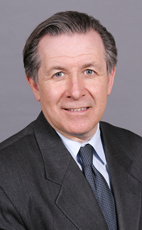
House of Commons photo

Crucial Fact

  • His favourite word was industry.

Last in Parliament September 2008, as Liberal MP for Algoma—Manitoulin—Kapuskasing (Ontario)

Lost his last election, in 2008, with 33% of the vote.

Statements in the House

Kosovo April 12th, 1999

Mr. Speaker, I do not believe for a moment that we have all the facts. I do not believe it is possible in anything as complex as this conflict that we could ever have all the facts.

I agree with the hon. member that much of the information we get is from the news networks. By their nature, coming from the western side so to speak, there may be a degree of western bias. That bias is mostly the result of the fact that journalists, as the hon. member has suggested, have been expelled from the principal region of conflict, from Kosovo.

Even though we may not have all the facts, I do believe that the journalists involved in interviewing refugees and others are attempting to glean as much of the true story as is possible. At best, we have available to us partial information. But when partial information comes from many directions and it is pieced together, it is possible to say with a reasonable degree of certainty that what is happening is actually taking place.

When a small child is about to tip a pot of boiling water from the stove onto his or her face, you do not stop to consider that it is gravity that is going to cause that pot to fall. You look at exactly what is happening and the potential for serious harm to the child.

In this case there is much that we do not know directly, but we have seen enough and know enough to act, and to act firmly and fairly. Even though Canada's reputation as a peacemaker and a peacekeeper may be compromised in the minds of some, in my mind it is not in the least.

Kosovo April 12th, 1999

Mr. Speaker, I want to thank members for the opportunity to share with them a few moments to reflect, discuss and consider Canada's participation in a very sad and tragic conflict in a region many of us know as eastern Europe.

I share with all Canadians, especially the constituents of my northern Ontario riding of Algoma—Manitoulin, a great sense of sadness that a century, indeed a millennium, is ending with war.

It may seem that this conflict is unique. Unfortunately it is one of many conflicts ongoing around the world. It is, however, at this point in time, in terms of air power, manpower and the involvement of armed forces personnel, the largest conflict that we are seeing on our television screens, hour after hour, day in and day out. Like the conflicts in Northern Ireland, in Africa and in many other parts of the world there is no easy solution. There is no simple set of reasons which brought the players to this place in time.

I am no expert in history. Like many Canadians I am probably not aware of all the facts. In this case we have to search back hundreds and hundreds of years to find many of the reasons for the conflict today.

As average Canadians and as we attempt as members of parliament to represent our constituents as best we can, we see the tragedy unfolding in the present. It is difficult for us to fully appreciate what brought the players, the stakeholders in this tragic conflict, to this point in time.

Before saying too much more, I would like to join my colleagues in commending our Canadian armed personnel that are involved directly in the Balkans or are in Canada providing very necessary support. Our hearts, our best wishes, our prayers go out to all of them.

I also want to say a few words commending many constituents in my riding. I think of the Killens family on Manitoulin Island, the Timeriskis on Elliot Lake, Reeve Aquino in Wawa and others. Those Canadians have picked up the phone, contacted their local service clubs, or have taken different initiatives to express in one way or another their support and their willingness to help the hundreds of thousands of refugees displaced in this conflict.

We live in a beautiful country. For the most part we live in relative comfort. It is easy for us to dismiss and not fully understand the degree of suffering that is going on. I include myself in that comment. It behoves us to make an extra effort to realize that hundreds of thousands of people have been removed from homes in which they have lived for generations, from communities where they have invested their lives. Their parents are from there and their ancestors are from there, yet they have been forcibly removed and taken to strange places and camps beyond their borders.

It is difficult for us to understand the deep sense of loss the refugees are feeling. When Canadians reach out and offer their assistance they are doing so with an appreciation that we are fortunate. Whatever Canada and Canadians can do to help to make sure those who are displaced can find some measure of comfort while this conflict continues is important.

The news tends to focus on what the leaders on all sides are doing. Far be it from me to understand the thinking of President Milosevic and his cohorts. I cannot understand how one human being can act such as we have seen toward another.

There are apologists on all sides. I am sure Mr. Milosevic has provided many reasons for what he has done, but what I see most of all is denial of the fact that at the grassroots it is innocent people who are being hurt.

There are innocent people on all sides. If average Serbian citizens who work in the restaurants and in the factories knew all the facts, I do not believe they could possibly support Mr. Milosevic. They too are victims in a way. They have seen conflict over many years. Certainly there are innocent victims in the Kosovo region.

If average citizens are for the most part innocent victims of what is going on, how can we as a civilized nation in any way do anything but participate in as forceful and as useful a way as possible? To those who would say we should not be participating in NATO, I suggest that had we chosen not to participate and NATO could not intervene in air attacks there would be no end in sight. It may seem even today that there is no end in sight but at least there is hope. Had NATO not decided to become involved, I believe Mr. Milosevic would have not only continued his atrocities in the way we have seen but even more so. I would worry not only about Montenegro but in fact the destabilization of the entire region.

I realize there is no vote at the end of this debate. It is difficult to debate the kind of action we should take in a conflict situation, but these debates are extremely important for Canadians, for all parliamentarians and for the leadership of the government who after all were duly elected to lead. These debates are of great assistance to the Prime Minister, to cabinet and in fact to all of us. They help to make sure this place has a sense of what Canadians are thinking from coast to coast.

I support Canada's involvement in NATO and the need for air strikes. If we accept what we see on the news it may be questionable whether we are seeing any progress. Is there a perfect solution to this conflict? I doubt it. We have to try to come out with the best solution from among many terrible solutions. If it takes a massive air offensive to destroy the military machine of President Milosevic and his so-called government, that is what we must do. We must shut down his ability to continue destabilizing not only citizens of his own region but those of a much wider area.

When it comes to the question of whether Canada should participate in a ground offensive, it certainly raises the stakes. I am not any kind of military expert. I doubt there are many here. We are just members of parliament trying to do our best to understand a very complex situation. My intuition is that it will be inevitable, that a ground offensive of some sort will be necessary.

Based on the Rambouillet negotiations it was hoped that at some point in time there would be an agreement that the NATO alliance, the United Nations and other bodies would create a force to essentially keep the peace.

As the days and weeks go by and we attempt to understand the thinking of President Milosevic, I conclude that we are not dealing with a leader who goes by any rules of engagement that we would ever understand. The use of deceit and manoeuvres designed to manipulate have convinced me that as much as we all want a negotiated settlement, the probability of that is not very high. As much as all of my colleagues and I would shudder at the thought of sending ground troops, Canadian military men and women to this region, it may be inevitable.

We are looking at a situation where hundreds of thousands of ethnic Albanians from Kosovo have been removed to places outside the region or into the mountains. Under the current circumstances they cannot return to their homes. If we believe as a member of NATO and as a civilized nation that ethnic Albanian Kosovars deserve the opportunity to go back to their homes and to rebuild, we must be involved, because Mr. Milosevic will not allow the creating of space to which they can return. Sadly that may mean space will need to be created on the ground by foot soldiers, by infantry. That is a dangerous situation.

There is no perfect solution. We cannot turn the clock back. Turning the clock back would mean going back hundreds and hundreds of years. It cannot be done. Emotions are running too high. We could look at the conflict in Northern Ireland, which is a little closer to home and maybe a little easier to understand. The emotions and feelings of nationalism running as deeply as we see in the Balkans, Ireland and elsewhere are not erased overnight. It will take years, decades or longer, maybe well beyond our own lifetimes, for there to be real solutions.

That does not mean we should sit back and allow the so-called ethnic cleansing to continue. As we close this century it is an absurd thought that we should sit back. We have done that before in this century and there was too much loss of life, dignity and civility.

As much as I would be reluctant to support any further engagement of Canadians, I feel it may be necessary. If it becomes necessary given all the facts, my constituents and I would support it. We would hope there would be no loss of life at all but realistically we have to be prepared for anything.

The air war up to this moment has resulted essentially in zero losses on the NATO side. There has been loss of life in Serbia and in Kosovo, the vast majority of it perpetrated by President Milosevic and a small number as a consequence of NATO's attempts to shut down the government and the regime of Mr. Milosevic.

As a civilized nation we owe it to our children and grandchildren to end conflict, but sometimes to end conflict it is necessary to engage in conflict. It seems oxymoronic that we must fight to end fighting, but a glance at history will show that is too often the case. We cannot avoid it simply because we wish it to go away.

I believe there may be a silver lining to this very dark cloud. This conflict is so public and so in our face because of the media coverage. Even though it is far away, it is still close to home. Maybe this conflict will provide us with the impetus to reconsider how we as a collection of nations allied for peace can involve ourselves in conflicts in areas which themselves are sovereign.

How do we learn from this experience where to draw the line on sovereignty? How do we know exactly when to intervene in a regional conflict when it may mean, as it has here, crossing into another country and interfering in a constructive way with a government in order to bring about peace?

I do not suggest that I have all the answers. Hopefully at least the worst of this conflict will be resolved in the next few weeks. I hope that in the wake of this conflict, NATO and all the member nations of the UN will pick through the bones of this conflict in an attempt to achieve some degree of wisdom. If and when this should happen again, we will know better how to resolve these conflicts and in the best way for all the stakeholders.

In conclusion, our hearts go out to the refugees. Our hearts go out to all the innocent victims of the conflict in this region, including those innocent people in Serbia who themselves do not support their own government in its ethnic cleansing in Kosovo. Our hearts go out to those refugees who have been removed from their homes and who now sleep under plastic tarps, if they even have a plastic tarp.

I applaud our government, all Canadians and the relief agencies in their efforts to bring food, shelter, medicine and supplies to those in need at this time.

It is a tough issue, Mr. Speaker, and I thank you for this opportunity to say a few words.

Fishers' Bill Of Rights February 1st, 1999

Mr. Speaker, I am pleased to join with a number of my colleagues on this side of the House and across the way as we debate Bill C-302.

I preface my remarks by saying that my northern Ontario riding abuts Lake Superior and Lake Huron. The commercial fishery is something that is important to my area as well. Even though an inland fishery, the Great Lakes are among the great waters of the world. The commercial fishers who extract fish from this resource are among the finest fishers anywhere.

Although I believe the genesis of this legislation relates more to the difficulties facing fishing communities and fisher persons on the east and west coasts, it is important that the House be reminded that there are a great number of people involved in the commercial fishing trade in the Great Lakes of Ontario. I hope they will take some comfort in the comments being made today that their concerns will be addressed as well.

Let me come to Bill C-302. We have heard that while this bill is well intentioned there are many flaws. This is not unusual when one attempts to make a simplistic response to a very complex problem. This is not to denigrate in any way the initiative of the sponsoring member, but the issues are complex.

When it comes to our fish resources the most important thing is that sustainability be our primary objective. It does no one any good and no fishing community any good if the long term sustainability of the fish stocks on which they depend is compromised. As the Minister of Fisheries and Oceans has said, above all we must ensure the viability of this fish resource. It is only from that principle we can ensure the long term viability of the communities, businesses and individuals that depend on it.

As a number of my colleagues on this side have said, fishers do not need a bill of rights. They need a healthy fishery, a fishery that is sustainable and that can support fishermen today and their children, grandchildren and future generations.

The average citizen who is not involved in commercial fishing is well aware through the media and news stories of the plight facing fishing communities and fishers. While there may be some merit to ensuring that fishermen are involved in planning for sustainable use of the resource, I do not believe that a bill of rights for fishermen is the way to go.

The goal of the government is to protect and conserve Canada's oceans and great lake resources on all fronts. As the minister has said, fish must come first so that people can then be taken care of.

No so-called bill of rights will protect fishers when the fish are in jeopardy or gone altogether. A bill of rights cannot prevent the disappearance of fish stocks. Only sound management, conservation based management can do that.

I would like to spend my remaining few minutes outlining some of the initiatives the government has taken. It is not by one silver bullet that all the problems can be solved but rather by a series of well targeted and well managed programs that objectives when it comes to preserving a sustainable resource of fish can be maintained.

Members opposite may be quick to point out what has not been done, but we know that politics is the art of the possible and much has been accomplished. We are living in a world where real achievement comes through patience, persistence and negotiation, not grandstanding. So much has been done that I can only highlight some of those accomplishments.

Last June was a particularly productive month. On June 19 the minister announced the $250 million Atlantic groundfish licence retirement program, which is part of the federal government's $730 million worth of measures for restructuring an adjustment in the Atlantic groundfish industry. The licence retirement program will help to reduce the number of groundfish enterprises in Atlantic Canada and Quebec. It provides financial assistance to groundfish licence holders who retire their licences and leave the commercial fishery.

Also in June the Minister of Fisheries and Oceans and the Minister of Human Resources Development announced $400 million worth of additional measures to restructure and rebuild the Pacific salmon fishery and to help people adjust to the reality of a smaller conservation based fishery. There is no denying the scientific evidence shows that wild coho are declining and that some stocks are at extreme risk.

As the minister said at the time, “permanent change is necessary for the future of fish and fishermen. We must get ahead of the curve and shift to a conservation based fishery”.

Canada made a major breakthrough on the east coast in June when member states of the North Atlantic Salmon Conservation Organization followed Canada's lead and agreed to a number of strong conservation measures. Among these was NASCO's formal adoption of the precautionary approach in Atlantic salmon fisheries management. Canada had already adopted a precautionary approach in its 1998 Atlantic salmon management plans. Greenland joined us in this approach when it agreed to restrict its 1998 fishery.

Progress is being made. It may seem at times that progress is slow but such is the way of the world. The inexorable flow is toward a better and better understanding of our fish resources and a better and better approach to sustainable conservation.

Just rounding out those June accomplishments, the minister announced that the Davis Strait turbot fishery had been fully Canadianized and that no foreign vessels would be used in this fishery. This should help allay the fears of those still raising the spectre of foreign overfishing.

The five year management plan the minister introduced was developed with the advice and recommendations of the Nunavut Wildlife Management Board and the views of the industry. These measures and numerous others are quite a record of achievement, one that demonstrates conviction and determination to put conservation first. It is not enough to say that mistakes were made in the past. What good is it to criticize the mistakes of the past and then advocate the same behaviour today?

We have to change our behaviour, as painful as that may be. That is what the minister has been telling Canada's fishermen. I believe that Canadians in my constituency, in particular in the riding of Algoma—Manitoulin which as I have said is a beautiful Great Lakes riding, understand the importance of making change. They trust that the government will make change in a responsible, caring way. Above all, as a government we have always tried to put people first. While I would be the last one to say we have never made any mistakes, I would put our record as a government up against any record of any government anywhere in the world, particularly against recent past governments of this country.

A bill of rights for fishers is certainly not necessary, especially when we consider the record of the government.

Committees Of The House November 25th, 1998

Mr. Speaker, I have the honour to present the second report of the Standing Committee on Natural Resources and Government Operations concerning Bill C-41, an act to amend the Royal Canadian Mint Act and Currency Act. The bill is being reported with amendments.

Mining November 24th, 1998

Mr. Speaker, the Canadian mining industry is a major creator and user of advanced technology for the global resource industry. Mining companies spend over $100 million a year on research and development and over 85% of the mining workforce uses advanced technology from electronics and advanced materials to geomatics and telecommunications. The primary metals industry is the most intensive user of the 10 leading technologies in the marketplace.

With the use of high technology and a highly skilled workforce, between 1986 and 1996 labour productivity increased by 48% in mining and by 37% in the smelting and refining industries. That compares with about 16% in the entire Canadian economy.

I call on members of the House to salute mining day on Parliament Hill and the achievements of this high technology industry.

Petitions November 23rd, 1998

Madam Speaker, I present a petition from a large number of constituents of my riding concerning the lack currently of a definition of marriage in legislation.

Their wish is that a clear definition relating to a single male and a single female be included to clarify any such confusion.

Michael Heintzman November 4th, 1998

Mr. Speaker, Michael Heintzman, a reporter with the North Shore Sentinel in Thessalon in my riding, has earned first prize two years in a row in the best historical story competition from the Canadian Community Newspapers Association.

The 1997 award was in recognition of his articles on Remembrance Day which appeared in a special section of the Sentinel that year. This beautifully produced section highlighted the tremendous contribution of local citizens, towns and villages of our region during the great wars.

Later today Mr. Heintzman will travel to Europe with our colleague, the Minister of Veterans Affairs, and a group of Canadian World War I veterans to participate in the commemorative ceremonies taking place to mark the 80th anniversary of the end of World War I.

Mr. Heintzman will have an excellent opportunity to experience this momentous event with a group of highly respected and decorated Canadian veterans. I look forward to reading his observations when he returns.

I am very proud of his work and that of the North Shore Sentinel in my riding.

Community Futures Development Corporations October 26th, 1998

Mr. Speaker, as we celebrate Small Business Week I rise today to remind the House of the important work done by the many community futures development corporations throughout Canada, especially in my riding of Algoma—Manitoulin.

With the help of volunteer boards of directors the seven CFDCs play a pivotal role in fostering local economic development. They work with our communities, give local small business direct access to capital and good advice, and make available to them the services of the federal government.

I wish to salute the Lacloche Manitoulin Business Development Corporation, the Waubetek Business Development Corporation, the Community Development Corporation of Sault Ste. Marie and area, the Community Development Corporation for East Algoma, the Nord-Aski Non-Profit Development Organization, and the Superior East and the Superior North Development Corporations for their excellent service to our communities and entrepreneurs in my riding.

I ask all hon. members to join me in congratulating the fine work of all CFDCs throughout Canada.

Lester B. Pearson Centre October 20th, 1998

Mr. Speaker, I rise today to inform the House that the Elliot Lake Centre in my riding of Algoma—Manitoulin will be renamed Lester B. Pearson Centre at a special ceremony this Saturday, October 24.

This honour reflects the many achievements of a former member of the House, a diplomat, prime minister and Nobel Peace Prize laureate. It coincides with the 50th anniversary of Mike Pearson's first election as member of parliament for Algoma East, a riding which he served admirably for 20 years from 1948 to 1968.

The Elliot Lake Centre was established as a centre of excellence in education and the performing arts in February 1965 with the encouragement and support of Lester B. Pearson. In the years since the founding of the centre, the city of Elliot Lake has been transformed from a one industry mining town to a community with a more diversified economy.

The Elliot Lake Centre has evolved as well and is at the forefront of the redevelopment of the city as it approaches the new millennium. The centre has been instrumental in the development—

Petitions October 2nd, 1998

Mr. Speaker, I have a petition from several dozen constituents of mine from Elliot Lake. They request that parliament support a motion concerning the rights of parents vis-à-vis the rights of the child and that all such matters take into consideration all members of the family.