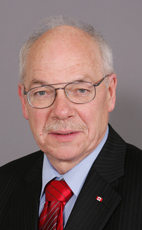
House of Commons photo

Crucial Fact

  • His favourite word was reform.

Last in Parliament September 2008, as Liberal MP for Kitchener—Waterloo (Ontario)

Lost his last election, in 2011, with 38% of the vote.

Statements in the House

Immigration March 25th, 1999

Mr. Speaker, the Immigration Act is quite clear on persons who were senior officials of certain governments which engaged in crimes against humanity and are inadmissible to Canada. These provisions have been put into place to protect the safety of Canadians.

If the Reform Party really cares about the integrity of the system, then it should be concerned that all inadmissible individuals to this country be removed.

Sledge Hockey March 19th, 1999

Mr. Speaker, I rise today to congratulate the Kitchener-Waterloo Sidewinders and wish them good luck when they host the International Sledge Hockey Tournament in my riding of Kitchener—Waterloo this weekend at the Waterloo Recreation Complex.

Sledge hockey is a form of ice hockey played by people who have physical disabilities. The game is played with players on a sled that has two skate blades under the seat. Players move around the rink on these sleds using two short hockey sticks which have picks on one end for pushing and a blade on the other end for shooting.

The opening ceremonies taking place tonight will be hosted by Ron Maclean of Hockey Night in Canada. Teams from across Canada, the United States, Holland and Norway are expected. A total of 30 teams with 700 players will be taking part in this exciting tournament.

I wish to congratulate the Kitchener-Waterloo Sidewinders for hosting this event. I wish them the very best for the tournament.

Income Tax Amendments Act, 1998 March 18th, 1999

Mr. Speaker, I invite the hon. member back to my riding—I know he has been there before—to continue his study into what makes a community click.

He talked about nurses leaving the country. In the case of the province of Ontario many nurses have left the country. It has everything to do with the fact that the provincial government, with which those members are so pleased, has fired 10,000 nurses. The government flips and flops and is trying to hire them back, bring them back from the United States. Poor planning.

Let me be very clear. For the most part, people who come out of Sir Wilfrid Laurier University go to very well paying jobs. Let me also inform the member that the Conestoga graduates have the highest employment rate of people going to community colleges in the province of Ontario. I am sure the member opposite would like to applaud that. The ranking was recently done and I believe it is at 94%.

When criticizing things, sometimes we hear mention of a glass of water. This glass of water happens to be 75% full. I would rather look at it as being 75% full than be like the official opposition and look at the glass of water and complain that it is 25% empty.

Income Tax Amendments Act, 1998 March 18th, 1999

Yes, Mr. Speaker, too many Canadians are poor. Certainly nobody in the House takes any joy in that.

Prior to coming to parliament I used to work with an organization called Youth in Conflict with the Law. Many of the people we worked with were before the courts due to poverty and lack of opportunities.

What I said in my speech was that the situation is Canada has improved greatly since 1993. All members of the House must work together to make sure that trend continues. Child poverty is very much an important concern of the government. If he examines the budgets over the last number of years, he will see we have spent $2 billion to fight in that endeavour. We will continue to do more.

Income Tax Amendments Act, 1998 March 18th, 1999

Mr. Speaker, the hon. member is welcome any time to come to my riding and see a community that actually works. If he actually talked to the people and listened to what they had to say, the hon. member would understand why Reform support keeps dropping and dropping from election to election.

Let me say to the member very specifically how the quality of life has improved in my community because of the government. First, fewer people are unemployed. We have one of the lowest unemployment rates in the country. It is below 6%. If the hon. member looked around my community and studied what makes my community tick, he would recognize that we made the transformation from an old economy to a new economy. Previous governments had the foresight to make the necessary investments that are well represented by the University of Waterloo, Sir Wilfrid Laurier University and Conestoga College.

Income Tax Amendments Act, 1998 March 18th, 1999

Mr. Speaker, if anybody needs any information on kibbutzim, the hon. Minister of Citizenship and Immigration worked on a kibbutz for a number of years before coming to the House.

It is important to focus the debate somewhat. It would be fair for me to say that the biggest cohort in the House is the class of 1993. When the Liberals formed the government at that time it is important to remember what our position was as a nation.

During the previous nine years the debt grew from $208 billion to $508 billion under the Progressive Conservatives and we had a record annual deficit of $42 billion.

In 1993, 11.4% of Canadians were unemployed and we were told by the former Tory prime minister that we should not expect anything below 10% before the year 2000. Although it is still much too high, the number right now is 7.8%.

In 1993 employment insurance premiums were scheduled to rise to $3.30. Since then we have lowered them each and every year. We are now at $2.55 for every $100 earned.

Our nation was falling into self-doubt and we were an economic basket case among western countries.

The reality is that we now have back to back balanced budgets for the first time in almost half a century. As we have recovered the fiscal integrity of our nation we must thank all Canadians for their support in this effort. We must also recognize and commend the leadership of the Minister of Finance and the Prime Minister in this effort.

Who would have believed that this day would come? In order to complete this first stage of the recovery plan and balancing the budget we pursued a balanced program of a reduction in spending, reducing transfer payments to the provinces and growing the economy. The decisions made and the actions taken were not easy for anyone, but they worked. We can once again look to the future with optimism.

Governing is about bettering the lives of Canadians and improving their standard of living. It is building today to ensure for a better tomorrow. In order to do this and do it well we as a government cannot work alone so we enlist the input of Canadians.

The principal concern of Canadians and Ontarians across the country is health care. We are making the largest single investment of the government in health care. Under the budget provinces will receive an additional $11.5 billion in transfers for health care over the next five years. My province of Ontario gets an additional $4.4 billion of that for a total of 38.2%. This investment will bring the health component of the Canada health and social transfer to the level it was before the 1990 cutbacks.

Because we are removing the equalization cap on British Columbia, Alberta and Ontario and moving to a per capita entitlement for equalization payments, Ontario will receive an additional $900 million in transfer payments.

Health care is a priority for Canadians and continues to be for the government. As the Minister of Health has said, and I am paraphrasing, we must strive for a people centred system, one that stresses transparency, sharing of information and the right provider giving the right care at the right time in the right place at a reasonable cost to taxpayers. This increasingly means innovative ideas and the use of the newest technology.

My riding of Kitchener—Waterloo is well known for innovation and research. The budget has tremendous gains in this area, both in health specific research and research in general. I have just spoken of the health research initiatives as a cornerstone of the budget and will now continue to discuss other forms of research, an issue near and dear to me and the people of Kitchener—Waterloo.

I am very happy to have contributed to this process through the post-secondary caucus of the Liberal Party. I was one of the original members, along with the hon. member for Peterborough and Dr. John English, the former member for Kitchener who has now returned to teaching at the University of Waterloo.

Our universities are very pleased with the budget. Bob Rosehart, president of Wilfrid Laurier University, stated:

The focus on health in Federal Budget '99 was great news for all Canadians. The enhanced health research opportunities presented to all universities...and the increased funding to the granting councils was great news. Obviously the federal government has been listening to the universities and WLU looks forward to participating in these new initiatives.

The comments from the University of Waterloo were much the same. I am very glad to be able to say that the Kitchener—Waterloo area is very well served by the budget and by the government. Having worked with the post-secondary education and research community for a long time I knew that our caucus would help them in putting their message across.

In the consultations before the last budget the post-secondary education caucus helped to ensure that the future of post-secondary institutions and hundreds of thousands of students was given high priority. As a result, the last budget was good news for post-secondary education. This year it continues.

That is why the budget works. The people had an influence on its preparation through public opinion polling and through different caucuses and committees. Canadians are working hard to better themselves and improve their prospects. In so doing they are enhancing Canada's economic strength and furthering Canada's future prospects, enabling us as a nation to compete successfully in the new economy.

Research and development are crucial to the economic well-being as we compete in the new economy. It is more imperative now as we are undergoing an information technology revolution and has a greater impact on jobs than the industrial revolution.

Millions of jobs across the country were lost in the old economy and the millions of net new jobs created in the past four years are a tribute to our ability to embrace the new economy, much of it a new economy founded on research and development.

For example, my community in Kitchener—Waterloo was once a manufacturing community and an insurance centre. Now its manufacturing sector is reduced and it specializes in higher education and high tech and is still an insurance centre. Under this new budget there is an increase in funding for research and research infrastructure that will be of great benefit to my riding, to my province and to my country.

This increase in funding includes another $15 million over three years for the Social Sciences and Humanities Research Council, $15 million over three years for the National Research Council, $75 million over three years for the Natural Sciences and Engineering Research Council, and $200 million for the Canada Foundation for Innovation. This new funding is in addition to the funding granted for health research.

The Canadian opportunities strategy increases our ability to achieve our goals by giving every Canadian better access to knowledge and skills. The 1999 budget builds on this strategy by investing more than $1.8 billion for this year and the next three years. This funding will go toward knowledge: creating knowledge, disseminating knowledge, commercializing knowledge and hence supporting employment.

The Canadian opportunities strategy includes Canadian millennium scholarships averaging $3,000 a year up to $15,000 in total for four years; Canada study grants averaging $2,225 per year to help students with the greatest need; support for advanced research as detailed earlier; and tax relief for interest on student loans in the Canada student loan interest relief. The strategy also encourages families to save for their children's education through the Canada education savings grant announced last year. The government contributes to RESPs.

The Canada opportunities strategy helps to disseminate knowledge across the country through SchoolNet, a program to connect every high school and library to the Internet before the millennium. It is due to be completed by March 31, 1999. The community access program will connect 10,000 rural and urban communities in two years.

There is no question that my community of Kitchener—Waterloo is part of the new economy. As Canada moves forward into the knowledge based economy of the present and the future, we will have a budget that helps us as a nation to prepare for that. We have many challenges before us as Canadians. I think the budget helps us in that direction.

Supply March 16th, 1999

Mr. Speaker, let me say to the hon. member that we will be reviewing the act. What he suggests in terms of bonds, in terms of sponsoring visitors, is certainly one area that will be discussed and actually has been discussed by some people. That is working in the criminal justice system as far as sureties and posting of bonds are concerned, which will be worthwhile looking at when we review the act.

Supply March 16th, 1999

Mr. Speaker, I say to the member opposite that I go out west twice a year. I stay for about a week at a time. When we first came to Canada we lived in Vancouver, including North Vancouver. I have returned there on many occasions.

If the member does not believe that the crime rates are dropping, there is not a whole lot I can do about it. I can only suggest to him that he read the facts.

People abusing our immigration system is a problem at times. The member continually refers to the Honduran claimants. Whether or not those people are kept in custody when they are apprehended or charged is a decision made by the local courts. It is important for the member to understand that. If the local courts believe that the person will commit another offence or not show up for the next hearing, the person will be kept in custody.

I implore the member to read the statistics so that he understands that the crime rate has been dropping not just in Canada but in the United States and in western Europe as well.

Supply March 16th, 1999

Mr. Speaker, I will be speaking to different parts of the motion, but I am first going to make some general comments.

The member said that he does not know much about criminal justice models around the world. I suggest that the member is correct. I suggest that the Reform Party knows little about criminal justice models around the world and if Reform members do, we would like to have them stand in the House and tell us which system they would like to see us model our system on. Would it be Europe? Would it be the United States? Would it be South Africa? Would it be Texas? Which?

One of the problems when we enter into this type of debate is that members of the official opposition ends up trafficking in a lot of fiction. By saying that I mean they would misrepresent a situation of crime and the number of victims in this country as to how we compare to other countries.

The Reform Party would have us believe that our Young Offenders Act is the most lenient act around. For the record, our Young Offenders Act incarcerates 15 times as many young people as similar acts in New Zealand and Australia, 10 times as many young people as in western Europe and even twice as many young people as in the United States. Our Young Offenders Act is more punitive to young people than an adult charged with the same kind of crime. Young offenders spend more time in jail for a crime than adults do in the adult system.

When I say that the official opposition is trafficking in fiction, that is exactly what I mean.

It is nice for the Reform Party to go around and say there is a fear of crime in this country and that people should not be afraid. Every one of us in the House would agree that one victim is one victim too many, that one crime is one crime too many.

The reality is that the crime rate has been dropping over the years. It has been progressively going down. Compared to the United States, our crime rate is much lower. Canadians feel much safer in this country than they do in the United States. Every example calling for tougher sentencing and dealing more toughly with law breakers always points to the American model.

One of the biggest fears people have of crime involves the use of guns. That is why the government put in place gun registration, which I must say is being ignored and was not supported by the Reform Party.

I want to touch on immigration. Immigration has certainly been a greatly exploited topic by the folks on the other side.

The safety and security of Canadians are a concern of the government. Through the immigration program numerous measures have been undertaken to ensure that criminals do not enter and that those who have entered have no right to remain and are removed.

This undesirable group, however, represents a small fraction of the total number of visitors and immigrants that come to Canada. Citizenship and Immigration Canada strives to ensure public safety while facilitating the entry of legitimate travellers. It is difficult to balance.

Last year alone 110 million people crossed our borders to enter Canada. Many of them were Canadian citizens returning home, as well as visitors, immigrants, foreign students and refugees. Security screening is used for all those who are entering Canada. Toward the goal of public safety there are three screens in place to guard against illegal entry and to identify those who should not be here.

Before I continue, I will be splitting my time with the member for Erie—Lincoln and I look forward to his contribution.

At the international level a screening occurs. Those wishing to come to Canada as visitors or immigrants are scrutinized when they apply for a visa. Immigration control officers working in Canadian embassies and missions abroad ensure that security and health checks are done. It is at the international level that we have formed partnerships with foreign governments to help confirm the identities of foreign criminals and to prevent them from coming to Canada. The problem of illegal migration is a global one with crime rings operating beyond national borders. It is therefore necessary to work toward solutions at the international level.

A second screen is conducted at the Canadian border where Citizenship and Immigration Canada officials and those of Revenue Canada deal with incoming travellers. The use of computer databases has helped greatly in establishing identification, ensuring that those seeking to enter Canada have not been previously arrested or removed. The work at these border crossings and airports is a key element in our defence against illegal entry.

The third type of screening goes on within Canada with the co-operative work of Citizenship and Immigration Canada, the RCMP, and all Canadian police forces. This inland screening is an ongoing process that makes use of shared databases and immigration warrants. Often something as routine as a traffic stop allows an officer to determine immigrant status and possibly the existence of warrants.

It is this information sharing with police forces across the country that has allowed Citizenship and Immigration Canada to identify and remove criminals and those without status in Canada. I remind members opposite that the removal of foreign criminals and failed refugee claimants has increased steadily over the last four years.

In 1998, 8,012 people were removed from Canada. This represents an increase of 67% from 1995 when citizenship and immigration effected 4,798 removals.

While there is much to commend in the current Immigration Act there are avenues for improvement. Changes are now being considered. On January 6 this year the minister proposed new directions for immigration legislation and policy. Under these proposals the system would be improved by clearly defining who is admissible to Canada, by creating new inadmissible classes, and by enhancing the capacity of government to remove people who have no right to establish themselves in Canada. Also among the proposals is the removal of a level of appeal for serious criminals as well as those people who obtain permanent resident status through misrepresentation.

As we advance with these proposed changes I look forward to the contributions of members opposite so that we might recognize the efficiencies and improve the Immigration Act.

There is no question that we have problems in enforcement in terms of having people who come to the country that commit offences.

When we look at our immigration policies over the years we have to recognize that we have a country with a population of 30 million. Something like six million people were not born here. We have a generous acceptance of refugees which is both humane and generous. Beyond that, the number of people who involve themselves in criminal activity compared to the whole is very small.

People look at Canada overall as being a nation of immigrants. I can look around the House and say there are 47 members who were born outside Canada. A number of people were refugees and are represented pretty well in all parties.

Canada is a nation that was built on immigration. If we look at the status we occupy in the world because of this reality, we have to say that our policies overall, which will get some improvement, have served the country very well.

Supply March 16th, 1999

Mr. Speaker, will the member tell the House, when he looks at all the countries in the world and all the criminal justice systems, which country does he think should be the model that Canada might look at? Which country's model is closest in its thinking and philosophy? I would like to hear that from the member.