
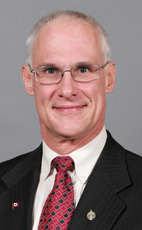
House of Commons photo

Crucial Fact

  • His favourite word was section.

Last in Parliament September 2008, as Liberal MP for Scarborough Southwest (Ontario)

Won his last election, in 2006, with 48% of the vote.

Statements in the House

Budget Implementation Act, 1998 March 24th, 1998

Mr. Speaker, it is a delight to be able to stand and offer my few comments on Bill C-36, the budget implementation act. I support the budget and therefore I am quite pleased to support any legislation to implement it.

I want to describe the budget and the budget implementation act by using one word, credibility. I want to do so by looking at history.

I was first elected by the people of the then riding of Scarborough West to come to this place in 1988. In 1988 we were in opposition. We listened very carefully to the government of the day, the Conservative government. I am addressing now historical fact which can easily be checked by examining the records and by examining Hansard .

Michael Wilson was the finance minister. At that time, in 1988 and early 1989, there were no Reform members in the House. There were no Bloc members in the House. Michael Wilson, year after year, stood and made promises. Year after year those promises were broken. Year after year he blamed the previous government. Year after year the debt and the deficit kept growing. What did the Conservative government do?

In 1986 the general surtax was brought in. What for? To pay down the deficit and to pay down the debt. Were they successful? No they were not. The debt and the deficit kept increasing, yet every year Michael Wilson would stand in his place as finance minister, except for the year the budget was leaked, and remind everyone that this year his promises would come true. It was like shooting fish in a barrel to be in opposition. We knew he would not fulfil his promises. He had no track record. He had no credibility. Everything he said did not come to pass.

The Conservative government implemented the general surtax in 1986, which was followed by the GST. Hon. members will remember that the debate was centred around modernizing the tax system, getting rid of the old tax. Sure there would be more money coming in, but what would they do? It would be revenue neutral. They would only charge sufficient GST to bring in the same amount of revenue as the old manufacturers' sales tax. If they were wrong in their calculations—and remember, Mr. Wilson was always wrong in his calculations—if there was an excess, they would apply it to reducing the deficit and the debt.

There was a huge excess in the GST coffers. An election was coming so what did the Progressive Conservatives do? They gave GST rebates and GST refunds instead of applying that money to the debt. It was great for the people who got the cheques, but it did not help reduce the debt. What happened to the debt? It kept rising. What happened to the deficit? It kept rising.

We campaigned on a number of things in 1993, including getting a handle on the debt and the deficit. We promised that we would eliminate the deficit and we were elected. We were given a mandate to do that, among other things. Lo and behold we had the Reform Party here. It was not the official opposition, but it was here. When our finance minister stood and delivered his first budget he pointed out that he was going to do two-year rolling targets. He did not want to say things on which he would be unable to deliver. He only predicted two years into the future, using very conservative business estimates.

What was the Reform Party's mantra? Of course they have forgotten about it now. It was very simple. It was “Oh, these are Liberals. They will never do that. All Liberals ever do is spend. You cannot believe the Liberals. They will never pay down the deficit, never mind make inroads on the debt, because they are Liberals”.

Day after day in question period on the first budget the Reform Party stood and said “This government has no credibility. They are Liberals. We do not care who the finance minister is. We do not care who the Prime Minister is. This government has no credibility. They are Liberals and they are going to spend us into bankruptcy”.

What happened? In each budget the finance minister was more than right. That makes it difficult for members of the opposition, I admit. It is sure nice to be on this side where the finance minister says he is going to deliver and he delivers. In each budget he has delivered he has neither overestimated nor overspent. He has been measured in his responses.

Conservatives cannot say this because they can hardly throw stones at their own glass house, but the Reform Party, not having been in government and not having understood how things worked realized “Hey, we have been yelling at the Liberals now for three years saying they are not going to pay down the deficit. Guess what? They are going to pay down the deficit, so we had better change tactics. We thought they were going to do things differently, but maybe they are doing things differently because now they have changed tactics. What are their tactics now? Their tactics are to cut taxes”.

The Reform Party was not telling us to cut taxes when we were cutting the deficit. They were making fun of us that we would never cut the deficit. This budget shows us that the deficit is gone. It is gone for good. It was the Liberal Party which got rid of it and a Liberal finance minister who delivered on everything he said in the budgets. That is credibility and that is what we start with in a budget. We start by saying that we are going to do something and we do it. Then we go beyond that and do a little more.

What was the Bloc doing throughout all this? Quebec does not have enough. We can listen to parrots for only so long. The fact is, we run a country. There are 10 provinces and two territories, soon to be three territories. We have to divide everything. We have to run this country equally to make sure that all Canadians from all provinces and all regions are looked after as best we can.

Here we have this budget which, like all the other budgets before it, will come true. Why? Because all the other budgets have come true and the finance minister has the rolling targets.

What is going to come true? One, no more deficit. What happens when there is no more deficit? We still have a big debt. Like everybody who has a big debt we want to pay it down. We are going to pay it down. How do we know that? Because we have said we are going to pay it down and each and every one of the predictions that the finance minister has made in the time he has been finance minister have come true and these will come true as well.

That is the Liberal way. It is not about slashing to reduce things. We have to do things in a measured, orderly way to reduce the deficit to zero, which has been done, to start reducing the debt, which is a legitimate goal, as well as to help ordinary Canadians.

Yes we agree we should cut taxes. I pay too many taxes in my opinion. Ordinary Canadians want to pay less in taxes. It would be wonderful if we could cut taxes across the board. What have we done? We have at least started.

The 1986 general surtax that was brought in by the previous government has been eliminated for the vast majority of Canadians. We have come up with some innovations with respect to helping low and middle income Canadians. We have to start somewhere. We are not going to start at the top like the Tories and help the rich first and work down. We are going to start by helping low and middle income Canadians.

What did we do? Beginning in July of this year the basic personal exemption will increase. What does that mean? That means 400,000 low income Canadians will no longer pay any federal income tax. If some province wants to try and go in there and pick up the slack and steal some money from these folks they will have to deal with it at the ballot box.

The 3% general surtax will be eliminated for people with an income of up to $50,000 and reduced for those with incomes up to $65,000. What is that going to mean? That is going to mean $1.4 billion dollars in tax relief for 14 million low and middle income Canadians by the year 1999-2000, 90% of all taxpayers.

While we are doing this we are paying down the debt. The deficit is gone. We are paying down the debt. We are doing what the Reform Party wants and what most Canadians who have any common sense when running their own families do, and that is starting to pay down the debt. But we are also starting to give tax relief.

Because this budget has credibility and because the finance minister has credibility, I know that in budgets to come there will be more tax relief and greater debt payment. That is why I am pleased to support this budget.

Budget Implementation Act, 1998 March 24th, 1998

We did not promise to abolish it. What election were you in?

Division No. 101 March 17th, 1998

Mr. Speaker, I would like my vote to be recorded as having voted no with my party.

Hungary March 12th, 1998

Mr. Speaker, I rise today to bring to the attention of this House the very special significance of Sunday, March 15 to Hungarians around the world.

In 1848, 150 years ago, Europe was in upheaval. It was the year of revolution. Absolute monarchies were decaying and freedom and liberty were attempting to break free of the chains of tyranny.

On that day in that year, the Hungarian people announced their revolt from the absolutism of the Hapsburg monarchy centred in Vienna. This was a bold act. It led to short lived freedom, to be followed by a generation of repression by the last vestiges of the regime.

The spark lit on March 15, 1848 ultimately led to a workable arrangement between Austria and Hungary lasting 50 years and ignited the flame of liberty in 1989, finally resulting in a free, independent and democratic Hungary which this year became one of our newest NATO partners.

Best wishes to Hungarians everywhere on the 150th anniversary of Hungary's national day.

Sri Lanka February 5th, 1998

Mr. Speaker, I want to draw the attention of the House to the 50th anniversary of the independence of Sri Lanka, once known as Ceylon.

The year 1948 marked the end of a period of colonization and the beginning of a journey for its people to turn Sri Lanka into a country that inspires the pride and support of all of its citizens.

Sri Lanka is a parliamentary democracy and a sister nation to Canada in the Commonwealth. It is a nation that is embracing modern business, trade and international relationships.

It does so as an island which is home to rich and unique languages, cultures and character based on a history going back hundreds and thousands of years.

We recognize that Sri Lanka has major challenges in ensuring standards of institutional fairness and equity among its peoples. It is to be hoped that the current violent conflict will end soon so that the people of Sri Lanka may grow and further develop in peace and harmony.

During the 50th anniversary celebrations I wish all Sri Lankans, especially those who have settled in Canada and in particular those who have made Scarborough, Ontario, their home, a prosperous and above all a peaceful future.

Canada Pension Plan Investment Board Act November 27th, 1997

Mr. Speaker, my intervention will not be long but I have been carefully listening to the interventions from our NDP colleagues with respect to this proposed amendment. Unless I heard it incorrectly, from the very mouth of the last speaker comes the reason why the amendment should not be supported.

She is talking about giving, as I understood, the opportunity for the provinces to dip into this fund and use the money for what they think is right, if I understand the amendment correctly. Yet in the very next sentence she points out the irresponsible behaviour of a certain province during the regime of a certain government. There is nothing in the future to prevent other irresponsible governments in other provinces from doing things that might be irresponsible with the CPP.

It seems that what Canadians want is to make sure that the Canada pension plan is there when they retire and to make sure that when they retire they will receive an appropriate pension, being one of the three pillars we are trying to get Canadians to appreciate.

If we are going to do that we want to make sure that the fund is invested in the most prudent and most efficient way to ensure profitability, not for the sake of profitability but for the sake of ensuring that those people who are retired can count on the Canada pension plan. One of the ways we want to do that is to make sure that the investments are invested in a prudent, financially secure manner. If we are going to leave it willy-nilly to governments that may or may not be good or bad from time to time, it seems to me that in itself is irresponsible.

If that is the intent of the NDP amendment I certainly cannot support it.

Speech From The Throne October 2nd, 1997

Mr. Speaker, I am always interested in the comments of the hon. member, having worked with him in the last parliament on the justice committee. I know the hon. member to be a lawyer. Therefore I am particularly interested in a couple of the comments he made pertaining to the position of the Bloc Quebecois.

One thing I believe he said—and he can correct me if I misunderstood him—was that somehow the Liberal Party was denying the democratic rights of the people of Quebec. I wonder if the hon. member even recognizes what democracy is, in view of the fact that the people of Quebec have very clearly expressed in two referenda that they wish to remain in Canada.

It seems to me it is the Bloc Quebecois that refuses to accept the democratic will of the people of Quebec by continually ignoring the results of two referenda, going back and going back until it hopes it will eventually get the answer it would like to get. It seems to me that is ignoring the democratic rights of the people of Quebec.

As a lawyer I would like the member to explain why he thinks it is inappropriate and incorrect to seek the opinion of the Supreme Court of Canada on matters of international law.

Marriage (Prohibited Degrees) Act October 1st, 1997

moved for leave to introduce Bill C-225, an act to amend the Marriage (Prohibited Degrees) Act and the Interpretation Act.

Mr. Speaker, the purpose of the bill can be succinctly stated. It would ensure that the only valid marriage in Canada is between one man and one woman. There are a few cultures and religions in the world which allow multiple wives or husbands. That is not part of Canada's history, tradition or values.

There are one or two countries or states which either permit or are thinking of permitting persons of the same sex to marry. That is not part of Canada's history, tradition or values.

Canada's history, tradition and values are being challenged in our courts. The United States has already passed similar legislation to defend the institution of marriage. It is time for Canada to do the same.

The bill would ensure that marriage remains what Canadians have always known it to be: a legal union between an unmarried female and an unmarried male.

(Motions deemed adopted, bill read the first time and printed)

Criminal Code October 1st, 1997

moved for leave to introduce Bill C-224, an act to amend the Criminal Code (offence committed outside Canada).

Mr. Speaker, section 6(2) of the Criminal Code specifies that, with few exceptions such as war crimes, hostage taking and hijacking, persons are not to be convicted of offences committed outside Canada. This results in situations where, as has happened, two Canadians holidaying in the Caribbean assault another Canadian. At present there is no way of prosecuting those people in Canada.

If the authorities in the Caribbean do not proceed with a charge, the people get away with what would clearly be a crime if committed in Canada.

My bill closes this loophole by providing that any act or omission committed outside Canada, which if committed in Canada would constitute an offence under the Criminal Code, shall be deemed to have been committed in Canada if the perpetrator is a Canadian citizen, a permanent resident or is present in Canada after the commission of the act.

(Motions deemed adopted, bill read the first time and printed)

Criminal Code September 30th, 1997

moved for leave to introduce Bill C-220, an act to amend the Criminal Code and the Copyright Act (profit from authorship respecting a crime).

Mr. Speaker, this bill would amend the Criminal Code and the Copyright Act to prohibit a criminal from profiting by selling or authorizing the story of a crime. If a person is convicted of an indictable offence under the Criminal Code any moneys he or she may have made or may make in the future from the creation of a work based on the crime would be deemed proceeds of crime, subject to seizure by the crown.

This is the same bill that I introduced in the last Parliament and which was passed unanimously by the House and sent to the other place where it was also referred to committee and then unfortunately died an unnatural death because of the call of the election.

I am hoping that with co-operation from all sides we can do the same and get it through the House this time.

(Motions deemed adopted, bill read the first time and printed)