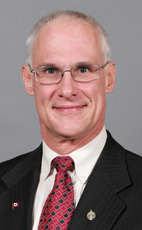
House of Commons photo

Crucial Fact

  • His favourite word was section.

Last in Parliament September 2008, as Liberal MP for Scarborough Southwest (Ontario)

Won his last election, in 2006, with 48% of the vote.

Statements in the House

Supply February 2nd, 1999

Madam Speaker, the comments of the last 10 minutes indicate why I am voting against the motion.

My hon. colleague can try to portray them any way she wants. She can take whatever shot she wants. I have stood in the House of Commons and spoken in front of Canadians as to my reasons. Let me say, however, I do not in any way, shape or form say that we should not in appropriate circumstances use the notwithstanding clause and I indicated what those circumstances were.

I should indicate that when I signed that letter my purpose was to indicate to the Prime Minister how very concerned we were as ordinary backbenchers as to the ramifications of this decision.

When the hon. member for Mississauga South spoke he made a number of very excellent points about why he signed the letter and I agree with all those. I signed the letter. I stood in this place and explained why I am not supporting this motion. Absolutely no one got to me, as the member puts it. No one has called me to tell me which way to vote. No one has twisted my arm. No one has asked me to hide behind the curtains.

Everybody knows that on an issue like this I will vote the way I think I should vote and I am going to vote against this motion for the reasons I indicated. What got to me was the wording of the motion.

Supply February 2nd, 1999

Madam Speaker, I am honoured to say a few words on the motion brought forward today.

I will try to be as careful as I can in my words and not impute motive, as has been suggested by members of the official opposition, but rather deal with the motion as put forward and my views on it.

It is useful to have a look at what the motion proposes:

That the government should take legislative measures to reinstate the law that was struck down by a recent decision of the Court of British Columbia—

That statement is simply wrong. The law in question, section 163 of the Criminal Code and some of its subsections, is still the law of Canada. A particular judge of the British Columbia superior court has ruled in what can only be described as a boneheaded decision that there is some sort of constitutional right to possess child pornography.

That ruling is not even binding on his fellow judges, never mind judges in other provinces, never mind appeal courts, never mind the Supreme Court of Canada. There is no doubt the judgment has caused a huge outcry in Canada. There is no doubt from listening to the debate today that everybody is completely in favour of making it a crime and continuing to have it a crime to possess child pornography. That is not the issue.

The issue is whether or not we vote in favour of the motion. If we vote no, why are we voting no? I will tell the House why I am voting no. We have a law and that law is still in force. It is still being enforced by police forces across the country. The Minister of Justice indicated that it is the will of the Government of Canada that the law continue to be enforced. Police forces across the country have indicated they will continue to do it.

In British Columbia, the subject of this judgment, there are lower courts which generally speaking have to follow the precedent of a higher court but can adjourn cases pending clarification of the law. They do not need to dismiss them. On any cases that are dismissed the crown counsel can appeal those decisions and make sure everything is in order waiting for the court of appeal.

How can we take legislative measures to reinstate a law that does not need reinstatement? It is still the law of Canada. To vote for the motion is to be completely illogical. We cannot vote to reinstate a law that does need reinstatement.

We are not talking about a circumstance down the road when the highest court of the land might theoretically overturn the section in question. If that were to occur, no matter how fast I hurried I would probably still not be the first person to call for the invocation of section 33 of the Constitution, and I would. However that time has not yet arisen.

The first reason I am voting against the motion is that it asks us to do something based on the false premise that the law is no longer the law of Canada. It asks us to reinstate something that is already in status. Second, it asks us to do so by invoking section 33 of the Constitution Act, 1982, the notwithstanding clause.

I have not been here all day so I do not know if anybody has referred to the actual wording of section 33(1) of the charter of rights and freedoms. It might be useful to have a look at the wording of that section if we are being asked to invoke it at this point in time:

Parliament or the legislature of a province may expressly declare in an Act of Parliament or the legislature as the case may be, that the Act or a provision thereof shall operate notwithstanding a provision included in section 2 or section 7 to 15 of this Charter.

That is a lot of gobbledegook to non-lawyers unless we analyse it, so I will analyze it briefly for us. Parliament may expressly declare under section 33 of the charter that section 163.1(4) shall operate notwithstanding a provision included in section 2 of the charter.

If the courts were to find as a matter of law that section 2 of the charter gives a charter right to the possession of child pornography, notwithstanding that court decision the Parliament of Canada using section 33 could declare section 163.1(4) still to be the law of Canada.

In order to invoke section 33 we need a judicial decision deciding that section 2 overrides section 163.1(4) and that judicial decision must apply across Canada. It has to make it a law of Canada that it is a charter right to possess child pornography.

There is no such decision in Canada today. If there is no such decision in Canada today, the notwithstanding clause of section 33(1) of the charter cannot be invoked because it requires something in the Constitution to be overridden notwithstanding that it is in the Constitution.

The judgment of Justice Shaw does not do that. The judgment of Justice Shaw stands completely alone. It stands isolated in Canada. None of the members of parliament who have spoken today support the judgment of Justice Shaw. None of us support his rationale, his legal rationale or any kind of rationale he proposed in his decision. That decision has been roundly and completely criticized in the House today. The House has sent a very clear message on behalf of Canadians to the court of appeal and to the Supreme Court of Canada.

How can we in good conscience as responsible legislators, notwithstanding that we abhor the concept of child pornography, that we do not agree it is a charter right to possess child pornography, vote for a motion that is based on two legal fallacies: one that the law protecting children is not in force across Canada and the other that there is somehow across Canada a declaration that it is a charter right to possess child pornography which therefore we have to override using the charter? Neither of those circumstances is in place.

That being the case, the motion if not technically and procedurally out of order is logically out of order since it does not make any legal sense whatsoever.

I want to make abundantly clear that if there is any kind of inordinate delay in getting to the court of appeal or any kind of dealing with the matter expeditiously, we still have the opportunity to consider the proposal put forward by the member for Pictou—Antigonish—Guysborough and a quick reference to the Supreme Court of Canada.

Should it be that the highest court in the land strikes this down, I will try to be the first to call for the charter to be invoked to override such a ridiculous decision. In the meantime, in law and in logic we cannot support the motion no matter what good intentions are behind it.

Supply February 2nd, 1999

Obviously members opposite do not wish to listen to reason.

The judge has rendered a decision based on rubbish thinking, but that does not render this law inviolate.

I would like to hear the hon. member's comments on that.

Supply February 2nd, 1999

Madam Speaker, unlike any member of the Reform Party, I was here in 1993. When this law was passed I was the official opposition critic for the solicitor general.

Unlike any member of the Reform Party, I voted for this law when it came into being. Every member of my party voted for this law and every member of the House of Commons voted for this law. This law was and is supported by the House of Commons.

The issue is the nature of the motion. Members opposite get very edgy when they are accused of rhetoric, and yet we hear one member referring to the leader of the country as a dictator. If that is not rhetoric I do not know what is.

Let us stick with the issue. The hon. member's motion wants us to take legislative measures to reinstate the law that was struck down by a recent decision of the court of British Columbia. That is plainly wrong.

The law is still the law of Canada. It does not need to be reinstated. One judge of one superior court in one province has rendered a decision—

Migraine November 17th, 1998

Mr. Speaker, I am pleased to inform the House that the week of November 14 to 20 is migraine awareness week.

Over 3 million Canadian men, women and children suffer from the pain of migraine, a debilitating neurological disorder which costs the Canadian economy an estimated half billion dollars a year.

The Migraine Association of Canada provides information and compassionate telephone support to help sufferers manage this disorder. The association is launching its third annual campaign to increase awareness of the serious nature of migraine. Volunteers across Canada will display information in workplaces, community centres and schools to foster a greater understanding of the symptoms of migraine and their effects on the sufferer.

Please join me in wishing the Migraine Association of Canada and its volunteers a very successful migraine awareness week.

Petitions November 16th, 1998

Mr. Speaker, I have petitions from Salmon Arm and Victoria, British Columbia; Cambridge, Brantford, Ottawa and Etobicoke, Ontario, all on the same subject matter.

These petitioners pray that parliament enact Bill C-225, an act to amend the Marriage (Prohibited Degrees) Act and the Interpretation Act, so as to define in statute that a marriage can only be entered into between a single male and a single female. There are 460 signatures.

Food And Drugs Act November 5th, 1998

moved for leave to introduce Bill C-455, an act to amend the Food and Drugs Act (nutrition information on foods).

Mr. Speaker, in every session of every parliament since October 4, 1989, I have introduced a bill to amend the Consumer Packaging and Labelling Act to ensure the nutritional value of food is clearly stated on packaged foods.

It is my wish that consumers have the information they need in order to make informed decisions on the foods they wish to purchase.

This bill is my effort for the 36th parliament. It is much more sophisticated than my previous bills. It proposes to amend the Food and Drugs Act to provide that packaged foods, bulk foods and fruit and vegetables sold at retail have specific nutritional information for consumers.

This bill is supported by a coalition of health and consumer groups representing almost two million consumers. I hope the House will support the bill.

(Motions deemed adopted, bill read the first time and printed)

Hungary October 22nd, 1998

Mr. Speaker, 42 years ago tomorrow, on October 23, 1956, the flame of freedom briefly burned to light the darkness of Stalinist Hungarian communism. Thousands died in a revolution for democracy and human rights and against dictatorship. If only these heroic freedom fighters were alive today to see the fruits which the tree of liberty has borne in Hungary nourished as they were by their blood.

Since 1990 successive Hungarian governments have worked to establish a solid democracy that is respectful of minority and human rights. Hungary is now our partner in NATO. Only the passage of time has been able to reveal to us the success that sprang from a revolution so brutally suppressed.

Freedom loving individuals the world over salute those who gave their lives to advance the cause of liberty 42 years ago.

Petitions October 7th, 1998

Mr. Speaker, I have five petitions on the same subject matter from the communities of Surrey, B.C., Kamloops, Ottawa, Lethbridge, Alberta and Nipissing, Ontario.

All five, totalling some 200 signatures, call for parliament to enact Bill C-225 in order to define in statute that a marriage can only be entered into between a single male and a single female.

Marriage Act, 1997 October 6th, 1998

Mr. Speaker, in this brief time we have had an opportunity to see the beginnings of the kind of debate we should be having in the House.

We heard some good speeches. We heard some speeches with different points of view. This should not be the end. This should be the beginning. Unfortunately it will be the end because when I am finished speaking this bill is dead for all intents and purposes.

Some speakers missed some of the points. For example, the hon. member for Burnaby—Douglas said that no one is shirking the debate. No one in here is shirking the debate because we are all here debating. However one of the stated reasons of the justice department for opposing the bill is that it risks opening further debate, particularly if referred to committee. The Department of Justice is shirking the debate, not members of parliament in the House of Commons.

Some speakers want to redefine marriage. I remind members that the position of the federal government, the position of the Government of Canada, the position of the minister, is that the law I quoted at the beginning is the law of Canada. The Department of Justice will continue to defend that law.

I am trying to put that in statutory form so that the judges of the country can see that the people of the country, as represented by their members of parliament, have spoken and give them guidance on the position of the government. Marriage is the voluntary union between one man and one woman who are not otherwise married. In fact that is what the majority of people believe a marriage should be. We are not talking about benefits. We are not talking about pensions. We are talking about the concept of marriage.

The member for Hochelaga—Maisonneuve says that we cannot take a moral viewpoint in legislation. I could not disagree more. Everything we do in this place has a moral foundation to it, depending on how we were raised and how we look at things.

He talks about my taking a legalistic point of view. What do we do in this place? We pass laws. We control or try to control the lives of people based on the laws we pass in this place. Each and every one of us brings a set of moral guidelines which they consciously or subconsciously apply to every piece of legislation, whether it is gun control, tobacco restriction, tobacco advertising restriction, control of gangs and gang related activity, or the Criminal Code of Canada in which every sentence has a moral aspect. It is a complete code of what one must or must not do.

The member for Hochelaga—Maisonneuve also said that the celebration of marriage was a provincial matter. That is completely incorrect in law. We have a federal Divorce Act. The reason for that is that marriage, the capacity to marry, is dealt with federally. It is up to the federal government to decide who can or cannot marry.

My friend asked whether two people could live together freely. Of course they can. Many people live together: brothers and sisters, uncles and aunts, lesbian and gay couples, but that does not make them entitled to marry as we have known it.

If we want to allow other types of relationships we will have to open it up to all kinds of relationships, and that is not a debate to take place in a courtroom. That is a debate to take place here because it is up to society to decide what relationships will be recognized as a marriage. It is not up to the courts.

The hon. member for Pictou—Antigonish—Guysborough went on and on about would this bill put a chicken in every pot, would this bill get a car in every garage. Of course it would not. All this bill is trying to do is enshrine in statute that which is currently the government's position, which is that there is no capacity to marry unless there is a male and a female.

In conclusion, as this is Private Members' Business this matter dies in about 10 seconds. I ask for the unanimous consent of the House to deem this bill votable so that we could debate the bill for another two hours and then have a vote.