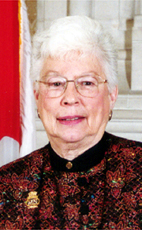
House of Commons photo

Crucial Fact

  • Her favourite word was saint.

Last in Parliament May 2004, as Progressive Conservative MP for Saint John (New Brunswick)

Won her last election, in 2000, with 51% of the vote.

Statements in the House

Supply March 17th, 2000

I do not know. I will not say what they are smoking. They will have to tell me what they are smoking. There is a real problem and we have been saying that from day one. When the government has its priorities in that order then we are in a serious situation. We truly are.

Let us look at what has happened to the military health care system. They did not put enough money into that either in the budget. I have risen in the House many times to discuss the ill effects and dangers of depleted uranium. Has the government ever done anything for them? No. It is just like hepatitis C. No, it has not.

When we are talking about transfer payments, the minister of finance for the province of New Brunswick is telling us that the amount of the transfer payments it will receive from the budget will only look after health care for three or four days. Where are the priorities of the government? We feel very strongly—

Supply March 17th, 2000

Yes, only the government's lawyers have been paid. What has happened to human society? What has happened to us? We are no longer there. I am really disappointed.

I happened to get a hold of the priority resolutions that the Liberal Party will consider at its convention today. I am sure, Madam Speaker, that you would not agree with the No. 2 priority resolution, the legalization of marijuana. Guess where the health care issue is on the list. It is not quite at the bottom but it is No. 9. Homelessness is No. 29, next to last.

The priorities of this present government have legalization of marijuana as second on the list and health care as ninth. What has happened?

Supply March 17th, 2000

Madam Speaker, when we look at the health care system we have to wonder what has happened and why so many ill people are on waiting lists today. When I had 4,000 men working at our shipyard back home, they were feeding their families and educating their children. They were happy. They added to the economy. Now I have them coming to my office, not just the men but their wives and their children as well. The stress they are under is affecting their health. They cannot work, go to college, elementary or preschool if they do not have their health.

It has to be a number one priority for the government of the day. I am really concerned about what is happening. When I look back at the cuts that have taken place since 1993, Mr. Hugh Scully, president of the Canadian Medical Association, stated that the increase did not take into account an increase in population, an older population, advances in technology or advances in knowledge.

I am disappointed that the government would make the cuts it has to health care. Back home in New Brunswick when the Liberal Party came into power and Frank McKenna was the premier, does the House know what he did to husbands and wives who were seniors? He brought in a policy that said if they had to go into a nursing home it did not matter where it was, that they had to take the first bed within 100 miles of where they lived. We had husbands in one home, 100 miles away from their families, and their wives 100 miles in another direction.

I had their children and relatives coming to me. They could not even go to visit their fathers or their uncles or their aunts. When Bernard Lord took over, the first thing he did was drop that policy. He said that the policy was inhumane and that if they had to go to a nursing home they would be together.

What has happened with our health care system is totally inhumane. I cannot believe it. My hon. colleague, our health critic, was the first person to bring before the House the hepatitis C issue. No one here mentions that, but he never gave up on it. Have they received their cheques? No. The only reason we were able to get any attention whatsoever was that the opposition side came together to fight for those people, but they still have not received a cheque.

Supply March 17th, 2000

Madam Speaker, this is a very serious issue that we have to deal with.

We have to deal with why so many people are lined up in our hospitals, waiting for operations and having a difficult time. I am so glad to see that the Minister of Industry is here today because I say if there is stress—

Supply March 17th, 2000

Madam Speaker, first and foremost I thank the hon. member from Charlotte county who brought forward the motion. It tugs at my heart to look today at the empty seats on both sides of the House.

St. Patrick's Day March 17th, 2000

Mr. Speaker, this is St. Paddy's Day and it is a very special day. I come from the most Irish city there is in Canada. That is why I am wearing the green.

House Of Commons March 16th, 2000

Mr. Speaker, first and foremost I want our friends from the Bloc to understand that we want our people from Quebec to be part of Canada. We know it is a very emotional situation, we really do, but I want to say that we in our party have great respect for you, Mr. Speaker. I cannot believe that anyone would put on the floor of the House a non-confidence motion in you, Mr. Speaker, in any of our clerks or in any of our people. I cannot believe it.

I understand that this is an emotional situation. I understand that there is a long debate, there has been and will continue to be I am sure in the future. But we want you to know, Mr. Speaker, that we do have respect.

I know from personal experience having been here with only two of us in our party, Jean Charest and myself, that had it not been for you, Mr. Speaker, I would probably never have stayed. But you encouraged me to be here because my people elected me and you treated me fairly. I find that you treat us all with respect. That is what it is all about. Yes, if there has been a mistake and if we do not agree perhaps with every decision you make, that is life. You do not agree with all the questions that we ask and I can understand that.

Certainly that is what this is all about. That is the democratic process and our colleagues have to understand that.

I ask my colleagues to withdraw the non-confidence motion. That motion is not the right thing to do. I ask that they consider that immediately. Yes, we want them to be able to debate. Maybe they should have had the 1,000 amendments and have been able to debate them, but I cannot agree with putting forward a non-confidence vote on our Speaker. I will not agree with it and neither will my colleagues. I ask that they withdraw the motion.

Lobbyists Registration Act March 16th, 2000

Mr. Speaker, violating the Lobbyists Registration Act is very serious and a conviction results in fines of up to $100,000 or two years in prison.

According to the minister, they have been in touch with the RCMP. What I would like to know is has the minister informed the RCMP that René Fugère lobbied for two hotels in the Prime Minister's riding? Did he tell the RCMP that he lobbied for HRDC for funds for a sawmill in the riding of Champlain?

What we would like to know is what information does the RCMP have and when can we expect an answer back?

Lobbyists Registration Act March 16th, 2000

Mr. Speaker, my question is for the Minister of Industry. The Lobbyists Registration Act, which is enforceable by the RCMP, demands that all lobbyists register with the registrar. Yet the Prime Minister's friend, Mr. René Fugère, carries on his activity lobbying different departments and never bothers to register.

The Prime Minister told the House that when he realized there was something wrong at CITEC he picked up the phone and called the RCMP, and rightfully so. Why has the Prime Minister or the Minister of Industry not picked up the phone and called the RCMP on René Fugère?

Government Response To Petitions March 16th, 2000

Mr. Speaker, I concur with the hon. member from the NDP and with the hon. members from the Bloc.

We are supposed to be in a democratic society. We come here and the people expect that it will be democratic within the House of Commons. If there is a non-confidence vote then it is imperative that it be debated and debated by both sides of the House. All of us, every person who is here, should have a say in that.

This is a very serious situation. If we were not allowed to do that, if we were not allowed to debate it, then the people of Canada would probably say—maybe we want to do this; who knows—that they are taking all the Liberals out in the next election if we do not have an opportunity here to show that their voices have been heard. That is for sure.