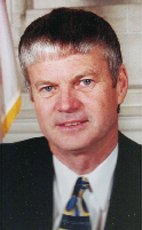
House of Commons photo

Crucial Fact

  • His favourite word was industry.

Last in Parliament May 2004, as Liberal MP for Prince Edward—Hastings (Ontario)

Won his last election, in 2000, with 50% of the vote.

Statements in the House

Petitions May 8th, 1996

Mr. Speaker, the second petition requests that Parliament recognize our Judaeo-Christian heritage and calls for the return to the holy Bible as our nation's moral standard.

The petitioners call for a return to Bible reading and prayer in our schools and to reinstate the name Jesus Christ in the Lord's prayer in the parliamentary daily opening prayer, and in recognition of the spiritual need of this nation to declare a national day of prayer and repentance.

Petitions May 8th, 1996

Mr. Speaker, I have two petitions.

The first petition requests Parliament not to amend the human rights code, the human rights act or the charter of rights and freedoms in any way which would tend to indicate societal approval of same sex relations or of homosexuality, including amending the human rights code to include in the prohibited grounds of discrimination the undefined phrase of sexual orientation.

Department Of Health Act April 22nd, 1996

Mr. Speaker, the hon. member and some of his colleagues should realize and admit that as a country, whether on health issues or any other, we will continue to be strong by working together.

If the hon. member is saying federal dollars for health should be handed over to each province and each province should do its own willy-nilly thing as far as health care is concerned, I am sorry, but he is speaking to the wrong government. He is speaking to Canadians who do not want to hear what he is saying.

Canadians have made it very clear to all of us that they recognize we do not have as many dollars as we once thought we had. We have to be doing more with less or at least as much with less in the future.

Only by sitting down and talking in forums such as the national health care forum with representatives of the federal government, the health care industry, the health delivery service and people in the provinces can we put our heads and available funding together, federally and topped up if necessary from the individual provinces, to provide what all Canadians have made it clear they want and having it made available to them in every corner of the country.

Department Of Health Act April 22nd, 1996

Mr. Speaker, it is certainly not something to win votes. The hon. member needs to recognize it is a Canada health act. The role of the federal government is to ensure all Canadians are treated the same way, that all Canadians have access to the same treatment as anyone else.

If the provinces in some cases wish to duplicate or add to those services as far as informational services are concerned, that is certainly up to them to do so. I would question whether that is necessary all the time.

If we look at the intelligence, the information the federal government makes available to Canadians, the government certainly feels it has an important duty to inform Canadians. No matter what the issue, all Canadians want to know from the same source if possible what the health and safety standards are in Canada, what the medicare standards are, what they can receive for medicare if they move from one province to another province. That is the role.

We have shown very clearly over the years this is the wish of Canadians. We in the government are determined to maintain that for all Canadians so they know its full value.

Department Of Health Act April 22nd, 1996

Mr. Speaker, I am pleased and proud to address the House today in support of Bill C-18, an act respecting the Department of Health.

We have all heard allegations that the federal government has no role in health. Some contend that the government should leave health issues to the provinces and territories which actually deliver the services to Canadians. The government fully appreciates the provinces have constitutional authority for health care.

The provinces are responsible for health care delivery which generally encompasses hospital and medical services. The provinces plan, manage and operate Canada's health care system. These systems operate however under the framework of Canada's national health insurance system which we all know as medicare. This national system ensures that all Canadians, regardless of ability to pay, have access to well trained doctors and well equipped hospitals.

I do not wish to lend credence to the myth that the federal role in health is limited to its financial and other support of Canada's medicare system. At the same time we have every reason to be proud of the system and of this government's support for medicare.

Canadians justifiably take great pride in our national medicare system and the quality of medical services available to all of us. They know that regardless of where they live, what language they speak or what their employment status may be, they are all assured of access to high quality medical and physician services whenever they are needed.

Medicare also has economic benefits that accrue to Canadian businesses. Business supports medicare because it provides it with competitive advantages in the global market. Canadian businesses do not pay the costs of providing private health care insurance for necessary hospital and medical services.

Even after taking Canada's taxes into consideration, the cost of providing employee benefits is significantly lower in Canada than in the United States. This is certainly one of the factors that helps to attract multinational corporations to Canada.

The national character of the system also enhances labour force mobility. Workers do not need to fear health insurance coverage for themselves or their families because they change jobs or move to another province in search of employment. Canadians retain their coverage even if we move and become unemployed.

By guaranteeing Canadians access to quality health care, medicare helps to ensure a healthy and productive labour force. I believe our health care system has also helped to foster a sense of unity among Canadians. Canadian society is multicultural and diverse, as we all know. At the same time, it is strongly tied to North American culture.

It is sometimes difficult for Canadians to define ourselves apart from our neighbours to the south, but health care is certainly an exception. Our universal health care system is closely tied to our Canadian identity. It is valued as an outward manifestation of fundamental shared values, justice, caring, compassion and equity. Not only is there more to health than health care, there is also more to the federal role in health than upholding the principles of the Canada Health Act.

There are only about 25 employees who administer the Canada Health Act. The department's other employees support uniquely federal roles and responsibilities, work which is not carried out by the provinces and in which the federal government has a clear jurisdiction.

I will briefly outline for the benefit of everyone the vital work of this department. The department's work is clearly focused on four business lines. The first of these involves supporting and renewing the health system. Health Canada works here to maintain universal access to appropriate health care while helping to ease financial pressures on the public and private sectors.

In support of these goals, the department administers the Canada Health Act and makes transfer payments to support provincial health insurance systems. It also promotes collaboration and consensus on options for involving the effectiveness and efficiency of Canada's health system.

A good example is where the department works closely with the provinces and territories to evaluate the quality and effectiveness

of how health services are managed and delivered across Canada. This information is shared by all jurisdictions and helps shape the renewal of our health care system.

The federal government has statutory responsibilities to protect the health of Canadians. The Department of Health carries out this responsibility by monitoring and assessing risks to health from emerging infectious diseases and other public health threats. All the provinces and public health agencies in Canada rely on the department's public health intelligence.

The second line is risk management. The department manages national disease control strategies and ensures the quality and safety of foods, drugs and medical services for all Canadians. It also regulates human and veterinary drugs, oversees the safety of biologics and cosmetics and ensures the safety and nutritional quality of Canada's food supply.

I cannot emphasize strongly enough the vital federal presence in this area and how important it is to the health of all Canadians. Canada currently has no capacity to identify and analyse potentially lethal infectious diseases such as the Ebola virus. However, the Department of Health is now constructing a level four laboratory in Winnipeg which will do just that. When it opens, this facility will employ 100 scientists. Their work will further enhance the health and safety of Canadians from coast to coast.

The department's third business line involves collaborating with partners on strategies related to the health of the population. These strategies include health promotion, illness prevention and public education elements. They mobilize efforts to address national issues such as cancer, family violence, AIDS and prenatal nutrition. These strategies address the factors that lead to ill health. They provide much needed support to vulnerable groups at risk including children, single parents, poor families and seniors. They help prevent and combat heart disease, breast cancer and many other illnesses.

These strategies complement but do not duplicate the work done by Canada's many national volunteer health organizations. We owe the many volunteers a big debt of thanks for the work they do on behalf of the health of all of us. We are recognizing volunteer week in Canada and the number of people in all our communities who work so hard for the benefit of all of us.

At the same time, these health prevention and illness prevention strategies of the Department of Health reduce demands on Canada's health care system, thus contributing to reduced health care costs.

Prenatal care is a good example. The cost of neonatal care for a low birth weight baby is about $60,000. The health promotion and prevention activities aimed at ensuring a healthy birth weight on average costs about $400 per child.

The Department of Health's fourth business line involves providing health services to First Nations and other groups such as Canada's military personnel. It is not generally well known that Health Canada provides community health services to status Indians on reserves and to residents of Yukon through 600 health facilities across Canada. It also ensures that registered Indians and eligible Inuit receive a range of medically necessary goods and services not available from the provinces.

Apart from transfer payments to provinces, two-thirds of Health Canada's budget is devoted to the health of natives and native health issues. This is the only area in which Health Canada is directly involved in the health care delivery system.

The department is responsible for assessing and sharing the health of special groups such as civilian aviation personnel. It ensures the safety of the Canadian public in cases of national civilian disasters.

Together these four business lines include a range of activities designed to maintain and improve the health, safety and well-being of Canadians. Without a strong federal role in health we would have no national standards or processes to ensure the safety of Canada's food supply, its medical devices and drugs. There would be no national public intelligence to protect us from the emerging infectious diseases which are becoming increasingly common and increasingly complex.

The Department of Health is certainly vital to the fabric and daily life of the nation. It helps ensure the safety and well-being of Canadians from coast to coast and makes important contributions to the nation's productivity, competitiveness and prosperity.

I am proud to go on record in supporting this bill.

Mark Fyke March 18th, 1996

Mr. Speaker, I also rise today to extend my sincere condolences to the family and friends of Mr. Mark Fyke, an 18-year-old constituent of mine from the city of Belleville who was murdered while on March break in Florida.

The loss of this energetic, bright and respected young man is a brutal and senseless tragedy that has shaken our community and indeed the nation.

I cannot express clearly enough our hope that the murder of this young man will at the very least result in a greater awareness in the state of Florida of the need to act to stem the tide of violent crime that has swept over this tourist region and taken so many innocent lives. This death need not have occurred and it is more than reason enough to ensure that measures are taken to prevent other meaningless murders in the future.

On behalf of the members of the House of Commons and all Canadians I extend our sympathy to Mark's family. I know we all share his family's shock and grief and we will remember them in our prayers.

Petitions March 11th, 1996

Mr. Speaker, the other group of petitioners humbly pray and call upon Parliament to ensure that the CRTC recognize that Canadians do not need to be shocked to be entertained. Foul language, excessive violence and explicit sex are not necessary to provide quality entertainment.

Petitions March 11th, 1996

Mr. Speaker, I have two petitions. In the first petition the petitioners pray and request that Parliament recognize their Judeo-Christian heritage and call for a return to the Holy Bible as the nation's moral standard. They call for the return of Bible reading and prayer in our public schools, the reinstatement of the name of Jesus Christ and the Lord's Prayer in the parliamentary daily opening prayer, and in recognition of the spiritual need of this nation, to declare a national day of prayer and repentance.

Food And Drugs Act December 7th, 1995

Mr. Speaker, a working group of senior executive officers and farmer representatives in the western grains industry has arrived at a basic consensus about what should be done with respect to government owned hopper cars, car allocation procedures and the role of the Canadian Wheat Board in transportation.

The report will be discussed at various farm organization meetings over the winter. Until farmers have had an opportunity to understand and comment on the recommendations, it would be premature to make a full or final decision with respect to the government's response to the report.

The consensus achieved by this group is certainly remarkable in itself. Only a few years ago many people would have thought it would be impossible for such a consensus to be reached by such a divergent group. It is a package involving a balance of tough but creative compromises and it has to be looked at as a whole, as a package.

The government will respond to this report in early 1996 and is proud of its record of consultation with stakeholders. This is the way we operate and this issue will be treated the same as all the others.

Recognition Of Quebec As A Distinct Society December 6th, 1995

Mr. Speaker, I am pleased to have the opportunity to put on the record some of the comments I have received from constituents. They have watched and participated with all of us, or most of us, as a number of members and parties in the House did not participate in the process, in order to reach out to the province of Quebec with most Canadians to set the country back on a path of a unified purpose and commitment to the dream which has made this country the envy of the world.

I would like to publicly thank those from the Prince Edward-Hastings riding who took that long bus trip to Montreal on October 27 to extend their hand and to once again tell Quebecers their Canada included Quebec. It certainly was a contribution I know was well meant and very useful. I thank them for that extra effort as well as the individuals and businesses in the riding that helped to make that possible during that day and during that critical time in the future of our country.

The resolution we are debating is certainly an honest and thoughtful fulfilment of an important commitment the Prime Minister made to the people of Quebec during the referendum debate. We are fortunate as Canadians to have a Prime Minister who displays and portrays very clearly integrity and sincerity in his actions. When he makes a promise to Canadians he fulfils that promise.

The package of unity measures announced and put forward to the House and to Canadians in every province has three parts, as we well know: to recognize within Canada that Quebec is a distinct society; not to proceed with any constitutional change that affects Quebec without Quebecers' consent; and to undertake changes to bring services and the decision making process closer to citizens, initially in the field of labour market training.

This kind of leadership, to put this type of thing before Canadians and before the House, is what is needed today in order to heal the wounds, and the recent wounds, that need to be healed in order to move forward together as Canadians. This motion along with the bill concerning the veto and other actions of the House concerning workforce training measures provide a confident display of national reconciliation.

The motion that addresses the legitimate concerns of the citizens of Quebec in terms of our acknowledgement of the distinctive characteristics of Quebec as a society is only a recognition of the reality there today.

If we analyze the motion by looking at the second part it says very clearly that Quebec includes a French speaking majority. That

is a reality. It says Quebec has a unique culture. That is a reality. It says Quebec is governed by the civil law tradition. That is a reality.

This motion does not give any special status to the people in Quebec. It recognizes one of the things we all say everyday, that our country is made up of many diverse cultures. However, we have six million French speaking people of a unique culture, different from many of the rest of us, in Quebec.

The motion provides them the assurance that the federal government will be guided by the recognition of that distinctness and carries the Prime Minister's personal commitment that he and the government will gladly incorporate into the Constitution, when all the provinces are prepared along with Quebec, appropriate resolutions to do so.

No matter what area we are dealing with, our own riding or an organization we belong to or in the House, we know there are differences. We know there are people who think differently. The important thing, whether in our own families or whether in the larger family of a constituency, a province, a municipality or in the House, is that we recognize and appreciate each other's differences.

We may not always agree but the only way we are to get ahead in a family of any kind, whether it is a family of the House or a family that we call Canada, is to go forward together. We are stronger as we work together to achieve that end. It is a disappointment to most Canadians when we see one political party in the House saying it wants a Quebec without Canada and another political party making it very clear it would be very happy, certainly not upset, if we had a Canada without Quebec.

The concerns that this motion conveys special powers to the province of Quebec or that this motion is an acknowledgement of the Constitution's inability to be flexible enough to accommodate such changes are simply unwarranted.

While this motion has no legal effect, it definitely expresses an important commitment by the elected body that speaks for all Canadians, this body that we are all part of here this evening, and it recognizes an obvious reality without giving the people of Quebec any powers that Canadians elsewhere do not possess.

That is not the intention of this motion. The intention of this motion and the intention and the challenge of the House is to treat all Canadians equally. We also have to recognize Canadians are not all the same when it comes to language, culture and, in the case of Quebec, the law and the civil law code they are governed by.

The Constitution is more than capable of accepting this change, as is the government. The willingness of the Quebec government to make that possible would be a significant help in giving greater weight to this important measure.

I am disappointed that the official opposition and the third party are opposed to this motion, opposed and fail to recognize the diversity of what makes up this wonderful country we are all part of.

The negative contributions to the debate during the referendum by some members of the House, some parties in the House, nearly cost us the country. We cannot stand by and allow that to happen again. It is illogical, narrow minded and not of the national character we have here Canada.

Canada must reassert our strength of purpose and unite our people. This is a commitment the government is prepared to make, and is making. It is the potential of this motion and it will be the legacy of the government and the Prime Minister.

We are a country incredibly rich in culture, resources, beauty, geography and opportunity. I encourage all members of the House to do what we can, individually and together, to make our country even stronger in the future than it is at the present time. I urge all members of the House to support this motion.