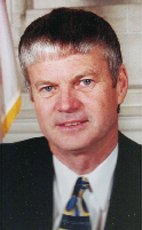
House of Commons photo

Crucial Fact

  • His favourite word was industry.

Last in Parliament May 2004, as Liberal MP for Prince Edward—Hastings (Ontario)

Won his last election, in 2000, with 50% of the vote.

Statements in the House

Canadian Wheat Board December 6th, 1995

Mr. Speaker, I would remind the hon. member that before he makes a statement on what the Prime Minister said, he should have his facts straight. I do not recall the hon. member being present when the Prime Minister made that statement. I was.

The Prime Minister at that time said the minister is following through on that. The minister has put in place a process called the western grain marketing panel to consult with members, participants, and all stakeholders in the western grain industry before the consideration of any changes, if there were ever to be changes, to the western grain marketing system.

Canadian Wheat Board December 6th, 1995

Mr. Speaker, I would remind the members opposite in the industry to keep the results of the plebiscite that was announced today in perspective.

As far as the results, that plebiscite gives us the opinions of a number of producers on an issue in one province. It is a wide-ranging issue that affects all of western Canada. The number of producers who expressed their view are just a little over 10 per cent of all the grain producers with permit books in western Canada.

Balkans December 4th, 1995

We want the same.

Trade November 27th, 1995

Mr. Speaker, the hon. member knows very well that a number of trade discussions are going on with the United States on a number of fronts. The challenge through the NAFTA panel process on supply management is only one of them.

We have said very clearly that we will continue to handle each concern which the United States has with us and which we have with it one at a time. We have also said very clearly that we will defend Canada's supply management system very fervently. We are confident the process will work in our favour.

Petitions November 2nd, 1995

Madam Speaker, I would like to table a petition from 33 Canadians in the Prince Edward-Hastings area calling on Parliament to take steps to keep the bovine growth hormone out of Canada by legislating a moratorium on the use and sale of the bovine growth hormone until the year 2000 and examining the outstanding health and economic questions through an independent and transparent review.

Quebec Referendum October 20th, 1995

Mr. Speaker, I received a letter the other day from the Prince Edward county council. Part of it reads:

Council was in unanimous agreement that I should forward a letter to you as our representative of the Government of Canada advising that Prince Edward county urges the residents of Quebec to remain a part of a strong and independent country.

Although ours is but a small voice in what has become a national debate, the people of Prince Edward have always had a strong sentiment for home and country, a country which includes Quebec.

This letter was signed by Laverne Bailey, warden of the county of Prince Edward.

Employment Equity Act October 16th, 1995

Mr. Speaker, the federal budget of last February did contain certain proposals on the payment to compensate for the ending of the Western Grain Transportation Act.

At the time of the budget, the government made very clear its intentions to consult extensively with farm leaders on these proposals so that the program would be as fair and as workable as possible.

In the budget we proposed that land which would be eligible for the $1.6 billion ex gratia payment was that land producing WGTA eligible crops and summer fallow. These provide reasonable approximation of the land base which benefit from the WGTA subsidy. This proposal was taken to farm leaders for discussion.

Through these consultations, farm leaders accepted the government's proposal on eligible acres and agreed that forage not be included. Adding forage crops to the payment base would have significantly diluted the payment.

In the case of who should receive the payment, again we took the government's proposal to pay landlords to farm leaders for discussion. Through consultations farm leaders told us they agreed with the proposal but felt those who rent farmland should also be somehow recognized in the program.

Based on this advice, the application procedures have been designed to ensure that owners and renters reach an agreement on how part of the benefit may be passed on to renters. It is expected that in many instances this will occur through lower farmland rental rates.

Through extensive meetings with farm leaders, the government was able to reach acceptance of the proposals on eligible acres. It was able to address the concerns of farm groups by adding a provision for renters in the application procedures for the program.

Employment Equity Act October 16th, 1995

Mr. Speaker, the federal government is strongly committed to ensuring effective protection of Canada's endangered species, which is part of our rich biological heritage.

Although certain aspects of the proposed legislation directly affect only a little more than 5 per cent of Canada's land base, it would also apply to federally managed species everywhere and federally managed marine areas.

The proposed legislation would establish a national listing process that would give legal recognition to all species in Canada at some risk of extinction regardless of where they occur. It is intended to form the federal component of a comprehensive national safety net for the country's most vulnerable species, a safety net in which the federal government does its part in co-operation with the provinces and the territories to ensure that species like the polar bear will continue to grace not only our coins but also our vast northern landscape.

With the co-operation of federal, provincial and territorial governments the proposed legislation would provide a strong national approach for the conservation of endangered species. This action will not intrude in provincial responsibilities. The federal government recognizes the common but differentiated responsibilities of the federal, provincial and territorial governments with respect to endangered species.

The proposed legislation is intended to complement, not contradict, provincial and territorial actions. The federal government is prepared to do its part and encourages the provincial and territorial governments to do theirs to ensure a truly national approach for endangered species conservation. We are confident of their support.

Canadians have a moral responsibility to ensure that future generations enjoy and benefit from the presence of diverse wildlife species. The federal, provincial and territorial governments must provide the required leadership and legislative tools.

Canadian Wheat Board October 6th, 1995

Mr. Speaker, I remind the hon. member that farmers will be consulted. I also remind the hon. member of the disappointment of all of us when the third party in Parliament recommends to farmers to break Canadian law and supports them in this.

We will follow the tradition of our party and consult. However, with regard to the wheat board, the Reform Party thinks it knows best and is requesting and supporting farmers to go against the rules and laws of the land with reference to the wheat board.

Canadian Wheat Board October 6th, 1995

Mr. Speaker, the minister of agriculture has made it very clear for a number of months that farmers will be involved in the future of the Canadian Wheat Board in Canada.

To emphasize that, he has recently put in place a very expert panel to go right across western Canada to talk to farmers, chat with farmers, and consult with farmers in all of the industry about their views on the future of the Canadian Wheat Board.

We will continue to deal with everyone and consult with everyone in the industry in order to talk about and deal with the future of that great wheat board.