
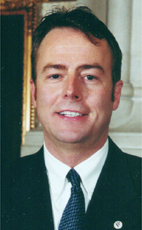
House of Commons photo

Crucial Fact

  • His favourite word was quebec.

Last in Parliament May 2004, as Bloc MP for Berthier—Montcalm (Québec)

Won his last election, in 2000, with 57% of the vote.

Statements in the House

Income Tax Conventions Implementation Act, 1997 November 28th, 1997

I do not understand why the Liberals are not applauding me this morning, when what I am saying is a self-evident truth.

I think it is normal for the opposition parties, including the Bloc Quebecois, which are seeking the greatest equity for the people of Quebec and Canada, to try to get legislation that is as free of flaws as possible. We want to remedy those flaws. These two examples, I think, are striking. What is involved here is not to have huge quantities of international tax conventions. We just want to have quality tax conventions so that there can be proper follow-up and everyone can pay his or her fair share of tax.

Earlier, the government member, the hon. member for Broadview—Greenwood, was criticizing Reform members. He was accusing them of giving up on tax reform.

I understand why he did not say this about the Bloc Quebecois, because we have been talking about tax reform for a long time for both corporations and individuals.

If we look more specifically at this morning's topic, international tax conventions, I can refer you to two proposals made by us in the fall of 1996 focusing on corporate taxation.

This could have been included in international treaties as part of a mini-tax reform. It did not have to be a major reform, but they could at least have shown some degree of good faith in ensuring that it is not always the same ones who have to pay. I believe that a certain equity must be sought, and I can understand the taxpayers who are sitting in their living rooms and watching the government members over there. They are saying that the same ones always end up paying, and I understand that.

The government has thus missed a great opportunity to show its good faith with this bill. One of the proposals made by the Bloc Quebecois in the fall of 1996 is the deductibility of interest charges. When a Canadian company has a branch in a tax haven, not only does it first of all take advantage of very low tax rates on profits earned outside the country, but it can also deduct from its income earned in Canada the interest on loans used to invest in that offshore branch. We think the tax system is too generous in this case.

We would also have liked the government to amend the Income Tax Act to put a stop to this abuse. I think everyone has got the point, but so people understand better, I will give you a specific example. I have a company in Barbados; I borrow money in Canada to invest in Barbados to increase my profits in Barbados; I pay practically no taxes in Barbados, but, moreover, I deduct my interest costs in Canada. This is a bit crazy. I think the government could help people by putting a stop to these tax shelters.

The other proposal—and I will be brief, because time is passing quickly—concerns the deduction for intercorporate dividends. When a Canadian company has a subsidiary in a country Canada has a convention with, the dividends paid by the subsidiary to the parent company are not taxed in Canada. There are certain conditions, but they are easily met. This Canadian rule is much more generous than what is done in the States.

We asked the federal government to amend the Income Tax Act in order to tax foreign subsidiaries in Canada and to give a credit to them for tax already paid. That did not come about, but you know how determined the Bloc is. When we have an idea we do not let go of it, especially when it is a good idea like Quebec sovereignty and income tax issues. We will continue, we will keep at the government and perhaps soon, the government will concede as it did with Bill C-10 on the tax convention between Canada and the United States.

I repeat, and I conclude on this point, this was a real battle horse for the Bloc. We won. We were there for our constituents and we will be there again, every day, until Quebec becomes a country.

Income Tax Conventions Implementation Act, 1997 November 28th, 1997

You are all here. Fine, they are all here listening carefully to what I am saying. They should listen more carefully, this way they would speak less nonsense than they have in the past little while.

That having been said, more seriously, the government confused the issue somewhat by putting together a bill containing a series of tax treaties between Canada and various countries which we cannot all treat equally because of their respective tax systems. Around the world, there are countries with tax systems very similar to that of Canada and countries with completely different tax systems.

We would have liked—this is admittedly a criticism I am making this morning, but a constructive and very positive one—Bill C-10 to deal exclusively with the American issue, a second bill to deal with other countries with a tax system similar to ours and a third one to deal with countries with a tax system completely different from ours.

It seems to me that this would have been less confusing and, particularly given the urgent, pressing need of many Quebeckers and Canadians and the fact that the United States are withholding money, I think that a tax convention, a bill dealing specifically with the U.S. would have helped expedite matters. These people who have been waiting for a cheque from the U.S. would have received it by now if we had worked diligently on preparing separate bills to expedite the process.

But the Liberals crammed everything into a single bill. For example, the purpose of parts 1 to 5 is to implement income tax conventions that have been signed with Sweden, Lithuania, Kazakhstan, Iceland and Denmark. These are countries with taxation systems that are, by and large, quite similar to Canada's.

The purpose of these conventions is to avoid double taxation and prevent fiscal evasion. They are based largely on the OECD model. It is not a case of reinventing the wheel. What is good is retained and used in the conventions with these countries.

There are also other countries with taxation systems less similar to ours, however, and a convention has also been produced to help in these cases. There is a tax convention signed with these countries. But many of them are considered to be countries where the rich hide their money, so-called tax havens. It is somewhat disappointing that they have all been lumped into one bill, Bill C-10.

Let us compare Canada's taxation system with the taxation systems of these countries. As I said earlier, a comparison of the maximum corporate and individual income tax rates reveals some differences and some similarities. For instance, the maximum corporate rate in Canada is 30.74% and the maximum individual rate is 52.94%.

In Sweden these percentages are similar. But in Lithuania, while the maximum corporate tax rate is 29% instead of 30.74%, not a major difference, the individual tax rate is 35% compared with Canada's 53%. You can immediately see the clear advantage for businessmen with a bit of money to pay their taxes in Lithuania rather than in Canada.

There are rather significant differences at various levels. One thing which is not really a concern, but which must be addressed is the fact that, over the years, Canada has signed many treaties with other countries. The figures I am quoting were given at a meeting of the Standing Senate Committee on Banking, Trade and Commerce, held on April 24, 1997. As of April 24, Canada had signed 57 tax treaties that were in effect between Canada and various countries, while 34 other ones had yet to be ratified.

As a member of the opposition, one wonders—again, this is not a negative criticism, on the contrary—whether the government allocated adequate resources to ensure a follow-up on all these conventions.

The tax treaties signed between countries are usually not for the benefit of ordinary citizens. Ordinary people do not have bank accounts in Switzerland or in Barbados, and they do not do business with Lithuania, Denmark, the Netherlands or the United States. Usually, the provisions of these treaties are used by multinationals, or by very wealthy people who have accounts here and there, such as in Switzerland or Barbados, and who travel frequently.

As an opposition party, we are the keepers of this government's sometimes deficient moral rectitude, and we have the right to wonder whether there are sufficient resources. With 57 treaties already signed and 34 other ones to be ratified—and more have probably been signed since April 1997—we wonder how many public servants are following up on all these conventions.

Mr. Speaker, I hope you are firmly seated in the Chair, because the committee learned that only one public servant was conducting this follow-up work. Thankfully, this person is working full time, which is something, given the cuts made by the government. We know there is an official monitoring this full time.

It is not being critical in a negative way to say that more than one official would have been better, considering what has gone on in the past and how people have been tricked in Canada and in Quebec. I think taxpayers, Quebeckers and Canadians, have been had in the past, including at roughly this time last year.

Of course, I am referring to the scandal of the family trusts. Everyone knows that it is rather frightening when officials, just before Christmas, can have a little meeting and decide to allow companies to send money outside Canada without paying any taxes. We are not talking here about $100, $1,000 or $100,000, we are talking about billions of dollars. I think that taxpayers, in these difficult times, could legitimately expect that there would be fair treatment for these companies but that they would be treated fairly too.

People who have means, who have two billion dollars in liquid assets and who want to transfer this money can afford to pay for very good legal advice, for good lawyers, but also for good tax experts. I am not saying that what they did was illegal, but it was certainly immoral, I want to state that very clearly, especially since everyone in Canada and in Quebec has to pay taxes, their fair share of taxes. I do not think it was proper for them to transfer this money without paying their fair share.

There are also other examples, when tax treaties are applied, when companies can afford good advisers, we see that certain people, certain companies can sidestep the law and avoid paying their fair share of taxes.

Briefly, I will give you a small example everyone knows about, Canada Steamship Lines. Everyone knows what that company is. Everyone knows that it is a Canadian company, but that its ships fly the flags of other countries, including Barbados and various countries. But why is that? It is to avoid paying their fair share of the taxes that they should be paying in Canada. This is not normal, especially considering who owns these ships. It is not normal that in Canada people should do such things.

Is the Bloc's criticism negative? No, this is positive criticism. We want as much as possible—

Income Tax Conventions Implementation Act, 1997 November 28th, 1997

Very good, thank you.

I am pleased to rise in the House today, particularly after the speech by the representative of the government, the hon. member for Broadview—Greenwood. I trust he was not generalizing, when he said that all the opposition did was criticize. I believe I am very well placed to point out that this was a half-truth.

I trust that he was not generalizing and was referring specifically to one, or all, Reform members. Since the beginning of this Parliament, looking back to when the government has presented bills, it has on a number of occasions had the complete co-operation of the Bloc Quebecois because not only were the rights and obligations of Canadians being advanced, but Quebeckers were also demanding to be properly represented and defended. That the Bloc has done. We have done it since June 2, and even before that, since the 35th Parliament.

In justice, I have personally given 100% co-operation to the new Minister of Justice and I have always offered constructive debate to move legislation forward, to advance the law.

I hope that the member was referring only to a member of the Reform Party or to the Reform Party as a whole and not to the Bloc.

That said, Bill C-10 is another example of the Bloc's leading the way in asking the Liberal government to act in this area, given its importance for a number of Quebeckers and Canadians. This is another area where Canadian and Quebec interests merge, and this bill is a striking example.

What is this bill about and what does it contain? It implements a series of tax conventions between Canada and other countries in order to avoid double taxation. Furthermore, Bill C-10 amends the 1984 tax convention between Canada and the United States, resolving the problems of Quebec and Canadian retirees receiving American pensions.

I am going to talk on behalf of the Bloc Quebecois and Quebeckers because I am in a good position to do so. A number of Quebecers worked in the U.S. and decided, on their retirement, to return to their homeland, the beautiful country of Quebec. They returned to Quebec and received American pensions. Because they had problems with taxation, these people were taxed in the United States and what little they had left from their pension was then taxed in Canada so they were doubly penalized and doubly taxed. Something had to be done.

My riding of Berthier—Montcalm is not near the American border, like other ridings along the Canadian border and the border between Quebec and the States. Despite that, there is a municipality in my riding called Rawdon where there are a number of anglophones who have worked in the States. For a while in the 35th Parliament, a number of my constituents in Berthier—Montcalm contacted me to draw my attention to this tax inequity.

Other members of the Bloc were also contacted. We thus became aware of the problem and rose on a number of occasions in this House with questions and worked in committee to oblige the government to act quickly. It did not act as quickly as we wanted, but it did act. A sin confessed is half forgiven. At least the government acted and introduced a bill. You know how the Liberals across the way are. With them, nothing is ever simple. You know how the many Liberals listening to my remarks today are. They had to cloud the issue.

Income Tax Conventions Implementation Act, 1997 November 28th, 1997

Mr. Speaker, I am not sure I understood right. Do I have ten, or twenty, minutes for my speech?

Canadians November 26th, 1997

Mr. Speaker, the member for Bourassa should know that this was not a point of order and that the only example of what I mentioned earlier is the Reform opposition day when they and the Liberals voted hand-in-hand to blame the government of Quebec, among others, for not having held consultations on the drivel called the Calgary declaration. If the member for Bourassa did not understand that yesterday, I am telling it to him now—he is in front of me—and I hope that now he will understand.

That having been said, I read the motion carefully and I must tell you—and here I agree with the parliamentary secretary when she says that this motion is in bad taste and ill-considered—that no matter how hard I try to read it from left to right and from right to left, I have difficulty understanding it. I would like to read it for those who are listening:

That a legislative committee of this House be instructed to prepare and bring in a bill in accordance with Standing Order 68(4) b ), to prevent the reference to and designation of any Canadian or group of Canadians in a hyphenated form, based on race, religion, colour or place of origin.

I read it several times, and I wonder what exactly he wants us to bring in a bill on? Will it be in the regulations made by this House or in the regulations made by a department? Will it be in the legislation, in the bills, in the acts? Is its purpose to make a law on private conversations between individuals and to prevent people from mentioning Canadians of Irish, Portuguese or Haitian origin, or even Quebeckers? Is its purpose to make laws on that? I do not know. Is it to forbid members in this House to use this language during debates. I do not know, the motion does not mention that.

There is one thing certain however. I agree with the parliamentary secretary. Earlier, I started by making a joke, but I agree with what has just been said on the government side. I would like to add that there is in Quebec a Charter on Rights and Freedoms. In Canada, there is the Canadian Charter on Rights and Freedoms, the Constitution Act, 1982. Quebec has never ratified it. No premier has signed it, as the member for Bourassa would mention, I am sure. But there is section 15.(1) which states:

Every individual is equal before and under the law and has the right to the equal protection and equal benefit of the law without discrimination and, in particular, without discrimination based on race, national or ethnic origin, colour, religion, sex, age or mental or physical disability.

The Quebec Charter of Rights and Freedoms has an equivalent of this section. I believe that as far as protecting individuals is concerned, in Canada and in Quebec, we have the appropriate tools. I believe that we are even ahead of many countries when it comes to individual rights. I sincerely believe that this is a debate that we should not be having.

I think this is a pointless debate under the circumstances, given that there are already provisions that deal very efficiently with this issue. You will have gathered from what I said that I am opposed to this motion.

I will conclude with two comments. First, with his motion, the hon. member of the Reform Party managed to suggest that the concept of Canadian culture should be redefined. I think that he does not understand his motion all that well either, because that was not exactly his intention.

Second, on the government side, in interpreting the motion, they managed to say that they were in favour of a strong and united Canada. Again, both sides are showing great imagination. But they are not really addressing Motion M-24 before us.

For all these reasons, you will understand that I cannot be in favour of Motion M-24.

Canadians November 26th, 1997

Mr. Speaker, I listened as carefully to the Reform Party member who introduced the motion as I did to the government party member.

To a certain extent, if sovereignists had resorted to the same discourse, I am absolutely certain that it would have been interpreted as racist, but when it comes from the two federalist parties, who are very often on the same wavelength and who join forces in running down Quebec, everything is just fine.

Criminal Code November 25th, 1997

Mr. Speaker, while I do not agree with the hon. member's bill, I first want to congratulate him for trying to find a solution to a problem in his riding and in his province.

This being said, I do not think the amendment proposed in Bill C-206 will achieve its purpose. Prostitution is indeed a very serious problem, but amending the section to provide for a longer prison term will not achieve the goal sought by the hon. member.

It is true that prostitution brings along various negative things on a street, in a municipality and in a province. Associated with this type of illicit trade are all sorts of illegal activities, such as drug trafficking, various types of offences, theft, violence, etc.

I am convinced that providing for stiffer penalties will not solve the problem. This was tried before by our predecessors. The hon. member is right when he says he is proposing a technical amendment. He is not proposing anything innovative.

Section 213, which deals with prostitution reads as follows:

Every person who in a public place or in any place open to public view a ) stops or attempts to stop any motor vehicle, b ) impedes the free flow of pedestrian or vehicular traffic or> ingress to or egress from premises adjacent to that place, or c ) stops or attempts to stop any person or in any manner communicates or attempts to communicate with any person for the purpose of engaging in prostitution or of obtaining the sexual services of a prostitute is guilty of an offence punishable on summary conviction.

Section 213 has evolved over the years. At the very beginning, it primarily dealt with communicating. Following recent changes, it now also deals with soliciting.

I think the section was amended appropriately and that, in its present form, it addresses the problem. The member's amendment merely adds to what I read. He would add the words “an indictable offence and liable to imprisonment for a term not exceeding ten years or is guilty” to the first sentence.

As for the rest, I understand that the member is happy with the wording of the section. He finds the sentence inadequate and he would like to see it increased to ten years. But, as I was saying earlier, it must be understood that in Canada, and this may seem strange, prostitution itself is not illegal. It is brothels and the prostitution trade that are illegal. To go from there to wanting to criminalize these individuals at all costs and sentencing them to ten years in jail is quite a leap.

When I heard the parliamentary secretary say that it was a disproportionately harsh sentence, I am forced to agree with her. If the sentence for prostitution is ten years, what will it be for rape? What will it be for the violence we see on a regular basis? I think the sentence has to increase in proportion to the crime.

I know that prostitution is wrong and immoral. I know all that. We must, however, compare this offence with other offences in the Criminal Code. I sincerely believe that this is not the way to resolve the problem of prostitution and, as the member who introduced the bill said, clean up our streets. This is not the way to go about it. Nor will we clean up our streets by gathering up syringes and other assorted objects from the sidewalks the next morning. Increasing the sentence is not the answer.

There is a problem, however. There is obviously a problem because, although prostitution is said to be one of the oldest professions in the world and to have been around forever, we can see that it is not on the decrease. Should there be more policing? Maybe. Should preventive efforts be stepped up? Of course. Education also comes into it, as does the tolerance of certain communities for this sort of activity. I think there has to be a global approach, with adequate enforcement of the legislation, zero tolerance, and youth education and prevention activities.

The member said earlier that young women, and even young men, were leaving home, assuming a new identity, and so on, to go into prostitution. I think that if young people do, they do so because of a much more important underlying reason, which is not prostitution. Prostitution is the result, not the source of the problem, which we have to look for in our society. If any energy is to be invested in this issue, I think it should be concentrated mainly on the source. It should be concentrated on young people.

This same party has been arguing against the Young Offenders Act for the past few days. There are all kinds of things we can do to ensure that timely action is be taken to help young people, to educate, reform and rehabilitate them so that they do not end up on the street, using an assumed name to live off prostitution.

By now, you will have figured that I am opposed to this bill. I think that Reformers are trying to address problems that do not really come under section 213. This section deals with sexual solicitation or communication: stopping or attempting to stop any motor vehicle; impeding the free flow of pedestrian or vehicular traffic; stopping or attempting to stop any person or in any manner communicating or attempting to communicate with any person.

In an instance the one mentioned earlier by the hon. member, where there is prostitution but drugs are also involved, as he seemed to indicate, I think that, then again, the Criminal Code contains provisions to deal with drug related offences, be it trafficking, use or what not. If violence was used, then again, I think that there are sections in the Criminal Code that deal with assault and violence. That too is provided for.

What I would like all parties to do more than anything else is for members each in their riding to bring pressure to bear so that the authorities, the community, the people in the area where there is a problem show zero tolerance and strongly support the police in properly enforcing the legislation.

Supply November 25th, 1997

The premier in Toronto understood.

Supply November 25th, 1997

The Premier of Ontario.

Supply November 25th, 1997

It's all one family.