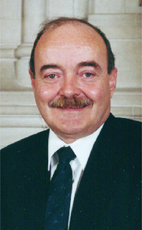
House of Commons photo

Crucial Fact

  • His favourite word was quebec.

Last in Parliament May 2004, as Independent MP for Chambly (Québec)

Won his last election, in 2000, with 50% of the vote.

Statements in the House

Income Tax Act May 29th, 2000

Madam Speaker, I am pleased to rise to speak to Bill C-205, introduced by my colleague, the member for Beauport—Montmorency—Côte-de-Beaupré—Île-d'Orléans and intended to enable mechanics to deduct the cost of purchasing or replacing tools from their income.

I was fortunate enough to work as a mechanic for 15 years with a North Shore mining company, IOC, in Sept-Îles. Fortunately, this company sometimes replaced lost tools. If we had had to pay for them out of our pocket, it would have been hard. Those not familiar with the job of mechanic, especially, that of heavy engineering, have no idea of the costs involved.

In 1980, a vernier used in measuring diameters cost a minimum of $150. With inflation and the rise in costs of all sorts, I am pretty sure that today it would cost $250. A mechanic's tool box has several such tools in it.

Not always through negligence, sometimes through misfortune, because of the location of the work and the conditions, tools, which are vulnerable, can get lost. I worked on a ship loader, on ocean going vessels, some 200 feet or 60 metres above the water and I have dropped tools into the water. At the time it represented several hundred dollars. It was accidental. Fortunately, this company, which I have always respected and which I was proud to work for for 15 years, replaced our tools.

I heard what the hon. member for Acadie—Bathurst had to say about cleaning his car after it had been repaired and finding two mechanic's tools. I had the same experience last year. When we are talking about Snap-On tools, they are quality tools, but I have seen screwdrivers cut in two by the spark produced when a mechanic touched two terminals, thus joining negative and positive. There went $15. That may not seem like much, but it adds up when the same thing happens a number of times in a year.

I think that it is doing justice to blue collar workers, to people who work with their hands, to recognize certain rights for them, the right to replace their tools and the right to acquire tools in order to get a job. This is doing them justice when other professionals of all kinds have obtained the right to replace or upgrade their equipment without having to ask for it.

Reference was made earlier to dentists. There are a number of different self-employed workers and professionals who have to replace their tools. When I was a notary, I bought pencils by the case. I did not have to fight to get them included in my operating expenses. This was taken for granted and no one disputed it. In my case, it is just about the only thing that was not disputed.

As for the mechanic, for whom the toolkit represents a major investment, all the more so because the tools are subject to loss or breakage, he is not entitled to this deduction, although he is probably a long way down on the scale of earnings.

I believe that the hon. member for Beauport—Montmorency—Côte-de-Beaupré—Île-d'Orléans is showing respect for workers. I believe his bill must be supported. I am delighted that it was introduced here by one of us.

I am all the more delighted that the other parties, those in opposition at least, seem prepared to espouse my colleague's cause.

Job Creation May 15th, 2000

Mr. Speaker, I listened with considerable interest to the member who has just spoken. It is a good thing that he only had ten minutes, because, had we let him go on, we would have ended up with a shortage of unemployed people in Canada.

It would perhaps be a good idea to look closely at the NDP member's proposal and read the motion. It provides:

That, in the opinion of this House, the government should take into account regional unemployment rates when establishing or expanding government offices and agencies so that regions with high rates of unemployment are considered for any new job creation.

I do not know if the member is aware of the scope of his motion. I was involved in the 1993 and 1997 election campaigns and I saw the Liberals opposite waving about the famous red book, which, the second time round, had rather a warmed over look about it. However, the government did not object.

The government is being asked today to honour its promises and do what it has always promised in the regions. The member who spoke before me gets around this when he says that unemployment dropped by 40%. This is why I was saying we will end up with a shortage of unemployed people. The member should have said that 40% of the 12% it had been, and it is still high, unfortunately.

Some 20 RCMP investigations are under way in management at Human Resources Development Canada. I did not invent that figure. It was in the papers again this morning: all sorts of misappropriation.

The minister explained her terrible boondoggles by saying that there were pockets of unemployment in the regions and that the department was acting based on these pockets. I wonder which pockets.

In any case, in response to a simple application for a name change, HRDC gave $720,000 to a company that had 118 employees and transferred them three or five doors down the street. Meanwhile, in my riding of Chambly, which is neither poor nor rich, just average like most constituencies represented by my colleagues, we feel that we are not getting our fair share, as the hon. member from the NDP pointed out.

When a party like the one in office has 98 of its 155 members coming from Ontario, it knows which side its bread is buttered on.

This is a recurring story itself, with the result that, since Confederation, the regions have been ignored, except during election campaigns, when politicians come and promise the world to everyone. But once they are elected, they make cuts affecting the regions and they centralize everything around the national capital, Ottawa, instead of trying to give the regions a fair share of the economic spinoffs resulting from government activity.

There are, of course, some exceptions. Unfortunately, these exceptions are all found in the 20 investigations currently being conducted by the RCMP on all kinds of misappropriation.

Is the hon. member of the NDP aware that Atomic Energy of Canada is preparing to outsource the building of its Candu reactors to someplace in Asia, Vietnam or a neighbouring country? I learned this last week when doing research on various government agencies, at which time I discovered that it has been five years since Atomic Energy Canada submitted its five year plan to parliament for approval, as it supposed to.

This has been going on for five years, under the supposed pretext that there is restructuring going on. As well, there are preparations under way for signing agreements with Vietnam and Cambodia, I believe, for production of Candu reactors over there. This is totally against the very principle of the motion by the hon. member from Nova Scotia and the totally gratuitous statements made by the Ontario member who spoke before me.

A total of $12 billion of Canadians' hard-earned dollars has been invested in Atomic Energy Canada at a time when there was no hope of any clear benefit from the production of Candu reactors. Time has passed and the interest has built up. If Atomic Energy of Canada were to pay back capital and interest to the Government of Canada, the total would be impressive, so much so that the figures might seem unrealistic. The interest that would normally have been paid back to the government was therefore written off.

This is a little like the government telling Canada Post “I transferred assets to you when I created Canada Post, so now I am entitled to dividends. I want to be reimbursed”. This is why André Ouellet, the President of Canada Post, pays the government dividends every year. Last year, he handed over $200 million in dividends to the government and he will likely hand over the same amount, maybe a bit more, this year, because Canada Post Corporation is doing quite well.

Why does the government require Canada Post Corporation to hand over dividends, but not Atomic Energy of Canada? For the simple reason that taxpayers are the ones who are going to be paying dividends to the federal government through Canada Post Corporation. They are easy to overtax and shove around because they do not answer back or, if they do, it is just part of the general background buzz, and no one pays any real attention.

But when Atomic Energy of Canada gets ready to contract out the building of its Candu reactors, there might be a slight possibility of some small benefits, rather than the already considerable capital losses and interest loads associated with this kind of project. But no, the government is going to contract this out to another country.

That is how this government treats Canadians who, election after election, want to see the government's actions produce some economic benefit. Generally, the parties that take office hold out the promise of tremendous post-election economic growth in the form of job creation.

In my riding, for instance, Marieville is located in one zone, because Canada has been carved up into zones for the purposes of the transitional jobs fund.

If you have less than 12% unemployment, no business in your riding or your region is eligible for the transitional jobs fund. Marieville, a pretty town in my riding, is a major centre. The region is almost 100% agricultural. The people not working in the farming community come into the major centre. The town of Marieville itself has perhaps 22% or 24% unemployment. However, neighbouring villages have almost full employment. There are family farms and small family businesses linked to the field of agriculture.

Marieville is being penalized, because it is in an area with less than 12% unemployment. If we isolated Marieville, it would be a pocket of unemployment in the opinion of the Minister of Human Resources Development and the Prime Minister. He considers these pockets when they are in his bailiwick, which is Saint-Maurice. He considers them such all the more since the RCMP is considering them as well, because it went rooting around there.

Why do these famous pockets not count elsewhere? Perhaps because the elsewhere did not elect someone in the party in power. What bothers me and what the member for Nova Scotia is right in saying is that this business is unfair.

Apart from those around Ottawa, in Ottawa itself, or in Ontario in the case of many, Canadians do not feel they are getting fair benefit from the government's economic activities. The government generates activity, for example for document printing or for jobs for public officials.

Although not necessarily for the same reasons as the Canadian Alliance, the Bloc Quebecois, for its own reasons and after considering all that I have said, feels it has to make the government see things as they are. It has to say to the government “You do not do what you should be doing unless you get a push from behind”. It takes motions such as the one by the member for Sydney—Victoria to say to the government “If you are unfair, rotten to the core, do not give people that impression. Try to at least appear to be fair”. That is what we want.

Canada Information Office May 11th, 2000

Mr. Speaker, we have learned from Access to Information that the Canada Information Office, the famous CIO, the federal propaganda agency, has given $1.2 million to BCE Média, an affiliate of BCE, headed by Jean Monty, for the production of a program, Scully RDI .

My question is for the Minister of Canadian Heritage. Why is the federal government subsidizing a company as rich as BCE, just so that it can be used as a front for producing Scully RDI ?

Criminal Code May 11th, 2000

For the benefit of this House.

Criminal Code May 11th, 2000

Mr. Speaker, I cannot ask my question without first wishing my colleague from Hochelaga—Maisonneuve happy birthday.

I would like to know if my learned colleague, who knows and studies every single piece of legislation introduced in the House, would agree that, in the responsibility placed on citizens and in the degree of criminality assigned to the actions of citizens, there should be some kind of gradation whereby sentences should also take criminal intent into account?

I totally agree that nobody should drive while impaired. Only a fool would say that it is acceptable, except that in Quebec—and the same thing must be happening throughout Canada—there is an increase in hit and run incidents.

Will the harsher sentences provided for in this bill cause a further increase in hit and run incidents? For example, when the person who inadvertently exceeds the speed limit has to pay a heavier fine than the man who assaulted his neighbour with a baseball bat, there must be something wrong.

I would like the member for Hochelaga—Maisonneuve to tell us if it is fair to say that the penalty imposed for a reprehensible act must be proportionate not only to the act itself but also to the intent of committing that act? The mens rea, or guilty intent, principle seems to be totally ignored in this bill. We know that there is no crime without the two main elements, namely actus reus and mens rea, the act and the intent.

Here is an example I studied in law school. Someone breaks into a residence, stabs the occupant in the back—and it has happened —and the occupant panics and jumps from the second floor to escape the aggressor and dies from the fall.

The courts said that the actus reus, or the act of stabbing the person, was not the cause of death. Some will say that this is an aberration. The bill before us must not lead to similar aberrations. Perhaps the member for Hochelaga—Maisonneuve, who is celebrating his birthday today—time flies—could tell us if this is one of his concerns. Could our brilliant colleague, who is also a legal expert, tell us that?

Sales Tax And Excise Tax Amendments Act, 1999 May 9th, 2000

Mr. Speaker, I listened with great interest to the comments of the Progressive Conservative Party member. Like him, I am worried.

I cannot understand this talk about inventing tax reform. Mr. Charest, a former Progressive Conservative who has come to Quebec, seemed to want to get away from the equation whereby government revenues, whether from individuals or corporations, are spent on services and generally the revenues pretty much balance out the services provided to the public.

There is another phenomenon where work must not contribute to poverty, so that the more you work, the poorer you get. This is another given. Reducing corporate taxes because it is the combination of the two, the corporate and the individual taxes. Of course, there are by-products of taxation such as sales tax, duties and taxes and so forth, but the fact remains that the government weighs the necessary balance between revenues on the one hand, and expenditures on the other. Expenditures are services.

The last tax reform was in 1971. That was the last, as far as I recall. Of course, there was the GST, which was introduced in 1984, I believe.

But the fact remains that this is the sort of thing governments must face. In the tax reforms to date, whether the government digs into the right pocket or the left, it is still the same pair of pants.

Despite all my efforts, I cannot see what these new sources of revenue would be. If we are speaking of individuals, it would be a disincentive to work. If we are speaking of businesses, it would discourage investment, entrepreneurship and so forth.

So perhaps the government has to decide to take an approach other than tax reform. I do not know what. We might be faced with worse choices, including in the health care sector and other sectors that are important to us, such as education. It must not come to that. I ask the member to tell me what the magic formula is.

Perhaps he has already had a chance to speak with the current leader of the opposition in Quebec City, Mr. Charest, who was in his party at one point. I wish he would enlighten me. I am honestly confused. I cannot imagine anything other than what we have now.

I am not a tax expert and I humbly ask him to enlighten me. I am open to his comments.

Modernization Of Benefits And Obligations Act April 10th, 2000

Madam Speaker, I rise on a point of order. When you call upon all members to pay attention to what my colleague from the Canadian Alliance is saying, this bothers me somewhat because I was quietly paying close attention. The one stirring things up is the hon. member across the way, who has been doing so for some time. The Chair should intervene.

Petitions April 4th, 2000

Mr. Speaker, I have a second petition here from 32 people calling upon the government to amend the Canada Post Corporation Act so as to repeal subsection 13(5), which bars collective bargaining for piece rate workers who deliver mail.

Petitions April 4th, 2000

Mr. Speaker, I have the pleasure this morning of tabling two petitions.

The first contains 25 names and calls upon the federal government to pass legislation on the labelling of genetically modified products.

Natural Gas April 3rd, 2000

Madam Speaker, I am pleased to have this opportunity to speak to Motion No. 298, presented by the member of the NDP.

This motion affords us an opportunity to look at our energy supply programs and forces us to reflect on how energy is being supplied to Canadians, instead of focusing on exports and on imagining ourselves as leading exporters of natural gas. The NDP motion makes us reflect on what should be done here before getting the idea that we are leading exporters of natural gas outside Canada, to just about everywhere else, as the Liberal member has just said.

Canada's natural gas reserves are immense. They are beyond anyone's imagination. We are talking 500 to 600 trillion cubic metres. Even someone with the most fertile imagination possible cannot imagine what a volume of 500 to 600 trillion cubic metres would be like. But it does exist.

The NDP's motion comes at an opportune time, as gas prices are at an all-time high, and some countries are being virtually strangled by the oil producing countries. This is an important factor in the issue. I cannot fault the oil exporting countries for setting prices and export quotas, but why should we not defend our interests as they do theirs? There is nothing wrong with that.

Considering that we are talking about 500 to 600 trillion cubic metres of gas in Canada and considering the return on the investment—today it would not be profitable, but in the case of future generations and, perhaps, given a certain kind of blackmail that will become more prevalent from year to year or decade to decade because fossil fuel sources are constantly diminishing and the more we burn the less there is left—we must find the alternatives sources that are out there.

Of course, the basic price, the cost of a cubic metre of natural gas must be taken into account, but there are other considerations including those relating to the environment and to the usefulness of the product. In light of global warming and of what was decided in Rio in the early nineties, that is to reduce greenhouse gas emissions, would the proposal made by the NDP member not be a step in that direction?

Of course, the cost of extending the natural gas distribution network all over Canada now would be astronomical. However, we must begin to think about these options now, because in 25, 50 or 75 years we will no longer be here, but future generations of Canadians will be at the mercy of countries that may still have oil, but in such reduced quantities that costs will be exorbitant, making that oil inaccessible for countries that are far from the Middle East, such as Canada.

This aspect of the member's proposal is very interesting, and I think the government should look into this question immediately, strike a committee in the House, perhaps even a joint committee with the Senate, call expert witnesses and look at the real issues. That is not what the government does. It reacts to a given situation, but advances nothing. I am not the one saying this. It was Senator Lynch-Staunton who said it in a speech he gave recently, on March 22 or 28, before the Canadian Club.

He said “Our governments react. They take no initiative, they propose nothing. They do not enter into discussion”. This food for thought was provided by a member of a party that is in a considerable minority here in this House.

Governments cannot just watch the train go by. They have to anticipate its passage. They have to be open to the future, stop thinking about what interests them right now without giving a thought to future generations.

It is not surprising that, for example, the Bloc Quebecois is in favour of the New Democratic Party's proposal. In a sovereign Quebec, as it very soon will be I believe, some things will not change. The St. Lawrence will continue to flow from the Great Lakes to the Atlantic, even after Quebec secedes. Ships will continue to travel it. The prevailing winds will continue to blow in the same direction.

Quebec is well intentioned. In partnership agreements, in agreements signed after Quebec becomes sovereign, the distribution networks, if there are any, like the one covered by the agreement signed last week between New Brunswick and Quebec, will continue to exist and to be recognized by a sovereign Quebec, as by a Quebec within Canada. The fact of being within Canada at the moment does not strengthen Quebecers' desire to assume their fair share of the costs of just about everything.

In the case before us, there will certainly be international agreements, because Quebec will be a nation by then, a recognized people, a state. There will be international agreements. If the Canadian government were to decide right now to take this sort of step, if it were to decide to look a bit further than the end of its nose and give some thought to North America's future from an energy angle, perhaps it would not hesitate to do some studies, take action, create incentives.

We in the Bloc Quebecois are in agreement. The NDP's suggestion is an excellent one. The government is not being asked to provide subsidies or assistance to companies responsible for extending or maintaining the existing network. At least there would be tax breaks, such as loan guarantees or some sort of commitments to serve heavily dependent communities.

My area, Chambly, is not particularly remote, but I have seen young single mothers faced with an unexpected increase in the price of heating oil. The direct result was that one, two or three children in a household were deprived of things as essential to their existence as food, because the price of heating oil doubled overnight. I have seen this. People I know well, some of my party workers, came and told me. They thought it was terrible, but it was something that happened.

The government has done nothing about this. It has begun to say that it would reduce its tax on a litre of gas if the provinces followed suit. This is a very petty attitude because we know that the provinces need these revenues in order to help people like those in my example who are devastated by a sudden increase in energy costs and who are unable to count on help from the federal government.

Therefore, I think that members of the Bloc Quebecois and I will support the proposal of the NDP member in principle.