
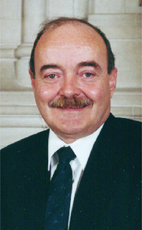
House of Commons photo

Crucial Fact

  • His favourite word was quebec.

Last in Parliament May 2004, as Independent MP for Chambly (Québec)

Won his last election, in 2000, with 50% of the vote.

Statements in the House

Canadian Institutes Of Health Research Act March 28th, 2000

Mr. Speaker, before asking my question, I would like to set the member who has just spoken straight on a few points.

He talked about moving Motion No. 56. First, he was not in the House. Second, he had presented the wording to our House leader, who had agreed to its being moved, even in the member's absence, on condition that certain words be changed. Third, after the motion was discussed or debated and brought forward with unanimous consent, the Parliamentary Secretary to the Minister of Health arrived with a proposal to again amend what had been agreed on with the member who has just spoken.

So, when he accuses the Bloc Quebecois of playing political games in this connection, I think he is showing obvious bad faith.

As for the bill itself—and this is my question—when the president of the governing council of an institute of health research is also the organization's president—even an ordinary caisse populaire does not make this kind of mistake and the director of the board of directors of a caisse populaire is never the caisse's director because of the potential conflict of interest—I would say the government would do better not to present its bill as the best thing since sliced bread. In my opinion, it should—and this was suggested by the member for Hochelaga—Maisonneuve in one of his many proposals—separate the functions of president of the governing council and president of the organization. There is no need to look very far; it is immediately obvious. This is something that is open to criticism.

What can the member say about this without getting into political games? I would remind him that we are in parliament and that we are just as entitled to express our views as he is. I would point out to him that 66% of Canadians did not vote for the Liberal Party of Canada in the last election.

Canadian Institutes Of Health Research Act March 28th, 2000

At Laval University.

Canadian Institutes Of Health Research Act March 28th, 2000

This is truly shameful.

Canadian Institutes Of Health Research Act March 23rd, 2000

Or the breaking of the Liberals.

In that case, economic development can be promoted on the basis of that research. This is what concerns me, and rightly so.

I learned a long time ago that, on the Liberal side, everything that shines is not gold. For the Liberals, chairs do not always have four identical legs. When they tell me about a chair, I have learned to be suspicious, because it does not mean there is an horizontal seat and a vertical back. In the Liberals' mind, a chair is not at all what you are sitting on, Mr. Speaker, so be careful. The Prime Minister has spent his life, his entire career, playing with words, concepts, and principles.

Yes, we are pleased about Bill C-13. But, for heavens sake, do not use it as an opportunity to once again fool about 80% of Canadians.

Canadian Institutes Of Health Research Act March 23rd, 2000

I thank you, Mr. Speaker, for listening to me with interest.

This is what worries parliamentarians. We know no modern country can make progress without helping scientific research. The member for Chicoutimi, whom I salute, is nodding in agreement; he knows that, in his riding as in ours, there are bright minds. But the private sector cannot always be there for them, because it takes equipment, infrastructures and money. “No money, no candy”, as our friends in Ontario say, and “no fun”.

We are welcoming this initiative to spread scientific research across the country instead of building a huge structure at some street corner, in Hamilton or Toronto, where scientific research would be concentrated.

Thanks to modern means of communication such as Internet, scientific research in a given field could be done by someone in Chicoutimi who would be connected to colleagues in Calgary, Mississauga or, of course, Chambly. Scientists could work and collaborate from their homes or their offices in the regions.

The strength of this bill, if it is implemented properly, is in networking. But if everything is in Toronto, if all the lines and wires are converging on Toronto, the bill will have a negative impact on the other provinces.

Research is important. We can focus our economic development according to our skills and expertise. That is the problem for all regions, except Ontario. In Canada, and this is a major mistake that was repeated thousands of times, economic development is invariably based on technical knowledge and expertise. If that expertise is concentrated in one area, the resulting economic development will benefit that specific area.

This is why, in the past, research on the seabed, marine species or fishery resources was conducted in the maritime provinces. Regional economy was based on the skills and knowledge that existed in a given region. The same research could not have been conducted in the central provinces, where agriculture is predominant.

When research is not based on raw materials, but on technical knowledge such as the breaking of the atom—

Canadian Institutes Of Health Research Act March 23rd, 2000

I hear the member for Acadie—Bathurst who would like me to mention his riding, which I have visited and which is indeed very beautiful.

We are talking about scientific research. We are talking about clarity and about good faith among parliamentarians just after an intervention where the leaders of all parties recognized that keeping one's word is sacred, including in parliamentary law.

We know the Minister of Intergovernmental Affairs, who never stops talking about good faith, kindness, friendship and compassion like the constitutional good guy that he is. On this side, we cannot adhere totally and without reservation to what is in the bill.

This bill is good for scientific research, but what worries the opposition is that, once again, the very same thing that happened with Atomic Energy of Canada, where development was done in Ontario, could very well happen again. Atomic Energy of Canada represents a $12 billion investment over the years. When it was noticed that there was a small head office in Montreal, it was quickly moved to Ontario a few years ago, because it was no longer appropriate to leave it where it was. The head office was in Montreal, but the activities of Atomic Energy of Canada were conducted exclusively in Ontario.

This has happened time and time again. For instance, Ontario got the lion's share of the automobile industry among others. We understandably have concerns about Bill C-13.

Mr. Speaker, you are frowning at me. I hope there is nothing unparliamentary in saying that we are concerned that once again the spinoffs of the act will benefit Ontario.

Canadian Institutes Of Health Research Act March 23rd, 2000

After the riding of Rivière-des-Mille-Îles represented by my colleague to my right, and maybe also after the riding of my friend from Châteauguay. In any event, it is one of the most beautiful ridings in Canada and I take this opportunity to salute all those who live there.

Canadian Institutes Of Health Research Act March 23rd, 2000

Mr. Speaker, one can easily get lost in this kind of debate. I do not know exactly where I was when you interrupted me.

My colleague from Hochelaga—Maisonneuve tells me that I was talking about the fact that there is pharmaceutical research being done in Chambly. There is also the space centre in Saint-Hubert, just a few kilometres from the beautiful riding of Chambly. Some people who work there live in my riding. At this time of year, with the Richelieu River thawing out and the Canadian geese flying across the area, Chambly is probably the most beautiful riding in Canada.

Canadian Institutes Of Health Research Act March 23rd, 2000

Mr. Speaker, I had the pleasure of addressing Bill C-13 before and my friend, the hon. member for Hochelaga—Maisonneuve, was quite pleased to see that even though the riding of Chambly, which I represent here, does not have research institutes as such, it may have some one day.

In Chambly, as elsewhere, we have skilled people. In particular, we have pharmaceutical institutes and companies, and this, of course, is of interest to our constituents.

I was listening to government and opposition members. Those who care about scientific research are pleased, in a way, to see that, at last, the federal government—

House Of Commons March 16th, 2000

Mr. Speaker, I unfortunately did not hear the beginning of the speech by the member who spoke before me. I think I heard the last half, with which I agree.

Given this type of a debate, is the role of the Speaker not to ensure some respect for democracy?

Let me explain what I mean. The fact that four cannibals decide to eat a fifth one does not make it democratic. A decision taken by a majority is not necessarily democratic.

Closure used to be an exceptional measure, but now it is the rule. Not one bill gets through this House without closure any more.

I would like the hon. member who just spoke to tell me if he does not think that part of the Speaker's role is to be able to intervene in such a case. I know there is another side to this. I would like to hear his explanation.